
How Acetate Sunglass Frames Are Made: Sheet to Shelf
A premium acetate sunglass frame can take days and dozens of hand operations to make — which is exactly why it feels and looks the way it does. Understanding the journey from acetate sheet to finished frame helps buyers judge quality, set realistic lead times and appreciate where cost comes from. Here's the process, stage by stage.
Stage 1 — Choosing the acetate
It starts with the material. Acetate comes in thousands of colors and patterns as sheets (or blocks for higher-end work). The brand selects a stock acetate or commissions custom acetate. Color, transparency, marbling and gradient are all decided here — and once chosen, no mould is needed, which is why acetate is flexible at low MOQ. Learn the material in what is cellulose acetate.
Stage 2 — CNC cutting
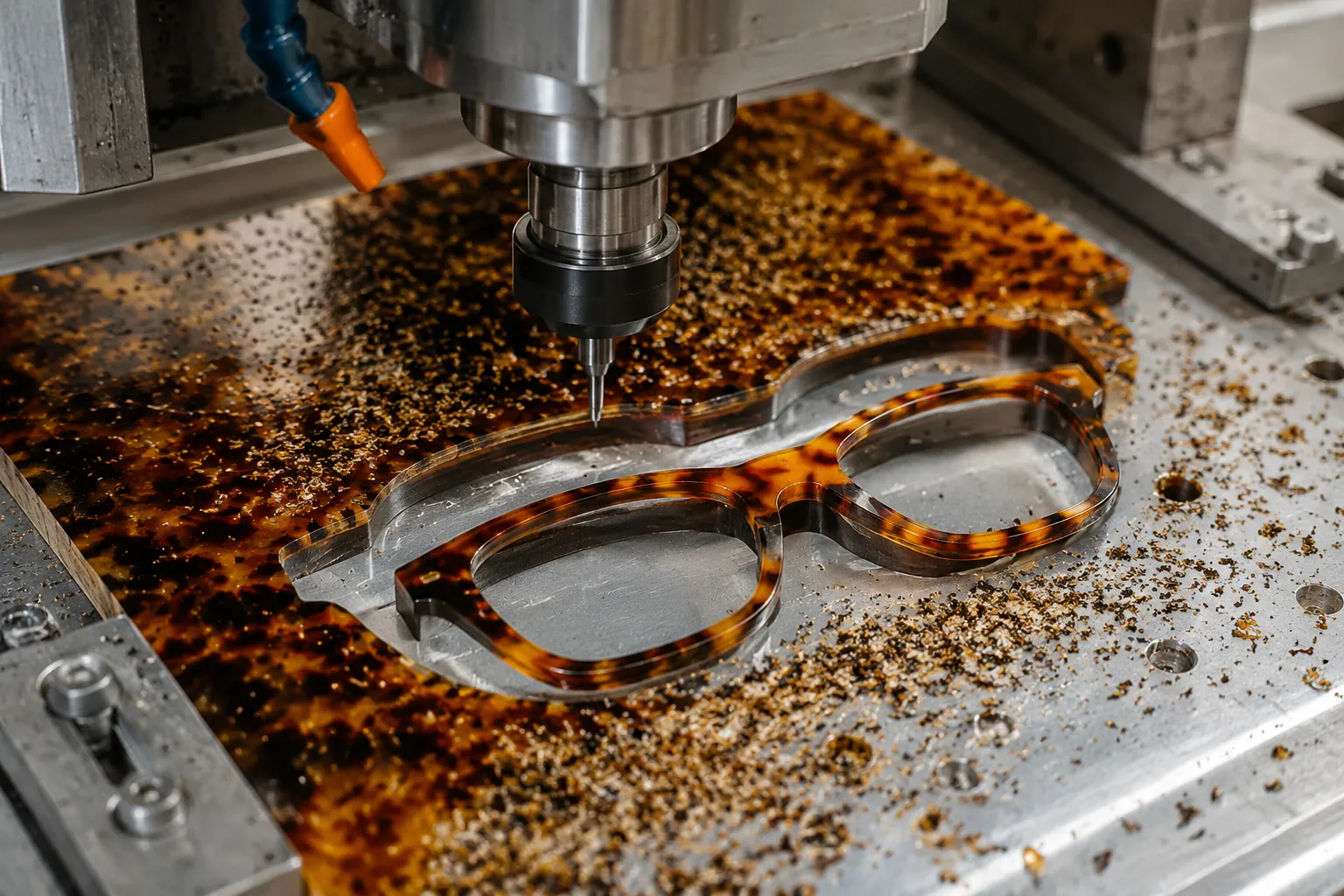
The frame shapes (fronts and temples) are CNC-milled from the acetate sheet. Precision here sets the foundation: lens groove accuracy, symmetry and fit all depend on clean, accurate cutting. Modern CNC machines cut the front profile, lens openings and temple blanks from the raw sheet.
Stage 3 — Shaping and bending
Flat-cut acetate fronts are heated and bent to the correct face curve (base curve) so the frame wraps the face naturally and the lenses sit correctly. Temples are shaped too. Acetate's thermoplastic nature lets it be heated, formed and set — a key reason it's so workable.
Stage 4 — Hinge setting
Metal hinges are embedded into the acetate, usually by heating and pressing the hinge into the material so it anchors securely. Hinge anchoring is a critical quality point — a poorly set hinge loosens or pulls out in use. The hinge type (spring, barrel) is chosen here — see hinge types.
You can't see a badly set hinge in a photo — but the customer feels it the first month. Hinge anchoring separates real acetate craft from corner-cutting.
Stage 5 — Barreling and tumbling
This is the stage that gives acetate its signature finish. Frames are tumbled in rotating barrels with wood chips, pumice and polishing compound — sometimes for days. The process rounds sharp edges, smooths surfaces and gradually brings up the deep gloss. The longer and more careful the tumbling, the richer the finish. It's slow, which is why quality acetate frames can't be rushed.
| Tumbling stage | Media | Result |
|---|---|---|
| Coarse | Rough chips/pumice | Removes machining marks, rounds edges |
| Medium | Finer media | Smooths surface |
| Fine/polish | Polishing compound + soft media | Deep gloss finish |
Stage 6 — Hand polishing
After tumbling, skilled workers hand-polish details — edges, bridge, temple ends — that machines can't perfect. This hand-finish is a hallmark of quality acetate eyewear and a major part of the labour cost.
Stage 7 — Assembly and decoration
Temples are attached, lenses fitted, and branding applied (laser engraving, metal logo plates). Logo decoration is timed to suit the method — see logo options. Core/wire reinforcement may be inserted into temples for strength.
Stage 8 — Quality control
Finished frames are inspected: symmetry, gloss, hinge action, color match, lens fit and decoration. Lenses are verified for UV400 and category. A documented AQL inspection against the gold sample protects bulk quality. See durability testing.
Want acetate frames made the right way?
LumiShades CNC-cuts, tumbles and hand-finishes acetate frames in Wenzhou — no rushed steps, no skipped polishing. Request a sample to feel the difference.
Get a sampleWhy it takes time — and costs more
From sheet to shelf, a quality acetate frame passes through cutting, shaping, hinge setting, days of tumbling, hand polishing, assembly and QC. That labour is the reason acetate costs more than injected plastic — and the reason it looks and feels premium. Understanding the process helps you set realistic lead times (production runs 25–35 days) and recognize quality in your samples.