
Frame Durability and Flexibility Testing for Sunglasses
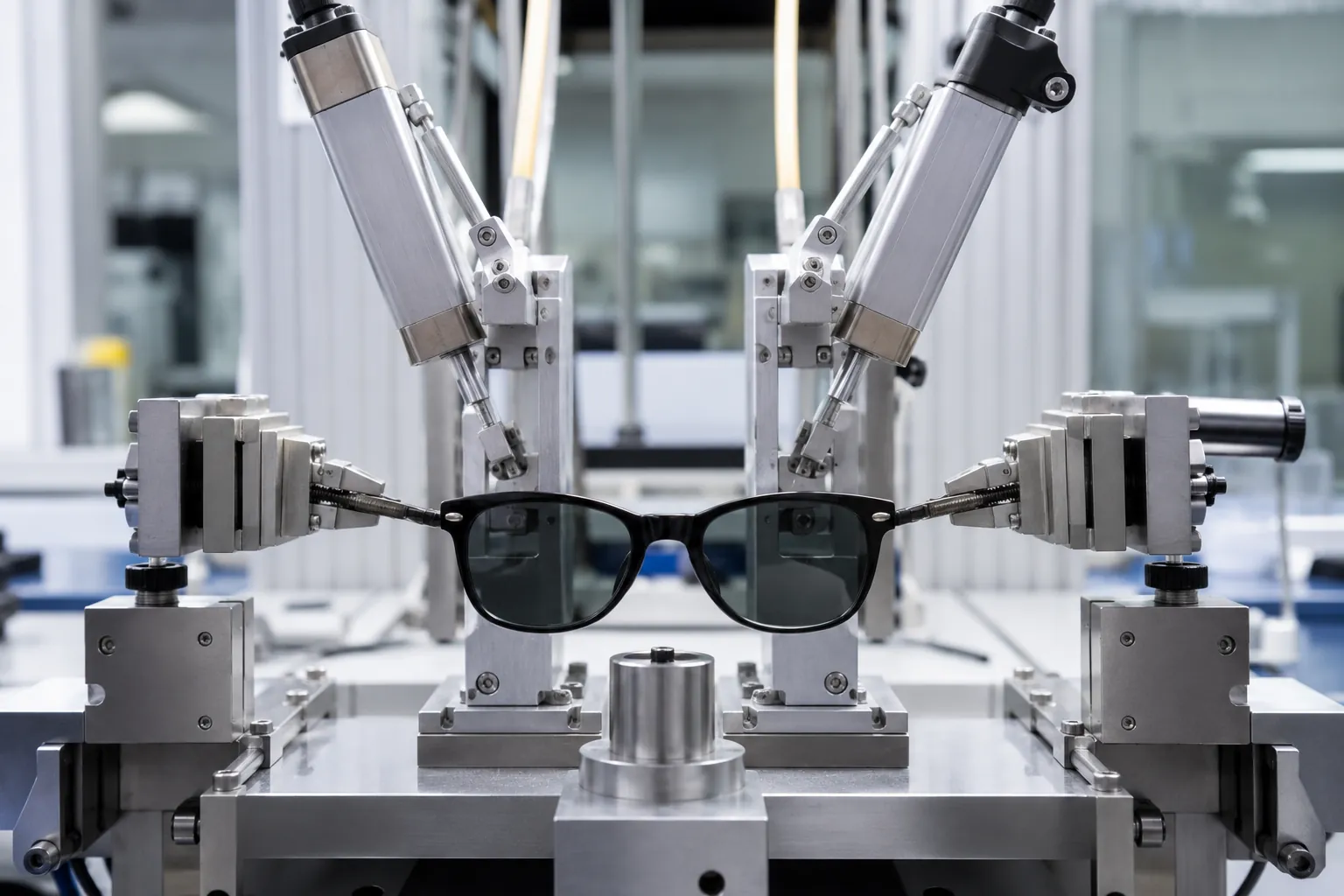
A sunglass frame can look perfect and still fail in the field — at the hinge, the bridge or after a season in the sun. Durability and flexibility testing is how serious manufacturers catch weakness before it reaches customers, and how compliant brands meet eyewear standards. This guide explains the key tests and what limits to write into your spec.
Why frame testing matters
Frame failures drive returns, warranty claims and reputational damage. Testing turns "we think it's durable" into measured, repeatable evidence — and many of these tests are part of formal eyewear standards (notably ISO 12870 for spectacle frames, alongside the EN ISO 12312-1 sunglasses standard). For B2B buyers, written test limits protect you when bulk arrives.
The core frame tests
| Test | What it checks | Why it matters |
|---|---|---|
| Deformation/flex | Front & temple bending recovery | Frame survives normal flex |
| Hinge endurance | Repeated open/close cycles | Hinge longevity (returns driver) |
| Temple flexion | Temple flex strength & recovery | Comfort & durability |
| Lens retention | Lens stays seated under force | Safety, fit |
| Drop-ball (lens) | Impact resistance | FDA/safety compliance |
| Sweat/corrosion | Resistance to sweat & salt | Plating & metal durability |
| UV/aging | Color & material stability | Frame doesn't gray/yellow |
| Nickel release | Skin contact safety | EU compliance, allergy |
Flexibility and deformation testing
Frames are flexed — fronts and temples — to defined loads and angles, then checked for recovery (do they spring back?) and damage. Flexible materials like TR90 excel here; rigid materials like acetate must recover within tolerance without cracking. Set a deformation recovery limit in your spec.
Hinge endurance — the big one
Because hinge failure is a leading return cause, hinge endurance testing matters most. The hinge is cycled open and closed thousands of times (standards often specify many thousands of cycles) and checked for play, stiffness and breakage. Spec a minimum cycle count your hinges must survive. More on hinges in hinge types.
If you only specify one durability test, make it hinge endurance. It's where frames most often fail and where customers most often complain.
Impact resistance (the lens side)
For the US market especially, FDA rules require sunglass lenses to pass an impact (drop-ball) test — a steel ball dropped onto the lens from a set height. Polycarbonate passes easily, which is why it's used for sport and kids. Confirm impact testing for safety and US compliance — see lens materials.
Environmental and material tests
- Sweat/salt-spray: verifies plating and metal resist corrosion from skin and sea air — critical for metal frames.
- UV/thermal aging: confirms colors and materials don't gray, yellow or become brittle.
- Nickel release: required for EU skin-contact compliance on metal frames.
Writing limits into your spec
- Reference the relevant standards (ISO 12870, EN ISO 12312-1, FDA impact).
- Set a hinge endurance cycle minimum.
- Set deformation recovery tolerances.
- Require lens drop-ball pass for US market.
- Require salt-spray/sweat and nickel-release tests for metal.
- Require batch test reports, not blanket claims.
Need frames that pass the tests?
LumiShades tests frames for hinge endurance, flex, impact and corrosion in-house, with reports per batch. Request a quote with full test documentation.
Request a free quoteSummary
Durability and flexibility testing — hinge endurance, deformation, impact, corrosion and aging — turns frame quality into measured evidence and keeps you compliant. Reference the standards, set explicit limits (especially hinge cycles), and demand batch test reports. It's the difference between a frame that survives the field and one that comes back.