
How Sunglasses Lenses Are Tinted: Inside the Process
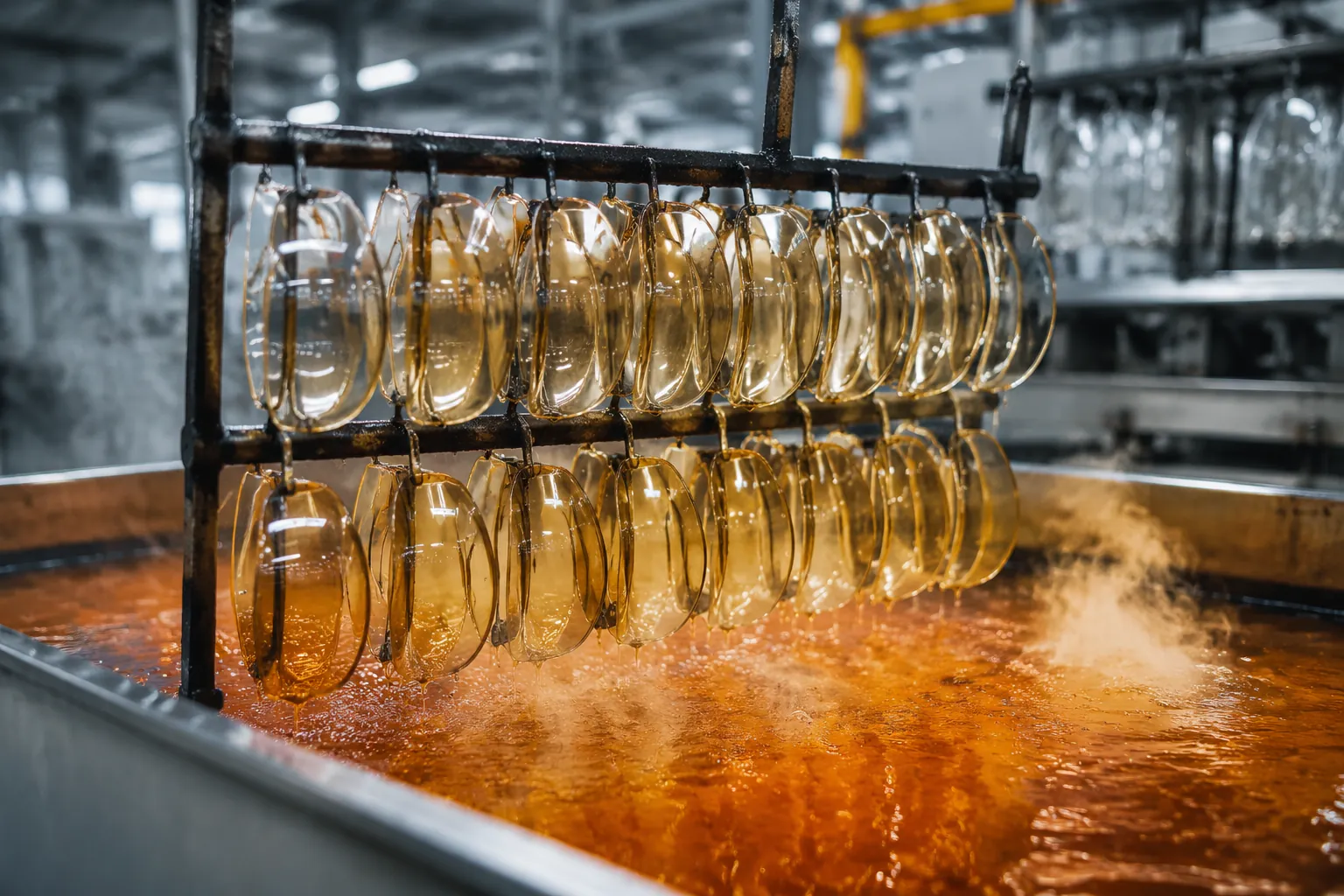
The color of a sunglass lens isn't an afterthought — it's a manufacturing process with real consequences for consistency, cost and look. Understanding how lenses are tinted helps brands spec color accurately and judge a factory's quality. Here's an inside look at dip dyeing, in-mass tinting and coating, plus the controls that keep color consistent.
Three ways to color a lens
- Dip dyeing: finished lenses are immersed in heated dye baths; the dye penetrates the surface. Flexible for custom and gradient colors.
- In-mass (solid) tinting: color pigment is mixed into the lens material before moulding, so color runs all the way through. Durable and consistent.
- Coating: color added via a surface coating (less common for primary tint, common for mirror/effect layers).
Dip dyeing in detail
Dip dyeing is the most versatile method and the one behind most custom and gradient sunglass colors. Lenses are lowered into a temperature-controlled dye bath; dwell time and dye concentration determine darkness. For gradients, the lens is slowly withdrawn so the top stays in longest. The skill lies in repeatability — bath temperature, dye age and timing all drift, so a disciplined dye line is essential for batch-to-batch matching. Gradients specifically are covered in gradient lenses guide.
Color consistency is a process-control problem, not a color-choice problem. The factory that controls its dye baths is the one whose 5,000th pair matches the first.
In-mass tinting
For solid, uniform colors — especially in polycarbonate — pigment can be compounded into the material before injection. The advantage: the color is part of the lens and can't fade or scratch off, and consistency is excellent. The trade-off: less flexibility for small custom runs and gradients, since it's tied to the moulding batch.
Method comparison
| Method | Best for | Pros | Cons |
|---|---|---|---|
| Dip dyeing | Custom & gradient colors | Flexible, any tint | Needs tight process control |
| In-mass tinting | Solid colors, PC | Durable, very consistent | Less flexible at low volume |
| Coating | Mirror/effect layers | Special looks | Not for primary tint |
Matching brand color
To hit a precise brand tint, provide Pantone references and approve a lab dip (a dyed test lens) before bulk. Set a Delta-E tolerance so "close enough" is defined numerically, not by eye. This is the same discipline used for frame color — see Pantone matching.
Quality controls for tinted lenses
- Lab dip approval before bulk dyeing.
- Per-batch shade check against the approved master.
- VLT/category test to confirm darkness meets spec — see categories.
- UV400 verification independent of tint.
- Gradient height/transition tolerance for gradient lenses.
Common tint defects to inspect
- Shade variation pair-to-pair (poor bath control).
- Blotchy or uneven dyeing.
- Gradient line at inconsistent heights.
- Color shift after the hardcoat or mirror is applied.
Need precise, consistent lens color?
LumiShades tints lenses in-house with controlled dye lines and Pantone-matched lab dips, plus VLT and UV testing per batch. Request a color sample.
Get a sampleSummary
Lenses get their color through dip dyeing, in-mass tinting or coating — each with trade-offs in flexibility, durability and consistency. The decisive factor isn't the method but the process control behind it. Approve a lab dip, set a Delta-E tolerance, and demand per-batch checks, and your lens color will stay on-brand from the first pair to the last.