
Pantone Color Matching for Custom Sunglasses
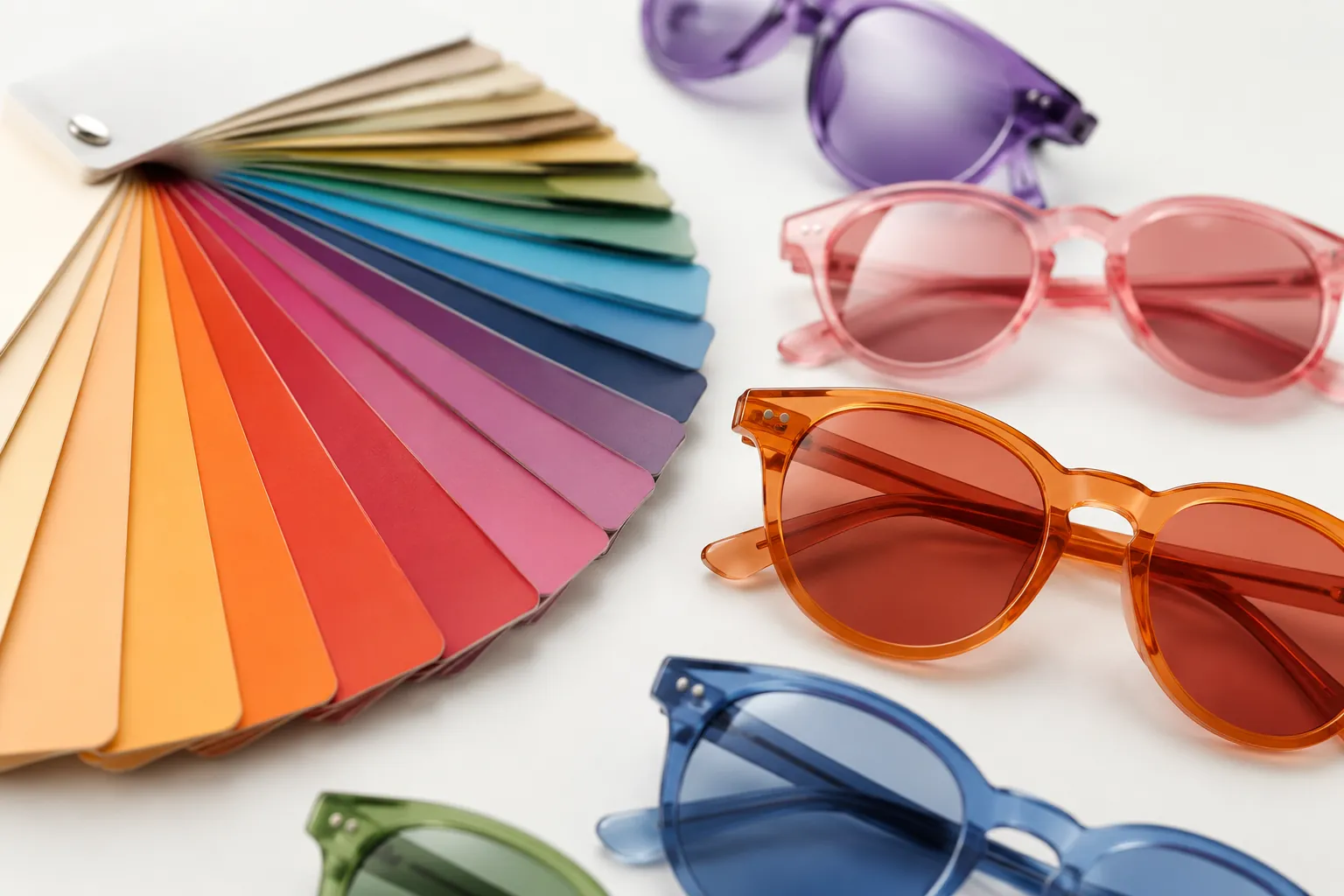
Brand color is one of the most powerful — and most fragile — elements of an eyewear product. A frame that's "almost" your brand color, or that shifts shade between production runs, quietly erodes brand consistency. Pantone color matching is how you lock exact, repeatable color across frames and lenses. Here's how it works for sunglasses.
Why Pantone matters in eyewear
"Make it navy" is an invitation to disappointment — there are hundreds of navies. The Pantone system gives every color a precise reference number, so "frame in Pantone 533 C" means the same thing to you and the factory. For brands whose identity depends on a signature color, Pantone matching is non-negotiable.
Where Pantone matching applies
- Frame color (injection): TR90/plastic injected to your Pantone — see TR90 frames.
- Frame color (acetate): selected from acetate stock or custom-made to match.
- Lens tint: dyed to a target color — see how lenses are tinted.
- Logo/decoration: pad-print ink matched to Pantone.
- Packaging: case, box and cloth printed to brand color.
How custom color injection works
For TR90 and plastic frames, color is achieved by compounding pigment into the material to match your Pantone target, then injection moulding. The factory mixes a masterbatch, moulds a test, compares to the Pantone reference, and adjusts until it matches. Because it's a batch process, custom color carries a minimum quantity. See tech pack guide for how to document color.
The Delta-E tolerance
"Matched" needs a number. Delta-E (ΔE) measures the difference between two colors; lower means closer. Setting a ΔE tolerance turns subjective "close enough" into an objective, enforceable spec.
| Delta-E (ΔE) | Perception | Use |
|---|---|---|
| < 1.0 | Imperceptible to most | Critical brand color |
| 1.0 – 2.0 | Very close, expert may notice | Recommended target |
| 2.0 – 3.5 | Noticeable on close compare | Acceptable for many |
| > 3.5 | Clearly different | Reject |
If your color spec doesn't include a Delta-E tolerance, you don't have a color spec — you have a hope.
The matching workflow
- Provide the Pantone reference (use the right book — TPX/TCX for textiles/plastics where applicable, C for coated).
- Factory produces a lab dip / color chip matched to it.
- You approve the chip against your reference (in consistent lighting).
- Set the ΔE tolerance for bulk.
- Factory checks each batch against the approved master.
Lighting and material caveats
Color looks different under different light (metamerism) — always evaluate under standardized lighting (e.g. D65 daylight). And the same Pantone can read slightly differently across materials (glossy acetate vs matte TR90 vs dyed lens), so approve a chip in the actual material, not just the paper reference.
Consistency across runs
The real test of color matching is the second order matching the first. Keep an approved master chip, require per-batch ΔE checks, and use the same pigment supplier/recipe. This is what keeps your brand color identical from launch to reorder.
Need your exact brand color on every pair?
LumiShades color-matches frames, lenses and packaging to Pantone with lab-dip approval and Delta-E tolerance control. Send your Pantone reference for a color sample.
Request a free quoteSummary
Pantone matching locks your brand color across frames, lenses, logos and packaging. Provide the right Pantone reference, approve a material-accurate lab dip, set a Delta-E tolerance, and demand per-batch checks. Do that and your signature color stays exactly right — pair after pair, order after order.