
Rubberized Sunglass Finishes: Risks, QC, and Sourcing
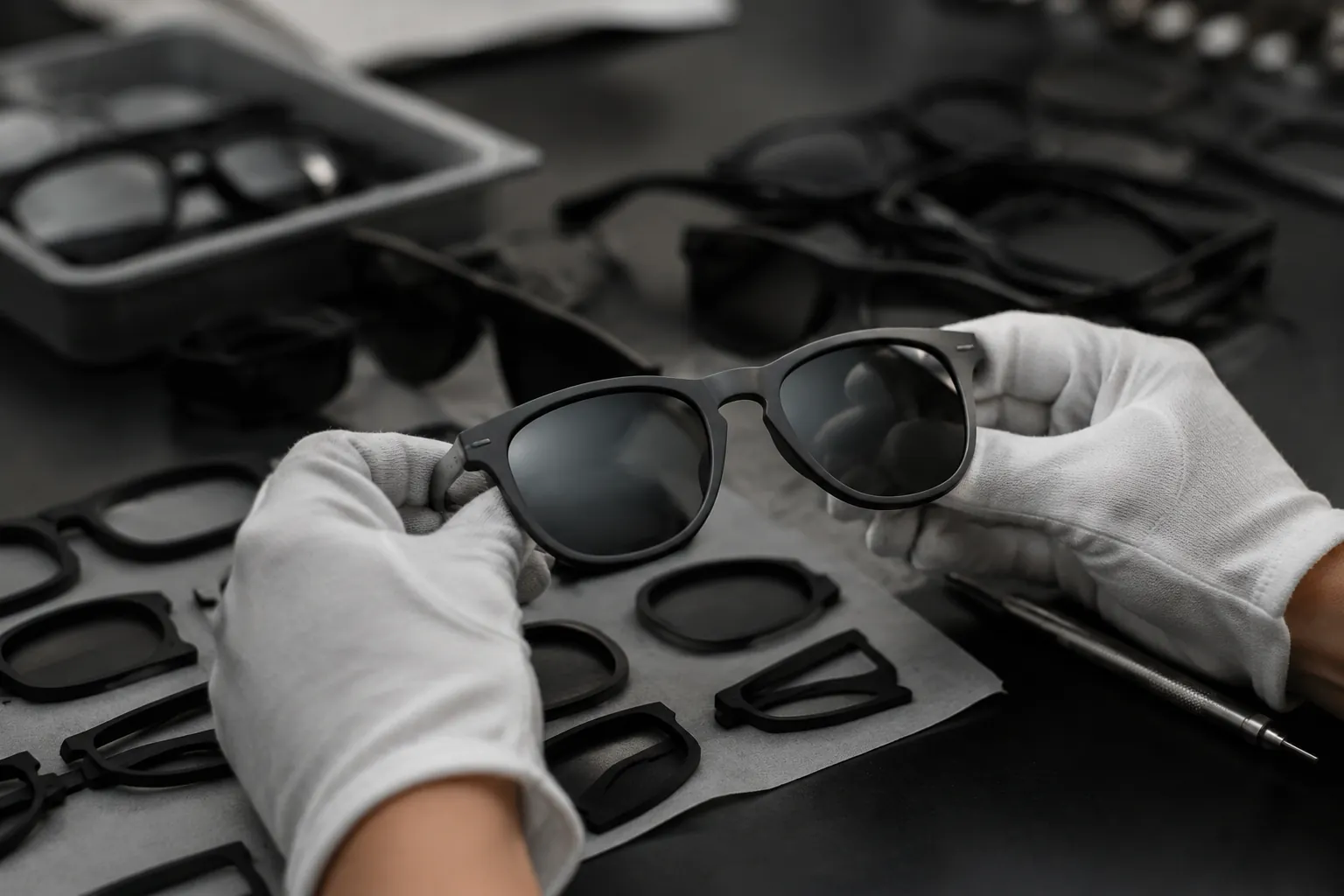
This guide is for brand owners, importers, distributors, and retail buyers deciding whether a rubberized finish belongs on a custom sunglasses program. A soft-touch coating can improve first-touch appeal because the frame feels less slick and more muted than a standard gloss finish. It also brings known risks: abrasion, polishing at contact points, sensitivity to skin oils and sunscreen, logo-adhesion issues, blocking in packed cartons, and higher cosmetic reject rates during assembly. That is the real sourcing question. Not whether the sample feels premium on day one, but whether the finish will still look commercially acceptable after normal handling, packing, shipping, and retail use in the channel you actually serve.
Start With Channel Stress, Not Sample Appeal
Rubberized finish, often called soft-touch, is a surface coating applied over the base frame substrate. In sunglasses, it is most common on injection-molded plastic frames such as polycarbonate or nylon-based materials. It can also be used on some metal or acetate components, but mixed-material builds need tighter control. Adhesion, color match, and visual consistency are harder to hold across dissimilar surfaces.
The appeal is simple. A rubberized frame often feels more expensive than the same frame in standard gloss or plain matte. That can help in fashion collections, gift programs, beauty or lifestyle collaborations, and short retail cycles where first handling matters.
But soft-touch is a coating system, not an inherent material property. Performance depends on substrate prep, coating chemistry, application consistency, cure control, and post-coating handling. Same frame. Different result. One factory or coating system can perform well; another can fail fast.
So start with channel stress. A frame sold through boutique fashion retail and worn occasionally faces a very different wear pattern from a frame used outdoors, thrown into a car console, or packed in bulk for promotions. Repeated wiping, sweat, sunscreen, heat, and packing pressure all raise the risk. Decide early. The finish affects decoration method, packaging, cosmetic standards, QC checkpoints, and post-sale claim exposure.
Where Rubberized Finishes Usually Make Sense
Soft-touch coatings make sense when tactile impression and muted styling matter more than maximum surface life. They are not the default choice for every program. In the right channel, they can work.
- Fashion retail and seasonal capsules: Suitable for short-cycle collections where shelf appeal, photography, and unboxing matter more than long-term abrasion resistance.
- Corporate merchandise and event distribution: Useful when the product is intended for limited-duration use and the buyer wants a frame that feels less overtly promotional.
- Minimalist brand positioning: Black, olive, slate, taupe, and other low-gloss neutrals often pair well with a soft-touch finish because the surface supports a quieter visual identity.
- Programs using existing molds: If the buyer wants to change the look of a proven frame without paying for new tooling, a coating can create a visible difference without changing the mold set.
Commercial viability depends on the supplier's process and order structure. Do not assume a universal MOQ or a fixed cost adder. Some factories will accept low-volume pilot orders. Others reserve rubberized coating for larger runs because spray setup, color approval, cure scheduling, and inspection labor add overhead. Ask for the supplier's MOQ by colorway, coating surcharge, and reject allowance for this finish. Generic market numbers are not enough.
Decoration strategy matters too. Soft-touch usually works better with restrained branding, such as a small interior logo, a subtle laser mark where the coating and substrate allow it, or a discrete metal logo plate. Large bright pad-printed graphics in high-rub areas are a harder sell. They need more testing and usually carry more cosmetic risk.
Where Buyers Usually Regret Using It
The failure pattern is familiar. The approved sample looks good. The selling channel exposes the limits.
- Sports and outdoor products: Sweat, sunscreen, dust, and frequent wiping can accelerate polishing and uneven wear.
- Kids' eyewear: Dropping, chewing, backpack abrasion, and rough handling make early cosmetic damage much more likely.
- Low-price mass retail: When margins are tight, even a modest rise in scuff-related complaints can damage program economics.
- Long storage cycles: In hot warehouses or compressed export packing, coated surfaces can block, mark, or feel tacky if cure or packaging conditions are not well controlled.
- White and pale shades: Dirt pickup and contact-point darkening usually show faster than on darker colors.
In practical terms, soft-touch is often a poor fit for products likely to live in glove boxes, gym bags, beach totes, rental fleets, or convenience-store spinner racks. In those channels, molded texture or standard matte usually gives a better wear-to-cost ratio.
Be realistic about end-user perception. Customers rarely separate structural durability from cosmetic durability. If the bridge turns shiny, the temple contact area burnishes, or the logo zone shows rub marks after short use, many will call it poor quality even if the frame is still functional.
Trade-Off Table: Feel vs. Wear Life vs. Cost
The comparison below reflects common sourcing logic for private-label plastic sunglass frames. Exact cost and performance depend on frame geometry, substrate, lens specification, decoration method, and packaging. The relative trade-offs are usually consistent.
| Finish option | Typical feel | Wear resistance | Logo compatibility | Relative cost impact | Best-fit channel |
|---|---|---|---|---|---|
| Gloss injection finish | Smooth, standard | Good | Very good for pad print and bright colors | Lowest | Promo, value retail, mass programs |
| Standard matte finish | Dry, low-shine | Good to very good | Generally stable across print and laser methods | Low | Core private label, outdoor casual, general retail |
| Rubberized soft-touch coating | Soft, warm, slightly grippy | Fair to moderate | Needs adhesion and rub testing before logo approval | Medium | Fashion, gifting, short-cycle drops |
| Textured molded surface | Controlled grip, less soft | Very good | Good for laser and selective print zones | Low to medium | Sport-inspired, utility, hard-use channels |
For pricing, avoid fixed assumptions such as a standard per-pair surcharge or a universal MOQ break. Coating cost depends on color count, coating system, spray efficiency, cure process, inspection standard, and reject rate. Ask for a line-by-line quotation that separates base frame, lens, decoration, packaging, and coating. Make the cost visible.
The main commercial issue is not just the coating add-on. It is the extra labor and reject exposure in spraying, curing, handling, inspection, and packing.
What Changes on the Factory Floor
Rubberized finish adds process sensitivity. It is not just a color choice. It adds variables that affect cosmetic yield and consistency.
A common production route is straightforward: mold the frame front and temples, trim and clean the substrate, apply any needed pretreatment for adhesion, spray the coating, cure it to the coating supplier's specification, allow any required post-cure stabilization time, inspect under controlled lighting, then move to decoration and final assembly. Some factories also mask hinge zones or reserved logo areas depending on the artwork and hardware plan.
The main risks are predictable. Dust contamination can create visible pinpoints or nibs. Incomplete cure can leave the surface too delicate or slightly tacky. Excess application can soften edge definition or create gloss inconsistency across curves and corners. Hard contact during assembly can leave shiny marks around screws, rivets, or hinge barrels. Packaging pressure can also imprint or burnish the surface if parts are packed before the coating is fully stable.
Decoration order matters. Pad printing on top of the cured coating may look fine at first and still fail rub testing if the ink system is not compatible. Laser engraving can work, but contrast depends on coating thickness and substrate color, so it has to be approved on the final material stack. Metal logo plates often hold appearance better over time, but they add hardware, placement labor, and another adhesion or fastening step. If the frame uses more than one decoration method, approval should be based on the final production sequence, not on separate mockups.
At the supplier level, verify whether the factory works under a documented quality system such as ISO 9001 and whether social compliance expectations such as BSCI matter for the program. These certifications do not prove coating performance. They do help show whether the supplier has formal process control and audit discipline.
QC, Tolerances, and Approval Criteria to Lock Early
The fastest way to create trouble in bulk production is to approve a soft-touch sample on feel alone. Set measurable acceptance criteria before the purchase order is released.
- Color consistency: Approve against a retained physical master sample under defined lighting. Soft-touch finishes can show visible lot-to-lot variation if application or cure shifts.
- Touch and gloss uniformity: Check high-contact areas such as the bridge, temple outer face, and temple tip for uneven sheen or inconsistent tactile feel.
- Surface cleanliness: Define what is acceptable for dust points, pinholes, drag marks, masking lines, and fixture impressions at a normal inspection distance.
- Rub performance: Require handling and rub checks focused on hinge zones, temple edges, and decorated areas using an agreed internal method.
- Blocking and tackiness: Review parts after time in the final pouch, polybag, or carton arrangement, especially if the goods will move through hot-climate logistics.
A practical approval method is to request pre-production samples with the actual lens, actual logo process, and final packaging. Then run the same handling events the product is likely to see in real life: pouch insertion, carton vibration, dry wiping, light damp wiping where appropriate for the market, and packed-stack pressure. The goal is simple. Surface the cosmetic failures most likely to trigger claims after arrival.
Buyers should also agree in writing on cosmetic tolerance zones. Hinge areas, screw locations, and temple ends are common contact points where this finish can mark during assembly. If the required appearance level is premium, the supplier needs both time and commercial room to build that standard into the job.
Compliance and Finished-Unit Checks Still Apply
The finish does not replace basic product control. A coated frame can still fail on lens performance, labeling, or documentation if the rest of the program is not managed correctly.
- CE EN ISO 12312-1: Relevant for general-purpose sunglasses sold into markets where this standard applies. Confirm lens category, UV performance, transmittance, and labeling requirements with the supplier and importer.
- ANSI Z80.3: A widely referenced US standard for non-prescription sunglasses and fashion eyewear. Verify that the finished product, not just the lens material, aligns with the intended market requirement.
- AS/NZS 1067: Important for Australia and New Zealand, where lens classification and UV-related claims must be supported correctly.
- REACH: Relevant when coatings, inks, adhesives, and trims are part of the product. Chemical review should cover the surface materials, not only the base resin.
- FDA registration: Often raised in US import discussions. Buyers should confirm whether it applies to their exact product category, sales channel, and shipment structure rather than assuming it is always required.
From a QA standpoint, approve the finished unit, not just the undecorated frame shell. Coating behavior can change after hinge installation, lens insertion, cleaning, bagging, and master-carton compression. The approved sample should match the item the end customer will actually receive.
How to Source It Without Expensive Surprises
The most reliable development path is to request two parallel samples on the same frame: one in standard matte and one in rubberized soft-touch, both with the same lens, logo method, and packaging. Compare them side by side under handling, wiping, pouch insertion, and packed abrasion. That turns the decision into a channel-based test, not a showroom decision.
Lead time varies by supplier capacity and process, so confirm it order by order. Ask separately for sample lead time, bulk lead time, color-approval timing, and any extra time needed for coating cure stability before packing. Late finish changes are expensive. They affect spray scheduling, retained approval samples, packaging checks, and final inspection planning.
For first orders, keep the program tight. Limit the number of colors. Avoid white and very pale shades unless there is a strong merchandising reason. Choose logo methods that fit the surface. Build the approval checklist around the real failure points: tackiness, scuffing at temple edges, print loss, packing marks, and shiny wear around the bridge and hinge zones.
Practical sourcing rule: use rubberized finish when the commercial goal is to improve first-touch perception on fashion-oriented custom sunglasses. Do not specify it when the real requirement is hard-use durability. That distinction matters. It leads to better decisions on cost, QC planning, and post-sale claim risk.
Have a custom sunglasses project in mind?
Send us your styles, target market and quantities and we will return a detailed quote with MOQ, lead time and a sample plan.
Get a QuoteWhy source this from Wenzhou with LumiShades
Wenzhou in Zhejiang Province is widely regarded as China’s eyewear manufacturing capital, producing a large share of the world’s sunglasses. That concentration matters to buyers: a deep local supply chain for acetate sheet, hinges, lens blanks, plating and packaging means shorter component lead times, easier color and material matching, and a workforce with decades of eyewear-specific skill. LumiShades has manufactured in this ecosystem since 2009, and our vertical integration — in-house injection molding, acetate cutting, CNC milling, lens tinting, decoration and quality control — means no part of your order is quietly subcontracted to a workshop you cannot audit.
For international buyers, that vertical control translates into accountability. When a single factory owns every step, defects are traced and fixed at source rather than bounced between vendors, and your specifications survive intact from first sample to bulk. We back this with 15+ years of experience, shipments to 60+ countries, more than 5 million pairs produced per year and a 98.5% on-time delivery rate. Our certifications — CE EN ISO 12312-1, FDA registration, ANSI Z80.3, AS/NZS 1067, REACH, ISO 9001 and BSCI audit — mean the compliance documentation your market requires already exists. Explore our manufacturing capabilities and quality control process to see how this works in practice.
Frequently asked questions
Does a rubberized finish make sunglasses more durable? Usually no. In most programs, a rubberized or soft-touch coating improves tactile feel and perceived value more than durability. Compared with standard matte, gloss, or textured molded surfaces, it is generally more vulnerable to polishing, scuffing, and visible wear at contact points. If the end use involves frequent wiping, sweat, sunscreen, dense packing, or rough handling, ask the supplier for comparison samples in at least two finishes and review them after handling and packing simulation before approving the specification.
What minimum order makes soft-touch coating practical? There is no universal MOQ. Practical order size depends on the supplier's spray setup, color-count complexity, inspection standard, and willingness to run low-volume coating batches. The right buying question is direct: what is the MOQ per colorway for this finish, what coating surcharge applies, and what reject allowance is built into the quotation? For first orders, buyers should also ask whether the supplier is pricing a pilot run differently from a repeat production run, because soft-touch programs often become more efficient only after the process is stabilized on that specific frame.
Which logo method works best on rubberized frames? For long-term appearance, small metal logo plates or hardware-based branding are often the lowest-risk options because they do not depend entirely on ink adhesion to the coated surface. Laser engraving can also work when the coating and substrate create clear contrast, but it has to be tested on the final material stack. Pad printing is possible, but it needs careful ink compatibility and rub testing on the fully cured coating. Do not approve logo artwork from isolated print chips or unfinished frame parts. Approval should be based on the final coated, decorated, and assembled sample.
Will rubberized frames pass CE or ANSI requirements automatically? No. The frame finish does not determine compliance. The finished sunglasses still need to meet the applicable market requirements for lens performance, labeling, and supporting documentation, such as CE EN ISO 12312-1, ANSI Z80.3, or AS/NZS 1067, depending on the target market. If coatings, inks, adhesives, or trims are used, REACH review may also be relevant. Buyers should request the actual test reports or compliance documents tied to the production specification they are buying, not generic statements that the factory can meet a standard.
How should we test approval samples before bulk production? Use fully finished samples with the final lens, final logo method, final hardware, and final packaging. Inspect them under normal lighting, then run practical handling checks that reflect the selling channel: repeated pouch insertion, dry wiping, light damp wiping where appropriate, packed-carton movement, and pressure in the final packing configuration. Focus on hinge areas, temple edges, bridge contact points, and decorated zones. Document what counts as acceptable cosmetic change before the PO is placed. If the supplier claims ISO 9001, ask how these checks are built into its control plan. If social audit compliance matters to your sourcing program, confirm whether BSCI status is current as well.
Ready to start?
Explore our shield & oversized sunglasses or request a quote — our sales team replies within 12 hours.
Request a Quote