
Regrind in Molded Sunglass Frames: Cost vs. Failure Risk
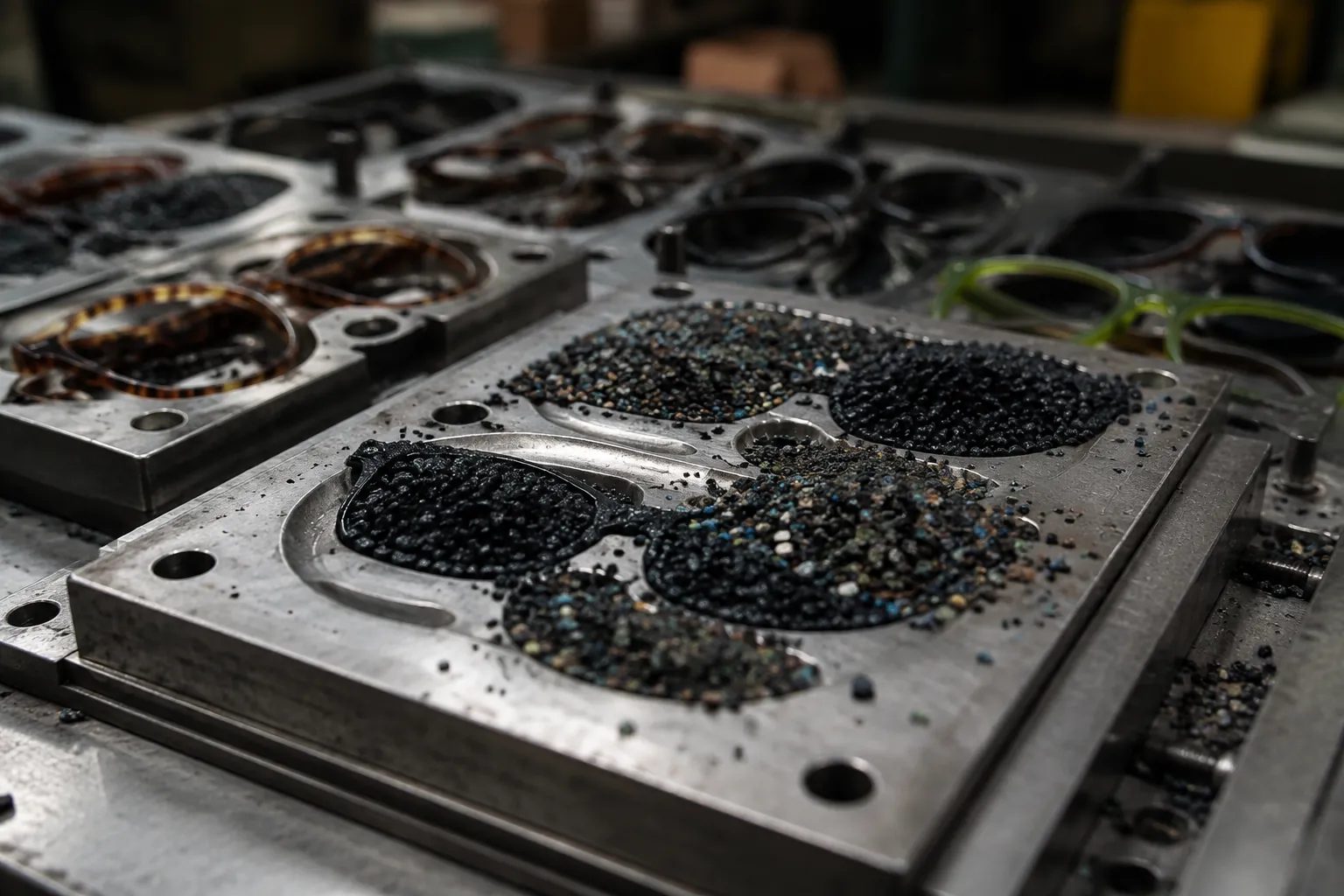
This guide is for brand owners, importers, distributors, and retail buyers sourcing injection-molded sunglasses at volume. Regrind can cut material waste and trim resin cost. It can also raise the odds of brittleness, color shift, warpage, hinge cracking, and decoration failure if the process is loose. That is the real issue. Not whether regrind exists. Many molding plants reuse some internal scrap. The question is narrower and more useful: what scrap is reused, at what percentage, in which resin, on which part, and under what drying, mixing, traceability, and QC controls.
Start With the Right Question: What Kind of Regrind, Where, and How Much?
Most injection-molding factories generate reusable scrap during production: runners, sprues, start-up shots, and parts rejected for cosmetic or dimensional reasons. Grinding clean in-house scrap and feeding a controlled portion back into production is common in plastics. In sunglasses, though, acceptability depends on part geometry, resin type, finish requirements, and the supplier's process discipline.
Many buyers ask, "Do you use recycled material?" That question is too broad to help. Internal regrind from the same resin grade and color family is not the same as mixed factory scrap or externally purchased recycled pellets with unclear origin. Those materials do not carry the same processing risk or traceability. A credible supplier should separate them clearly.
For a basic opaque frame with generous wall thickness and low cosmetic sensitivity, a controlled internal regrind ratio may be acceptable. For wrap sport frames, slim temples, crystal colors, high-gloss surfaces, rubber-touch finishes, or styles that must hold alignment through repeated opening and closing, the margin is tighter. Much tighter. In those programs, a small resin saving can disappear fast once cosmetic rejects, assembly issues, or field failures show up.
Push for specific answers. Ask where the scrap comes from, whether it is segregated by resin and color, whether it is dried before reuse when the resin requires it, whether regrind is limited to certain parts, and how the maximum percentage is controlled on the floor. If the answers stay vague, assume the policy is loose.
Where Regrind Helps and Where It Starts to Hurt
Regrind shows up first in three places: melt behavior, cosmetic consistency, and mechanical performance. Once resin has been heated, cooled, reground, and reheated, its processing behavior can change. How much it changes depends on resin type, thermal history, moisture exposure, contamination, and regrind percentage. Risk rises when the ratio is too high, the scrap stream is mixed, or moisture-sensitive material is reused without proper drying.
On sunglass frames, the weak spots are predictable: hinge boss, screw seat, bridge, lens groove, and temple bend. A frame can pass visual inspection at packing and still fail later. That is because the weakness is structural, not just cosmetic.
| Area | Lower Regrind Risk | Higher Regrind Risk | Typical Failure Mode |
|---|---|---|---|
| Front frame | Opaque black, matte, basic square shapes with moderate wall thickness | Thin rims, high-gloss fronts, crystal or translucent colors, aggressive wrap | Warping, sink marks, flow lines, color inconsistency |
| Temples | Straight thicker temples with low flex demand | Slim temples under spring force, sharp bend zones, logo insert areas | Stress cracking, whitening, hinge-area breakage |
| Bridge and lens groove | Wide bridge, generous groove design, low-camber geometry | Narrow bridge, tight lens-fit tolerance, sporty wrapped fronts | Brittle fracture, lens retention issues, fit distortion |
| Decorated surfaces | Dark matte textures with low gloss sensitivity | Pad print zones, UV print areas, high-gloss polish, metal plate insertion | Adhesion failure, orange peel, cosmetic rejection |
There is a simple pattern here. Basic dark frames with forgiving geometry can tolerate controlled internal regrind better than premium or performance-driven designs. Once the frame needs precise symmetry, stable lens fit, long flex life, or decoration consistency, virgin resin or a very low internal ratio is usually the safer call.
Material Behavior: PC, Nylon-Based Resins, and Other Compounds
Material choice matters more than many buyers assume. A supplier saying, "We only use a little regrind," is not enough. Ask which resin is being molded. The same percentage can be manageable in one material and risky in another.
Polycarbonate is valued for impact performance, but repeated heat history can reduce toughness and make stress whitening more visible around screw seats and hinge bosses. Nylon-based frame materials, including TR90-type compounds, are more sensitive to moisture handling. If regrind is not dried correctly before remolding, hydrolysis can reduce molecular weight and contribute to splay, brittle behavior, and dimensional instability. That affects hinge fit, temple alignment, and lens retention directly.
Some factories also mold frames in PC blends, TPE or TPU overmolded components, or proprietary compounds developed for touch, flex, or finish. Those materials can react differently to reheating and reprocessing. Painted, rubber-coated, or UV-coated finishes may also reveal substrate inconsistency faster than raw matte surfaces.
- Opaque commodity styles: controlled internal regrind may be acceptable if scrap is segregated by resin and color and the supplier verifies part performance.
- Translucent, crystal, or white frames: regrind risk rises because yellowing, black specks, silver streaking, and flow variation are easier to see.
- Sport or high-wrap frames: use tighter limits because front curvature, lens groove stability, and impact performance are more sensitive.
- Children's eyewear: be stricter on traceability, mechanical robustness, and chemical compliance documentation.
- Multi-finish premium programs: print adhesion, gloss consistency, and surface appearance often make substrate consistency worth more than small material savings.
Acetate sits outside this discussion. It uses a different manufacturing route, different scrap recovery logic, and different appearance standards. For injection frames, the only reliable way to discuss regrind is by resin type, part function, and finish requirement.
The Cost Math Buyers Should Actually Run
Factories use regrind to cut material cost and reduce waste. That is normal. The mistake is stopping the analysis there.
On injection-molded sunglasses, resin is only one part of the finished-pair cost. Tooling allocation, machine time, labor, lenses, decoration, assembly, packaging, inspection, and freight all shape the final price. So even when regrind lowers raw-material cost, the reduction in finished-pair cost may be modest. Sometimes very modest. Meanwhile, the downside of unstable quality can be expensive.
Ask a harder question: what is the finished-pair saving created by the declared regrind policy if all other variables stay constant? Then compare that number with the likely cost of replacements, reinspection, sorting, delayed shipment, claim handling, and retail disruption if output turns inconsistent.
This is a commercial decision, not an ideological one. Limited, declared internal regrind can make sense where design risk is low and market tolerance is high. It should be restricted or refused where the downstream cost of failure is higher than the material benefit.
What to Ask Before You Approve Production
Skip vague sustainability questions if your real concern is durability and consistency. Ask process questions. Ask for answers that can be checked.
- What is the source of the regrind? Same-model runner scrap, same-resin in-house scrap from multiple jobs, or externally purchased recycled pellets?
- What is the maximum percentage by part? Ask separately for front frame, temples, side shields, and any small molded inserts.
- Is scrap segregated by resin and color? Mixed-color grinding is a direct risk for white, crystal, light smoke, and translucent tones.
- How many heat histories are allowed? One controlled regrind loop is different from repeated cycling back into production.
- How is moisture-sensitive material dried? Ask for dryer type, temperature range, and standard drying time before remolding nylon-based compounds.
- Which parts are virgin-only? Many buyers require virgin resin for hinge zones, thin temples, high-gloss fronts, or premium visible surfaces.
- What tests are run at sample stage and during bulk? Ask for hinge cycling, drop checks, lens retention, alignment checks, cosmetic review, and dimensional confirmation.
A capable supplier should be able to answer in plain language and, ideally, put the policy on the quotation, sample approval sheet, or production specification. If the answer is only "small percentage" or "factory standard," you still do not know the risk. You know the wording.
Decoration method matters here too. Pad printing, hot stamping, UV printing, laser engraving, spray coating, and rubber-touch coating all interact differently with the substrate. If the frame includes printed logos, metal logo plates, or a soft-touch finish, ask whether the declared resin policy was validated on the decorated version, not only on the raw molded part.
Sampling and QC: How to Catch Failure Before Shipment
Many buyers inspect only color, logo position, and packaging. That is not enough. Regrind-related defects often show up in mechanical behavior, dimensional drift, or finish inconsistency rather than obvious first-look cosmetics.
During sampling, ask for both a declared material policy and a targeted stress check. For injection sunglasses, useful checks include repeated opening and closing of the temples, light torsion at the temple bend, bridge flex observation, lens retention after stabilization, and inspection for whitening around screw seats or molded hinge inserts. If the style uses spring hinges, check left-right torque balance and screw retention after repeated movement.
For production QC, the checklist should go beyond cosmetic AQL review and include process-sensitive controls:
- Weight consistency across sampled pairs, because unusual spread can indicate unstable shot fill or material variation.
- Temple opening force and left-right symmetry after assembly.
- Front warpage and lens seating after cooling, especially on wrapped styles.
- Surface review for black specks, silver streaks, burn marks, swirls, and gloss variation.
- Print and coating adhesion checks on decorated areas.
- Random stress checks from early, middle, and late production rather than only from first-run parts.
That last point matters. Regrind-related issues can appear after long machine runs, after color changes, or when process control drifts across shifts. A clean first-article sample does not prove stable bulk output.
Also keep compliance and material control separate in your thinking. CE EN ISO 12312-1, ANSI Z80.3, AS/NZS 1067, REACH controls, FDA registration where applicable, ISO 9001, and BSCI each cover different parts of supplier qualification or product compliance. None of them, by themselves, prove that a factory runs a disciplined regrind process. You still need a clear material policy, traceable production control, and part-specific performance checks.
When Regrind Is Usually Acceptable and When It Is Not
Buyers do not need a blanket ban on regrind. They do need an approval rule tied to product risk, finish sensitivity, and end use.
Regrind is usually more acceptable when the frame is a basic promotional style, the color is black or another forgiving opaque tone, wall thickness is not too thin, geometry is simple, and the supplier limits reuse to clean internal scrap from the same resin family. In those cases, a low and declared percentage may be commercially sensible if sample validation and bulk QC are both in place.
It is usually a poor choice when the frame depends on flex life, surface perfection, precise fit, or premium retail presentation. Thin fashion frames, crystal colors, mirrored sport wraps, children's styles, and decorated programs with pad print, hot stamp, or metal logo insertion should be reviewed more conservatively. In those cases, the cost of cosmetic rejection or field failure can erase any material saving fast.
| Decision Band | Typical Use Case | Suggested Material Rule | Buyer Action |
|---|---|---|---|
| Green | Basic opaque promo sunglasses | Low controlled internal regrind may be allowed | Approve with declared percentage, sample stress check, and bulk QC verification |
| Yellow | Mid-range fashion styles with decoration or slimmer geometry | Very limited regrind, often restricted away from visible or stress areas | Approve only with part-specific controls and stricter sample validation |
| Red | Sport frames, kids' styles, crystal colors, premium retail programs | Virgin resin strongly preferred for fronts and high-stress components | Reject regrind unless supplier provides clear performance data on the final build |
The approval logic is simple: ask for the resin type, source of regrind, percentage by part, drying method, and virgin-only zones. If the supplier cannot state those points clearly, you do not have a material policy. You have an assumption. That is not enough for production approval.
A Practical Buyer Position
The most useful position is neither "all regrind is bad" nor "factory standard is fine." It is a part-specific, resin-specific, finish-specific rule tied to measurable risk. Serious buyers treat regrind as a process-control variable, not a slogan.
For low-cost opaque promotional sunglasses, controlled internal regrind can be acceptable when the supplier has discipline around segregation, drying, traceability, and QC. For premium, decorated, flexible, or visually demanding programs, virgin-first policies are usually safer. The more the frame is sold on durability, fit, appearance, and repeat-order consistency, the less tolerance you should have for unclear resin history.
Before approving bulk production, get the regrind policy in writing, link it to the exact resin and parts being molded, and verify it during sampling and inline QC. That is how buyers control cost without buying future claims.
Have a custom sunglasses project in mind?
Send us your styles, target market and quantities and we will return a detailed quote with MOQ, lead time and a sample plan.
Get a QuoteWhy source this from Wenzhou with LumiShades
Wenzhou in Zhejiang Province is widely regarded as China’s eyewear manufacturing capital, producing a large share of the world’s sunglasses. That concentration matters to buyers: a deep local supply chain for acetate sheet, hinges, lens blanks, plating and packaging means shorter component lead times, easier color and material matching, and a workforce with decades of eyewear-specific skill. LumiShades has manufactured in this ecosystem since 2009, and our vertical integration — in-house injection molding, acetate cutting, CNC milling, lens tinting, decoration and quality control — means no part of your order is quietly subcontracted to a workshop you cannot audit.
For international buyers, that vertical control translates into accountability. When a single factory owns every step, defects are traced and fixed at source rather than bounced between vendors, and your specifications survive intact from first sample to bulk. We back this with 15+ years of experience, shipments to 60+ countries, more than 5 million pairs produced per year and a 98.5% on-time delivery rate. Our certifications — CE EN ISO 12312-1, FDA registration, ANSI Z80.3, AS/NZS 1067, REACH, ISO 9001 and BSCI audit — mean the compliance documentation your market requires already exists. Explore our manufacturing capabilities and quality control process to see how this works in practice.
Frequently asked questions
Is all regrind a quality problem in injection-molded sunglasses? No. Controlled internal scrap from the same resin and color family can be acceptable in some basic opaque styles, especially when wall thickness is forgiving and cosmetic demands are low. Risk rises when the percentage is high, the scrap stream is mixed, the resin is moisture-sensitive, the part is thin, or the style has premium finish requirements. The practical step for buyers is simple: ask for the source, the maximum percentage by part, and the validation results for the exact frame being purchased.
What regrind policy should I ask for in writing? Ask for six points in writing: the resin type, the source of the regrind, the maximum percentage allowed by part, whether fronts and temples have different limits, the drying method for moisture-sensitive materials, and which components must remain virgin-only. Also ask whether repeated regrind loops are prohibited and where this rule will appear in production paperwork. The best place is the sample approval sheet, production specification, or purchase-order attachment so the rule can be checked during bulk inspection.
Can a frame still meet CE EN ISO 12312-1 or ANSI Z80.3 if it contains regrind? Potentially yes. CE EN ISO 12312-1 and ANSI Z80.3 are finished-product standards; they do not automatically ban controlled use of internal production scrap. But passing those requirements does not prove the supplier has strong material control. Buyers should treat compliance testing and regrind control as separate checks: confirm the applicable standard for the finished eyewear, and separately require mechanical checks, dimensional consistency, and a declared regrind policy for production.
How should I compare regrind savings against quality risk? Do not treat regrind as only a resin-cost issue. Ask the supplier to show the finished-pair price difference between virgin-only material and the proposed regrind policy with all other variables unchanged. Then compare that number with the likely cost of reinspection, sorting, replacements, shipment delays, customer claims, and retail disruption if quality becomes unstable. If the supplier cannot quantify the saving or define the control method, there is no solid basis for approving the risk.
Should I allow regrind on decorated sunglasses with logos and special finishes? Only with caution. Pad printing, hot stamping, UV printing, rubber-touch coating, laser engraving zones, high-gloss surfaces, and metal logo plate areas tend to reveal substrate inconsistency faster than raw matte parts. For those programs, keep regrind very low, restrict it away from visible and high-stress components, or specify virgin-only material on critical parts. Buyers should also require adhesion and appearance checks on the fully decorated sample, not only on the molded frame before finishing.
Ready to start?
Explore our shield & oversized sunglasses or request a quote — our sales team replies within 12 hours.
Request a Quote