
PC Injection vs Acetate: The Real Cost Crossover
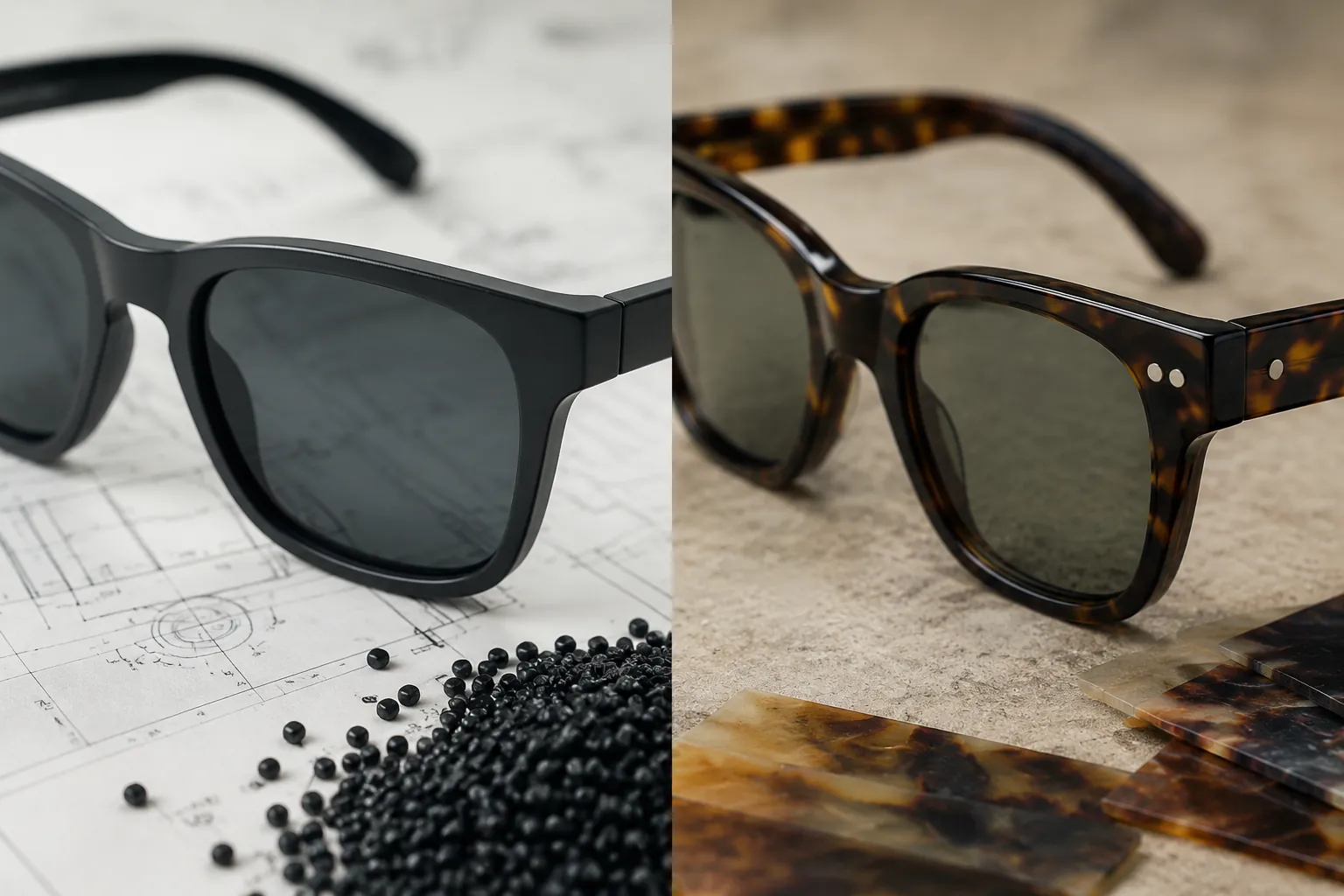
Buyers often treat this as a material decision. It is not. It is a program decision. PC injection and hand-cut acetate run on different cost structures, different capacity limits, and different quality risks. A prototype may look fine in either material, then fall apart commercially once tooling, labor, yield loss, decoration, and approval timing are added back in. This guide shows where PC injection usually becomes the stronger commercial choice, where acetate still holds up, and which factory questions expose the difference. The goal is simple: match frame construction to reorder pattern, retail position, and compliance needs instead of choosing by looks alone.
Start With Order Pattern, Retail Position, And Reorders
Do not start with the material board. Start with the business case. Expected volume, reorder confidence, channel, target retail, and allowable ex-factory cost matter more than surface appearance.
PC injection usually fits programs that need cost control, repeatability, and scale. That often means promotional sunglasses, chain retail, resort merchandise, and price-sensitive private-label styles where the frame has to work commercially at higher quantities and branding is fairly simple.
Acetate makes more sense when the frame itself carries part of the value. Buyers choose it for visible lamination, deeper polish, more substance in hand, or a finish level that supports a higher retail position.
MOQ alone is a weak filter. Factories can often offer low starting quantities in both routes, but that does not make both routes economical. At low volume, setup, development, and decoration overhead are spread across too few sellable pairs. The better comparison is total cost per sellable pair across the first production cycle and likely reorders. That means looking past the opening PO to replenishment assumptions, acceptable defect rate, packaging level, and whether the same geometry can be reused later.
Where The Cost Crossover Usually Happens
There is no single break point. Geometry, mold status, decoration, packaging, and reorder volume all move the number. Still, the sourcing pattern is consistent. If a style can run on an existing mold or a proven shared geometry, PC injection usually becomes the more efficient commercial route once volume is high enough to benefit from lower labor content and more repeatable output. Acetate avoids injection tooling, but its unit economics stay tied to sheet material, machining, polishing, and fitting labor.
| Factor | PC Injection | Hand-Cut Acetate | What It Means For The Buyer |
|---|---|---|---|
| Typical MOQ logic | Often easier to justify when an existing mold or shared geometry is available | Can be developed without injection tooling, but labor content stays high at low volume | Low MOQ does not automatically mean low cost; setup burden matters in both routes |
| Indicative ex-factory price band | Varies by mold status, lens specification, branding, and packaging | Varies by acetate grade, machining complexity, hardware, finish level, and packaging | Buyers should request line-item quotes instead of relying on generic price bands |
| Best commercial volume band | Usually stronger where repeat orders and scale matter | Usually more defensible where design and finish support higher retail pricing | The real crossover depends on whether higher frame cost is recoverable in the channel |
| Tooling profile | Existing mold is a major advantage; new mold cost must be amortized over expected volume | No injection mold required, but programming, jigs, and fit correction still create setup cost | A small first PO may lean acetate only when new injection tooling cannot be justified |
| Reorder economics | Usually improves once mold, color, and logo placements are approved | Usually remains more labor-dependent on every repeat order | Injection is often stronger for repeat campaigns and replenishment planning |
Here is the blunt version. If the program is mass distribution and price led, PC injection often becomes the better fit sooner than buyers expect. If the program is boutique, design led, and priced to absorb a higher frame cost, acetate can stay viable longer. Prestige is not the point. Cost recovery is.
Why Acetate Costs More In Practice
Acetate can look simple in a showroom. On the factory floor, it is not simple. It is a multi-step route with several chances for waste, rework, and fit correction.
A typical acetate frame route includes:
- Sheet selection by color, pattern, and thickness according to the design
- Conditioning or stabilization of the sheet before cutting, where required by the factory process
- CNC or pattern cutting of fronts and temples
- Milling for bevels, bridge areas, hinge pockets, and lens groove
- Barrel tumbling for edge softening and surface refinement
- Manual polishing to develop gloss and even out edges
- Hinge installation, rivet or screw fitting, and temple alignment
- Lens fitting, warm adjustment, cosmetic inspection, and packing
Each step can add waste or rework. Material utilization depends on how well the frame shape nests within the sheet, and complex silhouettes usually create more scrap than simple ones. Patterned or laminated acetate also varies from sheet to sheet, so an approved sample may not repeat exactly across the full lot.
Tolerances matter too. If hinge pockets drift, alignment becomes inconsistent. If the lens groove is off, the lens may fit too loosely or under too much stress. Buyers should ask what dimensional controls the factory uses for lens fitting, hinge placement, and final alignment, and how those points are checked during production. A useful answer names the control points and inspection method. "We do QC at the end" is not a useful answer.
PC injection compresses much of the front-shaping work into the molding stage. Once the mold, resin settings, and cooling profile are stable, repeatability is usually easier to control at scale and labor per pair is lower. That does not make injection risk-free. Warpage, sink, flow marks, ejector witness, and gloss variation still happen. But the process is generally easier to standardize once it is set correctly.
Cost Drivers Buyers Miss In RFQs
Unit price rarely tells the full story. The crossover often shifts because key costs are hidden, bundled badly, or added late after sample approval.
- Tooling amortization: A new injection mold can make the first quote look weak. The right comparison is expected cost per sellable pair across planned volume, not first-PO price alone.
- Yield loss: Acetate utilization depends on frame shape, sheet pattern, and rework rate. Buyers should ask whether the quote already assumes realistic yield.
- Decoration complexity: A basic pad print is not equivalent to metal logo application, deep engraving, or multi-location branding. Decoration changes both cost and rejection risk.
- Hardware specification: Hinges, metal trims, and embedded brand elements can materially change unit economics, especially on acetate frames.
- Packaging creep: Cases, pouches, barcode labels, hangtags, and retail boxes can narrow or erase the apparent cost gap between two frame constructions.
Decoration needs extra scrutiny. On PC injection, common branding methods include pad printing, lens printing, laser marking where appropriate, and metal logo insertion if the structure allows it. On acetate, buyers may ask for inlay logos, riveted metal details, or more demanding laser work on polished surfaces. Those upgrades can improve presentation. They also raise process difficulty.
That is why line-item quoting matters. Ask the factory to separate frame, lens, hinge, logo process, packaging, tooling, and setup charges. A blended quote hides the real cost pressure and makes it harder to compare injection and acetate on equal terms.
Lead Time, Capacity, And What Delays Shipment
Cost is only half the decision. The other half is timing. Some programs fail on calendar, not price.
Injection sampling can move quickly when the buyer uses an existing mold and changes only color, lens treatment, or logo placement. A new mold is different. That adds design review, machining, trial shots, polishing, and fit correction before the sample is commercially meaningful. Ask the supplier to break timing into mold lead time, first-shot timing, and revised-sample timing. One headline number is not enough.
Acetate avoids injection mold development, but it is often more sensitive to design correction. Frames with demanding bevel balance, hinge placement, or lens-fit requirements may need more than one sample round before they are ready for bulk approval. The reason is straightforward: the final result depends on cutting, milling, and finishing consistency, not a fixed mold cavity alone.
Bulk timing behaves differently as well:
- Injection: Usually more predictable once molding, lens preparation, decoration, and assembly are scheduled in sequence
- Acetate: Usually more dependent on labor availability in machining, polishing, fitting, and final alignment
- Hybrid risk: When molding, decoration, and QC sit in separate workshops, transfer and queue time can become the real source of delay
Ask which processes sit in the same plant and which are outsourced. In-house control over injection, lens handling, decoration, and QC can reduce schedule risk. For acetate, in-house machining and polishing capacity matter just as much. If critical finishing steps are subcontracted, the quoted lead time may be less reliable than it looks.
If the launch date is fixed and the product is price sensitive, PC injection is often the safer scheduling choice. If the brand position depends on acetate, allow more time for sample correction, pre-production approval, and in-line QC.
Compliance, Material Behavior, And The Limits Of Certificates
For overseas buyers, sunglasses are a finished product. Not just a frame with lenses dropped in. The compliance picture can include optical performance, UV protection, impact-related requirements, restricted substances, and market-specific labeling. The documents buyers usually see in this category include CE EN ISO 12312-1, ANSI Z80.3, AS/NZS 1067, REACH, FDA registration, ISO 9001, and BSCI. They do not mean the same thing.
CE EN ISO 12312-1, ANSI Z80.3, and AS/NZS 1067 relate to finished-product performance in specific markets. REACH addresses restricted substances. FDA registration is often requested in U.S.-linked paperwork flows, but it does not prove that a sunglass model meets the relevant performance standard. ISO 9001 covers quality-management systems. BSCI covers social compliance expectations. Neither confirms that a specific sunglass passes optical or safety-related requirements.
Material choice affects compliance in practical ways. PC injection frames are often selected where toughness and dimensional repeatability matter, but a PC frame does not make the product compliant by itself. Lens category, visible light transmission, UV performance, assembly quality, and labeling still determine whether the finished product suits the target market.
Acetate creates a different control problem. It can support a more premium finish, but buyers should watch lens-fit stress, groove consistency, and post-polish geometry closely. Excessive stress at the lens edge or too much adjustment after finishing can affect durability and consistency in shipping and use.
Serious buyers should verify three things before accepting compliance paperwork:
- The report matches the intended market and standard
- The report is relevant to the actual lens category and construction being purchased
- The tested sample is materially representative of the production SKU family
Certificate files are not enough. Ask what was tested, when it was tested, which lab issued the report, and whether the approved sample matches planned production in lens, frame, and labeling details.
How To Compare Both Routes Properly
A good RFQ should expose the crossover fast. It should show whether the commercial fit is real instead of hiding two very different cost structures behind one unit price.
When asking factories to quote PC injection against acetate, keep the conditions aligned. Use the same lens specification, the same branding locations, the same packaging standard, and the same shipment terms. If one quote includes a premium case, upgraded lens treatment, or extra logo work and the other does not, the material comparison is distorted from the start.
Ask for at least two scenarios when possible: one based on existing geometry and one based on custom development. This matters most in injection, where the presence or absence of an approved mold changes the economics sharply. For acetate, ask whether the quoted design uses standard hardware and common sheet thickness or requires special setup that could reduce repeatability later.
The goal is not to force both materials into the same factory logic. The goal is to isolate the real cost and risk differences so the decision can be made on commercial terms.
A Practical RFQ Framework For Choosing The Right Route
A disciplined RFQ is still the fastest way to test whether PC injection or acetate is the better fit.
Use this screening framework before approving development:
- Set target retail and max ex-factory cost. If the program only works with tight frame cost control, test PC injection first and require a clear retail case before accepting acetate.
- Estimate total program volume, not just the opening PO. Tooling and development should be judged across expected reorder volume, not first shipment alone.
- Confirm existing mold versus new mold. For injection, this is one of the biggest variables in the crossover.
- Ask for unit pricing at multiple volume breaks. This shows whether the supplier has a real cost model and helps reveal where amortization or labor intensity changes the result.
- Audit decoration early. Separate core frame economics from branding and packaging upgrades before approving samples.
- Check where the work sits. In-house control over molding or machining, lens handling, decoration, and QC usually improves timing and accountability.
- Lock compliance scope by market before sampling ends. Late lens or labeling changes can trigger retesting, delay approval, and distort the original cost comparison.
The short version is simple. Acetate gets harder to justify when the brand story does not recover the extra frame cost, the reorder pattern is uncertain, and the buyer still needs price-sensitive economics. PC injection gets less obvious when the product must deliver a finish, feel, or design language that molded frames cannot credibly support in the target channel.
Ask direct operational questions too. Is the quoted shape based on an existing mold? Which processes are in-house? What inspection points control lens fit and alignment? What is the realistic timeline from artwork approval to sample release, and from sample approval to bulk production? Those answers usually tell you more than the sample itself.
Have a custom sunglasses project in mind?
Send us your styles, target market and quantities and we will return a detailed quote with MOQ, lead time and a sample plan.
Get a QuoteWhy source this from Wenzhou with LumiShades
Wenzhou in Zhejiang Province is widely regarded as China’s eyewear manufacturing capital, producing a large share of the world’s sunglasses. That concentration matters to buyers: a deep local supply chain for acetate sheet, hinges, lens blanks, plating and packaging means shorter component lead times, easier color and material matching, and a workforce with decades of eyewear-specific skill. LumiShades has manufactured in this ecosystem since 2009, and our vertical integration — in-house injection molding, acetate cutting, CNC milling, lens tinting, decoration and quality control — means no part of your order is quietly subcontracted to a workshop you cannot audit.
For international buyers, that vertical control translates into accountability. When a single factory owns every step, defects are traced and fixed at source rather than bounced between vendors, and your specifications survive intact from first sample to bulk. We back this with 15+ years of experience, shipments to 60+ countries, more than 5 million pairs produced per year and a 98.5% on-time delivery rate. Our certifications — CE EN ISO 12312-1, FDA registration, ANSI Z80.3, AS/NZS 1067, REACH, ISO 9001 and BSCI audit — mean the compliance documentation your market requires already exists. Explore our manufacturing capabilities and quality control process to see how this works in practice.
Frequently asked questions
At what volume does PC injection usually beat acetate on total cost? There is no fixed volume threshold for every project. The result depends on mold availability, custom tooling, decoration complexity, and reorder confidence. To test it properly, ask the supplier for line-item pricing at several quantity breaks using the same lens, logo, and packaging specification for both materials. Then compare total projected cost across expected 12-month volume, not just the first PO.
Can acetate ever be the cheaper option at low MOQ? Yes, but usually only in a narrow case: the injection route needs new tooling and the order is too small or too uncertain to absorb that tooling responsibly. Even then, check the full scope. Confirm that the acetate quote already includes the intended hardware, finish level, logo application, and packaging. A low-MOQ acetate quote can look attractive early, then lose the advantage once the production details are matched properly against injection.
What process tolerances should buyers ask about? Ask the supplier how it controls lens fit, hinge placement, front-to-temple alignment, and cosmetic acceptance. Do not accept a generic statement that quality is checked. Request the in-process inspection points, the method used to check alignment and lens fit, and the reject criteria applied before packing. If the supplier cannot explain those controls clearly, the approved sample may be hard to repeat at bulk level.
Does PC injection mean lower quality? No. PC injection and acetate solve different commercial and design problems. A well-made injection frame can deliver consistent dimensions, stable branding placement, and reliable large-scale repeatability. A well-made acetate frame can deliver a different finish, feel, and visual depth. Judge quality through mold or machining control, lens fit, assembly consistency, decoration durability, and compliance relevance to the target market rather than assuming one material is always superior.
What should I verify before accepting compliance documents? Check five points. First, confirm the document matches the destination market and relevant standard, such as CE EN ISO 12312-1, ANSI Z80.3, or AS/NZS 1067 where applicable. Second, confirm that the report applies to the actual lens category and construction being purchased. Third, verify that the tested sample is materially representative of production. Fourth, review the date, issuing lab, and report scope rather than relying on a certificate title alone. Fifth, separate product-compliance documents from company-level documents such as ISO 9001, BSCI, or FDA registration, which do not by themselves prove that a sunglass model meets finished-product performance requirements.
Ready to start?
Explore our round sunglasses or request a quote — our sales team replies within 12 hours.
Request a Quote