
How to Source Recycled-Metal Sunglasses Safely
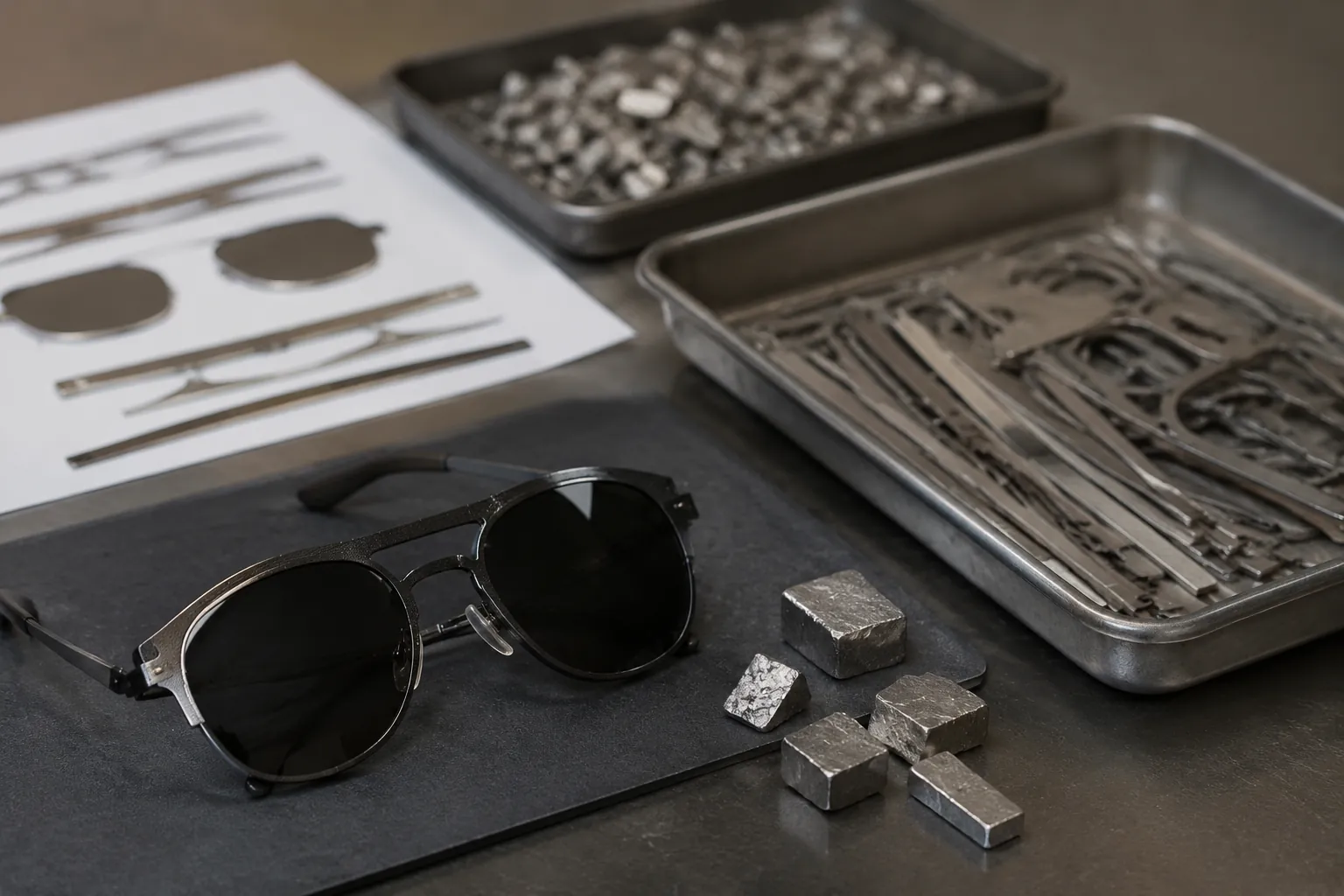
This guide is for brands, importers, distributors, and retailers developing recycled-content metal sunglasses at volume. The goal is control. Define a claim you can prove. Choose an alloy that suits the frame. Link the material batch to production. Inspect the product and the paperwork before shipment. Recycled metal can work well in eyewear, but the evidence file must be built before the purchase order is finalized, not after the cartons are packed.
Start With the Claim, Not the Drawing
The first sourcing mistake is treating recycled metal as a styling detail and fixing the paperwork later. That is backwards. Your claim determines the evidence you need, the alloy choices, the component scope, and the risk level with retailers, customs authorities, and consumer-protection regulators.
Specific claims are safer. Broad claims are trouble. Saying the metal front and temples contain recycled stainless steel is easier to support than saying eco-friendly sunglasses. Saying the frame metal components contain at least 60% recycled content by weight is stronger than saying made from recycled materials, especially if the lenses, nose pads, screws, coatings, and packaging are not verified as recycled.
Before sampling, define these points in the quotation sheet:
- Material scope: front, bridge, brow bar, temples, hinges, logo plates, screws, or all metal parts.
- Measurement basis: recycled percentage by named metal component weight, total frame weight, or total finished sunglass weight.
- Source type: pre-consumer scrap, post-consumer scrap, or mixed recycled feedstock.
- Minimum claim level: for example, 30%, 50%, 60%, or another percentage the supplier can document.
- Sales territory: EU, US, UK, Canada, Australia/New Zealand, or retailer-specific sustainability review.
- Excluded components: lenses, nose pads, screws, plating, coatings, packaging, accessories, or other parts not covered by the recycled-content evidence.
For LumiShades projects, proposed claim wording should be reviewed during quotation and confirmed before packaging artwork is approved. This prevents a common failure: the buyer approves hangtag copy after production, then discovers the material records do not support the printed claim.
Proof Levels: Strong Evidence vs Weak Paper
A factory letter alone is weak evidence for a serious recycled-content claim. It may help during early screening, but it does not prove that a specific production lot used a specific recycled metal batch. Stronger evidence connects the metal supplier, alloy grade, material batch, component production, assembly order, and finished shipment.
| Proof item | What it should include | Strength | Buyer action |
|---|---|---|---|
| Supplier recycled-content declaration | Alloy, claimed recycled percentage, source type, supplier name, issue date, and whether the declaration is batch-specific | Medium | Use for quotation screening; do not rely on it alone for shipment release |
| Mill test certificate or material certificate | Alloy grade, chemical composition, heat number, batch number, coil number, bar reference, or other material identifier | Strong if linked to the purchase order and production order | Match the batch or heat number to the factory work order and incoming material record |
| Purchase invoice or delivery note for metal | Material quantity, material description, supplier, delivery date, batch reference, and factory recipient | Strong | Check that the purchased quantity is plausible for the order quantity, including normal process loss and rejects |
| Mass balance worksheet | Input weight, component weight, expected process loss, rejected parts, reworked parts, and finished shipment quantity | Medium to strong | Look for a logical relationship between metal purchased, components produced, rejects, and finished pairs |
| Finished goods compliance reports | UV protection, optical performance, impact or robustness requirements where applicable, nickel release, and restricted-substance results | Strong for product safety and market access | Use these for compliance, but do not treat them as proof of recycled origin |
Process loss is normal in metal eyewear. Stamping, trimming, CNC machining, polishing, plating rejects, and assembly rejects all reduce usable yield. The loss rate depends on frame geometry, alloy, process route, and defect level. If a traceability file shows almost no loss through several metalworking and finishing stages, stop. Ask for the calculation and the records behind it.
Choose the Alloy Before the Percentage
Recycled content cannot fix a poor alloy choice. Sunglasses still need spring performance, corrosion resistance, hinge strength, soldering or welding compatibility, plating adhesion, stable lens fit, and safe skin-contact surfaces. The right alloy depends on the frame shape, finish, price point, production process, and target market.
Stainless steel is common for thin sheet fronts, brow bars, temples, and lightweight metal styles. It can work with recycled-content sourcing, but spring-back and forming behavior must be controlled. Tight eyewire curves, narrow rims, screw holes, and hinge areas should be checked against approved drawings and physical samples.
Aluminum is light and may be available with recycled content. It is often used for machined or thicker-profile designs. It needs suitable anodizing, painting, powder coating, or clear coating control. Threads, screw retention, and hinge areas need extra attention because poor design or insufficient wall thickness can cause loosening or deformation.
Monel and nickel-silver type alloys are widely used in eyewear because they form, solder, and plate well. The watch point is nickel release. For EU-bound products, skin-contact metal parts such as temples, bridges, and nose pad arms should be assessed under REACH requirements. Lead and cadmium risks also need attention in solder, plating, pigments, coatings, and decorative metal parts.
Titanium is light, strong, and corrosion resistant, but recycled titanium sourcing is more specialized. Do not make a recycled titanium claim unless the supplier can provide batch-level procurement records and production traceability. Titanium also requires different welding, surface treatment, and quality-control methods from stainless steel or monel.
The rule is simple: approve the alloy and construction first. Then set the recycled-content claim at a level the supplier can verify for that alloy, that component scope, and that production batch.
Build Traceability Into the Production File
A recycled-metal program needs a tighter production file than a standard fashion eyewear reorder. The file should show the material route from incoming metal to finished sunglasses.
- Confirm claim and component scope. Example: front and temples only, minimum 60% recycled stainless steel by named metal component weight.
- Approve alloy and finish. Confirm whether plating, PVD, painting, electrophoresis, anodizing, brushing, polishing, or clear coating is compatible with the alloy and target market.
- Create a component weight sheet. Weigh the relevant components separately: front, left temple, right temple, hinges, screws, lenses, nose pads, logo parts, and decoration where applicable.
- Link batch to work order. The production order should identify the metal batch used for each style, color, and size.
- Control scrap and rework. Record process loss, rejected parts, reworked parts, plating rejects, broken components, and replacement parts.
- Keep approved reference samples. Retain signed samples for frame shape, lens fit, color, logo placement, hinge feel, coating appearance, and packed presentation.
- Reconcile shipment quantity. Packing list, carton marks, test reports, batch records, and final inspection report should use the same style codes, color codes, and quantities.
Lead time should be confirmed project by project. Recycled-content sourcing can take longer if the order needs a reserved metal batch, a specific alloy declaration, additional document review, or third-party testing. If a retailer must approve the sustainability file, put that review into the launch schedule before committing to delivery dates.
MOQ, Price, and Lead-Time Reality
Recycled metal sunglasses are not automatically expensive. Small orders, however, carry more cost pressure. The extra work is not only the metal. It can include document review, batch segregation, incoming material checks, component weighing, compliance testing, traceability records, and additional QC verification.
LumiShades can support small custom orders, including low-MOQ development, but the claim and documentation package must match the order scale. At a small pilot quantity, the buyer may need to accept an available recycled alloy and use conservative component-specific wording. At larger quantities, it is more realistic to reserve material, separate production lots, and maintain a fuller batch record. Pricing depends on alloy, frame construction, lens type, coating, decoration, packaging, testing requirements, and documentation depth. Quote against a confirmed specification, not a vague recycled-content request.
| Order stage | Typical quantity approach | Best use | Lead-time and cost logic |
|---|---|---|---|
| Prototype | Very small sample run | Fit, shape, lens color, logo position, finish trial | Fastest for design checking, but sample metal may not be the final bulk batch unless specified |
| Pilot order | Low-MOQ test order | Retailer sell-in, market test, influencer kits, internal approval | Higher unit cost; limited leverage for custom recycled-metal procurement |
| Commercial order | Confirmed launch quantity | Repeatable QC, packaging approval, retailer shipment | Better batch control; require pre-shipment inspection and document pack before release |
| Volume program | Forecast-based production | Best planning for material, colorways, testing, and reorders | Lock forecast, test schedule, packaging, carton rules, and traceability requirements in advance |
Be direct about your forecast. If the quantity is small, use careful component-specific language and do not overstate the claim. If the program is large or repeated, request reserved material batches, lot-by-lot records, and a shipment plan that avoids mixing documented production with undocumented stock.
Finishes and Logos Can Create New Risks
Decoration is not just visual. It can affect compliance, durability, and the credibility of the recycled-metal claim. A recycled stainless steel frame with poor plating, weak logo adhesion, sharp logo edges, or flaking paint can fail retail inspection even if the material claim is accurate.
Common metal eyewear finishes include electroplating, PVD, spray painting, electrophoretic coating, anodizing for aluminum, brushing, polishing, and laser marking. Common logo methods include laser engraving, pad printing, metal logo plates, debossed temple details, and printed lens marks. Each method needs a control point.
- Laser engraving: durable and precise; confirm position, depth, legibility, and whether the engraving exposes base metal that needs corrosion protection.
- Pad printing: flexible for color logos; request adhesion, rub, and solvent-resistance checks where relevant.
- Metal logo plates: premium look; check plating quality, edge smoothness, attachment strength, and restricted substances.
- PVD or plating: attractive and durable when controlled; coating buildup can affect hinge fit, screw torque, and lens seating.
- Anodizing: suitable for aluminum; check color consistency against approved limit samples under controlled lighting.
For LumiShades projects, define measurable specifications before production: lens category, UV performance, logo location, engraving or print appearance, temple opening angle, screw tightness, coating adhesion, lens retention, nose pad alignment, and packed condition. The recycled-content file does not replace standard product-quality controls.
Compliance Is Not Recycled-Content Proof
Recycled content is a sourcing and marketing claim. It is not a safety certificate. Sunglasses still need to meet the rules and standards of the markets where they are sold.
For EU sales, sunglasses are commonly assessed against EN ISO 12312-1 and require appropriate CE documentation. The buyer should keep the declaration of conformity, test report, product identification, labeling information, and technical file. For the US, ANSI Z80.3 is the common non-prescription sunglasses standard, and FDA registration or listing obligations may be relevant to import handling depending on the role of the manufacturer, importer, and product category. FDA registration is administrative; it is not a product performance certification. For Australia and New Zealand, AS/NZS 1067 applies. REACH remains important for restricted substances in frames, coatings, lenses, packaging, and skin-contact parts.
LumiShades lists the following compliance and factory-management credentials for relevant eyewear programs: CE EN ISO 12312-1, ANSI Z80.3, AS/NZS 1067, REACH, FDA registration, ISO 9001, and BSCI. These do not prove recycled content. They serve different purposes: product safety, restricted-substance control, regulatory access, quality management, and social compliance.
For metal frames, pay special attention to nickel release, lead, cadmium, lens UV performance after tinting or mirror coating, hinge function after coating, sharp edges after stamping or CNC machining, screw security, and lens retention after adjustment. A practical inspection plan should include AQL sampling, visual checks, dimensional checks, hinge movement, coating adhesion, screw tightness, nose pad symmetry, temple alignment, lens fit, barcode or SKU verification, carton marks, and document review.
Set Claim Language and Release Rules
Good claim language is narrow, measurable, and tied to a component. Bad claim language makes the whole product sound greener than the evidence supports.
| Risky wording | Safer wording | Reason |
|---|---|---|
| Eco-friendly sunglasses | Metal front and temples contain recycled stainless steel | Avoids broad environmental benefit claims |
| Made from recycled materials | Frame metal components contain at least 60% recycled content by weight | Defines scope and measurement basis |
| 100% sustainable eyewear | Recycled-content claim applies to the metal frame only; lenses and nose pads are excluded | Prevents overclaiming across mixed materials |
| Certified recycled frame | Recycled content supported by supplier declaration, material certificate, and batch records | Avoids implying a certification that has not been obtained |
Before shipment release, check that the purchase order, batch record, component weight sheet, test reports, packing list, carton marks, final inspection report, and approved packaging all refer to the same SKU, color, and quantity. If the shipment contains multiple colors, each color should be traceable. Mixed cartons and late packaging changes often create claim errors.
Simple rule: if your team cannot explain which metal batch went into which finished SKU, do not print a recycled-content claim on that SKU.
Control translations too. A careful English claim can become an inflated green claim in French, German, Spanish, Japanese, or another market language if a distributor rewrites it for style. Provide approved claim wording for each sales territory and keep it aligned with the production file.
Have a custom sunglasses project in mind?
Send us your styles, target market and quantities and we will return a detailed quote with MOQ, lead time and a sample plan.
Get a QuoteWhy source this from Wenzhou with LumiShades
Wenzhou in Zhejiang Province is widely regarded as China’s eyewear manufacturing capital, producing a large share of the world’s sunglasses. That concentration matters to buyers: a deep local supply chain for acetate sheet, hinges, lens blanks, plating and packaging means shorter component lead times, easier color and material matching, and a workforce with decades of eyewear-specific skill. LumiShades has manufactured in this ecosystem since 2009, and our vertical integration — in-house injection molding, acetate cutting, CNC milling, lens tinting, decoration and quality control — means no part of your order is quietly subcontracted to a workshop you cannot audit.
For international buyers, that vertical control translates into accountability. When a single factory owns every step, defects are traced and fixed at source rather than bounced between vendors, and your specifications survive intact from first sample to bulk. We back this with 15+ years of experience, shipments to 60+ countries, more than 5 million pairs produced per year and a 98.5% on-time delivery rate. Our certifications — CE EN ISO 12312-1, FDA registration, ANSI Z80.3, AS/NZS 1067, REACH, ISO 9001 and BSCI audit — mean the compliance documentation your market requires already exists. Explore our manufacturing capabilities and quality control process to see how this works in practice.
Frequently asked questions
Can we claim the whole sunglass is recycled if only the metal frame uses recycled content? No. Limit the claim to the metal frame or named components unless the lenses, nose pads, screws, coatings, packaging, accessories, and other parts are also verified as recycled. Use wording such as: "The metal front and temples contain recycled stainless steel." If you state a percentage, define the basis clearly, such as "by metal component weight."
What documents should we request before placing a bulk order? Request the recycled-content declaration, alloy or mill certificate, batch or heat reference, metal purchase or delivery record, component scope, component weight sheet, and a mass-balance plan. Separately, request market compliance documents such as CE EN ISO 12312-1, ANSI Z80.3, AS/NZS 1067, REACH reports, or FDA registration/import records where relevant. Do not approve packaging artwork until the claim wording matches the documents.
Does REACH prove recycled content? No. REACH addresses restricted substances; it does not prove recycled origin. It is still important for metal eyewear because skin-contact parts, plating, solder, coatings, pigments, and decorative parts may involve nickel, lead, cadmium, or other restricted substances. Treat REACH as a safety and chemical-compliance check, not a recycled-content certificate.
Will recycled metal change frame quality? Not necessarily. Quality depends on the alloy grade, material consistency, frame design, forming or machining process, soldering or welding, coating, decoration, and QC. Before bulk production, approve a physical sample and confirm hinge strength, lens retention, temple alignment, coating adhesion, corrosion resistance where relevant, screw security, and skin-contact safety.
What is a realistic development timeline? Confirm timing with the supplier after the alloy, finish, claim wording, testing scope, packaging, and inspection plan are known. Recycled-content programs may need extra time for batch reservation, document review, component weighing, retailer approval, or third-party testing. Do not set a launch date based only on normal eyewear sampling time if the recycled-content file has not been approved.
What MOQ should we use for a recycled metal test order? Use the smallest quantity that still lets you validate fit, finish, lens performance, logo method, packaging, and documentation. For a low-MOQ test order, keep the claim conservative and component-specific. For a larger commercial order, require reserved material, batch traceability, a pre-shipment inspection, and a document pack before release.
What should be checked before shipment release? Check three things: product, documents, and claim wording. Product checks should cover visual defects, dimensions, hinge function, screw tightness, lens fit, UV or optical performance reports, coating adhesion, nose pad alignment, and carton condition. Document checks should confirm batch records, material certificates, component weights, test reports, packing list, and carton marks. Claim wording should match the exact components and recycled percentage the file can prove.
Ready to start?
Explore our round sunglasses or request a quote — our sales team replies within 12 hours.
Request a Quote