
Wire Cores in Plastic Sunglasses: When They Pay Off
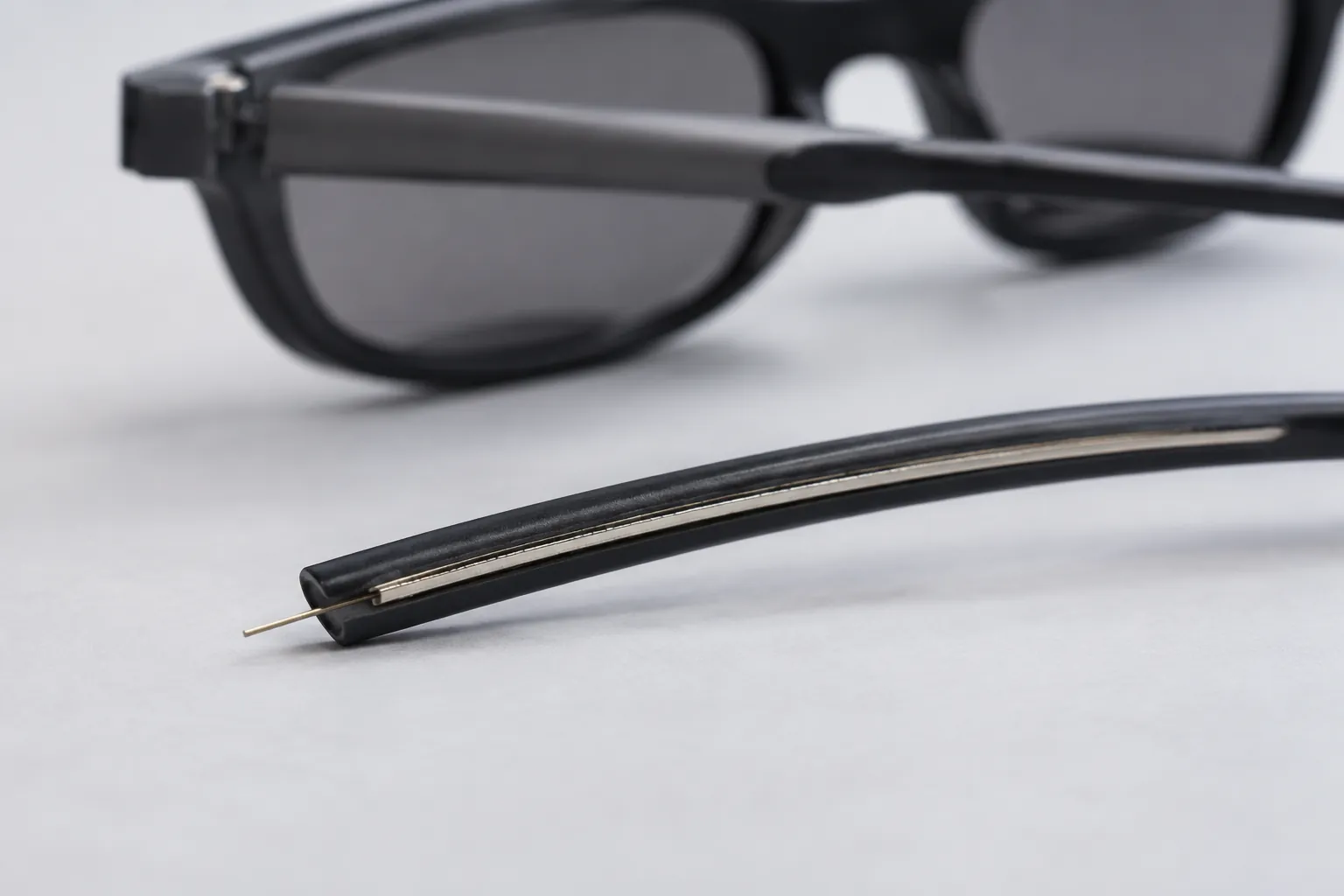
This guide is for buyers developing plastic sunglasses for brands, retail programs, and private-label lines. Wire cores are metal inserts inside the temples. They can improve first-touch feel, allow limited post-fit adjustment, and shift how a frame reads at retail. They also add cost, process steps, tighter wall-thickness control, and more QC around the hinge and bend zone. That trade-off is the point. The real question is not whether wire cores are better. It is whether they improve the product enough to justify the added FOB, sampling complexity, and production discipline for your channel and price band.
Start with the buying decision, not the feature
Wire cores are metal inserts embedded inside plastic temples, usually running from the hinge area through most of the temple length. They are common in many acetate frames and less common in low-cost injection-molded sunglasses. Buyers often ask for them after handling a sample because the frame feels denser, less hollow, and easier to tune during minor adjustment. Fair reaction. Still not a reason by itself.
Start with the commercial case. Then check the technical fit. For giveaway orders with tight FOB targets, wire core is often the wrong place to spend money. For fashion retail lines where shelf feel matters, it can pay back. For optical-inspired sun frames with thicker temples, acetate construction, or visible metal decoration, it often fits the product position.
Three filters matter most. First, retail position: entry-level price points leave little room to recover hidden construction cost. Second, fit strategy: if your channel includes optical stores, boutiques, or retail staff who may make light comfort adjustments, a core can add real value. Third, material: acetate usually carries wire-core construction better than thin, low-cost injection-molded temples because it has the thickness, polishability, and visual depth to hide the insert cleanly.
Factory structure matters too. If acetate cutting, CNC milling, polishing, logo application, and QC sit in one controlled process chain, wire-core construction is easier to manage. If those steps are split across vendors or subcontractors, tolerance drift can turn into visible defects: shadow lines, uneven left-right flex, or cracking near the hinge after adjustment.
What wire cores actually change
Wire cores usually affect three things buyers notice fast: hand feel, limited adjustability, and perceived quality. A plain plastic temple can look fine in photos and still feel cheap in hand. A metal core adds internal mass and changes how the temple flexes. On acetate temples with enough finished thickness, the difference is often obvious.
- Adjustability: A wire core can allow limited tuning at the temple tip and bend zone. In practice, an optician or retailer may be able to add a small ear bend or modest inward adjustment with more control than on a plain plastic temple. The actual range still depends on material, thickness, core profile, and local wall thickness.
- Hand feel: Added internal metal can increase density and reduce the hollow sensation found in some low-cost plastic temples. On acetate, the result is often a more substantial feel. On injection-molded temples, the improvement may be there but is usually less pronounced.
- Perceived quality: Consumers may not know why, but they notice balanced weight, more controlled flex, and temples that do not feel flimsy when opened and closed.
- Support for premium decoration: Temples carrying metal logo plates, foil logos, hot-stamped marks, or embedded hardware often benefit from wire-core construction because the whole temple feels more solid.
What wire cores do not do is fix weak fundamentals. They do not compensate for poor hinge mounting, thin end pieces, unstable lens groove dimensions, low-grade base material, or weak logo adhesion. If the hinge screw strips, the front is out of alignment, or the lens fit is loose, the hidden wire changes nothing.
Material behavior matters. Acetate is dense, polishable, and generally more forgiving visually when the core is centered properly. It also supports a cleaner finish after milling and polishing. TR90, polycarbonate, and other injection-molded plastics can use inserts, but adjustability is usually more limited, and wall-thickness control becomes more critical because molded parts may show sink, distortion, or stress around internal structures.
Where wire cores make sense by material and price band
| Frame type | Typical finished temple thickness | Wire core value | Typical reason to use | Buyer caution |
|---|---|---|---|---|
| Acetate front + acetate temples | 4.0-6.5 mm | High | Better adjustable fit, denser hand feel, stronger premium signal | Core must stay centered; outer wall usually needs about 0.8-1.2 mm cover to reduce show-through risk after polishing |
| Injection-molded TR or PC temples | 3.0-4.5 mm | Medium to low | Can improve feel on better retail programs | May not justify cost on price-led orders; bend range is narrower and visual risk near thin sections is higher |
| Mixed-material sun frame with metal logo plate | 4.5-6.0 mm | High | Balances temple weight and supports a more substantial construction story | Wall thickness must remain consistent around both insert and logo hardware |
| Kids or promo sunglasses | 2.8-4.0 mm | Low | Usually not needed unless light fit adjustment is part of the program | Added cost is hard to recover; simpler construction may be the better commercial choice |
In practice, wire cores usually justify themselves fastest on acetate. Buyers already expect acetate to feel richer than basic molded plastic, and the material gives the factory more control over channel cutting, insertion, and polishing. On budget injection-molded sunglasses, the money may be better spent elsewhere: a better hinge, more consistent lens tint, improved logo durability, or tighter front symmetry.
Price band is the second filter. For a low-FOB program, hidden construction upgrades are hard to recover. For mid-market or premium private-label lines, the same upgrade may improve conversion because first-touch feel matters. If your retail target depends on the frame feeling premium within a few seconds of handling, quote wire core early. Do not add it late as a rescue feature.
Cost, MOQ, and lead-time logic
Wire-core construction adds cost through insert material, machining or slotting, insertion labor, fixing or adhesive steps where used, higher reject risk, and extra QC time. For buyers, the useful number is not a generic surcharge. It is the delta versus the same temple built without the core.
MOQ is usually driven more by the base frame construction, color, and decoration than by the wire core itself. Even so, the commercial impact is often sharper at lower volumes because development effort, setup, and sample revisions are spread across fewer units.
Wire core usually affects development timing more than bulk timing. Sample builds may need an extra review cycle to confirm channel depth, insert profile, bend response, and surface finish. Whether that adds time depends on the factory's process, whether temple tooling or CNC files are already proven, and whether the style uses acetate or an injection-molded part. Ask suppliers to state clearly whether wire core changes sample lead time, bulk lead time, or both.
Get both quotations at the same time: plain temple and wire-core temple, with the same hinge, lens, and logo method. That isolates the real commercial delta. Also ask what happens at the next volume break, because a construction upgrade that looks expensive on a pilot run may become acceptable at scale.
Decoration method can change the answer. If the temple already carries a metal logo plate, foil logo, laser mark, pad print, or hot-stamped branding, you are already paying for more involved processing. In those cases, wire core often makes more sense because it supports the overall build instead of standing alone as hidden cost.
How factory process changes the result
Wire-core sunglasses do not all feel the same because the insert is only one variable. The final result comes from the mix of wire profile, temple geometry, plastic hardness, hinge placement, polishing pressure, and left-right consistency. A thin core inside a thick soft temple may do very little. An oversized core placed too close to the surface may telegraph through after polishing or after heat exposure during transport or storage.
In acetate production, a common route is to cut or mill the temple blank, machine a channel, insert the core, fix it, then finish, polish, assemble, and inspect. CNC milling is especially useful on shaped temples because it helps keep the core centered where thickness varies. On injection-molded parts, the factory may use insert-based or post-process methods depending on the material, mold design, and target cost.
Typical process-control points include:
- Channel depth held consistently enough that outer wall thickness remains visually even from hinge to tip.
- Core length matched to the actual bend zone so stiffness does not end too abruptly near the ear bend.
- Hinge reinforcement and screw-seat geometry designed so adjustment force does not concentrate into a thin plastic wall.
- Polish heat and pressure controlled to reduce print-through, stress whitening, or over-thinning on one side.
- Left and right temples checked for matched opening force and bend resistance before packing.
This is where buyers get misled. The insert alone does not create premium feel. Balanced construction does. If the temple is too thin to hide the core, if the hinge sits in a weak end piece, or if polishing is too aggressive, the factory can spend more and still make the product worse.
Failure modes that cause regret
Most wire-core problems show up in handling and use, not in the quotation. That is why this feature needs to be checked during sampling and again during pre-shipment inspection.
- Visible shadow line: The core sits too close to the surface, or polishing removes too much cover material. Under side light, the temple shows a dark or metallic line and the frame looks cheaper immediately.
- Uneven left-right tension: One temple opens or bends more easily than the other because channel position, insert fit, or base-material condition varies side to side.
- Cracking near hinge: The end piece is too thin, the core ends too abruptly, or adjustment force concentrates in the wrong area around the hinge seat.
- Poor bend recovery: The temple takes a set too easily or does not hold a minor adjustment consistently after light tuning.
- Rattle or movement: The insert was not fixed securely, and the temple feels loose or makes noise in use.
These are commercial defects, not just workshop defects. They can drive returns and damage first impression. Buyers who approve only front-view photos can miss all of them. Ask for close side-view photos, a short video of opening and closing, and a light manual bend demonstration at the temple tip. If the style is intended for volume, inspect random pieces from packed production rather than relying only on the approved sample.
One practical point matters here. Thick polished temples can hide defects in straight-on photos. Side lighting is the useful check because it reveals wall-thickness variation, polishing waves, and core show-through much more clearly.
Compliance and QC still matter more
Wire core is a construction detail. Compliance still sits with the finished sunglasses as a whole. For importers and brand buyers, lens performance, chemical compliance, labeling, and documentation remain higher priorities than hidden temple architecture. A premium-feeling temple does not offset a failed lens test or missing paperwork.
Depending on destination market and product category, relevant references may include CE EN ISO 12312-1, ANSI Z80.3, AS/NZS 1067, REACH, and FDA registration where applicable. Factory systems such as ISO 9001 and social compliance programs such as BSCI can indicate process discipline, but they do not replace product-specific test evidence.
QC for wire-core plastic sunglasses should include both standard eyewear checks and construction-specific checks:
- Temple open-close cycle check and hinge screw security
- Front alignment and left-right temple symmetry
- Controlled bend check at the temple tip to confirm minor adjustability without whitening or crack initiation
- Surface inspection under angled light for core show-through or polishing distortion
- Lens inspection for tint consistency, fitting stability, and compliance documentation
If budget is tight, do not cut compliance testing or traceability paperwork to fund a wire core. Secure lens quality, regulatory conformity, and documentation first. Then decide whether the in-hand upgrade is still worth adding.
A practical yes-or-no rule
If the sunglasses need to feel premium in hand within the first few seconds, wire core deserves a quote. If the program wins mainly on price, skip it unless light fit adjustment is a clear requirement.
Use a simple filter. Add wire core if at least two of these are true: the temples are thick enough to hide it cleanly, the retail position depends on denser hand feel, the frame carries premium decoration, or the channel benefits from minor fit adjustment. Skip it if your target FOB is tight, the temple is thin or aggressively tapered, or the main product risk sits elsewhere such as lens consistency, hinge durability, or logo adhesion.
For many buyers, the safest path is to sample both versions. Request one plain-temple sample and one wire-core sample built from the same front, hinge, lens, and branding spec. Then compare weight balance, bend control, hinge-area behavior, and side-surface finish in hand. That test answers the question faster than a long email thread because wire core is easier to judge physically than theoretically.
The takeaway is simple. Wire cores are not mandatory, and they are not a shortcut to a premium frame. They are a construction tool. In the right frame, with enough temple thickness and good process control, they can improve fit, feel, and retail credibility. In the wrong frame, they add cost, risk, and development time without enough return.
Have a custom sunglasses project in mind?
Send us your styles, target market and quantities and we will return a detailed quote with MOQ, lead time and a sample plan.
Get a QuoteWhy source this from Wenzhou with LumiShades
Wenzhou in Zhejiang Province is widely regarded as China’s eyewear manufacturing capital, producing a large share of the world’s sunglasses. That concentration matters to buyers: a deep local supply chain for acetate sheet, hinges, lens blanks, plating and packaging means shorter component lead times, easier color and material matching, and a workforce with decades of eyewear-specific skill. LumiShades has manufactured in this ecosystem since 2009, and our vertical integration — in-house injection molding, acetate cutting, CNC milling, lens tinting, decoration and quality control — means no part of your order is quietly subcontracted to a workshop you cannot audit.
For international buyers, that vertical control translates into accountability. When a single factory owns every step, defects are traced and fixed at source rather than bounced between vendors, and your specifications survive intact from first sample to bulk. We back this with 15+ years of experience, shipments to 60+ countries, more than 5 million pairs produced per year and a 98.5% on-time delivery rate. Our certifications — CE EN ISO 12312-1, FDA registration, ANSI Z80.3, AS/NZS 1067, REACH, ISO 9001 and BSCI audit — mean the compliance documentation your market requires already exists. Explore our manufacturing capabilities and quality control process to see how this works in practice.
Frequently asked questions
How much more should I expect to pay for wire-core temples? Do not ask for a general surcharge. Ask the supplier for a side-by-side quotation for the same style with and without wire core, using the same hinge, lens, logo method, packaging, and Incoterm. Then ask what portion of the delta comes from material, machining or slotting, labor, and added QC. Also ask whether the delta changes at higher volume. That gives you a usable commercial answer instead of a rough estimate that may not fit your construction.
Can wire cores be added to any plastic temple design? No. The temple has to support the insert physically and visually. Ask the supplier to confirm minimum cover thickness around the core, especially near the hinge, bend zone, and any sharp taper. If the temple is very thin, strongly curved, or heavily tapered, request a cross-section drawing or side-profile review before approving the concept. If the supplier cannot show how the core will stay centered with adequate wall thickness, treat the design as a poor candidate.
Are wire cores mainly for acetate, or also for injection-molded sunglasses? They are usually most worth considering in acetate because acetate supports cleaner channeling, polishing, and a more noticeable improvement in hand feel. They can also be used in injection-molded sunglasses, but the commercial return is often lower on price-driven styles and the useful adjustment range is usually smaller. If your program is injection-molded, ask for a physical comparison sample before approving the upgrade.
Do wire cores affect compliance testing? Not in the same way lenses and chemical composition do. Compliance applies to the finished sunglasses, and buyers should still verify the relevant requirements for the destination market, including CE EN ISO 12312-1, ANSI Z80.3, AS/NZS 1067, REACH, and FDA registration where applicable. The practical action point is simple: do not treat wire core as a compliance feature. Treat it as a construction choice, and keep your test reports and regulatory documents focused on the complete product.
What should I inspect on pre-production samples? Check five things in a documented way. First, inspect both temples under angled side light for shadow lines, polishing waves, or uneven wall thickness. Second, compare left and right opening feel and bend resistance by hand. Third, examine the hinge area for thin walls, stress marks, or signs that the core ends too close to the hinge seat. Fourth, confirm that a light adjustment at the temple tip does not immediately cause whitening or cracking. Fifth, compare the wire-core sample against a plain-temple sample built to the same specification. If you cannot inspect in person, ask for side-view photos, a bend demonstration video, and a written confirmation of the temple material and construction method.
Ready to start?
Explore our sport wrap sunglasses or request a quote — our sales team replies within 12 hours.
Request a Quote