
Sunglass Finishes: Glossy vs Matte vs Rubberized
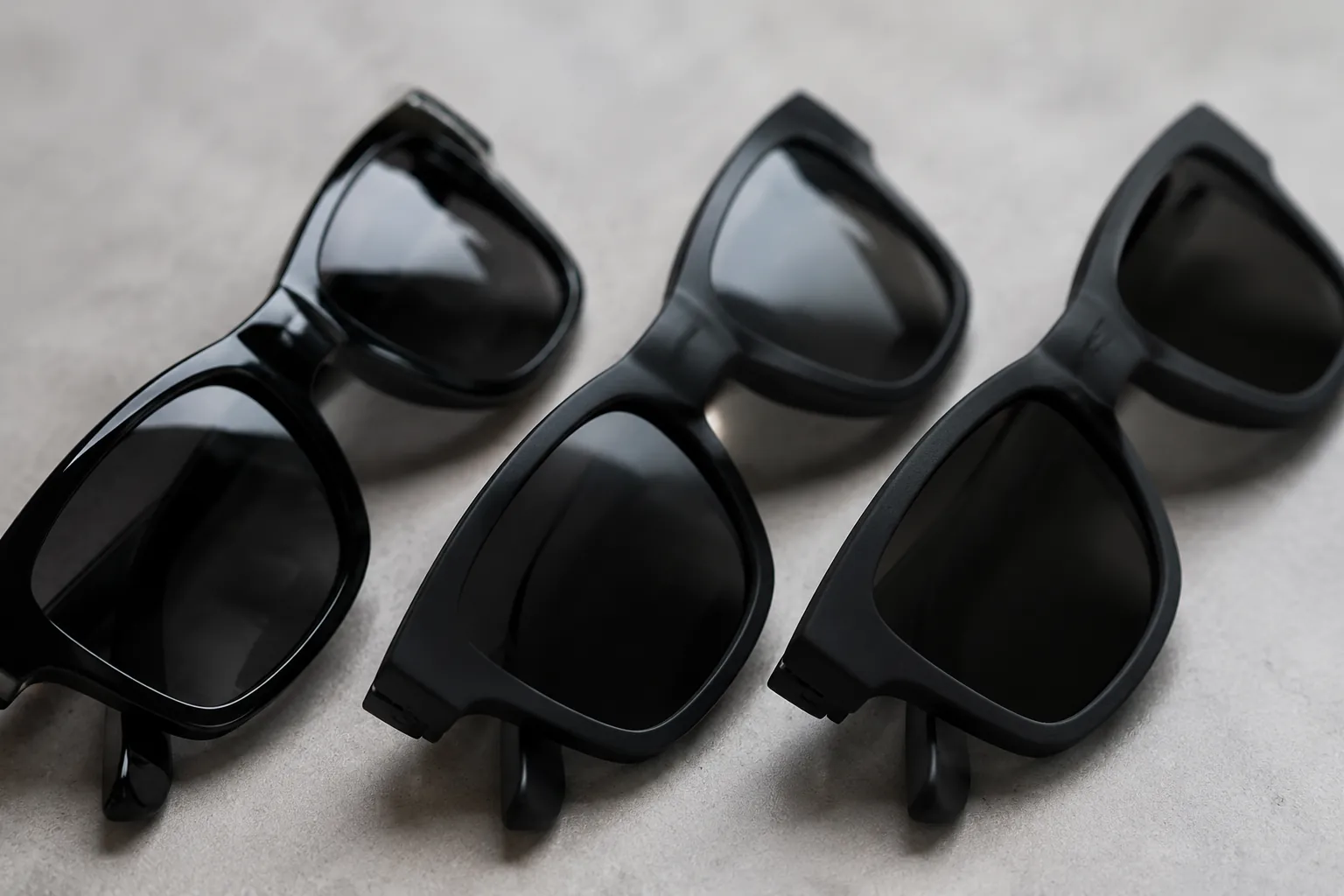
This guide is for buyers sourcing plastic sunglasses at volume and deciding which frame finish fits the sales channel and use conditions. It compares glossy, matte, rubberized, and soft-touch finishes in practical terms: how each is made, how it feels, how it wears, how it shifts color appearance, and what it changes in sampling, QC, and reorder consistency. This is not a style piece. It is a buying and approval guide. The goal is simple: choose the finish earlier, set workable approval standards, and avoid preventable disputes. The article also links finish choice to standard eyewear production steps such as injection molding, acetate machining, polishing, spray coating, decoration, assembly, and final inspection.
Start with the channel, not the color chip
Buyers often pick finish from a moodboard first. That is usually backward.
Start with the sales channel, expected handling level, cleaning environment, and reorder requirements. Then choose the finish.
A high-gloss black frame can read premium in optical or fashion retail because reflected light adds depth and sharpens edges. Put that same frame in a beach, travel, or festival setting and fingerprints and hairline scratches show fast. Rubberized and soft-touch surfaces can feel better on first contact, but they usually need more testing in channels exposed to sunscreen, sweat, makeup, or alcohol wipes.
For B2B programs, finish should match real use:
- Optical, boutique, premium private label: polished gloss is often the lowest-risk option. It presents cleanly, supports sharp decoration, and wipes down easily during repeated customer handling.
- Sports, outdoor, travel retail: molded matte textures are usually safer than sprayed tactile coatings. They hide handling marks better and do not depend on coating adhesion.
- Fashion gifting and limited drops: soft-touch or rubberized can work if tactile feel is central to the concept. Add rub testing and pouch-abrasion checks to approval.
- Promotional and repeat-order programs: simple gloss or molded matte is usually easier to control across batches because there are fewer finishing variables.
In the first sample round, review the finish under normal use conditions, not just under showroom lighting. Handle the frame with clean hands and after applying lotion or sunscreen. Open and close the temples repeatedly. Put the sample into the intended pouch and remove it several times. Wipe it with microfiber. Wash it with mild soap and water if that matches the care instruction. Nice samples are easy to approve. Stable production is harder.
How each finish is made, and why that matters
These finishes do not come from the same type of process. Some are created by the base material, mold texture, or polish level. Others depend on a coating layer, curing profile, and adhesion. That difference drives wear pattern, color consistency, rework options, and inspection standards.
| Finish type | Typical process | Common base materials | Main process controls | Main risk point |
|---|---|---|---|---|
| Glossy | Polished mold surface, tumbling/buffing/hand polishing, sometimes clear topcoat | Acetate, TR90, PC, CP | Mold polish level, cooling stability, buffing consistency | Shows scratches and fingerprints quickly |
| Matte | Mold texture, bead-blast texture, or low-gloss topcoat | Injected plastics, acetate with surface treatment | Texture uniformity, mold maintenance, sheen control | Shiny burnished spots from rubbing |
| Rubberized | Spray-applied tactile coating over molded frame | PC, CP, TR90 blends, other injected plastics | Surface prep, spray thickness, flash-off, oven curing, adhesion test | Oil pickup, edge wear, coating rub-through |
| Soft-touch | Fine spray coating with velvety hand feel | Injected plastics, some metal-plastic combinations | Coating viscosity, dust control, cure profile, handling after cure | Can become shiny, sticky, or inconsistent between lots |
Gloss on acetate usually comes from several finishing steps: sanding after cutting or CNC machining, tumbling, buffing with compound, and final hand polishing. On injection-molded frames, gloss is often set mainly by the mold surface. A well-polished mold cavity usually gives more stable gloss than trying to add shine later with an extra layer.
Matte is generally more stable when it is built into the mold or base surface. Molded matte avoids the risk of a separate layer wearing through. Sprayed matte topcoats can still be useful, but they add another process variable and can create visible sheen differences if coverage is uneven.
Rubberized and soft-touch finishes are coating systems. Full stop. Common failure points include poor cleaning before spray, uneven thickness at corners and hinge areas, incomplete flash-off before curing, and handling parts before full cure. Decoration, hinge assembly, tray contact, and packaging can all damage the coating after application.
For buyers, the key question is simple: does the finish come from the substrate, the mold, the polishing process, or a separate coating layer? That answer usually tells you more about likely wear than a sample photo does.
Feel, visual read, and decoration fit
Finish shapes perceived quality before the customer checks lens category, hinge tension, or fit.
Glossy feels hard, smooth, and dense. It gives the strongest apparent color depth. Black looks deeper, crystal colors look cleaner, and tortoise acetate usually shows more contrast because light reflects cleanly off the polished surface.
Matte cuts reflection and can make shape lines look more technical or understated. It may flatten bright colors slightly, but that can help on sporty, commercial, or unisex styles. Matte also hides minor surface waviness better than high gloss.
Rubberized feels warmer and grippier than gloss or matte plastic. It can improve first-touch perception on simple injected frames that might otherwise feel cheap. But if the coating builds too heavily at edges, the frame can lose crispness.
Soft-touch is usually finer and less grippy than standard rubberized coating. The feel is more velvety than tactile. On some concepts that reads as premium. On others it reads as fragile.
Decoration performance changes by surface:
- Pad printing: usually performs best on smooth gloss. On textured matte, very fine lines may not print cleanly because the ink bridges the surface texture.
- Laser engraving: can work well on matte and coated surfaces, but mark quality depends on coating thickness, base color, and contrast.
- Hot foil: generally works best on smooth, flat areas and is less reliable on strong texture.
- Metal logo plates: broadly compatible, but recess dimensions, edge finish, and adhesive performance need closer review on coated tactile finishes.
If your branding includes very small text, serial-style side markings, or metallic decoration with tight detail, gloss is usually the easiest finish to execute consistently.
Scratch visibility, wear pattern, and return risk
Many finish decisions fail for one reason: the sample is judged only when new.
Gloss scratches visibly because reflected light catches even light abrasion. The upside is that the wear pattern is familiar and easy to explain. On polished acetate, light surface marks may sometimes be improved by factory repolishing, depending on construction and decoration. On coated gloss systems, rework is more limited.
Matte usually hides fine scratches better, especially when the texture is molded into the part. The common problem is burnishing. Repeated rubbing at temple tips, bridge contact points, brow corners, and folded-temple contact zones can create localized shiny areas. The frame may still be structurally fine. The appearance is what changes.
Rubberized and soft-touch surfaces often hide early scratches, but they can fail more clearly once the coating starts to wear. Typical weak points are hinge shoulders, top temple edges, sharp corners, bridge sidewalls, and areas that touch trays, pouches, or assembly fixtures. If the coating thins there, the contrast between the top layer and substrate becomes obvious.
A practical factory QC checklist should include:
- Cross-hatch adhesion test on coated parts.
- Dry-rub and wet-rub checks after full cure, not immediately after spraying.
- Visual gloss or sheen check under a fixed light source and angle.
- Temple fold test to confirm no contact marking between front and temple.
- Pouch insertion test and packed vibration check before shipment release.
For repeat-order programs, the lowest-risk options are usually polished gloss, gloss injection, or molded matte. Tactile coatings can still make sense. They just need tighter process control and clearer acceptance standards.
Color stability, contamination, and cleaning
Finish changes both shelf appearance and day-to-day behavior.
Gloss usually preserves apparent color saturation best. It makes black, dark green, navy, and tortoise look richer. The trade-off is obvious: fingerprints, dust, and skin oil show immediately. Cleaning is usually simple with microfiber and mild soap. That is one reason gloss remains common in optical and fashion channels.
Matte reduces glare and usually hides fingerprints better. On light colors it often looks cleaner for longer. On dark colors, repeated rubbing can create localized sheen change that looks like fading even when the pigment itself has not changed.
Rubberized and soft-touch finishes are usually the most sensitive to contamination. Sunscreen, makeup, lotion, hair products, and strong alcohol cleaners can leave shiny patches or change the hand feel. Light colors show this quickly. Dark colors may hide dirt better, but they can still develop an oily sheen.
Lot-to-lot consistency also matters. Gloss and molded matte are usually easier to match because the visible result depends mainly on resin color, mold condition, and stable polishing. Coated tactile finishes add coating thickness and cure condition as extra variables, which can affect both color and touch.
Keep care instructions short and realistic:
- Use mild soap and water, then dry with a soft cloth.
- Avoid acetone, strong solvents, and aggressive alcohol use on tactile coatings.
- Do not store frames loose against rough zippers, metal hardware, or abrasive cartons.
- For beach, outdoor, or travel retail, test sunscreen contact before bulk approval.
If in-store try-on will be heavy, review packing details carefully. Separator tissue, individual bags, and pouch material can materially affect finish survival during shipment and retail handling.
Cost, lead time, and sourcing risk
Finish affects cost through labor, reject risk, handling complexity, and approval workload, not just raw material input.
| Finish | Relative cost impact | Lead-time impact | Typical scrap risk | Best order profile |
|---|---|---|---|---|
| Glossy | Low to moderate | Usually base lead time | Low to moderate | Optical, core fashion, repeat-order programs |
| Matte molded texture | Low to moderate | Usually base lead time once tooling is set | Low | Sports, promo, everyday retail |
| Rubberized coating | Moderate | Adds coating and curing steps | Moderate to high | Short-run fashion, tactile retail concepts |
| Soft-touch coating | Moderate to high | Adds coating time and tighter QC | Moderate to high | Premium tactile concepts with controlled packaging |
Avoid fixed assumptions such as a standard surcharge or universal extra lead time. Actual impact depends on frame geometry, color, decoration, coating-line capacity, and rework rate. The safer rule is straightforward: gloss and molded matte are usually simpler to control; tactile coatings usually add more approval variables.
When requesting quotations, ask suppliers to separate these items in writing: base frame process, finish process, decoration method, packing method, and any extra inspection standard for coated parts. That makes cost comparisons cleaner and helps explain price gaps between suppliers.
If the finish is central to the concept, leave time for at least one physical approval round. For coated finishes, review more than the first sample. Check whether the supplier can maintain the same touch, sheen, and logo result on a second sample or pilot run.
One practical sourcing rule: use rubberized or soft-touch only where tactile differentiation clearly supports the brand concept or channel. Applying them across a full collection increases quality-management complexity fast.
PO checks and a simple finish decision framework
If you need to narrow options quickly, use this filter:
- Pick glossy if you want maximum color depth, easy cleaning, clean logo execution, and simpler reorder control. Accept visible fingerprints and scratches.
- Pick molded matte if you want lower scratch visibility, practical daily wear, and simpler maintenance. Accept the possibility of shiny wear zones over time.
- Pick rubberized if first-touch feel is part of the sell and the channel is not heavily exposed to sunscreen, cosmetics, or aggressive cleaners. Accept stricter care needs and greater process sensitivity.
- Pick soft-touch if you want a refined tactile surface and can control packaging, storage, and handling conditions. Accept a narrower consistency window.
Before releasing the PO, verify these five points:
- Base material and finish method: confirm whether the frame is acetate, PC, CP, TR90, or another material, and whether the finish comes from polish, mold texture, or coating.
- Decoration compatibility: confirm the branding method, minimum readable detail, and any adhesion or durability limit for that surface.
- Packing method: review pouch material, inner bag or tissue use, and whether folded temples can mark the frame front during transit.
- Care instruction: especially for tactile coatings or dark matte colors sold into warm, cosmetic-heavy, or outdoor channels.
- Compliance and factory documentation: align lens and finished-product testing with the destination market and request only the documents that apply, such as CE EN ISO 12312-1, ANSI Z80.3, AS/NZS 1067, REACH, FDA registration where required, plus factory-management records such as ISO 9001 or BSCI if those are part of your vendor qualification process.
Finish does not replace compliance. It is a product and merchandising choice. Lens performance, chemical control, labeling, and market documentation still need separate review.
What to approve in the sample, not just in the artwork
Many finish problems can be reduced at sample stage. Do not approve by photo alone, especially for matte, rubberized, or soft-touch finishes.
Ask for the same frame design in at least two finishes, ideally in one dark color such as black, dark green, or deep olive. Dark colors usually reveal edge behavior, logo contrast, sheen inconsistency, and wipe marks more clearly than pale colors.
During sample review, check these points under daylight and standard retail lighting:
- Uniformity of sheen across front, bridge, temples, and temple interior.
- Any coating build-up on edges or thin spots around hinge shoulders.
- How quickly fingerprints show after repeated handling.
- Whether folding the temples leaves contact marks on the front.
- How the frame looks after microfiber wiping and mild-soap cleaning.
- Any residual coating odor after the frame has been packed for 24 hours.
For bulk approval, ask the factory to retain a signed approval sample and define acceptable variation clearly. This matters more on matte and tactile finishes than on standard gloss. If decoration is included, confirm process order. Laser after coating can create a different edge effect than laser before coating, and pad printing on a textured or low-energy surface may require artwork adjustment or added process control.
The practical takeaway is simple. Choose finish by channel reality, not swatch appeal. If your priority is lower sourcing risk, stay with gloss or molded matte. If your priority is tactile differentiation, tighten sample testing and written QC standards before PO release.
Have a custom sunglasses project in mind?
Send us your styles, target market and quantities and we will return a detailed quote with MOQ, lead time and a sample plan.
Get a QuoteWhy source this from Wenzhou with LumiShades
Wenzhou in Zhejiang Province is widely regarded as China’s eyewear manufacturing capital, producing a large share of the world’s sunglasses. That concentration matters to buyers: a deep local supply chain for acetate sheet, hinges, lens blanks, plating and packaging means shorter component lead times, easier color and material matching, and a workforce with decades of eyewear-specific skill. LumiShades has manufactured in this ecosystem since 2009, and our vertical integration — in-house injection molding, acetate cutting, CNC milling, lens tinting, decoration and quality control — means no part of your order is quietly subcontracted to a workshop you cannot audit.
For international buyers, that vertical control translates into accountability. When a single factory owns every step, defects are traced and fixed at source rather than bounced between vendors, and your specifications survive intact from first sample to bulk. We back this with 15+ years of experience, shipments to 60+ countries, more than 5 million pairs produced per year and a 98.5% on-time delivery rate. Our certifications — CE EN ISO 12312-1, FDA registration, ANSI Z80.3, AS/NZS 1067, REACH, ISO 9001 and BSCI audit — mean the compliance documentation your market requires already exists. Explore our manufacturing capabilities and quality control process to see how this works in practice.
Frequently asked questions
Which finish is safest for a first private-label order? Usually glossy or molded matte. Both are generally easier to match on repeat production, easier to clean, and less sensitive to coating-related variation than rubberized or soft-touch finishes. For a first order, ask the supplier to confirm whether the appearance comes from mold texture, polishing, or a coating layer, then review a physical sample under normal handling conditions before approval.
Do rubberized and soft-touch finishes fail more often in hot markets? Heat can contribute, but it is rarely the only factor. The bigger risk is combined exposure to skin oil, sunscreen, makeup, sweat, friction, and strong cleaners. If the product is intended for warm-weather, beach, travel, or festival use, ask for specific rub, pouch-abrasion, and sunscreen-contact checks on the approved sample or pilot lot.
Can matte frames be made without spray coating? Yes. Many injected frames use mold texture to create matte directly in the part, and that is often more stable than adding a matte topcoat later. When sourcing matte, ask the supplier directly whether the finish is molded, blasted, polished down, or sprayed. That answer matters because each method wears differently and has different rework options.
Does frame finish affect compliance with CE EN ISO 12312-1 or ANSI Z80.3? Not in the same way as lens category, UV performance, transmittance, or mechanical requirements. Those standards focus mainly on sunglass safety and performance. Finish materials can still matter for chemical-control review and buyer approval. If you are importing into markets that require specific documentation, confirm the applicable sunglass standard, ask for REACH information where relevant, and verify whether FDA registration is needed for your market-entry process.
What is the most practical sampling plan for comparing finishes? Use one frame design and one dark color across all finish options. A practical comparison set is gloss black, molded matte black, and one tactile option such as soft-touch black. Review them side by side for touch, sheen consistency, fingerprint visibility, logo clarity, pouch abrasion, and temple-to-front contact marks. If a tactile finish is shortlisted, request a second confirmation sample or pilot run before releasing bulk production.
Will soft-touch always cost much more? Not always, but it usually costs more than standard gloss or molded matte because it adds coating, curing, handling, and inspection steps. The real buyer question is not only surcharge but process risk. Ask the supplier to state separately whether the extra cost comes from coating labor, lower yield, added packing protection, or tighter QC. That makes quotations easier to compare and helps you judge whether the tactile effect is worth the added complexity.
Ready to start?
Explore our shield & oversized sunglasses or request a quote — our sales team replies within 12 hours.
Request a Quote