
PC vs TR90 Sunglass Frames for Bulk Orders
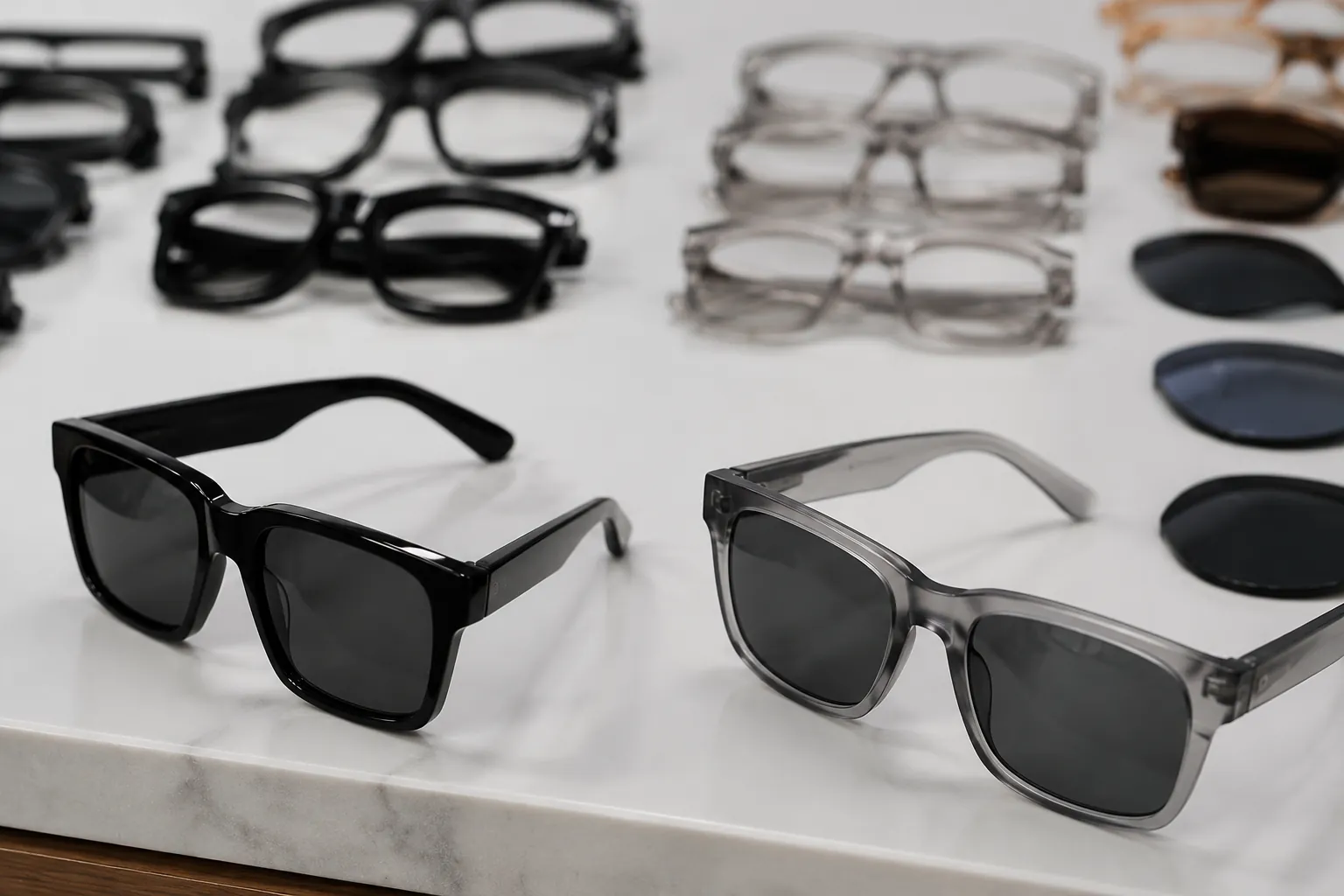
This guide is for overseas brands, importers, distributors, promotional buyers, and retailers choosing frame materials for volume sunglass programs. Injected polycarbonate (PC) and TR90 can both work in commercial orders. They do not behave the same. The differences show up in tooling, molding, assembly, decoration, comfort, and cost control. Choose the material before tooling. Write a tighter RFQ. Do not wait for a bulk order to reveal a problem the sample stage should have caught.
Fast Choice: PC for Cost, TR90 for Comfort
If the program is price-led, promotional, or based on bold molded shapes, injected PC is often the first material to quote. It can hold clean details, support many colors, and work well for simple high-volume frames when the design, hinge, lens, and decoration requirements are controlled.
But PC is not automatically the cheapest finished product. Lens type, hinge construction, logo method, packaging, inspection level, and order quantity can change the unit cost more than the resin choice.
TR90 is usually the stronger option when the buyer cares most about lightweight feel, flex recovery, and longer-wear comfort. It is a nylon-family injection material used often for sport, kids, outdoor, and active-lifestyle frames. It normally costs more than basic injected PC because of resin cost, processing needs, and tighter control. The payoff is comfort. A good TR90 frame feels less stiff on the head than many low-cost PC frames.
Practical rule: if the end user mainly judges the product by price, shape, and logo visibility, PC may be enough. If the sunglasses will be worn for hours, compare TR90 against the same lens, hinge, and decoration specification.
How the Material Feels in the Finished Frame
PC and TR90 can look similar on a quotation sheet. Both can be injection molded. In the finished frame, they are not the same.
PC is rigid, impact resistant, and good for defined lines, thicker fronts, fashion shapes, and promotional styles where visual sharpness matters. The tradeoff is feel. A PC temple with limited flex can press against the side of the head, especially on wider head sizes, aggressive wrap frames, or designs with narrow temple openings.
TR90 is lighter and more elastic than standard rigid frame plastics. A well-designed TR90 temple can open wider and recover better. That matters in export programs because the final wearer may never try the sample before purchase.
TR90 is not a shortcut to quality. Thin hinge areas can still deform. Poor gate placement can create weak flow or weld-line areas. Uneven wall thickness can cause twist after cooling. Still, for comfort-led products, TR90 has a clear material advantage when engineered and molded correctly.
| Buyer concern | Injected PC | TR90 |
|---|---|---|
| Typical feel | Firm, solid, and sometimes stiff at the temples | Light, flexible, and more forgiving on wider heads |
| Best commercial use | Fashion, promotional, private-label retail, giveaways | Sport, kids, outdoor, active, long-wear ranges |
| Shape detail | Strong for crisp molded lines, thick fronts, and logo zones | Good, but flow, shrinkage, and wall thickness need close control |
| Fit risk | Temple pressure if curve, opening, or temple geometry is wrong | Lower pressure risk, but possible twisting if structure is weak |
| Cost behavior | Often lower for simple high-volume programs | Usually higher, with a stronger comfort and performance story |
Molding Risk: Drying, Flow, Shrinkage, First Shots
For PC frames, the factory should control cycle stability, shrinkage, surface finish, color consistency, hinge alignment, and lens groove accuracy after demolding. Common defects include flow marks, sink marks near thick logo zones, flash around parting lines, inconsistent gloss, and lens groove distortion.
These are not just technical defects. They are commercial defects. A sink mark beside a metal logo plate can make a frame look cheap. So can an uneven gloss patch on a matte finish.
TR90 needs disciplined resin handling and process control. Drying matters. Excess moisture can contribute to streaks, bubbles, weak areas, and inconsistent surface or mechanical performance. The design team also needs to review wall thickness, gate position, cooling balance, hinge-seat strength, temple symmetry, and lens groove stability.
A temple can look fine in CAD and still twist after cooling. One thick section or a poor flow path can be enough.
- Confirm 2D drawings with target dimensions before mold work.
- Review 3D structure for wall thickness, gate location, hinge seat, lens groove, nose bridge, and stress points.
- Confirm whether the project needs existing tooling, modified tooling, prototype tooling, or full production tooling.
- Run first-shot samples and check shrinkage, color, surface finish, lens fit, hinge fit, and assembly fit.
- Adjust mold steel, process settings, or frame geometry before approval samples.
- Lock the approved resin, color masterbatch, hinge, lens, and decoration method before bulk production.
Ask who controls molding, lens fitting, decoration, assembly, and final inspection. A supplier that coordinates these steps directly can usually solve fit and decoration issues faster than a supply chain split across unrelated subcontractors. The RFQ still needs clear acceptance criteria.
Tolerance and Fit Details to Put in the RFQ
Most bulk frame failures do not come from the material name alone. They come from vague specifications.
A buyer approves a good-looking sample, then leaves hinge screws, lens retention, frame curve, temple opening, and screw torque undefined. The shipment may pass a basic visual inspection and still create returns. Lenses rattle. Temples feel tight. Screws loosen after repeated opening.
For molded PC and TR90 sunglasses, critical dimensions need agreed tolerances before production. A practical tolerance such as +/-0.3 mm may be reasonable for some molded frame dimensions, but the right tolerance depends on the part, tool condition, measurement method, and function.
Lens groove fit needs special attention. If the groove is too tight, the frame may stress the lens, distort polarized film, or make assembly inconsistent. If it is too loose, the lens may rattle or pop out during handling or drop checks. Temple opening angle, front width, bridge width, temple length, pantoscopic tilt, and base curve should all be checked against the approved sample.
- Lens groove: specify lens thickness, lens material, groove depth, retention requirement, and whether lenses are PC, TAC, nylon, or another material.
- Hinge: confirm hinge type, screw diameter, opening angle, screw-retention requirement, and whether spring hinges are required.
- Temple force: request a wear-fit check across relevant head widths, not only a flat table inspection.
- Frame curve: define base curve and wrap level, especially for sport, outdoor, or active sunglasses.
- Decoration area: reserve stable surfaces for pad printing, laser engraving, heat transfer, metal logo plates, or other branding methods.
- Color approval: approve production color under consistent light with a physical sample or approved color standard, not only phone photos.
Decoration Methods and Material Effects
Decoration is where many simple quotes become complicated products. A plain black PC frame with one-color pad printing is not the same product as a TR90 sport frame with two-color temple printing, rubberized tips, a metal logo badge, polarized lenses, and a hard case.
Specify decoration early. It can affect mold design, surface preparation, inspection time, and reject rate.
Common methods include pad printing for small logos, silk printing for larger simple graphics, laser engraving for permanent marks on suitable surfaces, heat transfer for more complex patterns, and metal logo plates for a higher retail look. PC usually supports crisp molded logo zones and many surface finishes well. TR90 can also be decorated, but adhesion and surface preparation need more attention, especially on flexible temple areas where bending can stress printed or bonded decoration.
| Decoration method | Best use | Process risk to confirm |
|---|---|---|
| Pad printing | Small temple logos, promotional marks, simple branding | Ink adhesion, position tolerance, abrasion resistance |
| Laser engraving | Permanent marks, subtle retail branding | Contrast on chosen color, surface burn, logo clarity |
| Metal logo plate | Premium private-label frames | Recess fit, glue strength, plating compliance, sink marks nearby |
| Rubberized temple tip | Sport and comfort programs | Bonding strength, color migration, added assembly tolerance |
For bulk orders, request an abrasion check on decorated areas. Focus on temple zones that rub packaging sleeves and logo areas near the hinge. The approved sample should use the real production decoration method, ink, coating, adhesive, and logo placement.
Cost, MOQ, and Price-Break Logic
Material choice is only one line in the quotation. Tooling complexity, lens category, hinge type, color count, logo method, packaging, inspection level, compliance documents, and order quantity all affect the final price.
Compare like with like. A simple PC frame with smoke lenses and one-color pad printing should not be compared with a TR90 sport frame using polarized TAC lenses, spring hinges, rubberized tips, metal plates, and a hard case.
If a supplier offers low-MOQ custom work, use that stage for sampling, market tests, pilot runs, or small launches. Do not treat it as proof of bulk pricing. Low-volume orders spread setup time, resin preparation, color change, machine scheduling, decoration setup, and QC paperwork across fewer units.
As quantity increases, material purchasing, machine use, decoration setup, and line planning usually improve. The exact price break should be quoted against the finished specification, not against the material name alone.
| Order stage | Typical use | PC cost logic | TR90 cost logic |
|---|---|---|---|
| Low-volume sample or pilot run | Sampling, market test, small launch | Useful for validation, but setup cost weighs heavily | Useful for comfort testing, with a higher setup burden |
| Small commercial order | Retail test order or distributor trial | Better machine and decoration efficiency than sampling | Viable when comfort or performance supports the price |
| Volume order | Importer, retail chain, or seasonal program | Often strong price-performance if the design is controlled | More reasonable when resin purchasing and line planning are stable |
| Large repeat program | Ongoing replenishment or multi-market rollout | Best suited to stable specs, locked colors, and simple decoration | Premium remains, but consistency and planning usually improve |
Lead Time Planning and Approval Gates
Lead time depends on the actual scope. Existing molds, new molds, color development, lens sourcing, decoration trials, packaging, and compliance testing can all change the calendar.
A sample timeline means little until the supplier knows the frame material, lens type, color target, logo method, packaging, and destination market. Bulk production should not begin until the buyer approves an assembled and decorated sample made with production materials.
PC programs are often easier to schedule because many factories process PC frame styles frequently. TR90 can still suit bulk programs, but it needs earlier confirmation of resin color, frame geometry, drying requirements, and fit testing.
For sport or kids frames, allow time for wear-fit checks, lens retention checks, hinge opening checks, and review of market-specific safety or labeling requirements. Do not approve only the front view. Open the temples. Twist them lightly. Fit the lenses. Check screw movement. Inspect the logo. Wear the sample.
A practical production calendar should include approval gates for material and color, first-shot frame, assembled sample, decorated sample, pre-production sample, inline inspection, and final inspection. Define who approves each gate, what evidence is required, and what happens if the sample fails a functional or cosmetic check.
Compliance and RFQ Framework for Bulk Buyers
Neither PC nor TR90 makes a sunglass compliant by itself. Compliance depends on the finished product: lens category, UV performance, optical quality, impact behavior, labeling, chemical restrictions, and destination-market documents.
For Europe, CE marking is supported by conformity to applicable requirements, commonly including EN ISO 12312-1 for sunglasses. For the United States, buyers often request FDA registration where applicable and alignment with ANSI Z80.3. For Australia and New Zealand, AS/NZS 1067 applies. REACH matters for chemical compliance in EU supply chains.
Frame material can still affect compliance risk indirectly. Paint, coating, printed logos, rubber parts, metal logo plates, nose pads, temple tips, adhesives, and colorants can introduce restricted substances. Request material declarations and test reports that match the actual production materials and colorways. A report for a similar old frame is not enough.
ISO 9001 and BSCI can be useful factory-system references, but they do not replace product testing or destination-market compliance review.
Your RFQ should not say only "custom sunglasses, black frame, polarized lens." Send target quantity, destination market, lens type, frame material preference, hinge type, logo method, packaging, compliance market, test-report requirement, and target delivery date.
If you are unsure between PC and TR90, ask for both quotes against the same design, lens, hinge, decoration, packaging, and inspection standard. Otherwise, the comparison is not clean. For new tooling or unfamiliar specifications, request a pilot run before full release. It can expose color drift, hinge loosening, lens stress, decoration abrasion, and packing damage before a larger order is committed.
The supplier can control molding, assembly, and inspection only when the buyer provides complete specifications and holds approvals tightly. The buyer should control the brief, confirm the compliance route, and keep signed samples and test requirements aligned with the final production order.
Have a custom sunglasses project in mind?
Send us your styles, target market and quantities and we will return a detailed quote with MOQ, lead time and a sample plan.
Get a QuoteWhy source this from Wenzhou with LumiShades
Wenzhou in Zhejiang Province is widely regarded as China’s eyewear manufacturing capital, producing a large share of the world’s sunglasses. That concentration matters to buyers: a deep local supply chain for acetate sheet, hinges, lens blanks, plating and packaging means shorter component lead times, easier color and material matching, and a workforce with decades of eyewear-specific skill. LumiShades has manufactured in this ecosystem since 2009, and our vertical integration — in-house injection molding, acetate cutting, CNC milling, lens tinting, decoration and quality control — means no part of your order is quietly subcontracted to a workshop you cannot audit.
For international buyers, that vertical control translates into accountability. When a single factory owns every step, defects are traced and fixed at source rather than bounced between vendors, and your specifications survive intact from first sample to bulk. We back this with 15+ years of experience, shipments to 60+ countries, more than 5 million pairs produced per year and a 98.5% on-time delivery rate. Our certifications — CE EN ISO 12312-1, FDA registration, ANSI Z80.3, AS/NZS 1067, REACH, ISO 9001 and BSCI audit — mean the compliance documentation your market requires already exists. Explore our manufacturing capabilities and quality control process to see how this works in practice.
Frequently asked questions
Is TR90 always better than injected PC for sunglasses? No. TR90 is usually lighter and more flexible, so it often suits sport, kids, outdoor, and long-wear frames. PC can be better for price-led programs, crisp molded shapes, promotional sunglasses, and simple retail frames. Compare both materials using the same lens, hinge, decoration, packaging, and compliance requirements.
Can I order a low MOQ for a custom frame? Possibly. It depends on the supplier, tooling situation, color, decoration, and lens specification. Use a low-MOQ order for samples, pilot runs, market tests, or small launches. Do not expect bulk pricing at pilot quantity because setup, color change, molding, decoration, inspection, and paperwork are spread across fewer pairs.
How long should I allow for samples and bulk production? Ask the supplier to quote lead time from your actual specification. Existing molds and simple decoration are faster than new tooling, special colors, polarized lenses, custom packaging, or compliance testing. Do not start the bulk-production clock until the assembled and decorated pre-production sample, artwork, packaging, payment terms, and compliance requirements are approved in writing.
Which material is safer for kids or sport sunglasses? TR90 is often preferred because it is lighter and more flexible, but safety depends on the complete product. Check lens retention, hinge strength, frame fit, sharp edges, lens category, UV performance, labeling, and destination-market testing. Relevant standards may include CE EN ISO 12312-1, ANSI Z80.3, AS/NZS 1067, and REACH chemical requirements depending on the market.
Can the same mold run both PC and TR90? Do not assume so. PC and TR90 differ in shrinkage, flow behavior, drying requirements, gate design, cooling behavior, and processing conditions. Ask the factory to confirm mold suitability before quoting both materials on one tool, and require first-shot samples in the actual production material before approval.
What should I check before approving production samples? Check frame measurements, lens fit, hinge tension, temple opening, screw behavior, surface defects, logo position, decoration adhesion, color under consistent light, packaging fit, labeling, and compliance documents for the destination market. Keep an approved physical sample and use it as the reference for bulk inspection.
Ready to start?
Explore our square sunglasses or request a quote — our sales team replies within 12 hours.
Request a Quote