
PC Injection Sunglasses Frames: Buyer Guide
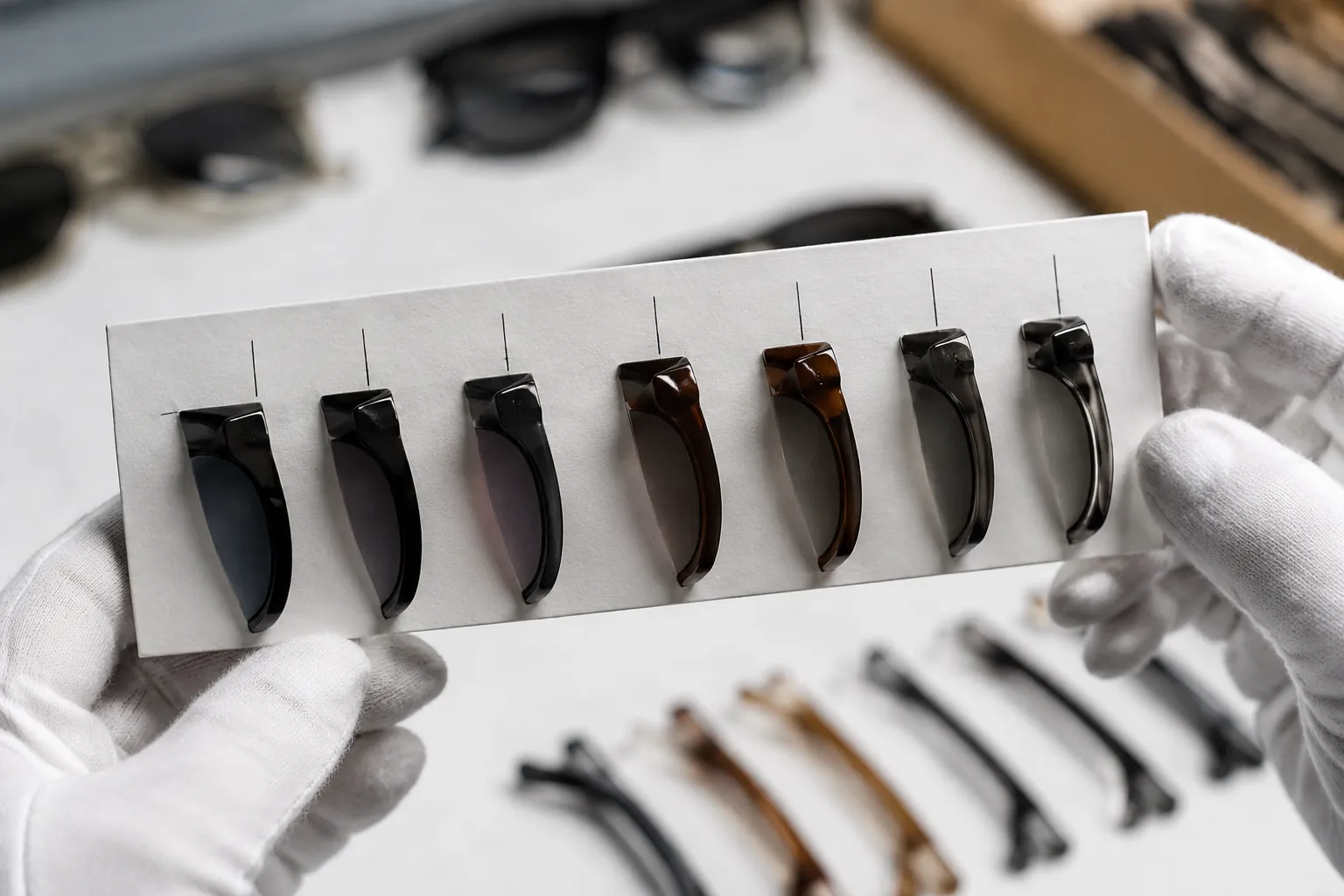
This guide is for buyers sourcing promotional, retail, kids, event, or entry-price sunglasses who need to decide whether polycarbonate injection frames fit the program. It explains where PC frames work well, where they cause complaints, and how mold choice, wall thickness, decoration, lens specification, MOQ, tolerances, packing, and compliance affect cost and lead time. Use it to write a clearer supplier brief, compare quotes on equal terms, and avoid sample revisions that should have been caught earlier.
Start with the buying decision, not the resin name
PC injection frames are usually chosen for three reasons: efficient unit cost at volume, good impact resistance compared with many brittle commodity plastics, and repeatable output once the mold, resin, color, and process settings are controlled. That makes PC practical for promotional sunglasses, kids' eyewear, event merchandise, sports-inspired entry retail, and distributor programs where the frame must survive handling at a controlled price.
The resin does not make the product good by itself. A PC frame still needs suitable wall thickness, controlled shrinkage, stable lens groove geometry, clean gate trimming, and decoration that suits the surface finish. Many injection sunglass frames use wall sections in the low-millimeter range, with thicker areas around hinges, bridges, and other stress points. Confirm the actual wall thickness by drawing and sample measurement. Frame size, lens curve, hinge type, and mold design all change what is workable.
PC is not the answer for every brief. If the brand needs a heavy luxury feel, laminated acetate color depth, hand-polished edges, exposed core-wire detail, or small-batch sculptural shapes, PC will limit the result. The real sourcing question is simple: does the material, mold, lens, decoration, packing, and order quantity match the sales channel and the buyer's expectations?
At LumiShades, PC programs can start from 50 pairs per design. That helps with early sampling, limited colorway tests, and small promotional runs. Unit economics still improve as quantity rises because setup time, fixture preparation, material loss, decoration setup, packing labor, and QC time are spread across more units.
Where PC injection frames fit best
| Program type | Why PC fits | Main risk | Buyer note |
|---|---|---|---|
| Promotional sunglasses | Controlled frame cost, broad color options, repeatable runs after mold approval | Cheap-looking finish if color, texture, or logo method is poorly chosen | Use simple shapes, solid colors, standard lenses, and one decoration method where possible |
| Kids' sunglasses | Light weight and good impact resistance for active handling | Poor fit if adult bridge and temple geometry are simply scaled down | Review age band, bridge width, temple length, pinch points, and applicable children's product requirements |
| Entry retail chains | Predictable repeatability and replenishment when specifications are controlled | Margin loss if too many colorways, coatings, lens options, and logo positions are added | Standardize lens base curve, hinge type, packaging format, and labeling rules across SKUs |
| Sports-inspired fashion | Works for wrap, shield-inspired, or lightweight casual styles when tooling is accurate | Warping, temple spread variation, or lens stress on aggressive curves | Check front curvature, lens retention, and temple opening angle on physical samples |
| Premium fashion collections | Can work for selected casual, active, or price-accessible styles | Material feel may not support premium pricing | Compare against acetate, TR90, metal, or hybrid construction before approval |
The fit is clear. PC works best where durability, weight, color flexibility, repeatability, and price control matter more than luxury hand-feel. It is especially useful for repeat-order programs because an approved mold can run again with controlled color and decoration changes, subject to resin availability and production scheduling.
PC works less well for thick sculptural fronts, deep transparent color, visible laminated layers, or high-gloss luxury finishing. It can be molded in solid, translucent, matte, and bright promotional shades. It does not replace acetate when the buyer expects layered color, polished depth, and a heavier frame feel.
How the frame is made
A PC injection frame is not just plastic pressed into shape. Each step affects appearance, fit, rejection rate, compliance preparation, and lead time. Buyers who understand the process ask better questions. They are also less likely to approve a sample that cannot be repeated reliably in bulk.
- Design freeze: Confirm the front, temples, hinge area, wall thickness, lens groove, bridge geometry, temple opening angle, logo area, and packing method. Small changes in lens groove, bridge width, or hinge position can affect assembly and fit.
- Mold strategy: Existing house molds reduce tooling cost and sample time, but they limit shape control. New tooling gives more control over size, curve, logo recess, hinge detail, and brand-specific geometry, but it adds cost, engineering review, and mold-trial time.
- Resin drying: Polycarbonate is hygroscopic and must be dried before molding according to the resin supplier's processing guidance. Poor drying can cause visible streaking, bubbles, splay, brittleness, or unstable dimensions.
- Injection molding: Melt temperature, pressure, gate design, cooling time, and mold temperature affect shrinkage, warpage, surface quality, and dimensional repeatability. PC shrinkage is generally lower than some other common plastics, but the part still needs process control to hold the lens groove and hinge alignment.
- Trimming and deburring: Gate marks, parting lines, and flash are cleaned. Weak cleanup is visible on temple tips, lens rims, bridge edges, and areas near the hinge.
- Decoration: Pad printing, silk screen printing, laser marking, hot stamping, in-mold color, coatings, and applied logo parts may be used depending on the design. Each method has different setup cost, durability, adhesion risk, and inspection requirements.
- Lens fitting and assembly: Lens size, lens thickness, base curve, groove depth, and frame flexibility must match. Over-tight fitting can stress the lens or frame. Loose fitting can cause rattle, gaps, or lens pop-out complaints.
- QC and packing: Cosmetic inspection, hinge movement, lens retention, temple symmetry, logo placement, color checks, labeling, and carton support should be reviewed before shipment.
LumiShades can support PC frame sourcing from mold selection through lens specification, decoration, assembly, QC, and packing coordination. Existing mold projects usually sample faster than custom tooling projects. Bulk lead time should be confirmed against the approved sample, decoration method, packaging, testing requirements, and production schedule. Do not assume it from the frame material alone.
Tolerances to set before sampling
For simple promotional frames, buyers often approve from front-view photos. That is risky. Sunglasses are worn products. Small dimensional issues can become comfort problems, lens retention failures, or retail returns.
A useful spec sheet should include more than color and logo artwork. Control points should include front width, lens width and height, bridge width, temple length, temple opening angle, lens groove width, hinge screw size, logo position, allowable color deviation, lens category, and packaging format. Set tolerances by dimension. One blanket number across the whole frame is rarely useful. Cosmetic surfaces, hidden areas, and fit-critical areas do not need the same control level.
For injection programs, ask the supplier to identify which dimensions are measured with calipers or gauges, which are checked with assembly fixtures, and which are controlled visually. Fit-critical points such as lens groove, hinge alignment, bridge symmetry, and temple opening angle need tighter control than non-critical cosmetic dimensions.
- Lens groove: Confirm lens thickness, groove depth, bevel, and base curve together. Do not approve the frame and lens as separate decisions.
- Bridge fit: Kids' frames need age-specific bridge review. A small bridge difference can change slip, pressure, and comfort.
- Temple angle: Check the open angle, pantoscopic angle, and temple drop from the side, not only the front view.
- Hinge zone: Ask for close-up photos or samples showing screw seating, flash cleanup, temple alignment, and hinge movement.
- Color tolerance: Use Pantone references or physical chips, but confirm whether the reference applies to molded resin, coating, print, or packaging. Molded PC color can look different across wall thicknesses and surface textures.
- Packing support: Confirm whether frames are packed in polybags, trays, pouches, retail boxes, or display cartons to reduce deformation and surface damage during storage and transport.
If the project uses an existing mold, ask for actual sample measurements instead of relying only on a catalog size. If the project uses new tooling, approve a technical drawing before mold cutting. Changing bridge width, lens shape, hinge location, or logo recess after tooling starts is slower and more expensive than correcting artwork or color references.
Material limits buyers need to accept
PC has real strengths: impact resistance, light weight, color flexibility, and efficient injection molding. It also has limits. Ignore them and the sample may look acceptable in the office but disappoint in stores, campaigns, or kids' channels.
The first limit is feel. PC frames are usually lighter and less substantial than acetate. That is fine for event sunglasses, children's sunglasses, and entry retail. It is less convincing for boutique products where the consumer expects weight, polish, rich material depth, and visible craft.
The second limit is surface behavior. Gloss PC can show scuffs and handling marks, especially in dark colors. Matte texture can hide light marks, but printed logos may look less sharp unless ink, pad, pressure, and surface preparation are adjusted. Coatings can improve feel or appearance. They also add cost and should be checked for adhesion, abrasion, and edge wear at bend and contact points.
The third limit is heat, pressure, and packing. PC is tough, but finished eyewear can still deform if packed under pressure or exposed to high heat for long periods. Long temple pressure, poor carton stacking, tight polybag packing, or unsupported retail boxes can affect temple spread, front flatness, and lens seating. For hot-season shipments or long freight routes, inner tray support or more careful carton loading may be worth the cost.
Use a blunt rule. If the consumer is meant to admire the frame material itself, PC is often the wrong hero material. If the consumer mainly needs sunglasses that survive events, travel, outdoor use, kids' handling, and repeat distribution at a controlled price, PC can be a strong platform.
Cost drivers that change the quote
Many buyers assume resin price drives a PC frame quote. It is only one part. Tooling, decoration, lens specification, inspection requirements, packaging, quantity, and testing needs often move the price more than the base resin. A simple existing-mold frame with a standard tinted lens and one-color temple logo is not the same product as a custom mold with mirror lenses, retail packaging, multiple prints, and strict color matching.
| Cost driver | Lower-cost choice | Higher-cost choice | Why price changes |
|---|---|---|---|
| Mold strategy | Existing house mold | New custom mold | New tooling adds mold cost, engineering time, mold trials, and approval risk |
| Order volume | Small test run | Large repeat program | Setup, scrap, decoration fixtures, packing labor, and QC are spread better at scale |
| Decoration | One-color pad print | Metal logo part, multi-position print, coating, or complex finish | More fixtures, alignment work, curing time, adhesion checks, and rejection risk |
| Lens spec | Standard smoke or brown tint | Mirror, gradient, polarized, special color, or tight category target | Lens material, coating, waste, inspection, and color control increase |
| Packaging | Polybag or simple pouch | Retail box, insert, barcode label, display-ready carton, or tray support | Material cost, labor, carton volume, labeling, and packing time rise |
| Compliance scope | One destination market with standard labeling | Multi-market labeling, age grading, channel-specific documents, or third-party testing | Extra review, samples, documentation, labeling, and test coordination add time and cost |
At LumiShades, MOQ can start at 50 pairs per design. Pricing improves at higher quantities, but the final unit price depends on mold, lens, finish, decoration, packaging, inspection level, and destination-market requirements. Compare quotes only after those variables are aligned.
The fastest ways to reduce cost are practical: choose an existing mold close to the target shape, limit first-run colorways, use one decoration method, standardize lens color, avoid late packaging changes, and keep compliance requirements specific to the destination market. The cheapest quote is not always the lowest total cost if it leaves out testing, labeling, packing support, or realistic rejection allowances.
Lead time: where days are lost
Lead time is not one number. It includes artwork confirmation, drawing approval, sample production, buyer review, correction time, bulk material scheduling, production, QC, packing, and shipping booking. The factory clock and the buyer approval clock both matter.
For a straightforward PC injection project using an existing mold, the sequence usually includes:
- Specification confirmation: Confirm frame mold, color reference, lens spec, logo file, logo size, destination market, packaging, labeling, and testing needs before sampling.
- Sample production: Existing mold projects are usually faster than new tooling. Custom colors, special coatings, mirror lenses, custom packaging, or new logo fixtures can add time.
- Buyer review: Check fit, lens retention, logo placement, color, hinge movement, packing, and markings. Submit corrections in one consolidated list where possible.
- Bulk preparation: Confirm approved sample, purchase order, material availability, decoration fixtures, packaging files, compliance markings, and inspection criteria.
- Bulk production and QC: Production time depends on quantity, mold capacity, decoration steps, lens type, packing method, and the factory schedule at the time of approval.
- Shipment preparation: Final inspection, packing, export paperwork, and freight booking happen after production. Shipping mode and destination add separate time.
The biggest delays are usually avoidable: late vector logo files, changed Pantone references after samples, switching from standard tint to mirror lens, adding barcode labels late, requesting new compliance wording after packing has started, or approving samples through scattered comment rounds. If a campaign date is fixed, lock the specification before sampling and send corrections together.
On-time delivery does not come from verbal urgency. It comes from decision discipline. Buyers protect the schedule by approving drawings before sampling, sending production-ready artwork, confirming the selling market early, and treating packaging and compliance as part of the product.
Compliance and PO checklist
Sunglasses are sold as a complete product, not just a frame. The lens, frame, markings, packaging, claims, user information, and destination market all affect compliance. State the destination market and required standard at quotation stage. Do not wait until bulk production begins.
Relevant standards and registrations that may apply to LumiShades programs include CE EN ISO 12312-1, ANSI Z80.3, AS/NZS 1067, REACH, FDA registration, ISO 9001, and BSCI. Do not request every document by default. Request the documents that match the selling market, sales channel, age group, material claim, lens claim, and retailer requirement.
Before placing the PO, confirm these items:
- Sales channel: promotional, retail, kids, distributor, event, or sports-inspired line.
- Frame platform: existing mold, modified mold, or new tooling.
- Final size: front width, bridge, temple length, lens size, and base curve.
- Material and color: PC resin color, finish, Pantone or physical reference, and tolerance expectation.
- Lens spec: UV claim, lens category, visible light transmission target, tint, mirror, gradient, or polarized option.
- Decoration: method, position, size, color, artwork file type, surface preparation, and durability expectation.
- Packaging: polybag, pouch, retail box, label, barcode, insert, user information, and carton support.
- Compliance: destination market, required standard, markings, age grading for children, chemical restrictions, and document package.
For first orders, a controlled run is usually smarter than launching too many SKUs at once. One or two frame colors, one lens color, one logo method, and simple packaging will show whether the shape sells and where quality matters most. Expand after the first run proves fit, finish, channel response, and compliance workflow.
Short version: PC injection frames are a strong platform for price-sensitive and impact-conscious sunglass programs. They are not a luxury material story. Buy them for durability, repeatability, and cost control. Write the specification tightly. Lock decoration, packaging, and compliance decisions before bulk production.
Have a custom sunglasses project in mind?
Send us your styles, target market and quantities and we will return a detailed quote with MOQ, lead time and a sample plan.
Get a QuoteWhy source this from Wenzhou with LumiShades
Wenzhou in Zhejiang Province is widely regarded as China’s eyewear manufacturing capital, producing a large share of the world’s sunglasses. That concentration matters to buyers: a deep local supply chain for acetate sheet, hinges, lens blanks, plating and packaging means shorter component lead times, easier color and material matching, and a workforce with decades of eyewear-specific skill. LumiShades has manufactured in this ecosystem since 2009, and our vertical integration — in-house injection molding, acetate cutting, CNC milling, lens tinting, decoration and quality control — means no part of your order is quietly subcontracted to a workshop you cannot audit.
For international buyers, that vertical control translates into accountability. When a single factory owns every step, defects are traced and fixed at source rather than bounced between vendors, and your specifications survive intact from first sample to bulk. We back this with 15+ years of experience, shipments to 60+ countries, more than 5 million pairs produced per year and a 98.5% on-time delivery rate. Our certifications — CE EN ISO 12312-1, FDA registration, ANSI Z80.3, AS/NZS 1067, REACH, ISO 9001 and BSCI audit — mean the compliance documentation your market requires already exists. Explore our manufacturing capabilities and quality control process to see how this works in practice.
Frequently asked questions
Is polycarbonate the same specification for frames and lenses? No. Polycarbonate can be used for both frames and lenses, but they are separate specifications. A PC frame does not automatically mean a PC lens. Confirm lens material, UV claim, lens category, visible light transmission, tint, impact expectations, markings, and destination-market standard separately from the frame material.
What order size usually makes PC injection sunglasses economical? LumiShades can support PC programs from 50 pairs per design. That works for samples, small campaigns, or early market tests. Unit cost usually improves as quantity increases because molding setup, color changeover, decoration fixtures, packing labor, QC, and material loss are spread across more pairs. For accurate comparison, ask suppliers to quote the same frame, lens, decoration, packaging, compliance scope, and inspection level at several quantity breaks.
Can PC injection frames look premium? They can look clean, consistent, and retail-ready when the mold, color, surface finish, lens fit, and decoration are well controlled. They usually do not provide the same weight, polish, transparent depth, or laminated material effect as acetate. Use PC for value retail, promotional, kids, active-use, and repeat-volume programs. Compare it with acetate, TR90, metal, or hybrid construction before using it for premium fashion positioning.
Which decoration method is best for PC sunglasses? For cost-sensitive programs, one-color pad printing on the temple is often the simplest starting point. Laser marking can work for subtle branding on suitable colors and finishes. Hot stamping, coatings, applied metal logo parts, and multi-position prints can improve appearance, but they add fixtures, setup time, adhesion checks, alignment risk, and rejection points. Ask for a decorated sample and define the acceptable logo position, size tolerance, color, rub resistance, and edge quality before bulk production.
How fast can samples and bulk production move? Timing depends on whether the frame uses an existing mold or new tooling, and on the lens, decoration, packaging, and compliance requirements. Existing mold projects are normally faster than custom mold projects. Special colors, mirror or polarized lenses, coatings, retail packaging, and third-party testing can extend the schedule. To protect the timeline, provide production-ready artwork, color references, lens requirements, destination market, packaging files, and labeling instructions before sampling.
What compliance documents should I ask for? Ask based on the destination market, product claim, age group, and sales channel. Common references include CE EN ISO 12312-1 for relevant markets, ANSI Z80.3 for the United States, AS/NZS 1067 for Australia and New Zealand, REACH for chemical restrictions where applicable, and FDA registration where relevant. ISO 9001 and BSCI relate to management system and social compliance expectations rather than sunglass performance. Also confirm lens category, UV claim, markings, user information, children's product requirements, and packaging labels before bulk production.
Ready to start?
Explore our rimless sunglasses or request a quote — our sales team replies within 12 hours.
Request a Quote