
Rx-Ready Sunglasses: OEM Specs to Fix Before Tooling
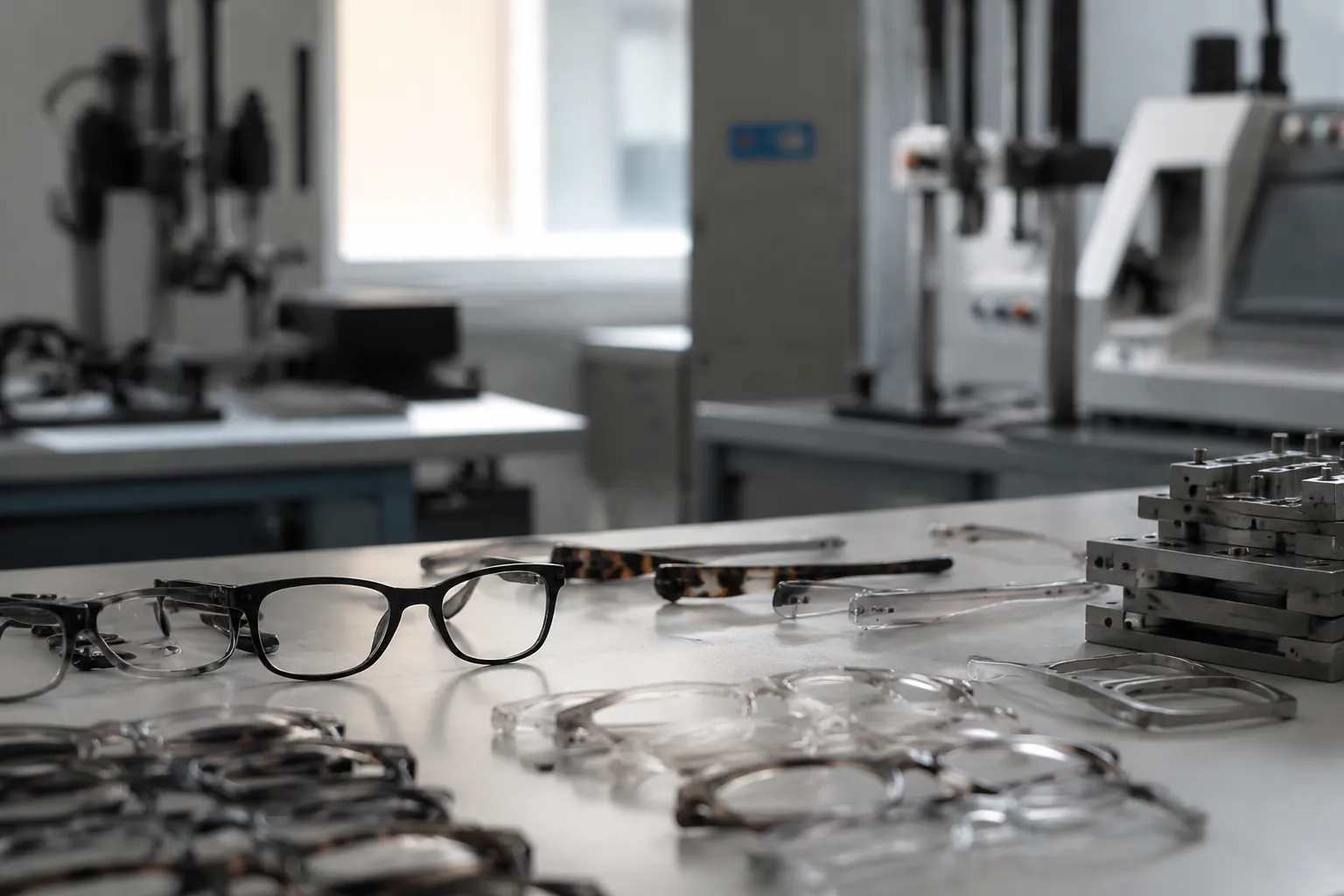
This guide is for overseas brands, importers, distributors, and retailers developing sunglasses that local optical shops may fit with prescription lenses. Rx-ready frames are not fashion sunglasses with demo lenses. They need a controlled front curve, stable materials, usable lens grooves, sensible decoration placement, and approval based on real lens mounting. The goal is simple: fewer lab rejections, fewer lens-rattle or lens-pop complaints, fewer sample rounds, and a technical brief that is clear before mold cutting, acetate machining, or bulk production begins.
Start With The Optical Lab, Not The Render
A sunglass frame can look right in CAD and still fail as a prescription frame. Optical labs care about different things: whether the lens shape can be edged, whether the groove is continuous, whether the frame can tolerate normal heating, and whether the mounted prescription lens causes distortion, rattle, rim gap, or front warpage.
First decide what the model really is. Is it Rx-ready, or only Rx-style? Rx-style frames may have demo lenses and a visible groove, but the rim may be too shallow, the wrap too strong, or the material too unstable for reliable local fitting. That gap matters when a retail customer takes the frame to an optician and expects a routine job.
Before sample approval, request the target base curve, lens groove width and depth, digital lens shape file, bridge size, eye size, B height, temple length, material grade, hinge type, and intended lens thickness range. Also define the Rx claim. Must the frame accept only plano sun lenses, low-to-moderate prescriptions, or a wider prescription range? If LumiShades is the selected supplier, put these details into the sample brief and verify them on physical samples before production approval.
Blunt rule: if a supplier cannot explain base curve, groove depth, heating behavior, and lens retention testing for the specific frame, do not market that model as Rx-ready.
Base Curve Is The First Pass-Fail Spec
Base curve describes the curvature of the lens and frame front. Many fashion and sport sunglasses use higher wrap because it looks dynamic and improves side coverage. Prescription lenses are less forgiving. Higher wrap can require compensated lens designs, create peripheral distortion, increase edge thickness, and make edging less predictable for ordinary optical shops.
For broad Rx-ready retail programs, base 4 to base 6 is usually the practical range. Base 4 is often the safer default for optical-shop compatibility. Base 6 can work when the groove, rim strength, and lens shape are controlled. Base 8 may work for sport programs, but treat it as a specialist optical project with a planned lens supplier and clear sales-channel instructions.
| Frame curve | Typical product use | Rx risk | Buyer instruction |
|---|---|---|---|
| Base 4 | Lifestyle and optical-friendly sun frames | Lower | Use as the default when broad prescription compatibility is the priority |
| Base 6 | Commercial fashion sunglasses with mild wrap | Medium | Use only after groove tolerance, material stability, and lab mounting are verified |
| Base 8 | Sport wrap and high-coverage frames | High | Use with a defined Rx lens plan, lab validation, and clear retailer instructions |
| Above base 8 | Specialty sport, shield, or performance styling | Very high | Do not claim ordinary Rx-ready compatibility without specialist optical validation |
The specification should state the target curve, the measurement method, and the allowed tolerance. For example, a buyer may approve a base 6 target only if physical samples stay within the agreed tolerance and pass lens-mounting checks. If the brand wants a wrapped fashion shape while still claiming optical-shop compatibility, approve a physical prototype and send it to a local lens lab before opening full tooling. Changing the front curve before mold cutting is far cheaper than explaining later why opticians refuse the frame.
Lens Groove: Small Dimension, High Complaint Risk
The lens groove is one of the most common failure points in Rx-ready sunglass programs. Too shallow, and lenses can pop out after heat adjustment, impact, or daily wear. Too narrow, and the optical shop may force the lens in and stress the rim. If the groove wanders around the rim, the frame may pass a simple factory appearance check but fail as soon as a thicker prescription lens is mounted.
For acetate and injection full-rim frames, buyers should specify groove width, groove depth, and groove position. A common working range for many full-rim eyewear designs is about 0.6 mm to 0.8 mm groove width and 0.5 mm to 0.7 mm groove depth. That is not a universal rule. The right value depends on lens thickness, frame material, rim profile, curve, and intended Rx range. Thin fashion rims, high-base fronts, and flexible materials may need a modified groove profile or tighter process control. The factory should measure several points around each eye wire, not one convenient point at the lower rim.
- Specify whether the frame must hold plano sun lenses, prescription lenses, or both.
- Request a digital lens shape file in a format your lens lab can use, plus a physical template for approved samples when possible.
- Check groove continuity at the bridge, nasal corner, temporal corner, and lower rim.
- Measure groove width and depth on both left and right rims, with at least four measurement points per eye wire.
- Test lens retention after normal optical heating, cooling, and repeated temple opening and closing.
- Keep metal logos, rivets, cut-outs, and heavy decoration away from rim areas that carry lens stress.
Groove approval should be a separate checkpoint in the sample report. Do not bury it inside a general note such as appearance approved. The report should include measured values, sample photos, the lens type used for mounting, and any visible rim gap or lens movement after heating and cooling.
Material Stability After Heating And Lens Mounting
Optical shops often warm frames before inserting prescription lenses or making fit adjustments. That is normal handling. The question is whether the frame returns to shape after heating or whether it twists, shrinks, opens at the rim, loses hinge alignment, or creates a visible gap around the lens. Material choice is not only about price, color, or hand feel.
Acetate is widely used for Rx-ready sunglasses because opticians understand it and can adjust it with heat. It still needs stable sheet quality, controlled machining, proper conditioning, and consistent polishing. Poorly stabilized acetate can shrink or distort after production, changing lens fit and bridge feel. PC injection can be cost-effective and scalable, but some grades have limited heat adjustability or may show stress whitening. TR-type flexible materials are light and comfortable, but flexibility can reduce lens retention if groove depth, corner geometry, and rim thickness are not engineered carefully. Metal and combination frames can hold lenses well, but screw quality, plating thickness, nose pad alignment, and soldering or brazing control become more important.
| Material | Rx-ready strength | Main risk | Process detail to lock |
|---|---|---|---|
| Acetate | Adjustable, premium feel, familiar to opticians | Shrinkage or rim distortion if sheet stability or conditioning is poor | Confirm sheet grade, machining tolerance, polishing loss, conditioning time, and post-heating shape check |
| PC injection | Low cost, impact resistant, scalable | Limited optical adjustment and possible stress whitening | Lock resin grade, injection parameters, cooling control, and lens insertion test |
| TR-type flexible material | Lightweight, comfortable, active-use friendly | Lens movement if rim flex is excessive | Increase retention testing and control groove depth around corners |
| Metal combination | Stable lens holding and thin-rim styling | More parts, plating risk, screw loosening | Define screw torque, plating spec, pad arm alignment, soldering quality, and hinge checks |
Ask when the sample will be measured. A frame measured immediately after molding, cutting, or polishing may not show its final behavior after resting, packing, shipment, and warehouse storage. For larger orders, request dimensional checks after conditioning, plus a heat-adjustment and lens-retention test before bulk approval.
Decoration Must Not Weaken The Frame
Decoration is often approved by marketing teams. On Rx-ready frames, it can affect lens fit. Metal logo plates, deep laser engraving, large rivets, cut-through temple features, embedded ornaments, and thick coatings all add process risk. The issue is not only whether the logo looks good. It is whether the decoration interferes with the rim, hinge, temple balance, heating behavior, or lens groove.
Common OEM decoration methods include pad printing, silk printing, laser engraving, hot stamping, metal logo insertion, metal temple plaques, enamel filling, custom hinge plates, and lens logo printing. Pad printing is economical for small logos, but abrasion resistance should be tested. Laser engraving can be clean on metal and some acetate surfaces, but depth must be controlled. Metal logos can look premium, but they add assembly steps and may loosen if the pocket fit, adhesive, or mechanical fixing is weak.
For Rx-ready frames, keep decorative features away from the lens groove and thin rim corners. On acetate, avoid cutting deep logo pockets close to the lens channel. On injection frames, avoid decoration that creates sink marks or weak points near the eye wire. On metal frames, confirm plating after soldering, screw function after plating, and logo alignment after final assembly. A useful sample approval should include logo position tolerance, color tolerance, adhesion test, abrasion check, and a final inspection after the frame has been heated and lens-mounted.
Check Optical-Shop Compatibility Before Bulk
The best approval process includes an optical fitting test, not only a sunglass wear test. Send approved samples to an optician or lens lab in the selling market. Ask them to edge and mount lenses that match your customer profile. Then ask for direct feedback on groove fit, curve, bridge clearance, front distortion, lens thickness, heating behavior, and temple closing.
Start with a low-to-moderate prescription. Add a higher prescription if the brand plans to advertise broad Rx compatibility. Check edge thickness, lens rattle, rim gap, front twist, hinge noise, and pressure points after mounting. For base 6 and above, ask the lab whether compensated lenses are recommended and whether ordinary retail optical shops can handle the job consistently.
- Approve CAD only after confirming the target base curve and lens plan.
- Request groove measurements from multiple points around both rims.
- Mount actual prescription lenses, not only factory plano lenses.
- Heat-adjust the frame as a local optical shop would.
- Inspect lens retention after cooling and after repeated temple opening cycles.
- Record dimensional changes before authorizing bulk production.
Build this process into the development calendar. Buyers should confirm current sample timing, local lab timing, and bulk lead time with LumiShades before placing an order. Do not start bulk production until the mounted-lens sample has been approved.
Compliance, QC, MOQ, And Price Logic
Rx-ready construction does not replace normal sunglass compliance. The supplied product still needs to meet the sunglass requirements of the destination market, lens category, tint, coating, and final construction. LumiShades lists eyewear-related compliance and management credentials including CE EN ISO 12312-1, ANSI Z80.3, AS/NZS 1067, REACH, FDA registration, ISO 9001, and BSCI. Buyers should request the actual reports or certificates, check the holder name, issue date, scope, tested model or material, and destination-market relevance, then confirm whether the final lens tint, coating, and frame material are covered.
Commercially, Rx-ready features do not always add major unit cost. They do add development discipline. The cost risk usually appears in extra sampling, mold adjustment, lens-lab checks, rejected samples, and slower approvals. MOQ and pricing should be confirmed by design, material, color count, lens type, decoration, packaging, inspection requirement, and delivery term. Higher quantities normally reduce the share of setup, color preparation, packaging, inspection, and line-planning cost per unit, but the final price must be quoted against a locked specification.
| Order level | Best use | Price logic | Timing expectation |
|---|---|---|---|
| Low MOQ trial | Market test, buyer approval, or limited capsule | Higher unit price because setup and approval cost are spread over fewer units | Confirm current sample timing and small-batch planning before ordering |
| First production run | Retail drop, distributor test, or channel validation | Better efficiency for color, lens, packaging, and inspection setup | Start only after specs, artwork, packaging, and lens-mounting checks are approved |
| Standard program | Repeatable brand or importer program | Stronger price position when materials, colors, and QC requirements are stable | Requires locked specs, packaging files, inspection plan, and shipment schedule |
| Volume program | Large retail, importer, or replenishment order | Best pricing potential when design, tooling, colorways, and packaging are standardized | Book inspection, production, and shipment windows early |
Do not compress the sample stage for new tooling. A few days saved before approval can cost far more time later if the groove, curve, decoration, or material behavior needs correction after bulk parts are already made.
Use A Practical Spec Sheet
A useful Rx-ready sunglass brief is not long. It is specific. Vague wording such as premium quality, optical grade, or good for prescription is not enough. The brief should give the factory measurable specs, required tests, market requirements, and approval responsibilities before development starts.
Use this checklist for RFQ, sampling, and pre-production approval:
- Frame type: full rim, half rim, acetate, injection, metal, or combination construction.
- Target base curve: for example base 4 or base 6, with measurement method and allowed production tolerance.
- Lens groove: width, depth, position, continuity, and whether both plano and prescription lenses must fit.
- Lens data: eye size, bridge, B height, lens shape file, and physical template if needed.
- Material: acetate sheet grade, injection resin, TR-type material, metal type, or mixed construction.
- Heating test: define adjustment temperature range, post-heating inspection, and retention check.
- Decoration: pad print, laser engraving, hot stamp, metal logo, lens logo, or plaque, with location tolerance.
- Compliance: target market, lens category, tint, coating, chemical requirements, and report coverage.
- QC points: curve, groove, lens retention, hinge function, screw torque, surface finish, logo position, and packing check.
- Commercials: MOQ by design and color, price tiers, sample timing, bulk lead time, payment terms, and inspection plan.
The buyer's job is to remove ambiguity before production. A clear spec sheet gives LumiShades or any other OEM supplier a measurable target, gives the optical lab something to validate, and gives the importer a defensible record if retailers or fitting partners question the frame later.
Have a custom sunglasses project in mind?
Send us your styles, target market and quantities and we will return a detailed quote with MOQ, lead time and a sample plan.
Get a QuoteWhy source this from Wenzhou with LumiShades
Wenzhou in Zhejiang Province is widely regarded as China’s eyewear manufacturing capital, producing a large share of the world’s sunglasses. That concentration matters to buyers: a deep local supply chain for acetate sheet, hinges, lens blanks, plating and packaging means shorter component lead times, easier color and material matching, and a workforce with decades of eyewear-specific skill. LumiShades has manufactured in this ecosystem since 2009, and our vertical integration — in-house injection molding, acetate cutting, CNC milling, lens tinting, decoration and quality control — means no part of your order is quietly subcontracted to a workshop you cannot audit.
For international buyers, that vertical control translates into accountability. When a single factory owns every step, defects are traced and fixed at source rather than bounced between vendors, and your specifications survive intact from first sample to bulk. We back this with 15+ years of experience, shipments to 60+ countries, more than 5 million pairs produced per year and a 98.5% on-time delivery rate. Our certifications — CE EN ISO 12312-1, FDA registration, ANSI Z80.3, AS/NZS 1067, REACH, ISO 9001 and BSCI audit — mean the compliance documentation your market requires already exists. Explore our manufacturing capabilities and quality control process to see how this works in practice.
Frequently asked questions
Can every sunglass frame be made prescription-ready? No. High wrap, shallow rims, unstable materials, thin decorative rims, and structures close to the lens groove can make a frame unsuitable for prescription fitting. For broad retail compatibility, start with a full-rim base 4 or base 6 design. Then confirm groove dimensions, material behavior after heating, and actual lens mounting with a local optical lab before making Rx-ready claims.
What dimensions should I ask the factory to measure on an Rx-ready sample? Ask for base curve, eye size, bridge, B height, temple length, lens groove width, lens groove depth, groove continuity, hinge alignment, and front symmetry. Groove measurements should be taken at several points around both rims, including the bridge area, nasal corner, temporal corner, and lower rim. Also request the digital lens shape file and a lens-retention result after heating, cooling, and repeated temple opening.
Is acetate better than injection plastic for prescription sunglasses? Acetate is often easier for opticians to adjust with heat, so it is a common choice for Rx-ready sunglasses. It is not automatically better. Poor acetate can shrink or distort, while a well-engineered injection frame may perform well for a defined Rx range. Compare materials by testing the actual sample: heat it, mount representative lenses, check rim gap and lens movement, and remeasure the frame after cooling.
Do CE EN ISO 12312-1 or ANSI Z80.3 certify every later prescription lens combination? No. These standards apply to the tested sunglass product and configuration supplied by the manufacturer. If an optical shop later replaces the original lenses with prescription lenses, that new lens combination is not automatically covered by the original sunglass test report. Buyers should keep the original compliance documents for the supplied sunglasses and separately validate any Rx program with their lens supplier or optical lab.
How much time should I add for Rx-ready development? Add time for technical sample review, groove measurement, local optical-lab lens mounting, heat-adjustment testing, and any correction round before bulk approval. The exact schedule depends on material, tooling status, decoration, base curve, and the lab's turnaround time. Do not release bulk production until the mounted-lens sample, compliance scope, packaging files, and inspection plan are approved in writing.
Ready to start?
Explore our aviator sunglasses or request a quote — our sales team replies within 12 hours.
Request a Quote