
Temple Core Wire in Plastic Sunglasses: Is It Worth It?
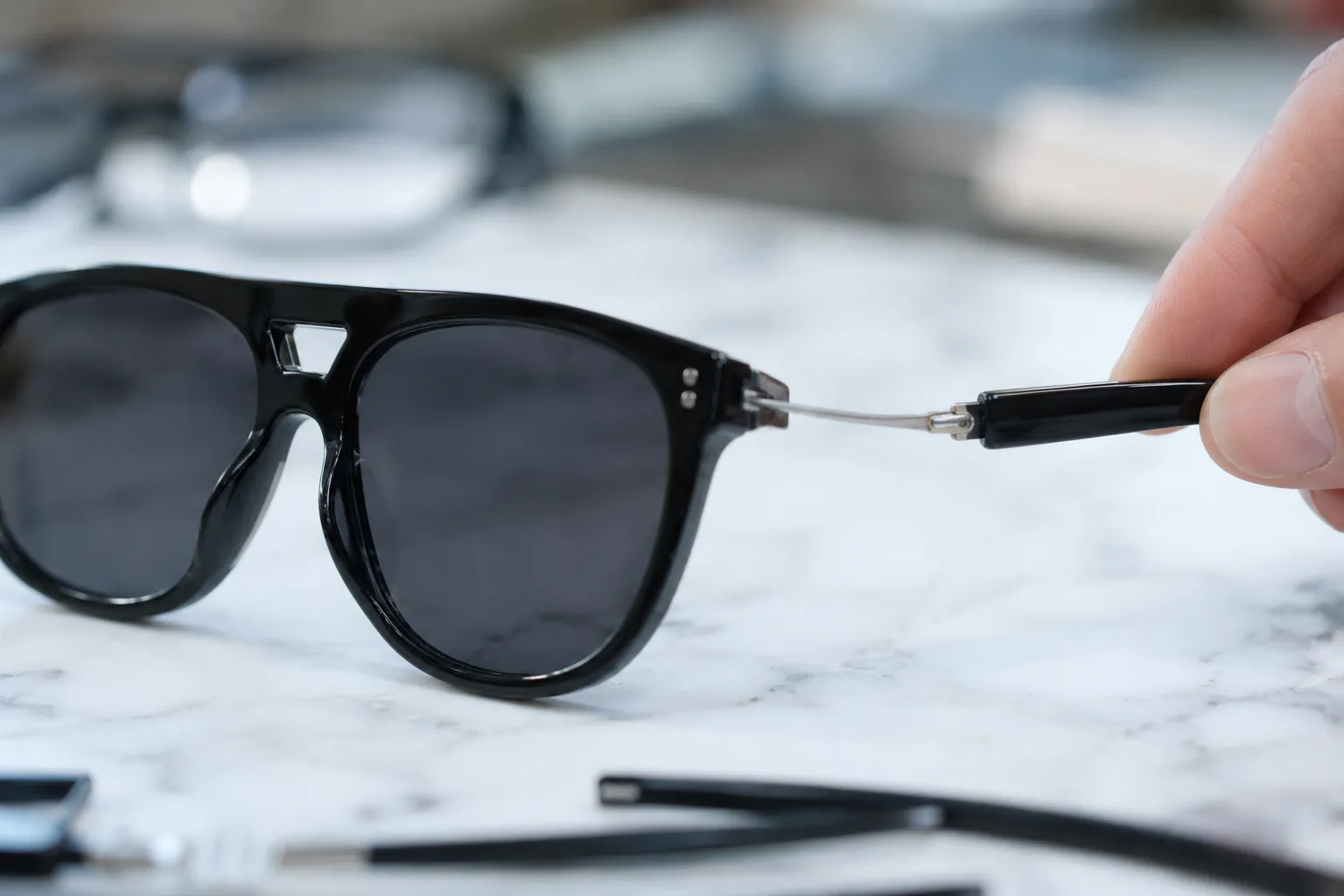
This guide is for brand owners, importers, and retail buyers sourcing plastic sunglasses at volume. Temple core wire is a small hidden part, but it can affect fit adjustment, comfort, perceived quality, reject risk, tooling, and landed cost. The real sourcing question is simple: will your product and sales channel use the benefit enough to justify the extra complexity? Below is a practical framework for making that call before sampling and before bulk approval.
Start with the buying decision, not the part
Temple core wire is a metal reinforcement inside the temple arm. Buyers usually ask for it for two reasons: they want a heavier, more solid feel, or they expect the frame to be adjusted during production, in store, or after sale. Both are fair reasons. Neither means every plastic sunglass needs it.
Start with one question: Will this frame be adjusted after assembly or after sale? If yes, core wire deserves a serious look. If no, a well-designed no-wire temple may give you lower cost, lower reject risk, and a simpler development path.
Wire tends to matter most in these cases:
- Optical-influenced fashion sunglasses worn for longer periods, where small changes to the behind-ear bend improve comfort.
- Mid-tier and premium acetate or acetate-look programs, where buyers want a denser feel and tighter shape control.
- Retail or distributor programs with fitting service, where staff may make minor comfort adjustments before sale.
- Programs with stricter assembly and alignment standards, where left-right symmetry and temple feel are checked closely before packing.
It usually matters less in low-price promotional sunglasses, beach styles, event giveaways, and impulse items sold mainly on trend and price. In those categories, the frame is usually worn as made. Not fitted. The added process cost often has no clear return.
Make the decision before tooling approval. Adding wire later is rarely a small upgrade. It can change temple wall thickness, internal channel design, cooling behavior, polishing steps, and logo placement. Leave it too late, and you may be redesigning the temple, not refining it.
What core wire changes in fit, feel, and durability
A plastic temple without wire mostly keeps the curve it was molded or finished with. It may flex in use, but it will not reliably hold a precise new bend after adjustment. A temple with internal wire usually allows more controlled adjustment, especially near the ear tip.
That can matter a lot. Even a small change in where the bend starts can reduce pressure behind the ear, improve grip, and make the front feel more stable across different head widths.
But there are limits. Core wire does not fix bad geometry. If the front curve is wrong, the hinge position is poor, or the temple spread is unsuitable, wire will not save the design. It is a fine-tuning tool. Nothing more.
Buyers should also separate three ideas that are often lumped together:
- Adjustability: the ability to create a new bend and have it hold.
- Shape retention: resistance to unwanted drift after wear or handling.
- Durability: resistance to cracking, whitening, or distortion during use and adjustment.
A steel or alloy core usually helps the first two. It does not guarantee the third. If the plastic shell is too thin, the wire sits too close to the surface, or the base material is brittle, adjustment can still cause whitening, stress marks, or cracks.
Do not rely on generic minimum thickness claims. Ask the supplier to confirm the intended plastic cover over the wire, the minimum temple section they can hold consistently, and whether the proposed build has already run in bulk in a similar color and finish. This matters more on translucent colors, crystal looks, and high-gloss dark colors, where read-through and surface distortion show fast.
The point is simple: wire works best when the temple section, material, and adjustment range are defined from the start. Not added later as a premium talking point.
Injection vs. acetate-look: the internal structure is different
One common sourcing mistake is treating all plastic sunglasses as if they behave the same. They do not. Wire behaves differently in injection-molded temples, acetate temples, and acetate-look plastic builds.
| Frame type | Typical wire method | Process detail | Main advantage | Main risk | Best use case |
|---|---|---|---|---|---|
| Injection molded temple | Integrated during molding or added into a predesigned internal structure, depending on factory method | Repeatable at volume when tooling and process control are stable; cooling balance and wire position are critical | Efficient scaling and lower base cost than acetate in many programs | Wire shift, surface read-through, sink, or left-right asymmetry if geometry is too aggressive | Fashion programs that need some adjustment capability without moving to acetate construction |
| Acetate temple | Wire inserted into a routed channel and closed during finishing | More labor and hand-finishing steps; channel depth and polish control matter | Strong premium feel and reliable adjustment response when well made | Higher labor cost, more finishing variation, and greater rework risk | Mid-tier to premium sunglasses with optical-style fit expectations |
| Acetate-look plastic temple | Depends on resin, section thickness, and whether the construction can support a stable internal channel or insert method | Can mimic acetate visually while using a lower-cost plastic route | Closer premium appearance at lower cost than true acetate | Buyer expects acetate-level adjustability when the structure does not support it | Design-led programs where look matters more than repeated fitting |
| No-wire injection temple | None | Temple shape is defined by mold geometry and material memory | Simplest development path, lowest cost, and fewer hidden structural variables | Limited fit correction after production | Promo, beach, impulse, or trend-driven volume styles |
In injection molding, wire-related problems often come from thermal behavior and wall balance. If the wire affects cooling unevenly or sits too close to one side, the left and right temples may not behave the same. In acetate, the challenge shifts. Now it is about routing accuracy, insertion consistency, closure quality, and polishing control.
So do not just ask, Can you add wire? Ask how the factory adds it, what temple geometry they need, what defects they watch for, and whether they have already produced that same structure in bulk.
Failure modes to check before sampling approval
Core wire defects are often hidden in early photos. They may only appear during handling, inspection, or wear. That is why the sample brief should cover both cosmetics and handling.
The main failure modes are predictable:
- Wire read-through: a visible or touchable line under the surface. More likely on glossy black, crystal, or translucent temples when cover over the wire is too thin.
- Wire migration or off-center placement: the wire sits unevenly, causing left-right asymmetry or different bending response.
- Whitening at bend points: the shell stresses during adjustment, especially in thinner sections or brittle materials.
- Localized hinge stress: a stiff temple body shifts the flex point too close to the hinge, increasing crack risk.
- Uneven shape retention: one temple springs back more than the other because wire material, length, or placement varies.
A serious QC review should include more than surface appearance. Check these points:
- Left-right temple symmetry after assembly.
- Front alignment and comparable opening feel on both sides.
- Minor hand-adjustment check to see whether whitening appears immediately.
- Surface review under strong light for sink, print-through, polishing distortion, or waviness.
- Hinge screw security and consistent open-close action.
During sample review, ask for two sample sets if possible: one cosmetic set for finish approval and one handling set for repeated opening, minor bending, and temperature exposure relevant to your market. A frame that looks fine on day one but shows read-through or whitening after a few adjustments is not ready.
Cost, MOQ, and lead time: when the upgrade pays back
Core wire itself is usually not the main cost issue. The real cost sits around it: tighter temple geometry, possible added labor, slower finishing in some builds, more QC checkpoints, and higher reject risk if the design is thin or cosmetically sensitive.
| Program choice | Typical MOQ fit | Estimated unit cost effect | Sample impact | Bulk lead-time impact |
|---|---|---|---|---|
| No core wire, injection temple | Suitable for low MOQ and high-volume programs | Baseline; lowest structural cost | Usually the simplest sample path | Usually the easiest structure to keep on schedule |
| Core wire in injection temple | More rational when the program volume can absorb extra development and QC | Higher than no-wire due to construction and control requirements | May require an extra review round if warp or read-through appears | Often manageable if decided early, but less forgiving of late changes |
| Core wire in acetate-look premium temple | Best justified when value perception and comfort both matter | Higher than standard injection due to added complexity and finish sensitivity | More detail to confirm on logo area, finish stability, and adjustment response | May require added process attention depending on construction method |
| Core wire in true acetate temple | Usually most commercial in mid- to higher-volume premium programs | Highest labor and finishing impact among the options shown | Sampling can be straightforward, but revisions may take longer because finishing is more manual | Generally less predictable than simple injection because finishing variation is higher |
Costs vary by temple shape, finish, material, country of manufacture, and defect tolerance. So ask for side-by-side quotations on matched builds instead of relying on generic add-on numbers. The useful comparison is not the wire cost alone. It is the total effect on unit price, reject risk, and approval time.
Commercially, wire is easier to justify when one of three things is true: the channel offers fitting service, the product position depends on premium touch and comfort, or the retailer expects tighter shape control than a basic no-wire temple can deliver. It is harder to justify when the style is price-led, short-life, and unlikely to be adjusted at any point in the sales cycle.
Lead time is usually manageable if the structure is decided early. Most delays come later, when a buyer approves a no-wire sample and then asks to add wire after logo approval or pre-production review. That often means a temple redesign, a new finish review, and another fit test.
Tooling, spec sheet, and decoration choices that prevent rework
If you want temple core wire, say so clearly in the spec sheet. Writing only metal reinforced temple is not enough. The construction details affect mold design, finishing steps, and decoration options.
At minimum, specify these items:
- Temple construction: injection, acetate, or acetate-look plastic.
- Expected use of adjustment: none, factory-only, or retail/post-sale.
- Critical temple dimensions or approved engineering drawing.
- Finish type: high gloss, matte, crystal, translucent, rubberized, or laminated look.
- Wire requirement: yes or no, plus any specific material or adjustment expectation if relevant.
- Appearance standard for symmetry and surface quality.
- Logo method and location.
Decoration matters more than many buyers expect. A metal logo plate may compete for space with the wire path or affect wall thickness in the logo area. Pad printing is usually more forgiving, but it will not hide slight surface distortion on glossy temples. Laser marking can expose waviness or thickness variation that was less obvious before decoration. Hot stamping should also be validated on the final structure, not an early draft build.
From a tooling standpoint, adding wire can change internal cavity layout, gate strategy, cooling balance, and ejector placement in injection programs. In acetate or acetate-look builds, it may change channel routing depth, closure method, and polishing time. That is why the structure should be frozen before final decoration approval.
Compliance is a separate issue. Core wire does not make a frame compliant. Buyers still need the finished sunglasses and documentation to match the target market, such as CE EN ISO 12312-1, ANSI Z80.3, AS/NZS 1067, and chemical requirements such as REACH where applicable. If the product enters the U.S. through channels that require it, buyers may also need to confirm the supplier's FDA registration status where relevant to the product category and importer process. Factory system documents such as ISO 9001 or social audit records such as BSCI may still be useful, but they do not replace product testing, fit engineering, or production control.
A sourcing process that avoids the usual mistakes
Bad core-wire decisions usually happen for a simple reason: the buyer is chasing image while the factory is chasing yield and lead time. Fix that with a tighter process.
- Define the sales channel first. DTC trend drop, retail chain, distributor, duty-free, or optical-adjacent. This tells you whether fitting service is actually part of the product experience.
- Set a target cost and an acceptable fallback cost. That makes the trade-off visible before samples are approved.
- Request two matched constructions if budget allows. Keep the same front, lens, hinge, and logo, and change only the temple construction. That isolates the value of wire.
- Run a handling review, not just a cosmetic review. Check opening-closing cycles, minor tip adjustment, and surface stability under strong light. If your market includes cold-weather use or long transport routes, include those conditions.
- Freeze the temple structure before final logo approval. Do not approve metal plates, laser positions, or final artwork on a temple that may still change internally.
- Approve with a checklist. Cover symmetry, opening feel, whitening after minor bend, surface quality, logo placement, lens compliance, and packing.
When buyers compare samples properly, the answer is usually obvious. If the wire version changes little in comfort or feel but raises visible defect risk, it may not be worth it. If it improves comfort, shape control, and hand feel without creating recurring production issues, it is usually the better investment.
Rule of thumb: If temple adjustment is part of the selling experience, core wire is often worth the extra process control. If adjustment is not part of the selling experience, wire can become hidden cost with little channel benefit.
That is the real decision. Not whether wire sounds premium on a spec sheet, but whether it improves an outcome your customer, retailer, or QC team will actually notice and use.
When the upgrade is worth it—and when it is not
Pay for temple core wire when your program needs one or more of these outcomes: in-store fit adjustment, better long-wear comfort, stronger shape retention, or a more substantial hand feel. It is most defensible on acetate and well-engineered acetate-look collections sold at mid-tier and above, where fit and finish affect perceived value.
Skip it when the product is driven mainly by low ticket price, fast trend turnover, promo volume, or a standard one-size approach to fit. In those cases, the same budget may do more work elsewhere: hinge quality, lens consistency, frame alignment, or cleaner decoration.
If you are unsure, compare two matched samples side by side and score them on five points: appearance, fit feel, adjustment response, defect visibility, and landed cost. That exercise usually gives a better answer than a blanket claim that wire is always premium.
In practice, core wire is not automatically a premium feature. It is an engineering feature. It becomes commercially useful only when the channel can turn better fit, better feel, or both into value. If the channel cannot, the smarter move is often to keep the temple simpler and spend the budget on features the customer will notice faster.
Have a custom sunglasses project in mind?
Send us your styles, target market and quantities and we will return a detailed quote with MOQ, lead time and a sample plan.
Get a QuoteWhy source this from Wenzhou with LumiShades
Wenzhou in Zhejiang Province is widely regarded as China’s eyewear manufacturing capital, producing a large share of the world’s sunglasses. That concentration matters to buyers: a deep local supply chain for acetate sheet, hinges, lens blanks, plating and packaging means shorter component lead times, easier color and material matching, and a workforce with decades of eyewear-specific skill. LumiShades has manufactured in this ecosystem since 2009, and our vertical integration — in-house injection molding, acetate cutting, CNC milling, lens tinting, decoration and quality control — means no part of your order is quietly subcontracted to a workshop you cannot audit.
For international buyers, that vertical control translates into accountability. When a single factory owns every step, defects are traced and fixed at source rather than bounced between vendors, and your specifications survive intact from first sample to bulk. We back this with 15+ years of experience, shipments to 60+ countries, more than 5 million pairs produced per year and a 98.5% on-time delivery rate. Our certifications — CE EN ISO 12312-1, FDA registration, ANSI Z80.3, AS/NZS 1067, REACH, ISO 9001 and BSCI audit — mean the compliance documentation your market requires already exists. Explore our manufacturing capabilities and quality control process to see how this works in practice.
Frequently asked questions
Can injection-molded sunglasses have adjustable temples with core wire? Yes, but only if the temple is engineered for it from the start. Ask the factory to confirm four points in writing: the method used to place the wire, the minimum temple section they require, how they control wire position during production, and what checks they use to prevent read-through or asymmetry. Then review a physical sample with minor adjustment, not photos alone. If the temple is too thin or the wire sits too close to the surface, adjustment may cause whitening, warpage, or visible wire lines.
At what order size does temple core wire usually make sense? There is no fixed order-size threshold. The answer depends on your price point, sales channel, and whether the product will actually be adjusted in use. A practical approach is to compare matched quotations and samples for wire versus no wire. If the wire version improves comfort, perceived value, or retailer acceptance enough to cover the added unit cost and QC risk, it can make sense even at moderate volume. If the product is price-led and unlikely to be adjusted, it often does not. Ask the supplier to quote both options with the same front, lens, hinge, and decoration so the difference is meaningful.
Does core wire help with compliance testing for sunglasses? Not directly. Compliance depends on the finished product meeting the requirements of the destination market. For sunglasses, buyers commonly review standards such as CE EN ISO 12312-1, ANSI Z80.3, and AS/NZS 1067, along with chemical requirements such as REACH where applicable. If your U.S. import process requires it, also confirm FDA registration details where relevant. Core wire affects construction and fit; it does not replace lens testing, documentation, labeling review, or chemical compliance checks.
Will a core wire make plastic sunglasses feel more premium to the end customer? Often yes, but not by itself. A well-made core-wire temple can feel more solid and can hold a cleaner adjustment than a simple no-wire temple. But customers also notice hinge action, frame alignment, finish quality, lens consistency, and logo execution. To judge whether wire adds real value in your program, compare matched samples side by side. If the improvement is obvious in touch, comfort, and stability without creating visible defects, the premium effect is more likely to be noticed.
What should I ask for during sampling if I am comparing wire vs no wire? Ask for matched samples that keep the same front, lens, hinge, color, and decoration wherever possible, with temple construction as the only intended difference. Request a short written construction note from the factory stating how the wire is added and what risk points they are monitoring. During review, check left-right symmetry, opening feel, minor adjustment response, whitening after a small bend, and surface appearance under strong light. If possible, ask for one cosmetic approval set and one handling set for repeated opening-closing and light adjustment. That gives you a better basis for approval than a single display sample.
Ready to start?
Explore our rimless sunglasses or request a quote — our sales team replies within 12 hours.
Request a Quote