
Wire-Core Temples for Plastic Sunglasses: Buyer Guide
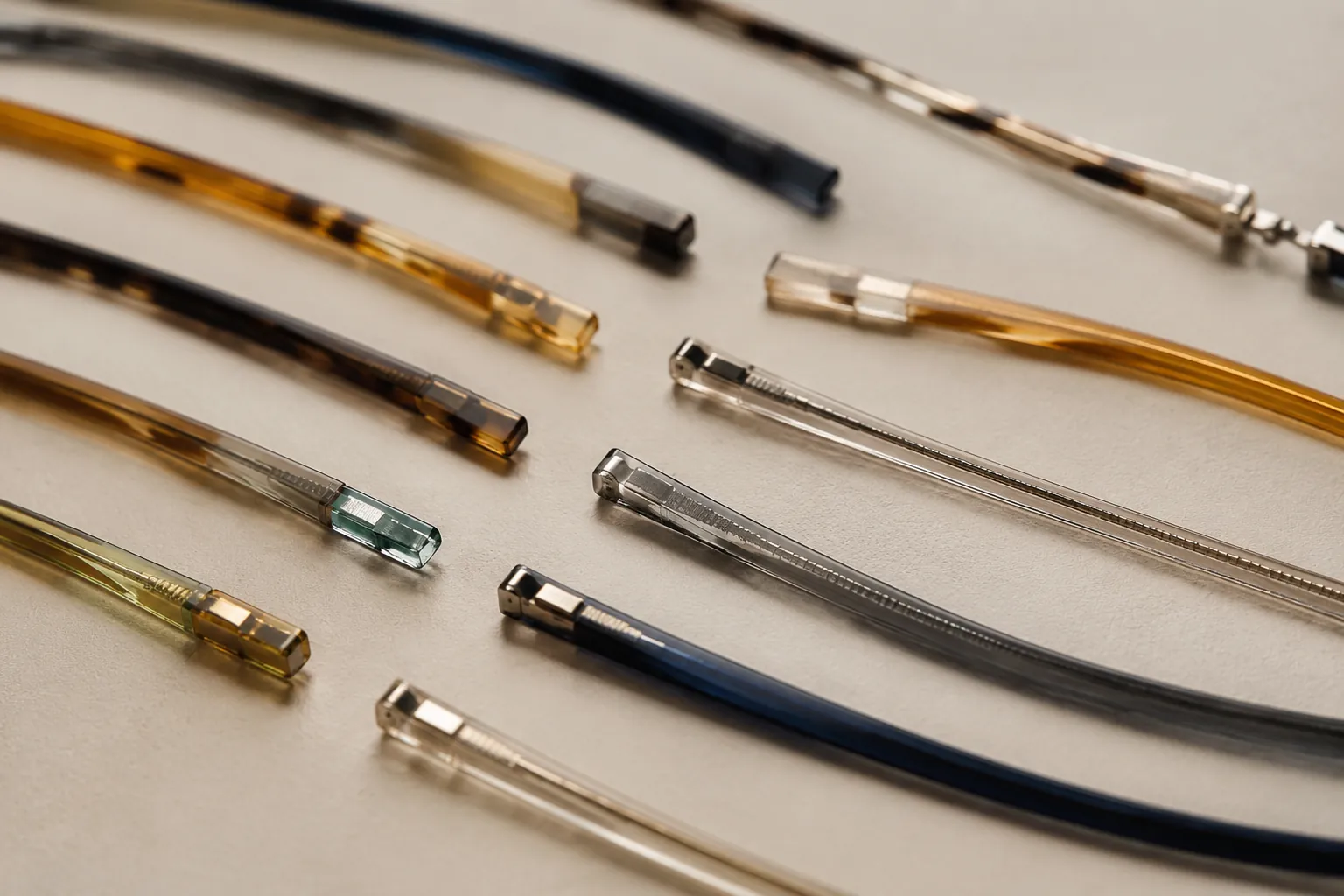
This guide is for brand owners, importers, distributors, and retail buyers deciding whether to specify wire-core temples in plastic sunglasses. The real question is simple: do they improve fit, adjustment, durability, or retail value enough to justify the added part, labor, process control, and inspection risk? Sometimes yes. Often no. Wire cores are most useful in acetate and thicker fashion temples where adjustment after production or after sale is expected. They are often unnecessary in low-cost injection-molded promotional frames, very thin temples, sports wraps, and short-life event sunglasses.
The Buyer Decision in One Page
A wire core is a metal insert placed inside a plastic sunglass temple. In acetate sunglasses, it is usually inserted into a prepared channel during temple production. In injection-molded plastic sunglasses, it may be overmolded or inserted through a designed channel, but only if the temple geometry, material, and tooling can support it.
The core changes how the temple bends and holds adjustment. A trained fitter may warm the temple and make small corrections, such as a slight inward or outward adjustment or a more comfortable bend behind the ear. That can improve comfort and stability at retail. On the sourcing side, it adds another component, more handling, more process variation, and more QC points.
Practical sourcing rule: specify wire-core temples when the frame is likely to be adjusted by an optician, retailer, or trained fitter after sale. Do not add them just because they look premium on a tech pack.
Start with the material, temple thickness, target retail price, and expected use. For acetate, optical-ready, transparent-temple, and higher-retail private-label programs, wire cores can make sense. For simple injection-molded promotional sunglasses, the value is usually weak. The key test is whether the finished product benefits from controlled adjustment and whether the supplier can produce the feature consistently in bulk.
What the Wire Core Actually Does
Plastic alone has limits. Acetate can be heated and adjusted, but some temple shapes may spring back, twist, or feel unstable without internal reinforcement. Many injection-molded plastics are durable, but they are not always suitable for precise post-sale adjustment. Flexible sport materials may recover their original shape well. That is useful in wear, but it also limits permanent fit correction. A wire core changes how the temple responds to heat and bending.
Core size, profile, and placement vary by temple design. There is no universal dimension that works for every frame. The core usually stops short of the hinge area and temple tip to reduce hardware interference, stress concentration, and uncomfortable end pressure. Confirm exact start and stop points on the drawing. Then validate them in samples.
- Fit adjustment: allows limited post-production adjustment when the material and construction support safe heating and bending.
- Shape retention: can help an adjusted acetate temple hold its position after cooling.
- Perceived quality: in transparent acetate, a visible and centered core can support a higher-retail appearance.
- Temple stability: can reduce unwanted twist in some long or flat temple designs.
A wire core does not fix poor frame balance, weak hinges, brittle plastic, or incorrect lens geometry. It does not make a sunglass compliant either. Compliance must be managed through the finished product, including applicable checks under CE EN ISO 12312-1, ANSI Z80.3, AS/NZS 1067, REACH review where relevant, and market-specific labeling or importer obligations. FDA registration may matter for companies handling regulated optical products in the United States, but it does not replace sunglass performance testing.
Material and Construction Comparison
The best wire-core decision depends on material and construction method. Acetate is usually the strongest candidate because it can be machined, polished, heated, and adjusted more like an optical frame material. Injection-molded plastics need more caution. The core can affect resin flow, create cosmetic marks, or show as a shadow line. Flexible materials often benefit less because their selling point is elastic recovery, not permanent adjustment.
| Frame Material or Program | Wire-Core Suitability | Process Risk | Buyer Guidance |
|---|---|---|---|
| Acetate sunglasses | High | Core centering, polish marks, heat-adjust behavior | Strong candidate for retail, optical-adjacent, and heavier fashion frames. |
| Transparent acetate temples | High | Visible off-center placement, bubbles, scratches | Agree cosmetic standards early because visible misalignment is easy to see. |
| Thick injection-molded plastic temples | Case by case | Sink marks, flow lines, insert movement during molding | Use only when wall thickness and tooling support stable insert placement. |
| Thin injection-molded promo temples | Low | Weak points, distortion, higher reject risk | Usually put budget into lens quality, UV performance, hinges, and print quality instead. |
| Flexible sport-style frames | Often low | Core may conflict with intended flexibility | Geometry and material memory often drive fit better than a metal insert. |
| Kids sunglasses | Case by case | Safety, exposed ends, abuse in bending | Prioritize tip safety, comfort, and compliance before adding internal metal parts. |
Do not treat all plastic temples as equal during quoting. A supplier may say wire cores are possible. That is not enough. Ask whether the factory can hold core position, avoid visible defects, and reproduce the approved bend behavior in bulk.
Programs That Usually Benefit
Wire-core temples make the most sense when the sunglasses have enough retail value and expected wear time for the user to notice fit. Heavier acetate fronts, longer temples, and styles intended for daily wear are common examples. In these cases, controlled adjustment can reduce pressure points, improve stability, and make the frame easier to fit after sale.
Good candidates include acetate fashion sunglasses, optical-ready sunglass frames, transparent or laminated temples where the core is part of the visual design, premium private-label programs, and distributor lines where repeat wear matters. If the buyer expects after-sale fitting, prescription conversion, or retail adjustment, the extra cost may be justified.
For optical-ready sunglass frames, wire cores can be especially useful because lens changes may alter weight balance and fit. Opticians often need some adjustment range at the temple to refine comfort and stability. For fashion retail, visible wire cores may also add perceived value when they are centered, symmetrical, and cleanly finished.
Test the feature. Do not assume it adds value. If the style is uncertain, request one sample with wire cores and one without. Compare fit, appearance, weight balance, and ease of adjustment before freezing the construction.
Where It Adds Cost Without Much Value
Some programs gain little from wire-core temples. Low-cost promotional sunglasses are the clearest case. If the product is for an event, giveaway, campaign, or short seasonal use, buyers usually gain more from reliable UV performance, stable lens tint, clean logo application, acceptable hinge function, and packaging that protects the shipment.
Thin injection-molded temples are another weak candidate. If the wall section is too thin, the insert can cause sink marks, visible lines, stress points, or inconsistent molding. During overmolding, the insert must be held securely and repeatably. Poor control means higher rejects.
Wire cores also add limited value when the design already relies on flexible material, spring-based comfort, wrap geometry, or engineered elastic pressure. In those frames, the concept may work better without a semi-adjustable metal insert inside the temple.
Avoid stacking features without a clear reason. A design can include spring hinges, polarized lenses, custom decoration, logo plates, and wire cores, but each added feature increases coordination and inspection work. In price-sensitive programs, secure the basics first: finished-product compliance for the target market, REACH review where applicable, UV performance, optical quality, hinge function, lens retention, decoration adhesion, and packaging suitability. Supplier quality systems such as ISO 9001 or social-audit credentials such as BSCI can support vendor evaluation, but they do not replace product-level inspection and testing.
Cost, MOQ, and Lead-Time Effects
The added cost is not only the metal insert. It can include insert sourcing or forming, deburring, dimensional checks, temple channel preparation or insert tooling, positioning during assembly or molding, more cosmetic inspection, and extra care during polishing and finishing. If the core is visible, reject rates may rise because misalignment, scratches, bubbles, and polishing distortion are easier to spot.
There is no universal cost uplift for wire-core temples. The impact depends on material, temple design, supplier process, and order structure. Compare like with like. A wire-core acetate program should be benchmarked against a comparable acetate construction, not against a basic injection-molded frame.
| Order Stage | Typical Timing | Wire-Core Impact |
|---|---|---|
| Sample development | Project dependent | May require extra checks for core position, bend feel, polish marks, and visible alignment. |
| Small MOQ trial | Project dependent | Useful for validation, but unit cost may not reflect stable bulk conditions. |
| Mid-size production | More stable | Better stage to compare core versus no-core pricing and reject risk. |
| Larger bulk production | More efficient | Fixtures, operator training, and QC routines can be standardized more effectively. |
| Bulk production | Project dependent | Usually manageable if the wire-core specification is frozen before final approval. |
Do not approve a no-core sample and then add wire cores at bulk confirmation unless the schedule allows a new approval round. Temple weight, stiffness, bend behavior, and finishing may change. Once the construction changes, the original sample is no longer a reliable production reference.
Factory Process and QC Checks
The production route depends on the frame material. For acetate, the factory prepares the temple blank, creates or uses the required channel system, places the core, shapes the temple, fits the hinge, polishes the surface, then assembles and adjusts the frame. For injection-molded plastics, the tool must control insert position during molding, or the design must provide a reliable post-mold insertion method.
A practical wire-core workflow should include these control points:
- Confirm temple material, thickness, length, hinge type, and whether the core is visible or hidden.
- Define core material, profile, dimensions, end shape, deburring requirement, and start/stop position on the drawing.
- Build sample temples and test adjustment behavior after heating and cooling for spring-back, cracking, bubbles, and surface read-through.
- Check left-right consistency, core centering, temple twist, hinge alignment, and comfort at the temple tip area.
- Inspect decoration interaction, including laser engraving depth, pad-print adhesion, metal logo plate placement, and any cutouts or drilled features near the core.
- Run finished-product checks for the destination market, including the applicable standard such as CE EN ISO 12312-1, ANSI Z80.3, or AS/NZS 1067, plus labeling and REACH review where relevant.
- Freeze the approved sample, drawing, and tolerance notes before bulk production starts.
For visible cores, agree cosmetic tolerances before production. Define acceptable left-right consistency, how visible off-center placement will be judged, and how scratches, bubbles, or polish distortion will be classified. For hidden cores, the bigger risks are temple twist, stress at the core end, and cracking after adjustment. In those cases, a controlled bend and recovery check is more useful than appearance alone.
Wire-core temples affect machining or molding, polishing, decoration, and assembly. That requires cross-department control. Ask who owns final approval of the wire-core specification and whether the supplier has a documented QC flow under its quality system, such as ISO 9001. Do not assume the feature will correct itself during production.
Purchase Order Specs and Final Recommendation
A purchase order note such as "metal wire inside temple" is too vague. It lets the supplier decide the core material, size, length, end shape, and position. The frame may look acceptable at first glance but still fail to deliver the fit or cosmetic result that justified the feature.
For a professional order, include the wire-core specification in the frame drawing or tech pack. Define temple material, temple length, core material, profile or section, dimensions, visible or hidden construction, start and stop points, hinge type, decoration method, lens category if relevant, packaging, and destination market. If any metal could become exposed, review material selection and REACH implications. If the supplier mentions FDA registration, treat it as a company or facility credential where applicable, not as proof that the sunglasses meet performance requirements.
Also specify decoration interaction. Pad printing usually has low structural impact, but adhesion should still be checked on the finished surface. Laser engraving should not cut into the core path or thin the temple wall too much. Metal logo plates, rivets, or embedded badges need clearance from the core to reduce cracking risk during pressing or later adjustment. For transparent acetate, core alignment is part of the visible design. Judge it as a cosmetic feature, not only as an internal construction detail.
The recommendation is direct. Use wire-core temples when the frame is acetate or similar construction, when after-sale adjustment is expected, or when the visible core supports the product position. Treat the feature as optional when the style is fit-sensitive but not clearly adjustment-driven. Avoid it in thin injection-molded temples, short-life promotions, and flexible sport frames unless sampling proves a real benefit. If in doubt, request matched samples with and without the core and decide from actual fit, finish, and manufacturability.
Have a custom sunglasses project in mind?
Send us your styles, target market and quantities and we will return a detailed quote with MOQ, lead time and a sample plan.
Get a QuoteWhy source this from Wenzhou with LumiShades
Wenzhou in Zhejiang Province is widely regarded as China’s eyewear manufacturing capital, producing a large share of the world’s sunglasses. That concentration matters to buyers: a deep local supply chain for acetate sheet, hinges, lens blanks, plating and packaging means shorter component lead times, easier color and material matching, and a workforce with decades of eyewear-specific skill. LumiShades has manufactured in this ecosystem since 2009, and our vertical integration — in-house injection molding, acetate cutting, CNC milling, lens tinting, decoration and quality control — means no part of your order is quietly subcontracted to a workshop you cannot audit.
For international buyers, that vertical control translates into accountability. When a single factory owns every step, defects are traced and fixed at source rather than bounced between vendors, and your specifications survive intact from first sample to bulk. We back this with 15+ years of experience, shipments to 60+ countries, more than 5 million pairs produced per year and a 98.5% on-time delivery rate. Our certifications — CE EN ISO 12312-1, FDA registration, ANSI Z80.3, AS/NZS 1067, REACH, ISO 9001 and BSCI audit — mean the compliance documentation your market requires already exists. Explore our manufacturing capabilities and quality control process to see how this works in practice.
Frequently asked questions
Does every acetate sunglass need a wire-core temple? No. Acetate is the most suitable material for wire-core use, but the feature should serve a real function. It is most useful in thicker temples, heavier fronts, optical-ready styles, and transparent temples where visible construction matters. Ask the supplier for two matched samples, one with a core and one without, and compare comfort, adjustment response, appearance, and production consistency before approving bulk.
Will a wire core make plastic temples stronger? Not automatically. A wire core can improve adjustment control and shape retention, especially in acetate, but it does not solve weak hinge attachment, poor plastic quality, or bad temple geometry. To evaluate durability, ask for the full construction details, inspect the core end position, and test the finished frame for hinge function, temple symmetry, and cracking after controlled heating and adjustment.
Can wire-core temples be used on injection-molded sunglasses? Yes, but only in some designs. The temple must have enough section thickness, and the tooling or post-mold insertion method must hold the core in a stable position without causing visible molding defects. Before approval, request clear photos or samples showing both sides of the temple. Inspect for sink marks, flow lines, surface distortion, and left-right consistency.
What tolerance should buyers set for visible wire cores? There is no single universal tolerance because acceptability depends on temple width, transparency, color, and retail position. The safest method is to approve a signed reference sample and add written cosmetic criteria to the drawing or PO: left-right consistency, maximum visible offset, how core drift will be judged at inspection, and how scratches, bubbles, or polish distortion will be classified. If the visible core is central to the design, make it an explicit A-level cosmetic checkpoint.
Does the wire core affect compliance testing? The core itself does not replace finished-sunglass testing. The complete product still needs to meet the requirements of the destination market, such as CE EN ISO 12312-1, ANSI Z80.3, or AS/NZS 1067, along with REACH review where applicable. Buyers should ask which standard the finished product is being built to, what test reports are available, and whether any construction change, including the temple core, requires revalidation of samples or labeling.
Will adding wire cores delay production? It can, especially if the feature is added late. When wire cores are specified during development and approved in the final sample, lead-time impact is usually manageable within the normal project schedule. If the feature is added after sample approval, buyers should expect another approval round because temple stiffness, balance, finish, and fit behavior may change. To avoid delay, freeze the core specification before bulk materials are ordered.
What MOQ makes wire-core temples practical? There is no universal MOQ because feasibility depends on the supplier's process and the frame design. The better buying question is whether the order size justifies added setup, QC work, and reject risk for the feature. For small trial runs, use wire cores to validate function or appearance, not to judge final economics. Before placing the order, ask the supplier for separate pricing for core and no-core versions, any sample-to-bulk construction differences, and whether cosmetic standards for visible cores have been costed into the quote.
Ready to start?
Explore our wayfarer sunglasses or request a quote — our sales team replies within 12 hours.
Request a Quote