
When Injection-Molded Sunglasses Beat Acetate
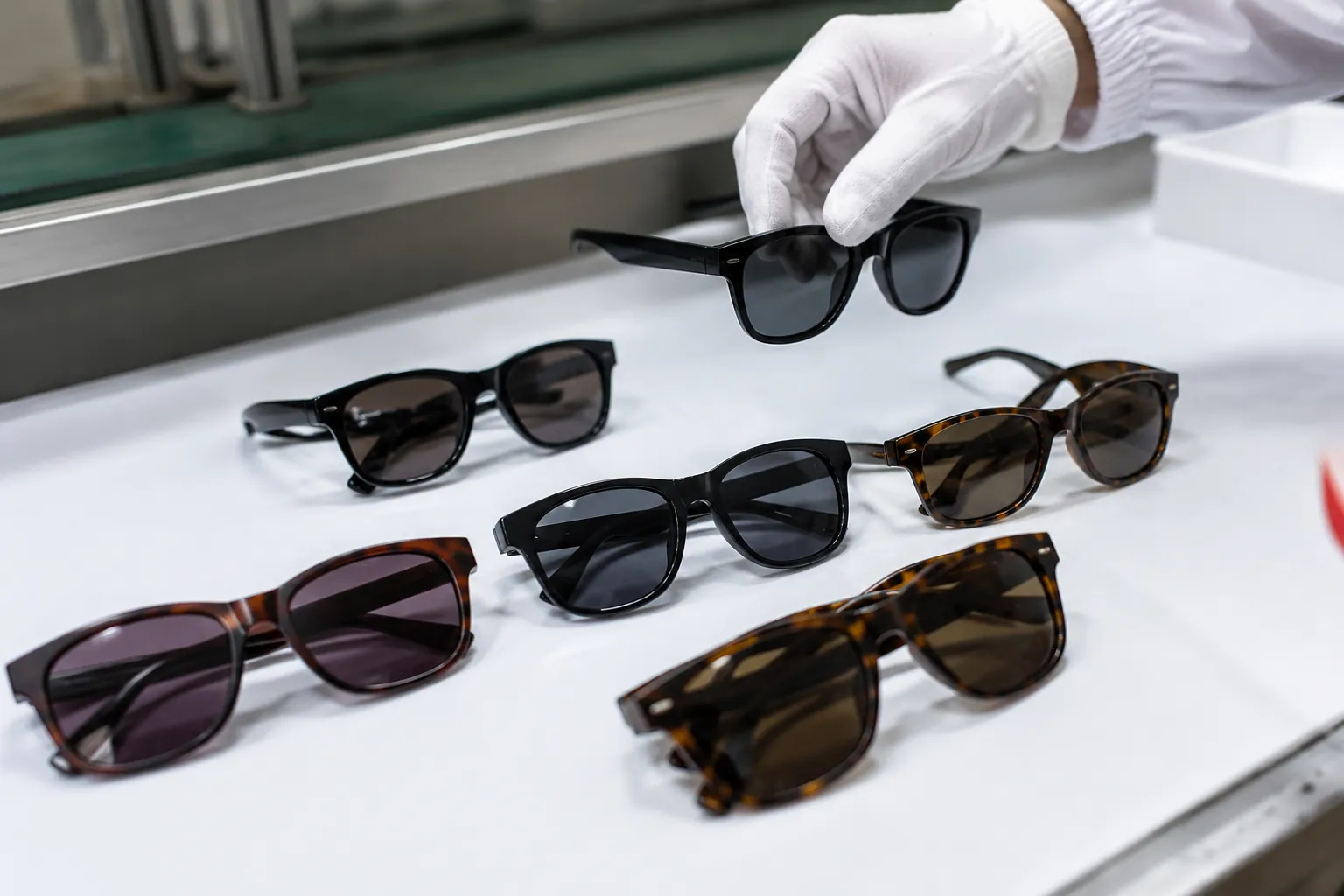
This guide is for buyers planning repeat sunglasses programs, not one-off fashion drops. Acetate and injection-molded frames can both work. They win under different conditions. The right choice depends on lifetime volume, tooling payback, color plan, decoration method, fit tolerances, compliance, and reorder predictability. Get it wrong and you either pay extra acetate labor on every pair or fund a mold that never pays back. Get it right and cost, delivery, color, and inspection become easier to control.
Start With The Commercial Breakpoint
For low-volume programs, acetate often makes sense. The setup burden is usually lighter, and the buyer can test a shape without paying for a dedicated injection mold. For repeat programs, injection-molded sunglasses often become more competitive. Tooling cost spreads across more units, and per-pair labor is usually lower.
Do not judge only the opening order. Judge lifetime volume. A first purchase order of 300 pairs may look too small for a new injection mold. But if the same style will repeat several times, or if one front and temple set will support several colors or lens options, the payback picture changes.
Ask suppliers to quote three paths: an existing mold, a modified existing platform where feasible, and a fully new mold. Existing mold programs can cut development time and reduce upfront cost. A fully custom injection mold makes sense only when the buyer has enough volume, a protected design need, or a clear replenishment plan.
The strongest injection candidates are repeatable basics, promotional frames, kids' sunglasses, sports wraps, chain retail replenishment, tourism programs, licensed lines, private-label continuity lines, and distributor stock. Acetate still fits premium capsule collections, fashion-led launches, optical-inspired sunwear, and products where sheet pattern depth is part of the consumer promise.
Where Injection Actually Saves Money
Buyers often compare resin cost with acetate sheet cost. That is too narrow. Injection can save money through repeatable cycle time, stable geometry, less manual shaping, and easier line balancing. Acetate starts as sheet material. It usually needs cutting, CNC shaping, tumbling, polishing, hinge fitting, lens mounting, adjustment, and final touch-up. Each step adds labor, work-in-process, and inspection risk.
| Cost / Process Factor | Injection-Molded Sunglasses | Acetate Sunglasses |
|---|---|---|
| Typical MOQ logic | Most attractive when using an existing mold or when repeat volume can amortize new tooling | Often practical for small tests, capsule colors, and uncertain demand |
| Tooling investment | Higher if a new mold is required; payback depends on total production volume and mold life | Lower initial setup for many designs, especially simple CNC-cut frames |
| Cycle and labor | Short molding cycles after process approval; less manual shaping before assembly | More cutting, tumbling, polishing, hand adjustment, and touch-up |
| Dimensional control | More repeatable once mold shrinkage, resin, and machine settings are locked | More variation can come from sheet stress, polishing removal, heating, and hand finishing |
| Color repeatability | Strong for controlled solid colors using approved resin and masterbatch | Excellent visual depth, but natural sheet variation should be expected |
| Best use case | Repeat volume, private label, promotions, uniform retail replenishment | Premium storytelling, tortoise depth, laminated effects, small-batch fashion |
A mold is an upfront cost. Manual labor is a recurring cost. If a frame family may run for thousands of pairs, calculate whether lower touch time and more repeatable assembly offset the tooling. If demand is still uncertain, acetate or an existing injection platform is safer.
Use A Volume And Tooling Payback Framework
If the design can be made more than one way, ask the supplier to quote both options. Compare total program cost, not only the first ex-works price. Include tooling, sampling, color approvals, lenses, decoration, packaging, compliance testing, expected rejects, inspection cost, and reorder frequency.
- Small order with uncertain reorder: Acetate or an existing injection mold platform is usually lower risk. A fully new injection mold may not pay back.
- Moderate order with likely repeat: Compare both options. Basic square, wayfarer-style, round, kids', shield, or sports-wrap shapes may favor injection if repeat demand is credible.
- Large repeat program: Injection is often the better commercial option when the buyer needs stable fit, consistent color, efficient replenishment, and predictable margin.
- Long-running style family: Injection usually deserves priority unless acetate appearance is central to the brand or retail price.
Color count can change the economics. One mold running several planned solid colors can be efficient if color changes are scheduled and approved properly. Many low-volume colors can hurt efficiency. Transparent, pearl, glitter, and special-effect colors often need more purging, setup time, and separate approval.
Existing mold platforms are the middle ground. If a buyer can accept a proven front shape with custom lens tint, temple logo, printing, engraving, or packaging, the program can avoid the cost and risk of new tooling. This is often the best way to test a new sales channel before funding a custom mold.
Ask the supplier to show amortization clearly: tooling cost divided by expected total pairs. Then compare that number with the per-pair saving versus acetate. If the saving does not recover the tooling within the realistic sales window, the mold is a risk. Do not hide that risk in an optimistic forecast.
Material Behavior, Tolerances, And Fit
Injection-molded frames are not automatically higher quality. They are often easier to control dimensionally at volume. Common injection materials for sunglasses include PC, TR90, TPEE-based materials, and other engineering plastics chosen for impact resistance, flexibility, weight, processing behavior, and heat performance. The right material depends on the frame design, lens type, hinge structure, target market, and test requirements.
Every injection material shrinks. The mold must account for material flow, gate position, cooling, wall thickness, and expected shrinkage. A supplier should not promise tight tolerances without confirming the material, mold design, and production process. Critical dimensions should be agreed before tooling and checked on pre-production samples.
For bulk sunglasses, tolerance control is mainly about repeatable fit and stable assembly. Buyers should define critical dimensions such as lens groove width, bridge width, temple length, hinge position, screw alignment, pantoscopic angle where relevant, and front curvature. Put the acceptable tolerance in the specification or approved sample record. Verbal agreement is not enough.
Injection has an edge because the mold cavity defines the part geometry. Once resin drying, injection pressure, holding pressure, cooling time, and mold temperature are controlled, parts can repeat more predictably. Acetate can move during cutting, tumbling, heating, polishing, and adjustment. Polishing can also remove material unevenly if process control is weak.
- Lens retention: Consistent lens grooves can reduce loose-lens complaints, but the lens base curve and groove design must be validated together.
- Temple alignment: Molded hinge seats can support more consistent temple angle, provided hinge insertion and screw torque are controlled.
- Bridge and front curve: Fixed tooling helps reduce variation that affects comfort, fit, and perceived quality.
- Heat performance: Buyers should confirm storage and transit requirements, especially for hot containers, vehicle storage, or outdoor retail environments.
The main QC risks in injection are mold accuracy, cavity balance, material drying, sink marks, weld lines, gate marks, stress whitening, hinge insertion strength, screw retention, and deformation after assembly. In acetate, the risks are more often front symmetry, polish quality, sheet matching, hinge setting, lens fit, and hand adjustment consistency.
Color, Finish, And Decoration Trade-Offs
This is where buyers need to separate brand preference from production need. Acetate usually wins on deep tortoise, laminated color, transparent pattern movement, and a premium hand-finished look. Injection wins when the buyer needs cartons to match, replenishment lots to stay consistent, and solid colors to remain close across repeat orders.
For injection, solid colors are usually controlled through resin and masterbatch. A black frame should remain visually consistent when the same approved material, ratio, processing window, and inspection lighting are used. Pantone-matched colors can be developed, but buyers should approve physical color chips or production samples. A digital Pantone reference is not enough.
Transparent injection colors are possible, but they are less forgiving. Flow lines, bubbles, gate marks, stress, and contamination are easier to see. If the consumer promise is crystal-clear transparency or premium depth, the supplier should confirm whether the target look is realistic in injection before tooling starts.
Acetate sheet variation is not automatically a defect. In tortoise, horn-look, or laminated sheets, no two fronts may look exactly the same. That variation can support a premium story. It can also create disputes if a retailer expects uniform planogram presentation. Define acceptable shade range, pattern distribution, and left-right matching before bulk production.
Decoration method also matters. It must suit the frame material, surface finish, and expected wear conditions.
- Pad printing: Cost-effective for temple logos, but ink adhesion and rub resistance should be tested on the exact material and coating.
- Laser engraving: Durable and clean on suitable materials, but contrast varies by plastic and color.
- Metal logo plates: Strong premium signal, but add component cost and require placement, adhesion, and corrosion checks.
- Hot stamping or foil: Useful for fashion effects, but should be wear-tested on the chosen surface.
- Lens tinting and mirror coating: Must be checked for color density, optical quality, UV performance, and the required lens category standard.
For large private-label programs, repeatability often matters more than novelty. If the sales promise is uniform color, fast replenishment, and predictable margin, injection is often the cleaner route.
Lead Time, Capacity, And Factory Control
Injection is not instant, especially with a new mold. A realistic timeline includes design confirmation, mold design, tooling, first mold trial, sample correction, color approval, pre-production sample approval, bulk molding, assembly, lens insertion, decoration, QC inspection, and packing. First production takes the work. Reorders are usually easier once the mold and process are approved.
Separate sample lead time from full custom mold development. A supplier may produce a fast sample from an existing mold. A new mold needs design review, machining, trial shots, corrections, and documented approval. The timeline also depends on material availability, lens type, packaging, testing, and inspection requirements.
Acetate production is more exposed to manual bottlenecks. Sheet cutting, CNC milling, tumbling, polishing, hinge setting, lens fitting, frame adjustment, and final matching all require labor hours. If polishing capacity is full or color matching is slow, an order can queue even when sheet material is ready.
For injection replenishment, output is easier to model because cavity count, cycle time, and machine allocation can be measured. Ask floor-level questions:
- Is injection molding handled in-house or by an outside workshop?
- How many cavities are planned, and what is the expected output under normal production conditions?
- What is the approved resin grade, masterbatch, and mixing ratio?
- How are color changes sequenced to reduce purge scrap, contamination, and downtime?
- Are lens tinting, logo decoration, hinge assembly, QC, and packing handled internally or subcontracted?
- What AQL level is used for final inspection, and which defects are classified as critical, major, and minor?
Factory control matters because sunglasses are assembled products. A supplier with documented control over molding, lens sourcing or lens processing, decoration, assembly, inspection, and packing is easier to audit and troubleshoot. If steps are subcontracted, ask who approves the subcontractor, who owns corrective action, and who carries final responsibility.
Compliance, Documentation, And Supplier Proof
Define compliance before sampling. Not after bulk production. The required standard depends on the destination market, product type, lens category, claims, labeling, and customer requirements. Do not assume a frame material or lens qualifies because a similar product passed before.
For sunglasses, common requirements include CE EN ISO 12312-1 for markets that require European conformity, ANSI Z80.3 for the United States, AS/NZS 1067 for Australia and New Zealand, REACH for restricted substances in the European market, and FDA registration where applicable for the U.S. supply chain. ISO 9001 and BSCI are supplier-management credentials, not product-performance tests. They can support factory evaluation, but they do not replace product testing.
Ask for documents that match the exact product. Generic certificates are weak evidence. A useful compliance file may include the approved sample, lens category, UV test result, optical test result, restricted-substance report where required, bill of materials, material declarations, packaging and labeling artwork, and inspection report. Check that the company name, product description, model number, lens color, and test date are consistent.
For private-label or retail programs, confirm who is responsible for testing cost, retesting after changes, document retention, and shipment release. If the lens tint, mirror coating, material, or supplier changes after approval, review the compliance status again.
When Acetate Still Wins And How To Decide
Injection is not automatically the better choice. Acetate still wins when the product sells on material richness, visual depth, laminated effects, and hand-finished character. A premium optical-inspired sunglass in deep tortoise acetate can justify a higher cost if the customer sees and values the material.
Acetate also fits low-volume capsules where the buyer wants several colors without committing to dedicated tooling. If a brand plans a limited fashion test and reorder demand is uncertain, acetate may keep risk lower. If the style fails, the buyer has not paid for a mold that sits unused.
The mistake is using acetate for commercial programs that do not benefit from it. Basic black sunglasses, event giveaways, school or sports programs, budget retail private label, and distributor replenishment usually do not need acetate's pattern depth. In those cases, buyers may pay for slower production and more manual variation without earning a retail premium.
Before approving material, ask the factory to quote the same style in the most realistic construction options. Compare total program economics, not only the first ex-works price. A cheap first order can become expensive if reorders are slow, colors drift, lens fit is inconsistent, or compliance documents do not match the shipped product.
- Confirm lifetime volume for the style, including expected reorders and seasonal repeats.
- Ask whether an existing mold platform can reduce tooling cost and sampling time.
- Calculate tooling amortization per pair at realistic demand levels, not optimistic forecasts only.
- Define the color plan: solid Pantone, transparent, crystal, tortoise-look injection, or true acetate sheet pattern.
- Match decoration method to the material and test adhesion, rub resistance, and logo placement.
- Specify destination compliance before sampling, including CE EN ISO 12312-1, ANSI Z80.3, AS/NZS 1067, REACH, FDA registration where applicable, ISO 9001, BSCI, or customer-specific requirements.
- Approve samples against fit, hinge strength, screw torque, lens retention, front curve, temple alignment, and color tolerance.
- Check production lead time against launch date, retail delivery window, testing schedule, and reorder cycle.
- Confirm QC reporting, AQL level, defect classification, carton labeling, barcode needs, and packaging requirements before deposit.
If a style is expected to reorder and visual uniformity matters more than acetate character, injection-molded sunglasses are usually the smarter commercial choice.
Have a custom sunglasses project in mind?
Send us your styles, target market and quantities and we will return a detailed quote with MOQ, lead time and a sample plan.
Get a QuoteWhy source this from Wenzhou with LumiShades
Wenzhou in Zhejiang Province is widely regarded as China’s eyewear manufacturing capital, producing a large share of the world’s sunglasses. That concentration matters to buyers: a deep local supply chain for acetate sheet, hinges, lens blanks, plating and packaging means shorter component lead times, easier color and material matching, and a workforce with decades of eyewear-specific skill. LumiShades has manufactured in this ecosystem since 2009, and our vertical integration — in-house injection molding, acetate cutting, CNC milling, lens tinting, decoration and quality control — means no part of your order is quietly subcontracted to a workshop you cannot audit.
For international buyers, that vertical control translates into accountability. When a single factory owns every step, defects are traced and fixed at source rather than bounced between vendors, and your specifications survive intact from first sample to bulk. We back this with 15+ years of experience, shipments to 60+ countries, more than 5 million pairs produced per year and a 98.5% on-time delivery rate. Our certifications — CE EN ISO 12312-1, FDA registration, ANSI Z80.3, AS/NZS 1067, REACH, ISO 9001 and BSCI audit — mean the compliance documentation your market requires already exists. Explore our manufacturing capabilities and quality control process to see how this works in practice.
Frequently asked questions
At what volume does injection molding usually make more sense than acetate? There is no universal pair count. The breakpoint depends on mold cost, cavity count, material, color count, decoration, lens type, reject rate, and expected reorders. Ask for two quotes: acetate or existing-platform pricing, and new-injection-mold pricing. Divide the tooling cost by realistic lifetime volume and add that amount to the injection unit cost. If the amortized injection cost is lower and the program needs repeatable color and fit, injection is likely justified.
Does injection molding always produce a cheaper pair of sunglasses? No. Injection can be more expensive on small or uncertain programs because a new mold creates upfront cost and development risk. It becomes stronger when the same mold will be used for enough pairs, colors, seasons, or reorders to recover that cost. Compare total landed program cost, including tooling, samples, testing, packaging, inspection, expected rejects, and reorder lead time.
What is the main QC advantage of injection-molded frames? The main advantage is dimensional repeatability. Once the mold, resin, drying conditions, injection pressure, cooling time, and assembly process are approved, key areas such as lens grooves, bridge width, hinge position, temple alignment, and front curve are easier to keep consistent across repeat runs. Buyers should still define tolerances, approve pre-production samples, and inspect production against an AQL plan.
When should a buyer still choose acetate? Choose acetate when the product value depends on deep tortoise, laminated sheet effects, visible material depth, premium polishing, or a handmade optical-inspired look. Acetate is also safer for low-volume fashion tests with uncertain reorder demand because it usually avoids the cost of a dedicated injection mold. Define acceptable sheet variation and matching standards before bulk production.
Can injection-molded sunglasses meet export compliance requirements? Yes, if the finished product is designed, labeled, and tested for the destination market. Specify the required standard before sample approval, such as CE EN ISO 12312-1, ANSI Z80.3, AS/NZS 1067, REACH, and FDA registration where applicable. ISO 9001 and BSCI can support supplier evaluation, but they do not replace product testing. Test reports should match the exact model, lens color, lens category, and materials shipped.
Ready to start?
Explore our cat-eye sunglasses or request a quote — our sales team replies within 12 hours.
Request a Quote