
Floating Sunglasses Production Guide for Buyers
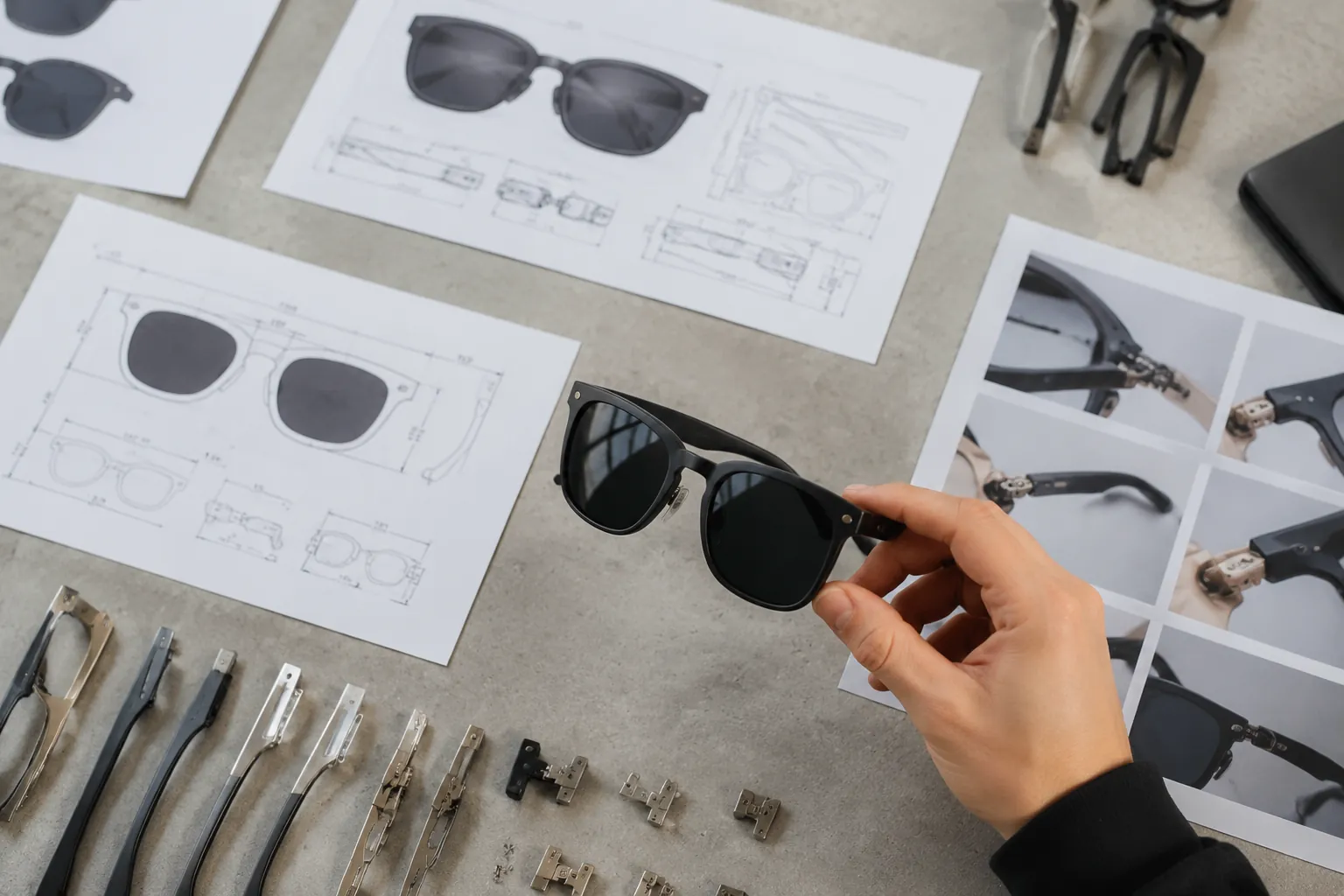
This guide is for resorts, water-sports brands, distributors, fishing retailers, and beach shops buying floating sunglasses in volume. It explains why a finished pair floats or sinks, where buoyancy is lost in production, and how to write a factory specification that can be checked in bulk. It covers materials, frame geometry, hinges, lenses, decoration, testing, compliance, MOQ, and lead-time planning. Use it as a purchasing and QC framework. Do not use it as a substitute for factory testing or accredited laboratory testing where your market requires it.
Start With the Failure Mode: Why Floating Sunglasses Sink
Floating sunglasses float only when the complete assembled product has enough buoyant volume to offset every heavier part. A bare injected frame may float during sampling. Then it sinks after lenses, screws, hinges, logo plates, coatings, and retail accessories are added. This is a common sourcing failure in water-retail eyewear.
Approve float performance on the finished SKU exactly as it will be sold and used: frame, lenses, hinges, screws, nose pieces, temple decoration, leash connector, and any permanently attached cord or tag. If a strap is included in the package but not normally attached during use, test both with and without it. Make the claim precise.
Small weight changes matter. TAC polarized lenses are often heavier than basic PC lenses of the same shape. Spring hinges and metal temple plaques add dense weight near the outside of the frame. Adhesive-backed metal badges on both temples can turn a safe sample into a marginal one if the original float margin was thin.
Buyer rule: approve float performance only on the complete decorated sample. A CAD rendering, resin name, or bare frame is not proof that the finished sunglasses will float.
Material Decision Matrix: Density, Feel, and Processing
Most true floating sunglasses use injection-molded low-density plastics. The material must be light enough for the final assembly to float, stable enough to hold lenses, and compatible with color, printing, hinge insertion, and normal retail handling.
Modified PP is often a practical starting point because many grades have low density and efficient injection-molding behavior. TPE or soft-touch blends can improve wet grip and comfort, but ink adhesion, surface marking, and dimensional stability must be verified on production-intent samples. TR-type plastics vary by grade. Do not assume float performance from the material family name.
Acetate is usually a poor choice for true floating sunglasses. It has a premium feel and rich pattern options, but it is relatively dense and is commonly processed by cutting, tumbling, and polishing rather than simple injection molding. It can work for resort fashion eyewear. It should not be marketed as floating unless the fully assembled pair passes the buyer's defined water test.
For floating programs, injection molding is usually the most controllable route. Wall thickness, ribs, hinge boss strength, color masterbatch, and internal structure can be engineered into the tooling. Decoration methods such as pad printing, laser engraving, and metal logo application must be evaluated before bulk approval because they affect appearance and final weight.
| Material option | Typical float suitability | Best use | Production watch-outs |
|---|---|---|---|
| Modified PP | High, when the frame has enough volume | Resort retail, promotions, large-volume beach programs | Can feel flexible; hinge boss needs ribs and enough wall thickness |
| TPE / soft-touch blend | Medium to high, depending on grade and design | Water sports, kids' styles, grippy temples | Surface can mark; pad-print ink adhesion and sunscreen resistance should be tested |
| Lightweight TR-type plastic | Medium; grade-specific | More premium retail styles | Do not assume it floats with TAC lenses or spring hinges; test the finished sample |
| PC frame | Low to medium | Clear colors, rigid styles, impact-focused designs | Density may be too high unless geometry adds enough buoyant volume |
| Acetate | Usually low | Premium beach fashion, non-floating resort eyewear | Generally too heavy for floating claims; longer production route and higher polishing cost |
Frame Geometry: Buoyancy Is Built Into the Shape
Material choice is only part of the answer. The frame must contain enough buoyant volume to carry the lenses and hardware. Thicker temples, wider fronts, one-piece bridges, and plastic-supported hinge zones can improve float margin. Thin fashion silhouettes, narrow metal-look fronts, and oversized lenses can remove it fast.
Specify the shape around the float requirement. Do not treat buoyancy as a material feature. Medium-to-thick temple sections, integrated molded bridges, and reinforced plastic hinge zones are usually safer than ultra-thin temples, separate dense inserts, or decorative hardware.
Wall thickness needs control. Too thin, and the frame may warp or weaken. Too thick, and the part may show sink marks, longer cooling time, and dimensional variation.
- Temple width: broader temples add buoyant volume and provide space for pad printing, laser engraving, or molded texture.
- Lens size: oversized lenses increase assembly weight. Check float performance early if using large shields, wrap lenses, or TAC polarized lenses.
- Bridge design: one-piece molded bridges are lighter and more predictable than separate metal or dense rubber bridge inserts.
- Hinge zone: reinforce the hinge boss with ribs or sufficient material around the screw area; water users often twist frames during active use.
- Drain behavior: avoid hidden cavities that trap water. Trapped water can make the sunglasses sit lower after immersion.
- Fit tolerance: specify even temple opening, no obvious rocking on a flat surface, and lens seating with no gaps or rattling.
A simple buyer-side screen is to submerge the finished sunglasses below the water surface, release them, and confirm that they resurface and remain visibly floating. Write the depth, water type, temperature, and test duration into the purchase specification. The factory and buyer must test the same way.
Hinge Choices: Durability, Corrosion, Weight, and Cost
Hinges affect buoyancy, durability, corrosion risk, and perceived quality. A low-cost poolside giveaway may be acceptable with a simple pin hinge if durability expectations are modest. A paddleboard, fishing, kayak, or seaside retail SKU needs stronger alignment, smoother temple movement, and better corrosion resistance.
Every hinge upgrade adds cost. It may also add weight. Validate hinge selection with the final float test, not before it.
For mainstream retail floating sunglasses, a reinforced standard metal hinge is often the best balance. Spring hinges can improve comfort and fit range, but the spring box adds weight and creates more metal surfaces that must resist corrosion. For marine or seaside programs, request stainless screws or another documented corrosion-resistant screw specification. Add saltwater exposure to sample evaluation.
After immersion and drying, hinges should still open smoothly. No red rust staining. No frozen screws. No visible corrosion residue around plated parts.
| Hinge type | Best use | Cost impact | Float and QC risk |
|---|---|---|---|
| Pin hinge | Low-cost resort giveaways and simple beach retail | Low | Lower twist durability; alignment must be checked closely |
| Standard metal hinge | Mainstream retail floating sunglasses | Low to medium | Requires screw quality control and consistent hinge insertion |
| Spring hinge | Lifestyle comfort styles and premium fit programs | Medium | Heavier; can reduce float margin and increase corrosion points |
| Integrated molded flex hinge | Kids' styles and lightweight sports frames | Mold-dependent | Material fatigue must be tested through repeated open-close cycles |
Include hinge cycling and alignment in pre-production inspection. If hinge durability is a selling point, define the cycle count or inspection method in the buyer's spec. At minimum, approved samples should be opened and closed repeatedly to check for loose screws, cracking around the hinge boss, squeaking, uneven temple tension, and temple misalignment.
Lens Specification: Float First, Then Check Compliance
Lenses affect assembly weight and regulatory compliance. Common choices include PC and TAC polarized lenses. Nylon may be used for higher-performance projects where the price point supports it.
PC is often selected for low weight and cost control. TAC polarized lenses add a clear retail benefit for fishing, boating, driving, and beach glare, but the final frame must be retested. Lens thickness, shape, and material construction change the total weight.
Define lens material, filter category or visible light transmission target, tint, UV claim, coating, and destination-market standard before sampling. Do not approve tint by digital image. Smoke, brown, green, mirror, and gradient lenses can look different under daylight, store lighting, and against different skin tones.
For market access and buyer files, request documents that match the destination market and product claim. Relevant standards and documentation may include CE EN ISO 12312-1 for the EU, ANSI Z80.3 for the U.S., AS/NZS 1067 for Australia and New Zealand, REACH restricted-substance documentation for the EU supply chain, and FDA registration information where applicable. ISO 9001 and BSCI may support factory management and social-compliance review, but they do not replace product optical testing or a compliant sunglass test report.
- Select lens material: PC for weight and cost control, TAC polarized for glare reduction, nylon only when the performance brief and price point justify it.
- Confirm the UV claim, filter category or transmission range, and destination-market standard before bulk production.
- Approve physical tint samples, including mirror color and coating appearance, under realistic lighting.
- Run buoyancy testing after final lens selection. A frame that floats with PC lenses may sit lower or fail with TAC polarized lenses.
- Check lens fit after assembly: no gaps, no rattling, no whitening at the lens edge, and no warped front curve.
For resort and beach retail assortments, buyers often separate lens options by use case: smoke for general retail, brown for contrast, mirror for display impact, and polarized lenses for higher-priced water or fishing SKUs. Treat each lens version as its own SKU if weight, tint, coating, or thickness changes.
Branding and Decoration Without Losing Float Margin
Decoration is a frequent failure point. A buyer approves a blank floating sample, then adds metal temple badges, thicker logo plates, heavy charms, or an attached accessory. The decorated production piece may float poorly. It may sink.
Include branding in buoyancy testing from the start. Pad printing is usually the lowest-weight option. It adds little mass and works well on broad temple surfaces when the ink system matches the plastic. Laser engraving is clean and durable, but contrast depends on base color and material response. Metal plates create a premium cue, but they add dense weight and require adhesive, heat staking, or mechanical fixing. Test the final version.
- Lowest weight: one- or two-color pad print on one or both temples.
- Subtle durable option: laser logo on suitable temple colors, verified for readability and consistency.
- Highest weight: metal plaques, especially if applied to both temples.
- Texture option: molded logo or raised temple pattern, useful when developing a private mold.
- Adhesion checks: test logo durability after exposure to water, sunscreen, sweat simulation, and handling.
Packaging does not usually affect frame buoyancy unless it remains attached during use. It does affect landed cost, carton size, shelf presentation, barcode handling, and inspection requirements. Specify microfiber pouches, hang tags, printed boxes, UPC labels, and retail display trays before quotation so the unit cost and carton plan are realistic.
Testing Plan and QC Points for the Purchase Spec
A serious floating sunglasses order needs a written test plan. The word "float" in an email is not enough.
The purchase specification should define the approved material, color, frame design, lens, hinge, screw, logo method, accessory, packaging, test method, acceptable result, and inspection reference sample.
For each approved pre-production sample, test the finished sunglasses in fresh water at a defined temperature range. For boating, fishing, surfing, or seaside resort use, also test in saltwater or a saltwater solution defined by the buyer. Record whether the sunglasses resurface after submersion, how they sit in the water, whether any part remains visibly above the waterline, and whether the float position changes after the agreed test duration.
After drying, inspect hinge movement, screw discoloration, lens coating condition, logo adhesion, trapped water, and frame deformation. If the product includes a leash, pouch, hang tag, or other accessory that may be attached during use, specify whether it is included or excluded from the float claim.
Dimensional QC matters as much as buoyancy. Poor lens fitting can stress the front and cause warping. Hinge misalignment makes temples sit unevenly on retail racks. A practical visible-alignment requirement is no obvious rocking when the opened frame is placed on a flat surface. Lens fit should show no open gaps, no rattling, and no forced-insertion whitening around the lens edge.
Factory-floor advice: approve a golden sample with the exact material, lens, hinge, screw, logo, color, accessory, and packaging. Require bulk QC against that sample and the written specification, not against a drawing alone.
MOQ, Cost, and Lead-Time Planning
Floating sunglasses can be produced from an existing mold or developed with a private mold. Existing molds are faster and better for first-season sell-through tests. Private molds make sense when the buyer needs a protected shape, exact buoyancy balance, signature temple branding, or a fit not available from open tooling.
MOQ, price, and lead time depend on the supplier, mold availability, color requirements, lens type, hinge selection, decoration method, packaging, inspection level, and required documents. Low-volume orders are useful for resort pilots, gift shop trials, influencer kits, and distributor samples. Unit cost is usually higher because setup, color change, printing, QC, and packing time are spread across fewer units.
Larger orders generally improve unit economics. They also raise the cost of mistakes. Lock the pre-production sample before scaling.
| Order scenario | Typical specification | Lead-time logic | Buyer note |
|---|---|---|---|
| Small pilot order | Existing mold, simple color, PC lens, pad print | Fastest route if the mold, lens, and logo method are already validated | Good for sell-through testing; unit cost is higher |
| Mid-size retail test | Existing mold, custom colors, optional polarized lens | Allow time for color chips, tint samples, logo adhesion checks, and float testing | Confirm lens tint and logo method before deposit |
| Seasonal distributor program | Retail packaging, multiple lens colors, formal QC plan | Allow added time for packaging proof, barcode review, inspection plan, and compliance files | Each lens and decoration version should be treated as a separate approval item |
| High-volume private-label program | Optimized material, custom decoration, possible private mold | New tooling, fitting trials, float-margin checks, and compliance testing add development time | Best unit economics, but confirm float performance before locking tooling |
For a clean quotation, give the factory your destination market, selling channel, target retail position, expected use claim, lens requirement, branding method, packaging format, inspection requirement, and required documents. A pool giveaway and a polarized fishing retail SKU should not share the same specification.
Have a custom sunglasses project in mind?
Send us your styles, target market and quantities and we will return a detailed quote with MOQ, lead time and a sample plan.
Get a QuoteWhy source this from Wenzhou with LumiShades
Wenzhou in Zhejiang Province is widely regarded as China’s eyewear manufacturing capital, producing a large share of the world’s sunglasses. That concentration matters to buyers: a deep local supply chain for acetate sheet, hinges, lens blanks, plating and packaging means shorter component lead times, easier color and material matching, and a workforce with decades of eyewear-specific skill. LumiShades has manufactured in this ecosystem since 2009, and our vertical integration — in-house injection molding, acetate cutting, CNC milling, lens tinting, decoration and quality control — means no part of your order is quietly subcontracted to a workshop you cannot audit.
For international buyers, that vertical control translates into accountability. When a single factory owns every step, defects are traced and fixed at source rather than bounced between vendors, and your specifications survive intact from first sample to bulk. We back this with 15+ years of experience, shipments to 60+ countries, more than 5 million pairs produced per year and a 98.5% on-time delivery rate. Our certifications — CE EN ISO 12312-1, FDA registration, ANSI Z80.3, AS/NZS 1067, REACH, ISO 9001 and BSCI audit — mean the compliance documentation your market requires already exists. Explore our manufacturing capabilities and quality control process to see how this works in practice.
Frequently asked questions
Can floating sunglasses use polarized lenses? Yes, but approve them as a separate finished SKU. TAC polarized lenses can be heavier than basic PC lenses, so test the fully assembled and decorated sunglasses with the exact polarized lens, hinge, logo, and accessory package. Do not rely on a float result from the same frame with non-polarized PC lenses.
What is the safest material for floating sunglasses? There is no universally safe material without finished-product testing. Modified PP is often a practical starting point because many grades are low density and injection mold efficiently. TPE blends can work when grip and comfort are important, but surface marking, ink adhesion, and dimensional stability should be checked. Approve the final decorated sample, not just the resin name.
Which compliance documents should we request for the U.S., EU, and Australia? Match documents to the destination market. For the EU, request CE documentation and testing to EN ISO 12312-1, plus REACH restricted-substance information where relevant. For the U.S., request ANSI Z80.3 test documentation and FDA registration information where applicable. For Australia and New Zealand, request AS/NZS 1067 documentation. ISO 9001 and BSCI can support factory review, but they do not replace product test reports.
Will metal logos make floating sunglasses sink? Not automatically, but metal logos reduce float margin because they add dense weight. If metal plaques are required, include their exact size, placement, attachment method, and adhesive or fixing hardware in the approved sample. Then run the freshwater and, if relevant, saltwater float test on that fully decorated version before bulk production.
What should a buyer include in a floating sunglasses purchase specification? Include frame material and color, lens material and tint, UV and market-standard requirements, hinge and screw type, logo method, accessory details, packaging, float-test method, acceptable float result, inspection level, and the approved golden sample reference. If any part changes after approval, such as lens type or temple badge, repeat the float test.
How should we plan MOQ and lead time for a resort trial order? Use an existing mold when speed and risk control matter more than exclusivity. Ask the supplier to quote the actual MOQ by design, color, lens option, and logo method. Confirm sample timing, bulk timing after approval, and document timing separately. Do not place the bulk order until the decorated sample has passed the agreed float test and lens/tint approval.
Should we develop a private mold for floating sunglasses? Use an existing mold for first orders, seasonal tests, or uncertain demand. Consider a private mold when you need a protected shape, a specific fit, molded branding, controlled buoyancy margin, or a temple design that avoids heavy add-on decoration. Before cutting final tooling, confirm the target lens, hinge, logo, and float requirement so the mold is designed around the actual assembly weight.
Ready to start?
Explore our wayfarer sunglasses or request a quote — our sales team replies within 12 hours.
Request a Quote