
Why Eyewear Frames Crack at the Hinge Before Bulk Production
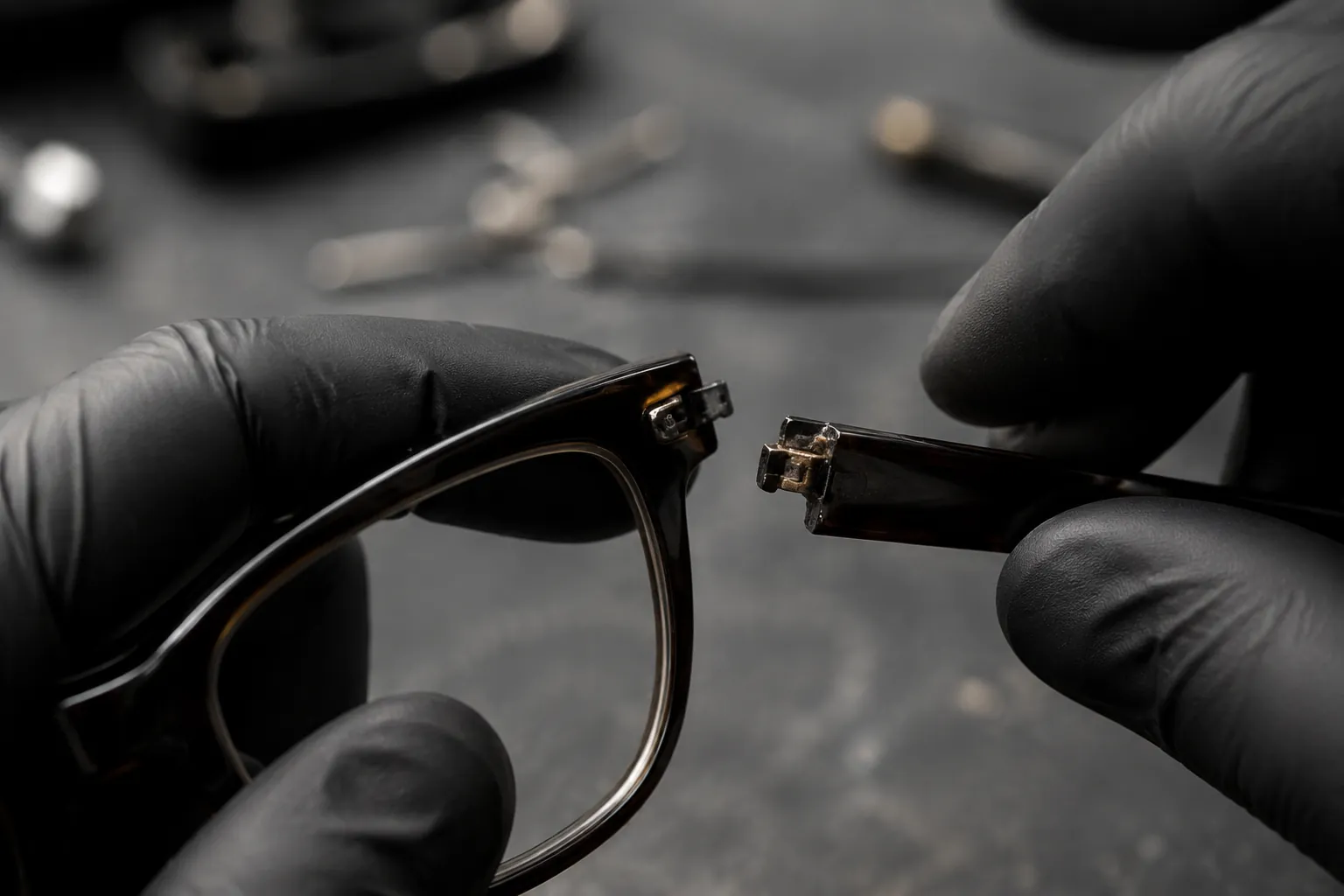
This guide is for brand owners, importers, distributors, and retail buyers sourcing custom sunglasses at volume. Cracks around the hinge area are a common return issue. They may show up after assembly, during shipping, or soon after the product reaches consumers. Most are not random. They usually trace back to design geometry, machining, assembly stress, or weak process control. Review the hinge zone early. Confirm how the factory builds it. Then inspect for stress, not just cosmetics. That is how you reduce avoidable claims before bulk shipment.
Where hinge cracks start
Buyers often call any break near the temple connection a hinge failure. Usually, the hinge is not the first part to fail. The surrounding frame material cracks first. Then the hardware loosens, shifts, or pulls out.
Most cracks start in one of four places:
- Injection-molded front or temple: the inside corner near the hinge insert, screw boss, or molded hinge pocket.
- Acetate temple: the milled edge of the hinge pocket, especially where the remaining wall is too thin or uneven.
- Riveted construction: the rivet entry area, where local compression and repeated movement concentrate stress.
- Mixed-material frame: the transition zone between a rigid metal core and a more flexible polymer shell or cover.
The hinge zone takes repeated opening force, torsion, and local compression. It may also absorb heat from polishing, force from screw installation or riveting, and extra stress from decoration placed too close to the hinge end of the temple. Once stress builds, the first visible sign is often whitening, crazing, or a fine line at an inside corner. Keep using the frame, and that line can turn into a full crack.
Over-extension is another common cause. If the frame opens beyond the angle intended by the design or hinge stop, the extra leverage transfers into the material around the hinge seat. Retail handling makes this worse. Display samples get opened again and again.
The point is simple. Hinge-area cracking is usually a design-and-process problem. Not random breakage. A supplier that reviews geometry, material condition, and assembly force during development is far more likely to control it than one that relies on final cosmetic inspection.
Failure modes by frame type
| Frame type | Typical crack location | Root cause | What to verify before bulk |
|---|---|---|---|
| Injection molded PC or TR90-style front | Inside corner beside hinge insert or screw boss | Wall section too thin, sharp internal radius, poor weld line location, excessive assembly stress, high molded-in stress | Confirm wall-thickness consistency on drawings and samples, review internal radii, compare samples from different cavities if applicable, check hinge pull resistance and repeated open-close performance on assembled samples |
| Acetate front or temple | Milled hinge pocket edge or rivet area | Pocket milled too deep, remaining wall too thin, residual sheet stress, heat damage or drying at the edge after finishing | Measure pocket depth during production, confirm minimum remaining wall on drawings and samples, inspect under side light for whitening, review rest or conditioning steps after machining and polishing |
| Mixed material temple with metal core and plastic cover | Transition line over the core end or bond interface | Different flex behavior, weak adhesion, torsion concentrated where the rigid core ends | Check bond consistency, compare samples before and after heat exposure, review core-end placement, and inspect for cracking after twist and repeated opening tests |
| Temple with metal logo plate near hinge | Around logo slot, pin hole, or plate edge | Too many cut features in a short zone, reduced material bridge, added stress during plate installation | Specify minimum hinge-to-decoration distance, define minimum remaining bridge on drawings, and test assembled decorated samples rather than undecorated prototypes |
Injection parts and acetate parts usually do not fail for the same reason. The fix cannot be generic. If a supplier answers every hinge crack complaint with "we will improve QC," push further. Ask what actually went wrong: molded stress, pocket depth variation, rivet compression, screw-installation force, alignment error, or decoration layout. No root cause, no real fix.
Design choices that lower risk early
The cheapest correction happens at drawing stage, before tooling, CNC programming, or decoration fixtures are locked. After that, every change gets slower and more expensive.
- Preserve material around the hinge seat. Do not thin the hinge zone too aggressively for styling. A slimmer profile may look better, but it can leave the hardware area under-supported.
- Use radiused internal corners. Sharp inside corners often start cracks. Smoother transitions reduce stress concentration and are easier to control in molding and machining.
- Match hinge size and construction to temple mass and leverage. A heavier or wider temple puts more repeated load on the hinge area. Review hardware and surrounding structure together.
- Control alignment and screw engagement. If hinge barrels are misaligned and the screw must be forced through during assembly, the frame absorbs that stress. Damage may not show immediately.
- Keep decoration away from the hinge zone. Metal logo plates, slots, pins, hot-stamped recesses, and deep embossing near the first section of temple length can weaken an already stressed area.
Buyers should specify measurable geometry in the tech pack, not just appearance. Useful callouts include:
- Minimum remaining wall around the hinge pocket or insert area
- Pocket depth tolerance
- Distance from hinge seat to the first decorative feature
- Opening-angle target or stop behavior
- Approved hinge type, barrel count, screw specification, and finish
An integrated factory may have an advantage because molding, acetate cutting, CNC milling, decoration, and assembly can be reviewed together. That helps. It does not replace a documented design review or clear dimensional standards.
What goes wrong on the factory floor
A sound design can still fail in production. Hinge-area cracks are often tied to process variation that looks minor on paper but matters a lot in a high-stress zone.
Injection molding: Material flow near the hinge side can create weld lines or residual stress around inserts, bosses, or section changes. Gate location, cooling balance, and packing conditions all affect how much stress stays in the part after molding. A frame may look fine out of the mold and still crack later after assembly or transport.
Acetate CNC milling: A pocket cut too deep reduces the remaining wall that supports the hinge. Tool wear, incorrect zero setting, fixture movement, or station-to-station variation can repeat the same weakness through bulk production if checks are weak.
Polishing and barrel finishing: Excessive heat or over-processing at the edge can make stress more visible and may weaken thin areas around milled pockets or rivet zones. A glossy finish proves very little. Side-light inspection after finishing is more useful for spotting whitening and early stress marks.
Assembly force: Over-tight screw installation and forced alignment are common avoidable causes. If operators work by feel alone and tools are not controlled, one line may build stress into the hinge area while another does not.
Logo plate installation: Press-fit pins, drilled holes, and riveted decorations near the hinge can create a second stress concentration beside the first. This is especially risky on slim temples where bevels, hinge pockets, and logo features all compete for the same material.
Good factories should be able to trace hinge-related defects by material lot, mold cavity or CNC station, assembly line, operator, and decoration method. Without traceability, root-cause analysis is mostly guesswork.
A buyer QC checklist that catches early cracks
Generic AQL inspection is not enough for hinge durability. Buyers need targeted checks that focus on assembly stress and early crack initiation.
- Visual inspection after assembly: Use strong side light and, if available, low-power magnification to check for whitening, crazing, hairlines, sink around inserts, or stress marks around rivets and hinge pockets.
- Repeated open-close check: Use a defined method on assembled samples from each lot or production segment. The goal is to reveal whitening, looseness, screw migration, or early crack formation under repeated movement.
- Over-extension review: Open the temple to the intended stop and review how the frame behaves if handling goes slightly beyond normal use. This matters for retail programs likely to be over-handled on display.
- Screw-installation control review: Ask the factory what tool is used, how screw installation is standardized, how alignment is checked, and how the line verifies consistency. "Operator experience" is not a control plan.
- Drop and transit simulation: Some cracks appear only after finished goods are packed and moved. Test the final packaged product, not just loose showroom samples.
Outgoing QC samples should be representative. Pull units from start, middle, and end of production, and from multiple cavities or CNC stations when relevant. If one cavity or one milling setup is producing a weaker hinge area, selective sampling can miss it.
Useful buyer questions include:
- Which cavity or station produced the failed sample?
- Was hinge-pocket depth checked during production, or only on the first article?
- Did bulk use the same hinge and decoration construction as the approved sample?
- Did final inspection include an assembled stress check, or only cosmetic review?
These questions move the discussion from reassurance to evidence.
Sampling, MOQ, price, and lead-time logic
Hinge-risk control matters on small orders as much as on large ones. Sometimes more. Small programs often carry more technical risk because development gets compressed to meet launch timing or cost targets.
Low MOQ can be commercially useful. It does not remove the need for engineering review. A short run built on an unproven hinge layout can fail just as easily as a large production run. Keep the commercial discussion separate from technical validation.
- Sampling stage: Approve samples only after checking actual hinge construction, decoration placement, assembly quality, and post-assembly stress around the hinge zone.
- Pre-production stage: Confirm that the bulk build uses the same hinge type, same pocket geometry, same decoration method, and same assembly approach as the approved sample.
- Bulk stage: Make sure the factory continues process checks during production rather than relying only on first-article approval and final appearance review.
Lead time matters too. A realistic production window should allow time for:
- Pre-production sample confirmation
- Material and hardware verification
- First-article hinge review
- In-line process control
- Final outgoing QC
If a supplier says there is no time for those checkpoints, the schedule is probably too tight. Fast delivery has value. So does not shipping avoidable failures.
When comparing quotations, do not look only at price or MOQ. Ask whether the supplier has allowed enough development and process-control time to build the hinge zone consistently in bulk.
Compliance matters, but it will not stop cracking
Buyers often mix up compliance and durability. They are related. They are not the same.
Documents and standards such as CE EN ISO 12312-1, ANSI Z80.3, and AS/NZS 1067 relate to sunglass performance and market requirements, depending on the destination market. REACH covers restricted substances. FDA registration may matter for US importer documentation and market access. ISO 9001 and BSCI refer to management-system or audit status.
None of that proves a hinge pocket was machined correctly, assembly force was controlled, or a logo plate was placed far enough from a stress zone. A frame can meet market-document requirements and still crack in use if the hinge area was poorly designed or poorly processed.
The practical order is straightforward:
- Confirm hinge-zone design robustness
- Confirm process control during molding, machining, decoration, and assembly
- Confirm compliance documents for the destination market
That order matters. Compliance supports shipment approval and market entry. It does not replace durability review.
What to put in your PO and tech pack
If hinge cracking has caused claims before, write preventive controls directly into the purchase order and tech pack. Verbal expectations drift.
- State frame material clearly, including the approved resin or acetate reference if relevant, because substitutions can change stiffness and crack behavior.
- Freeze hinge specification: hinge type, barrel count, size, screw specification, finish, and approved source if the hardware is critical.
- Call out minimum material thickness around the hinge pocket, insert area, or rivet zone on drawings.
- Define pocket depth and any critical tolerance that controls the remaining wall.
- Limit decoration near the hinge. If using metal logo plates or pins, specify minimum distance from the hinge seat and minimum material bridge.
- Require approval-sample sign-off using the same hinge, same decoration construction, and same assembly method planned for bulk.
- Require outgoing QC focused on whitening, hairline cracks, hinge alignment, and post-assembly stress marks.
- Define acceptance criteria for hinge feel, screw retention, and visible stress after the agreed sample check method.
This level of detail cuts ambiguity. If the tech pack says only "acetate temple with logo," the factory still has broad room to improvise. If it specifies hinge geometry, minimum remaining wall, logo position, approved hardware, and inspection checkpoints, the production team has a clear standard.
Good frames do not survive by luck. Treat the hinge zone as a high-stress feature in design, machining, assembly, and inspection.
Have a custom sunglasses project in mind?
Send us your styles, target market and quantities and we will return a detailed quote with MOQ, lead time and a sample plan.
Get a QuoteWhy source this from Wenzhou with LumiShades
Wenzhou in Zhejiang Province is widely regarded as China’s eyewear manufacturing capital, producing a large share of the world’s sunglasses. That concentration matters to buyers: a deep local supply chain for acetate sheet, hinges, lens blanks, plating and packaging means shorter component lead times, easier color and material matching, and a workforce with decades of eyewear-specific skill. LumiShades has manufactured in this ecosystem since 2009, and our vertical integration — in-house injection molding, acetate cutting, CNC milling, lens tinting, decoration and quality control — means no part of your order is quietly subcontracted to a workshop you cannot audit.
For international buyers, that vertical control translates into accountability. When a single factory owns every step, defects are traced and fixed at source rather than bounced between vendors, and your specifications survive intact from first sample to bulk. We back this with 15+ years of experience, shipments to 60+ countries, more than 5 million pairs produced per year and a 98.5% on-time delivery rate. Our certifications — CE EN ISO 12312-1, FDA registration, ANSI Z80.3, AS/NZS 1067, REACH, ISO 9001 and BSCI audit — mean the compliance documentation your market requires already exists. Explore our manufacturing capabilities and quality control process to see how this works in practice.
Frequently asked questions
Which material is most likely to crack at the hinge: injection plastic or acetate? Either can crack, but the failure mode is usually different. Injection parts more often fail because of thin wall sections, sharp internal corners, weld lines, residual molded stress, or stress around inserts and screws. Acetate more often fails because the hinge pocket is cut too deep, the remaining wall is too thin, the rivet area is overstressed, or finishing exposes stress at the edge. Do not ask only which material is stronger. Ask how the supplier builds, measures, and checks the hinge area for that specific construction.
How many open-close cycles should I ask a factory to test? There is no single cycle number that proves durability for every eyewear program. What matters is a defined, repeatable method applied to assembled samples from bulk-representative production. Ask the factory to document sample size, opening angle, speed or method, pass-fail criteria, and what is checked afterward, such as whitening, screw migration, looseness, or visible crack initiation. If your market involves heavy retail handling or frequent try-on, ask for a tougher internal screening method than a basic sample demonstration.
Can a five-barrel hinge solve cracking by itself? No. A larger or stronger hinge does not fix a weak surrounding structure. If wall thickness is too low, pocket geometry is poor, assembly is forcing misalignment, or decoration has removed too much material, a bigger hinge may simply transfer load into the same weak zone. When reviewing a proposed fix, ask the supplier for three things together: the hinge specification, the local frame-section drawing around the hinge, and the assembly method used in bulk.
Should I avoid metal logo plates near the hinge? Not always, but they need strict layout control. Logo plates, pins, holes, and slots can remove material or create local stress near an area that already carries load. If you want decoration close to the hinge, require the supplier to show the exact position on the drawing, define the minimum remaining material bridge, and provide assembled decorated samples for review. Do not approve hinge durability based only on undecorated prototypes if bulk will include metal branding in that zone.
Do CE EN ISO 12312-1 or ANSI Z80.3 prove the frame will not crack? No. These standards address sunglass performance and market requirements, such as optical and labeling-related criteria. They do not prove hinge durability. A compliant sunglass can still fail in the hinge area if the frame is poorly designed or assembled. Treat compliance documents and hinge-risk review as separate workstreams. For durability, ask for drawing controls, process checks, and post-assembly inspection evidence specific to the hinge zone.
Is a low MOQ too small to do proper durability checks? No. MOQ is a commercial term, not a technical reason to skip validation. Even on a small run, buyers should still confirm hinge geometry, review decorated assembled samples, and perform a defined repeated-opening and visual stress check. If the supplier argues that the order is too small for proper review, treat that as a risk signal. A smaller order may justify simpler packaging or fewer customization steps. It does not justify weaker control of a known failure area.
Ready to start?
Explore our rimless sunglasses or request a quote — our sales team replies within 12 hours.
Request a Quote