
Metal-Core Wire Frames for OEM Sunglasses
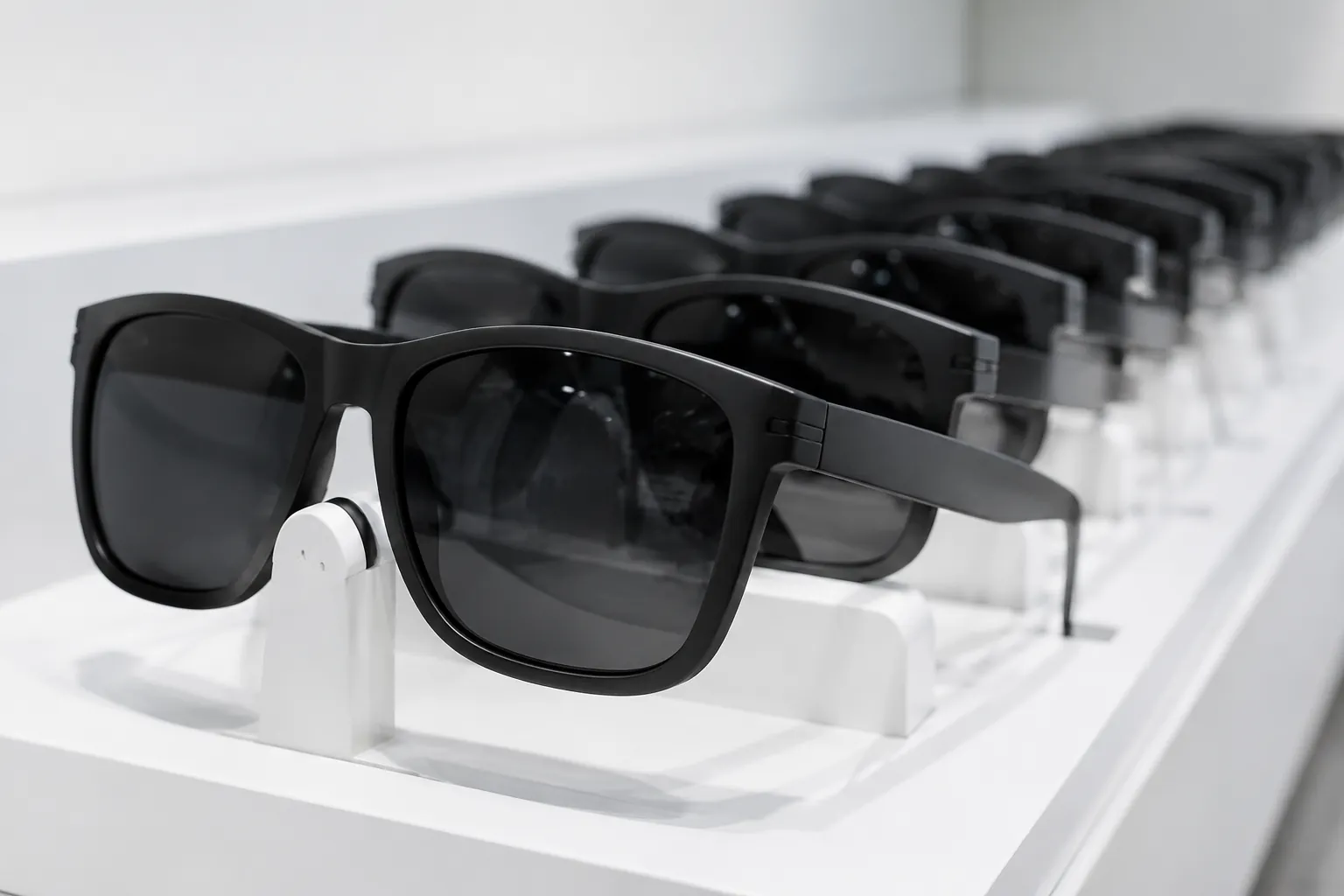
If you buy sunglasses for a brand, import business, distribution program, or retail chain, metal-core wire frames deserve a look. They can improve temple stiffness, shape retention, and the feel of the frame, but only if the factory controls insertion, heating, assembly, and finishing. This guide explains where metal-core construction fits, where it does not, and what to check before you place a production order.
What a metal-core wire frame is
A metal-core wire frame is still a plastic-frame product. The difference is inside the temple. A metal wire or shaped insert sits within the plastic to improve stiffness, alignment, and shape retention. In most OEM sunglasses programs, the core is inside acetate temples, injected temples, or hybrid constructions where the front stays plastic and the temples carry the reinforcement. It is not a full metal frame. It is a plastic frame with internal structure.
The value is control. A temple core is usually a thin metal wire or strip formed to match the temple curve, hinge angle, and endpiece line. Once it is inserted and secured, the frame resists twisting better than a hollow plastic temple. It also keeps its shape better during normal handling. That matters on sunglasses that will be worn often, packed for export, and reordered later.
The core changes how the frame feels too. A standard plastic temple can feel light or hollow. A well-made metal-core temple feels denser and steadier, especially at the hinge and behind the ear. The buying issue is not decoration. It is consistency. The frame should sit level, open evenly, and keep its curve after transport and use.
At the factory, sequence matters. The core must be cut to length, deburred, formed, placed at the right depth, and secured before final finishing. If the core is off-center or loose, the left and right temples can drift out of symmetry. On a premium OEM program, that shows up fast.
Why buyers choose metal-core construction
Buyers usually choose metal-core construction for four reasons: a more premium feel, better fit control, stronger temples, and more repeatable production. It is not about flash. The best metal-core sunglasses look restrained. The value comes from structure and consistency.
Commercially, metal-core frames sit between basic injected plastic frames and fully metal frames. They usually cost more than a simple plastic style, but they can avoid the higher part count and more complex finishing of an all-metal build. That makes them useful for private label sunglass programs that want a better feel without stepping into a more expensive frame category.
- Stiffer temples reduce the loose feel common in low-cost plastic sunglasses.
- Core wire helps the factory hold temple curve and face fit across size runs and reorder batches.
- It supports premium decoration methods such as laser engraving, pad printing, foil details, and metal logo plates.
- It gives brands a cleaner silhouette than bulky plastic-only frames while keeping production simpler than full metal.
For importers, the case is strongest when the target retail price needs a clear upgrade in feel and appearance. A well-made metal-core style can sit above commodity sunglasses in perceived quality without the corrosion management, plating complexity, and tooling approach of a fully metal collection.
Where metal-core frames beat standard plastic frames
Standard injected plastic sunglasses are usually the lowest-cost option. They can also be produced quickly. That is the main draw. But they can feel softer in the temples, and they can drift more in alignment if cooling, material choice, or mold condition is not well controlled. A metal-core structure improves recovery and helps fitting stay more repeatable, especially on repeat orders where the buyer expects the second run to match the first.
The table below shows the trade-off in buyer terms.
| Option | Typical buyer use | Strengths | Weak points |
|---|---|---|---|
| Standard injected plastic | Entry-price volume programs | Lowest cost, fast molding, simple QC, easy color changes | Less premium feel, weaker temple memory, higher warp risk if cooling is uneven |
| Metal-core temple | Mid-premium OEM sunglasses | Better rigidity, cleaner fit control, stronger temple return, more premium hand feel | More assembly steps, tighter tolerance control, higher rejection risk if the wire shifts |
| Full metal frame | Higher-end metal collections | Thin profile, strong brand perception, stable structure when well made | Higher cost, more parts, plating and corrosion considerations, more complex repair and QC |
Metal-core construction usually wins when the design needs structure but not a fully metallic look. It works well on acetate-style sunglasses, thicker fashion frames, and hybrid products where the buyer wants a more substantial silhouette. If the target is ultra-light sport eyewear, wrap-around performance product, or a very low-cost mass-market line, the extra structure may not justify the added cost.
There is also a durability angle. A good metal-core temple can help a frame survive more opening cycles before the hinge area feels loose. It does not make the product indestructible. It does not replace proper hinge design. Still, it can reduce the cheap or flimsy impression that often hurts repeat purchase in higher-end retail programs.
Manufacturing details that decide success or failure
Metal-core frames are only as good as the process behind them. The factory needs control over wire specification, insertion depth, heating time, alignment, and finishing order. If any one of those steps is loose, the bulk order can drift away from the approved sample.
A reliable production sequence usually looks like this: the wire is cut and formed, the temple or front component is prepared, the core is inserted or overmolded, the assembly is cooled and stabilized, the hinge is mounted, and then final polishing, coating, printing, or plating is completed. After that comes fit verification, lens seat inspection, and final QC.
For OEM buyers, the key technical questions are simple. Ask what wire material is being used, such as stainless steel, spring steel, or another corrosion-resistant alloy, and ask for the wire diameter tolerance. Also ask for temple length tolerance, hinge alignment tolerance, and left-right symmetry targets. The exact acceptable tolerance depends on the style. What matters is whether the supplier can hold the same geometry on every batch and keep the finished pair free of visible tilt or uneven opening on the face.
Ask the factory to define which dimensions are checked on every batch and which are sampled. That distinction matters. A frame can look fine in a showroom and still fail under production load if the process has no measurable control.
- Confirm core wire material, diameter, bend profile, and surface finish.
- Verify insertion depth and temple symmetry before final polishing or coating.
- Measure hinge torque after assembly, not only during sample approval.
- Check lens seat or groove dimensions after finishing, especially on hybrid constructions.
- Inspect logo placement, print registration, and decoration adhesion after the last surface step.
Good buyers ask for control points in writing. They also ask which dimensions are measured on every batch and which are checked only by sampling. That is the fastest way to narrow the gap between a good sample and a weak bulk run.
Cost, MOQ, and lead time
Metal-core construction adds material cost, labor cost, and rejection risk. It also adds coordination time because the factory has to manage insertion, assembly, and finishing in the right order. The upside is that once the design is stable, volume pricing can still be attractive. For OEM sunglasses, the economics usually improve as order size rises and setup time is spread across more pairs.
LumiShades' MOQ starts at 50 pairs per design, which works for a market test, a buyer presentation, or a small launch run. Metal-core styles usually become more efficient at larger order sizes because setup and assembly costs are spread across more units. Exact pricing depends on frame structure, lens specification, decoration, packaging, and order volume.
The price band holds only when the design is locked. Add multiple colors, special plating, custom logo plates, polarized lenses, mirrored coating, or complex temple decoration, and unit cost changes. So does lead time, because each extra feature adds process steps and QC checkpoints.
| Order level | Buyer expectation | Cost effect | Lead-time pressure |
|---|---|---|---|
| 50 pairs | Sample-to-market test | Highest unit cost, setup cost dominates | Lower batch efficiency, more sensitivity to revision cycles |
| 300 pairs | Small launch or chain test | Better material use and setup spread | Scheduling improves if spec is frozen early |
| 1000 pairs | Repeat program | Clear unit-cost drop, better leverage on labor | Bulk QC and packing become the main risk points |
| 5000+ pairs | Core collection or seasonal volume | Best pricing leverage, strongest purchasing power | Tooling, capacity, and raw material planning become critical |
Typical samples take 7 to 10 days when the design details are clear and logo files are final. Bulk production usually takes 25 to 35 days for a straightforward order. If the buyer changes temple length, lens tint, decoration color, packaging, or logo placement after approval, that timeline extends.
The best way to control cost is to limit variables. One core wire spec, one temple length, one approved lens package, and one decoration method usually produce better pricing and better repeatability than a highly customized order with many small variants.
Compliance and testing buyers should ask for
For export sunglasses, compliance should be specific. Buyers should ask which standard the style is built to meet, which documents exist for the tested sample, and whether the finished bulk variant matches the sample that was tested. The certifications and standards that commonly matter in this category include CE EN ISO 12312-1, ANSI Z80.3, AS/NZS 1067, REACH, FDA registration, ISO 9001, and BSCI.
The key is matching the market. CE EN ISO 12312-1 is the relevant sunglasses standard for the EU. ANSI Z80.3 is the common benchmark for the U.S. market. AS/NZS 1067 applies to Australia and New Zealand. REACH covers restricted substances and matters especially where frame material, coatings, inks, adhesives, or metal decorations are involved. FDA registration is part of the U.S. regulatory picture, but it is not a substitute for product-specific testing.
Buyers should also ask exactly what was tested. The question is not just whether the style passed; it is which model, which colorway, which lens tint, and which decoration package were used in the test. A certificate on one black matte sample does not automatically cover a glossy finish, a different tint, or a version with a metal logo plate.
Buyer rule: Match the test record to the production SKU. Ask for the exact model code, lens color, coating, and decoration combination that were submitted for testing.
Decoration materials matter too. If the frame uses pad printing, foil, plating, or glued metal details, those components can affect chemical compliance and durability. A good factory will tell you whether the ink, plating, adhesive, or surface treatment was included in the test scope. If not, treat the product as unverified for that exact configuration.
Design choices that make metal-core frames worth it
Not every sunglasses design should use a metal core. The extra structure has to support the product story. The best candidates are frames where weight, shape retention, and premium feel help the item sell. Oversized fashion sunglasses, acetate-inspired silhouettes, and hybrid frames with longer temples are often good fits. A tiny minimalist style or an extreme-sport design may not need the added structure.
In practice, the best use cases are:
- Premium fashion sunglasses with acetate-style temples and a richer hand feel.
- Hybrid frames that need a more controlled temple curve and improved alignment.
- Private label programs that must repeat fit and appearance across multiple reorders.
- Retail assortments where the product has to justify a higher shelf price through build quality.
Decoration should be chosen early, not after the sample is approved. Laser engraving works well on exposed metal areas and can look clean if the surface is stable enough to hold detail. Pad printing is flexible and cost-effective, but it needs adhesion testing, especially on coated or polished surfaces. Metal logo plates can create a premium signal, but they add parts, adhesive risk, assembly time, and snag points. If the goal is smoother production and lower defect exposure, simpler decoration is usually the safer choice.
Buyers should also think about finish compatibility. A high-gloss polish can hide minor surface variation, but it may show fingerprints more easily. A matte or soft-touch coating feels modern, but it can be more sensitive to scratches and handling marks. The right choice is the one that matches the target customer, retail price, and expected reorder cadence.
A practical buyer checklist
Before you commit to a metal-core OEM sunglass program, lock the technical and commercial details in writing. That is the easiest way to prevent a polished sample from becoming a different bulk reality.
- Confirm the target market and the exact compliance standard required.
- Approve frame material, wire material, wire diameter, temple length, and hinge type.
- Freeze lens tint, UV requirement, polarization, mirrored finish, and lens color code.
- Specify decoration method, logo placement, and acceptable print or engraving tolerance.
- Request sample lead time, bulk lead time, carton details, and packing method in writing.
- Agree on QC checks for symmetry, hinge torque, lens fit, finish quality, and decoration adhesion.
If you are buying from LumiShades, use the factory strengths where they matter: in-house molding, acetate cutting, CNC milling, tinting, decoration, and QC. That reduces handoff mistakes and makes repeat orders easier to control. For overseas B2B buyers, repeatability is the real value. A sample is useful. The ability to reproduce that sample on the third reorder is what protects margin.
Ask for pre-production confirmation on dimensions, finish, and decoration before the bulk run starts. If the factory can show you the same control points on every order, metal-core construction becomes much less risky and much more useful.
How to decide if metal-core is right
Choose metal-core wire frames if your sunglasses need a better feel, tighter geometry, and a more premium presentation without moving into full metal pricing. Skip them if your main target is the lowest possible cost or if the design depends on very high flexibility. The material choice should serve the market. Not the mood board.
The decision test is simple. Ask whether the added structure helps the frame sell and stay consistent after production. If the answer is yes, metal-core is usually the right call. If the answer is no, simplify the build and save the cost for a better lens package, better decoration, or stronger packaging.
For brands and importers, that is the real purchasing decision: not whether the frame looks good on a sample card, but whether it holds shape, clears QC, and lands at the target cost on the second and third reorder. In an OEM sunglasses program, that is where the profit is won or lost.
Have a custom sunglasses project in mind?
Send us your styles, target market and quantities and we will return a detailed quote with MOQ, lead time and a sample plan.
Get a QuoteWhy source this from Wenzhou with LumiShades
Wenzhou in Zhejiang Province is widely regarded as China’s eyewear manufacturing capital, producing a large share of the world’s sunglasses. That concentration matters to buyers: a deep local supply chain for acetate sheet, hinges, lens blanks, plating and packaging means shorter component lead times, easier color and material matching, and a workforce with decades of eyewear-specific skill. LumiShades has manufactured in this ecosystem since 2009, and our vertical integration — in-house injection molding, acetate cutting, CNC milling, lens tinting, decoration and quality control — means no part of your order is quietly subcontracted to a workshop you cannot audit.
For international buyers, that vertical control translates into accountability. When a single factory owns every step, defects are traced and fixed at source rather than bounced between vendors, and your specifications survive intact from first sample to bulk. We back this with 15+ years of experience, shipments to 60+ countries, more than 5 million pairs produced per year and a 98.5% on-time delivery rate. Our certifications — CE EN ISO 12312-1, FDA registration, ANSI Z80.3, AS/NZS 1067, REACH, ISO 9001 and BSCI audit — mean the compliance documentation your market requires already exists. Explore our manufacturing capabilities and quality control process to see how this works in practice.
Frequently asked questions
What minimum order makes metal-core frames practical? LumiShades starts at 50 pairs per design, which works for sampling or a small launch. Metal-core styles usually become more cost-efficient as volume increases because setup, insertion, and assembly costs are spread across more units.
Do metal-core frames always cost more than injected plastic frames? Yes. They add material and labor cost, and they also require tighter QC. The gap usually narrows at higher volumes, but a metal-core frame still costs more than a basic injected plastic style with fewer assembly steps.
How long does sampling take for a metal-core sunglasses style? A straightforward sample is typically ready in 7 to 10 days when the design, wire spec, lens tint, and logo file are already approved. Changes to dimensions, decoration, or lens specification can extend that timeline.
Which compliance documents should I ask for on export orders? Ask for the documents that match your market and SKU: CE EN ISO 12312-1 for the EU, ANSI Z80.3 for the U.S., AS/NZS 1067 for Australia and New Zealand, and REACH where relevant. Also confirm whether FDA registration, ISO 9001, and BSCI documentation are available if they are part of the supplier's compliance file.
What tolerances matter most on metal-core frames? Focus on wire diameter, insertion depth, temple length, hinge alignment, and left-right symmetry. The key is not a single universal number; it is whether the factory can keep the approved geometry consistent across the whole batch and whether the finished pair sits level on the face.
Can metal-core frames support laser engraving and metal logo plates? Yes. Metal-core designs are commonly used with laser engraving, pad printing, and metal logo plates. The decoration method should be finalized before bulk production so the supplier can confirm adhesion, placement, and finish compatibility on the approved sample.
Ready to start?
Explore our shield & oversized sunglasses or request a quote — our sales team replies within 12 hours.
Request a Quote