
Metal Core Wires, Hinges, and Inserts: Margin Impact
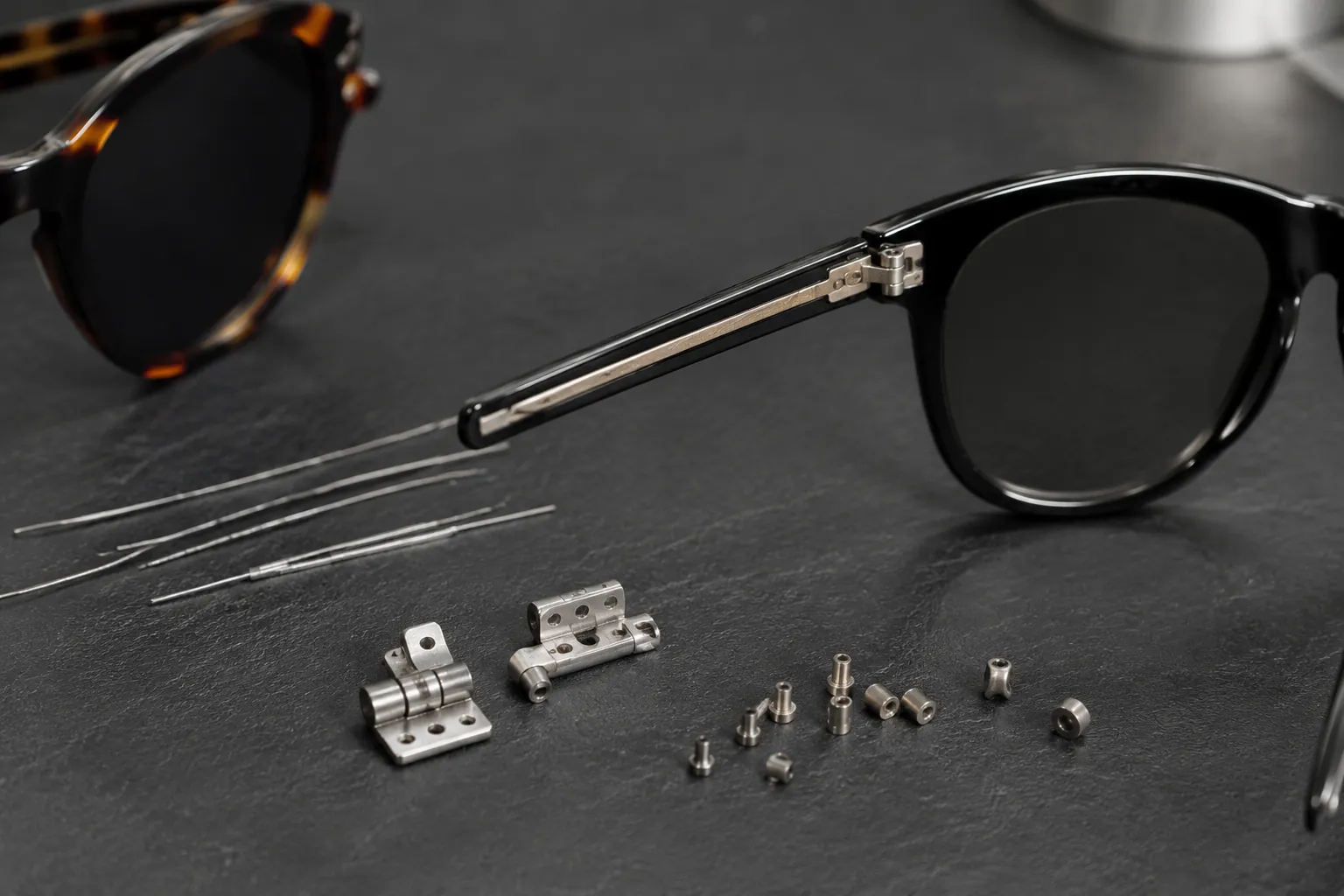
If you buy sunglasses or optical frames at volume, the hidden parts matter as much as the lens and front shape. Metal core wires, hinges, and temple inserts affect breakage, weight, fit, and how often customers send product back. They also change tooling cost, assembly time, and landed price. This article breaks down the choices that move margin and returns.
1) What these hidden parts do
Buyers usually start with lens tint, front shape, and finish. Fair enough. But those are not the parts that drive return rates.
In production, the hardware inside the temple and front frame often decides whether the product survives daily use or comes back with loose arms, warped temples, or cracked acetate near the hinge.
The three parts that matter most are the metal core wire inside acetate temples, the hinge assembly, and any temple insert or reinforcement piece. Each one solves a different problem. The core wire controls straightness after heat setting and helps the temple keep its curve. The hinge controls opening torque and cycle life. The insert spreads load in a weak zone, especially where a screw, logo plate, or spring hinge puts extra stress on a narrow temple.
These are not minor details. They change labor, reject rate, and replacement cost. A frame can look identical online and behave very differently in use if the wire is off-center, the hinge barrels are misaligned, or the insert is decorative when the design needs reinforcement.
Three outcomes matter most: first touch quality, durability after a few weeks, and the amount of rework needed before shipment. Handle those well, and margin holds. Miss them, and returns eat it.
2) Metal core wire: small part, real cost
On acetate and some hybrid temples, the metal core wire is the backbone. It gives the temple shape before and after heat setting, and it helps the arm keep tension against the head.
If the wire is too soft, the temple drifts out of shape during wear or when a customer adjusts it by hand. If it is too stiff, assembly slows down. Workers have to force the bend into place, and that raises scrap, finish damage, and polish defects. Simple as that.
Core wire choices usually come down to thickness, profile, and surface treatment. A common spec sits around 1.0 mm to 1.2 mm for many acetate temples, but the right choice depends on temple thickness, length, and rear-side load. A thin fashion temple may only need a simple wire. A thick acetate temple with a heavy logo plate or long tail may need a stronger profile and better corrosion resistance. Some factories use perforated or etched wire to improve adhesive grip, though that adds process complexity.
Fit is the real issue. If the temple wall is thin and the wire is oversized, you can get print-through, uneven heating during bending, or edge cracking after repeated adjustment. If the wire is too narrow for the groove, it may shift during insertion and leave the temple twisting slightly left or right. That twist often passes visual QC, then shows up later as discomfort or uneven fit.
Good factories check wire straightness before insertion, verify insertion depth after heating, and confirm the wire is centered before final polishing. Buyers should ask about internal offset along the full length of the temple, not just final alignment. A small wander inside the temple can become visible at the tips or create stress near the hinge block.
Practical rule: spend more on core wire only where the design needs shape retention, such as thicker acetate temples, heavy front frames, or products with metal logo plates that add rear-side stress. On low-price programs, a basic wire can work, but only if bending control is tight and the heat-setting route is repeatable. Ask for wire type, thickness, centering method, and bend-check standard. "Stronger temples" is not a spec.
3) Hinges: where returns start
Hinges are the first part many buyers try to save on. That often backfires. A weak hinge causes wobble, loose screws, uneven arm tension, and left-right misalignment. End users notice fast. Very fast.
Retail returns often begin with simple complaints: one arm feels loose, or the temple will not stay straight. In most programs, the hinge is where the customer judges build quality within the first ten seconds.
There are three common hinge families in sunglasses production: standard barrel hinges, spring hinges, and integrated hinge designs used with acetate or injected frames. Standard barrel hinges are cheaper and easier to service. Spring hinges improve comfort and give more room for wider faces, but they add parts, assembly time, and risk if the spring spec is weak or the screw-locking method is poor. Integrated hinges reduce visible hardware, but they require cleaner molding or CNC work and tighter tool control because the hinge seat becomes part of the structure.
The buying logic is simple. A basic barrel hinge usually wins on cost and simplicity, especially for promotional, mass retail, or replenishment programs. A spring hinge may be worth the extra cost when the customer expects a softer fit, wider-face accommodation, or a more premium opening feel. But it is not free. It raises unit cost, adds inspection points, and needs better control of barrel alignment and torque balance on both sides.
Ask for cycle testing at sample stage. Not generic "strength testing." Ask how many open-close cycles the factory uses, what torque range it targets, and whether the left and right sides stay consistent after cycling. Some buyers target around 5,000 cycles for lower-cost styles and 10,000 cycles or more for better retail programs. The number matters less than whether the hinge stays smooth and aligned at the end. Also ask about screw locking. A hinge can look strong and still fail if the screw backs out in use.
| Component choice | Main benefit | Main risk | Typical buying impact |
|---|---|---|---|
| Basic barrel hinge | Low cost, simple assembly, easy repair | Less forgiving on fit, abuse, and repeated flex | Best for price-sensitive programs and simple replenishment |
| Spring hinge | Better comfort, wider-fit tolerance, premium feel | Higher part cost, more assembly control needed | Useful for retail styles with higher return sensitivity |
| Integrated or reinforced hinge area | Cleaner look and stronger load spread | Tooling and process control are stricter | Works best on well-specified OEM/ODM projects |
If you want fewer hinge complaints, ask for the torque target, screw-lock method, and alignment inspection point. Boring questions. Good ones.
4) Temple inserts and logo plates
Temple inserts are often treated as decoration. They do more than that. A metal insert can stiffen the temple, carry branding, hide a reinforcement zone, or create a mounting point for a logo plate. It can also cause problems if it is too heavy, poorly anchored, or installed with weak adhesive control. In a narrow temple, even a small insert changes the feel in hand and on face.
In acetate temples, inserts must match the material's heat behavior. If the insert sits too close to the outer surface, it can telegraph through the finish or show a visible line after polishing. If it sits too deep, it adds labor without real structural benefit. Buyers should ask where the insert sits relative to the outer wall, how it is retained, and whether the factory polishes before or after insertion. Sequence matters. Get it wrong and you expose an edge or create sink marks.
For metal logo plates, the key issues are adhesion, plating quality, edge finishing, and placement repeatability. Sharp edges create comfort complaints. Weak adhesive creates peeling. Poor plating creates color variation between sample and bulk, which is risky on shiny rose-gold, gunmetal, or brushed finishes. If the logo plate is laser-cut or stamped, ask whether the edges are tumbled or micro-deburred before mounting.
Decoration method changes the commercial outcome too. Laser engraving is usually the lowest-risk brand mark for a durable, clean look because it avoids adhesive failure and does not add thickness. Pad printing is cheaper and fast, but it can wear down during cleaning or storage friction. Metal logo plates add perceived value, but they also add at least one part, one placement step, and one rejection point. On a 50-pair MOQ, that extra work matters.
LumiShades' in-house decoration setup, including laser engraving, pad printing, and metal logo plates, helps keep branding decisions tied to actual assembly behavior instead of guesswork. That matters when the temple is narrow and every extra gram changes balance. It also matters when a buyer wants the same logo across several materials, because the best branding method is rarely the cheapest one.
5) Material pairing: acetate, injection, and metal hybrids
Internal components behave differently depending on frame build. Acetate frames give you room for core wires and inserts, but they need careful heat setting and polishing to avoid distortion. Injection frames can carry integrated structure and sometimes reduce part count, but not every hinge or insert solution transfers cleanly from acetate. Metal frames and hybrids add strength in stress zones, yet they are more sensitive to alignment and finishing defects.
The practical comparison is straightforward: what material carries the load, what part adds rigidity, and where does the assembly line need more control? An acetate front with wire temples usually gives a premium hand-feel and good repeat adjustment, but only if wire insertion and polishing are controlled. An injected frame with metal core reinforcement can be efficient at scale, but you still need to verify hinge seat strength, mold consistency, and whether the part shrinks evenly after cooling. A metal or hybrid build may be stronger in stress zones, but it is often less forgiving during alignment and finish cleanup.
Hidden cost appears when the pairing is wrong. A heavy spring hinge on a thin acetate temple forces over-adjustment, which increases labor and can damage the finish near the hinge block. A weak insert in a long temple creates flex and discomfort even if the sample looks clean on the table. A decorative plate placed on the wrong section of a temple can create a balance issue that feels small in hand but becomes obvious after extended wear.
The best buyers look at weight, load path, and bend behavior together. A frame that is too light may feel cheap and twist easily. A frame that is too heavy can slide on the nose or create ear pressure. The right build is not the strongest one on paper. It is the one that fits the target retail price, user profile, and the number of open-close cycles the frame will see before and after sale.
For overseas buyers, the answer is not "stronger is always better." It is "which component protects the part most likely to fail first?" That question saves more margin than chasing a feature list.
6) Cost, MOQ, and lead-time trade-offs
Internal frame parts affect cost in three ways: parts, labor, and scrap. A better hinge or insert costs more per unit. It also takes longer to assemble, align, and inspect. If the spec is vague, the factory will lose time on rework, and that gets priced into the order whether you see it or not.
At LumiShades, MOQ starts at 50 pairs per design. Pricing improves around 300, 1,000, and 5,000+ pairs, with volume pricing reaching about $2.10 per pair on the right program. That number is not a promise. It shows how sharply unit economics respond to scale. A simple acetate frame with standard hinge hardware sits on a very different cost curve than a metal-accent model with logo plates, reinforced inserts, and spring hinges. Add components, and you add part cost, placement time, QC time, and a higher chance of cosmetic rejection.
Lead time follows the same pattern. Samples are typically 7-10 days. Bulk production is 25-35 days. More complex internal hardware can push the lower end of that range upward if new tooling, insert placement, or extra QC steps are involved. If you switch from a basic barrel hinge to a spring hinge, do not expect the same turnaround without confirming the revised assembly route. The factory may need a different screw-locking process, extra torque checks, or more careful alignment during pre-assembly.
As volume increases, the economics shift. At 50 pairs, setup cost dominates, so every nonessential decoration or complicated hinge adds a disproportionate burden. At 300 pairs, hardware choices start to matter because the factory begins to see repeatable efficiency. At 1,000 pairs, better QC and tighter spec control can lower the cost of returns enough to justify a more durable component. At 5,000+ pairs, the supplier can often lock material purchasing and reduce variation, but only if the spec is stable.
| Program level | Typical MOQ logic | Cost pressure point | Lead-time note |
|---|---|---|---|
| 50 pairs/design | Useful for testing a style or small drop | Tooling and setup are spread over few units | Sample-like economics; small changes hurt price fast |
| 300 pairs | First real volume step | Hardware and decoration choices start to matter | Good point to lock hinge and insert specs |
| 1,000 pairs | Best balance for many private-label programs | Labor efficiency improves | More room for tighter QC and lower unit cost |
| 5,000+ pairs | Stable replenishment or chain retail | Component selection drives margin at scale | Supplier can plan materials and reduce variation |
If margin is tight, spend on the part that prevents returns. Do not spend on visible hardware that adds no functional value. That is the fastest way to control landed cost.
7) How to specify parts so factories can build them
Buyers lose money when the spec sheet says "premium hinge" or "strong temple." That is not a spec. It is a wish. A usable purchase brief should name the hinge type, target temple thickness, wire profile, insert type, and decoration method. It should also state acceptable opening feel, target torque range, and whether the frame must hold shape after repeated bending.
Be clear about what the factory needs to check. Ask for temple straightness after wire insertion, left-right torque consistency, screw retention method, finish quality around the hinge zone, and whether logo application changes weight balance. If the frame uses an insert, specify whether it is structural, decorative, or both. If it is decorative only, say so. Otherwise the factory may overbuild or underbuild it.
- Define the frame material first: acetate, injected, metal, or hybrid.
- Choose hinge family: barrel, spring, or integrated.
- State temple build: wire gauge, insert location, and whether the temple is hollow or reinforced.
- Lock branding method: laser, pad print, or metal plate.
- Ask for sample checks on alignment, open-close feel, and finish around the hinge zone.
For compliance, keep the target market in view. LumiShades can support production aligned with CE EN ISO 12312-1, FDA registration, ANSI Z80.3, AS/NZS 1067, REACH, ISO 9001, and BSCI. That does not replace your own market checks, but it does mean the build needs to fit those requirements from the start. If you change materials late, you may also change the compliance path. Even a small shift in coating, plating, or insert material can change the documentation the supplier can support.
Short version: write the hardware spec before you approve the sample. If you approve on appearance alone, you are gambling on returns.
8) Buyer checklist before you place the order
Before you confirm production, ask the factory the questions that expose weak hardware decisions. This is the part many teams skip. It is also where avoidable return issues show up. A good supplier should answer with process details, not slogans.
- What is the exact hinge type, and is it standard or spring-assisted?
- What is the temple core wire thickness, and how is insertion centered and checked?
- Is the temple insert structural, decorative, or both?
- What is the torque feel target for opening and closing?
- How are screw locking, polishing, and hinge alignment controlled in QC?
- Which certification path matters for the destination market: CE EN ISO 12312-1, FDA registration, ANSI Z80.3, AS/NZS 1067, or REACH?
A practical supplier should answer in process terms, not slogans. They should be able to tell you which step is in-house, where the risk sits, and which detail changes cost. At Wenzhou-scale production, those small choices decide whether a program ships on time and stays profitable after chargebacks, returns, and replacements.
When you review a sample, inspect the hinge closure feel, temple symmetry, finish around the insertion zone, and whether the logo component sits flush after polishing. Ask for at least one bent-and-reset check if the style will be sold in a segment where customers adjust their own frames. If the product survives that, it has a better chance of surviving real use.
If you are buying for a brand, importer, distributor, or retailer, treat the hidden hardware as part of the product, not an afterthought. That is the difference between a frame that sells once and a frame that keeps coming back for the wrong reason.
Have a custom sunglasses project in mind?
Send us your styles, target market and quantities and we will return a detailed quote with MOQ, lead time and a sample plan.
Get a QuoteWhy source this from Wenzhou with LumiShades
Wenzhou in Zhejiang Province is widely regarded as China’s eyewear manufacturing capital, producing a large share of the world’s sunglasses. That concentration matters to buyers: a deep local supply chain for acetate sheet, hinges, lens blanks, plating and packaging means shorter component lead times, easier color and material matching, and a workforce with decades of eyewear-specific skill. LumiShades has manufactured in this ecosystem since 2009, and our vertical integration — in-house injection molding, acetate cutting, CNC milling, lens tinting, decoration and quality control — means no part of your order is quietly subcontracted to a workshop you cannot audit.
For international buyers, that vertical control translates into accountability. When a single factory owns every step, defects are traced and fixed at source rather than bounced between vendors, and your specifications survive intact from first sample to bulk. We back this with 15+ years of experience, shipments to 60+ countries, more than 5 million pairs produced per year and a 98.5% on-time delivery rate. Our certifications — CE EN ISO 12312-1, FDA registration, ANSI Z80.3, AS/NZS 1067, REACH, ISO 9001 and BSCI audit — mean the compliance documentation your market requires already exists. Explore our manufacturing capabilities and quality control process to see how this works in practice.
Frequently asked questions
Should I always choose spring hinges for better quality? No. Spring hinges improve comfort and flex, but they add cost, parts, and assembly risk. Use them only when the target customer, fit expectation, and price tier justify it.
What is the most common hidden cause of returns? Loose or misaligned hinges are a frequent trigger. Temple core issues and poor insert placement come next, especially on acetate frames where small alignment errors are easy to miss at inspection.
Does a thicker metal core wire always mean a stronger temple? Not always. If it is too thick for the temple wall, it can crack the acetate, make bending harder, and create surface distortion or print-through.
How should I spec temple inserts for private label sunglasses? State whether the insert is structural or decorative, where it sits, what finish it needs, how it is retained, and how branding is applied. Do not leave it to the factory to guess.
Can a low MOQ order still use metal logo plates and reinforced hinges? Yes, but the unit cost will rise. At 50 pairs per design, setup and labor are spread over fewer units, so keep the spec tight, purposeful, and limited to the features that protect sales or reduce returns.
Ready to start?
Explore our aviator sunglasses or request a quote — our sales team replies within 12 hours.
Request a Quote