
TR90 Sunglasses Guide for Private Label Buyers
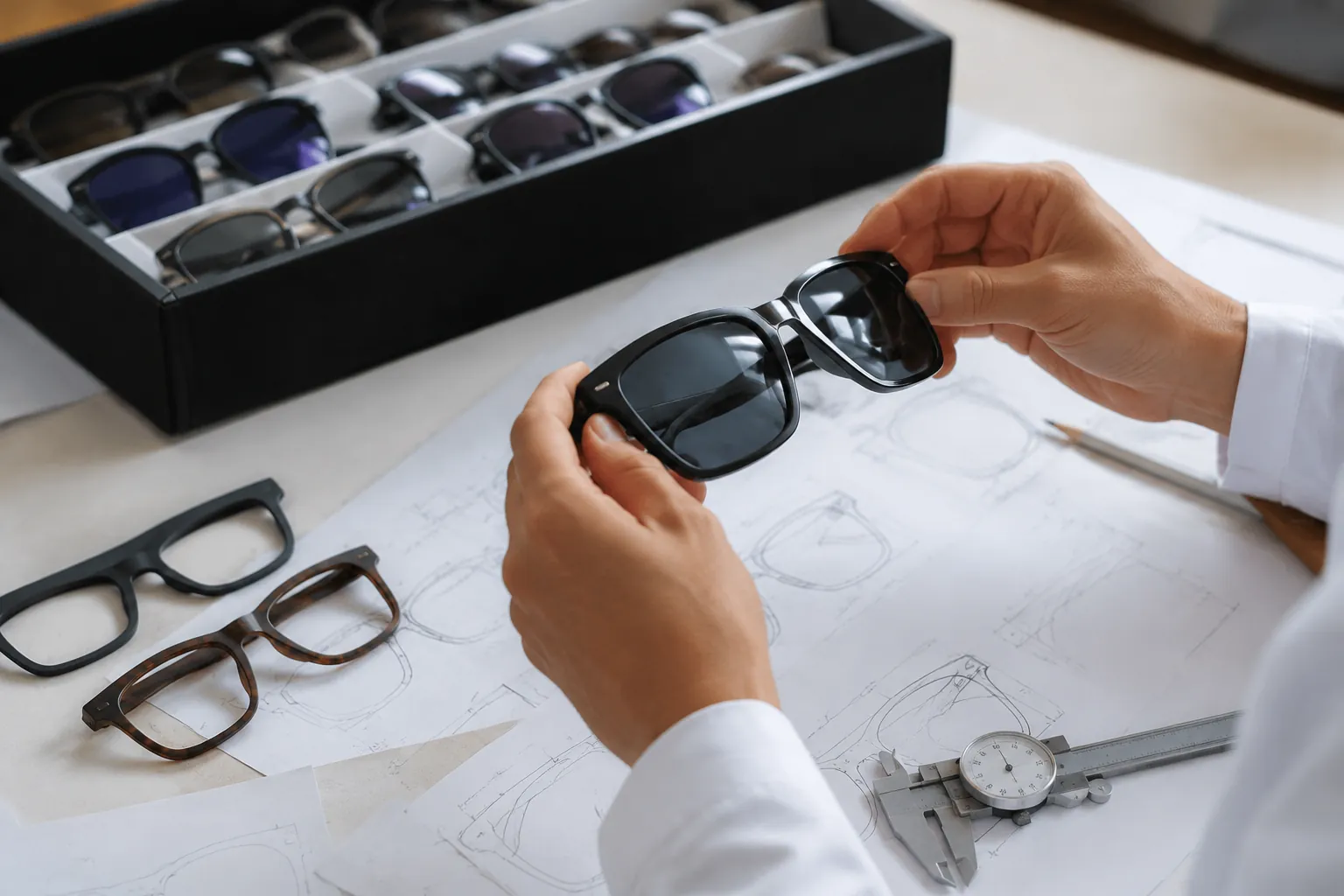
This guide is for overseas brands, importers, distributors, and retail buyers planning lightweight private label sunglasses in TR90. It covers where TR90 works, where it creates production risk, and what to confirm before paying for molds or approving bulk. The aim is simple: better fit, tighter color control, stronger hinge areas, cleaner compliance files, and fewer surprises between sample approval and shipment.
Start With The Product Role, Not The Material Name
TR90 is a flexible nylon-based frame material used widely for lightweight sunglasses. It is not automatically better than acetate, PC, or metal. It works best when the brief calls for low weight, bend recovery, daily comfort, and controlled cost at repeat volume.
Use TR90 for sports-casual sunglasses, kids and junior styles, travel retail programs, polarized driving sunglasses, and private label lines where comfort and return-rate control matter more than a luxury hand-finished feel. A typical TR90 front often feels much lighter than acetate at the same visual size. Temples can flex outward without the brittle snap seen in low-grade PC frames.
Do not ask TR90 to behave like acetate. If the design needs deep laminated tortoise, sharp hand-cut edges, thick premium bevels, or a heavy feel, acetate may be the better choice. TR90 is injection molded. That means the frame has to be designed around mold flow, shrinkage, hinge reinforcement, lens groove stability, and surface texture.
At LumiShades in Wenzhou, TR90 projects usually fit a practical sourcing window: MOQ starts from 50 pairs per design for small tests, with better unit economics at 300, 1000, and 5000+ pairs. On larger suitable programs, pricing can move down to about $2.10 per pair depending on frame complexity, lens type, hinge, logo process, packaging, and inspection level. Samples normally take 7 to 10 days after clear specifications. Bulk production usually takes 25 to 35 days after sample approval and deposit.
TR90 Versus Common Frame Materials
Material selection should follow the selling channel, target retail price, and expected consumer use. A beach promotion, a junior sports line, and an optical boutique program do not need the same frame behavior or finish standard.
| Material | Best Use | Typical Strengths | Main Production Risk |
|---|---|---|---|
| TR90 | Lightweight flexible sunglasses, sports casual, kids, travel retail | Low weight, good bend recovery, comfortable for long wear, stable at volume | Needs correct hinge boss thickness, lens groove depth, color control, and mold shrinkage planning |
| Acetate | Fashion frames, thick profiles, premium private label lines | Rich color depth, polishable surface, strong perceived value | Heavier, longer cutting and polishing process, higher waste and cost |
| PC | Low-cost promotions, simple giveaways, short-life programs | Low price, fast injection, good for basic shapes | Can feel cheap, may be brittle in poor grades, lower perceived value |
| Metal | Aviators, thin rims, rimless or semi-rimless fashion styles | Slim profile, adjustable nose pads, mature classic designs | Requires plating control, solder strength checks, and corrosion testing |
TR90 is a strong choice when a buyer wants a frame that survives normal bending, bag storage, travel use, and daily handling without feeling heavy. It is not the best choice when the sales story depends on handmade character, layered colors, or visible polishing. For private label buyers, the safest use is often a core repeat style: a proven shape, stable black or matte color, UV400 or polarized lenses, and controlled packaging.
Mold Strategy: Existing Tooling, Modified Tooling, Or New Tooling
The mold decision controls cost, timing, and ownership. Existing tooling is fastest and lowest risk for small test orders. Modified tooling can work for minor changes. New tooling is best for brand-owned shapes, special fit requirements, or long repeat programs, but it needs discipline before steel work begins.
For existing molds, confirm front width, lens width, bridge, temple length, pantoscopic angle, base curve, hinge type, nose fit, and whether logo areas can be decorated without weakening the structure. A frame that is only 2 mm too narrow can feel tight for European or North American buyers even if it looks correct in photos. Temple length differences of 5 mm can also change comfort and fit security.
For new molds, approve a 2D technical drawing before tooling. For higher-value programs, add a 3D file, printed fitting sample, or CNC prototype. TR90 molds need attention around gate position, shrinkage allowance, hinge boss thickness, lens groove depth, temple curvature, and wall thickness transitions. Thin hinge areas can crack after screw assembly or open-close cycling. Over-thick areas can create sink marks or visible surface distortion.
- Use existing molds for 50 to 300 pair tests, fast market launches, and price-sensitive programs.
- Use modified molds for small logo pads, temple texture changes, or minor decoration adjustments.
- Use new molds for exclusive shapes, special bridge fit, custom lens geometry, or 1000+ pair repeat plans.
- Do not approve tooling from beauty renders only; request mechanical drawings and sample-fit checks.
LumiShades handles injection molding in-house, which shortens the feedback loop between engineering and production. That matters because mold performance is not theoretical. The production floor must be able to fill the part cleanly, release it without warping, assemble hinges consistently, and hold the lens without stress marks.
Color Consistency And Surface Finish Control
Color drift is one of the most common TR90 problems. It can appear between sample and bulk, between left and right temples, or between repeat batches. Causes include resin lot variation, pigment dosing error, machine temperature, recycled content contamination, surface texture differences, and unclear approval standards.
Buyers should approve color from a physical frame, not a screen image. Use a signed golden sample, Pantone reference where practical, or physical color chip plus assembled frame. For black, matte black, crystal grey, navy, olive, translucent brown, and smoke colors, ask how the color is made: solid compound, translucent compound, sprayed finish, painted finish, or coating. Each method has different durability and inspection needs.
Flat chips are not enough. Wall thickness and curvature change how color reads. A translucent front may look darker at the bridge and lighter near the rim edge. Matte texture can make black appear softer or slightly grey. Gloss makes the same compound look deeper. If the style uses matching lenses, check the complete sunglass under daylight and indoor light.
Set a practical bulk tolerance before production starts. For many commercial sunglasses, the buyer may approve a controlled visual tolerance against the golden sample under standard light. For stricter programs, request Delta E color measurement where the factory has the equipment and the material supports it. The key is not the method name. It is having one master sample, one inspection standard, and batch separation for repeat orders.
- Approve a physical frame as the color master.
- Confirm whether the finish is solid, translucent, sprayed, painted, matte, or gloss.
- Keep one signed master with the buyer and one at the factory.
- Inspect first bulk pieces before the full run continues.
- Record resin grade, pigment formula, lens color, and finish for repeat orders.
Hinges, Screws, Lens Grooves, And Flex Points
TR90 frames usually fail around moving parts before they fail at the center front. Hinges, screws, temple roots, lens grooves, and logo plates need close attention. The frame may be flexible, but the hinge area must still hold repeated movement.
Most private label TR90 sunglasses use regular metal hinges, spring hinges, or integrated flexible temple designs. Regular hinges are cost-effective and stable for casual eyewear. Spring hinges improve fit range, especially for mixed head sizes, but add cost and create another failure point if the hinge seat is weak. Integrated flex designs reduce metal components but require proven mold geometry and bending tests.
Ask the factory what checks are performed on the hinge area. Useful controls include hinge pull testing, temple open-close cycling, screw torque checks, lens retention checks, and visual inspection after assembly. For bulk sunglasses, a practical QC routine can include repeated temple opening, controlled hand twisting, screw-backout inspection, and checking whether the lens pops out under light pressure. These basic checks catch real field complaints.
Watch for whitening, cracks, sink marks, angled screws, loose temples, and uneven lens seating at sample stage. Do not assume bulk will improve. If a sample hinge already feels loose or the screw enters the plastic at an angle, production operators will usually reproduce the same weakness at scale. Decoration should also stay away from thin flex zones unless engineering confirms the structure can handle it.
LumiShades can combine TR90 injection with metal logo plates, laser engraving, pad printing, hot stamping, lens tinting, and mirror coating. Each process should be chosen for function first. A logo plate near the hinge may look premium, but if it removes plastic thickness or adds stress, it shortens product life.
Lens Pairing And Compliance Requirements
A TR90 frame is only half the sunglass. The lens determines UV protection, comfort, category labeling, visual quality, and market compliance. Buyers should confirm lens and finished-product requirements before bulk production, not after cartons are packed.
For general sunglasses, LumiShades works with CE EN ISO 12312-1, FDA registration, ANSI Z80.3, AS/NZS 1067, REACH, ISO 9001, and BSCI. Use only the standards that apply to the destination market and product type. Do not request unsupported claims such as polarized, UV400, impact resistant, or category markings unless the documents and test reports support them.
Lens choice affects both cost and defect risk. Standard tinted lenses suit fashion programs and entry price points. Polarized lenses cost more but support driving, fishing, and outdoor positioning. Mirror coatings create strong shelf appeal but need abrasion checks and protective packing because surface marks are easy for consumers to notice. Gradient lenses need tighter visual inspection because tint symmetry and left-right matching can drift.
- EU programs should confirm CE EN ISO 12312-1, REACH status, lens category, labeling, and user information.
- US programs should confirm FDA registration relevance and ANSI Z80.3 where required by the buyer or channel.
- Australia and New Zealand should confirm AS/NZS 1067 suitability and category labeling.
- Polarized styles should be checked for axis consistency, distortion, delamination, and left-right match.
- Kids styles need extra checks for fit, sharp edges, small parts, and age-appropriate packaging warnings.
Compliance should be built into the purchase order. Confirm UV protection, visible light transmission, lens category, warning text, markings, hangtags, and instruction leaflet before production starts. Correct paperwork cannot rescue a wrong lens category after shipment.
Bulk Production Flow And QC Checkpoints
A clean TR90 order follows a controlled sequence: specification confirmation, sample build, sample approval, material preparation, injection molding, trimming, tumbling or surface finishing, hinge assembly, lens cutting, lens tinting or coating, logo decoration, final assembly, QC, packing, and shipment. Skipping steps rarely saves money. It moves the cost into rework, rejects, and customer complaints.
The risk profile changes with order size. At 300 pairs, setup consistency matters because the run is short and operators may switch styles quickly. At 1000 pairs, process stability matters more because small defects repeat. At 5000+ pairs, ask how production is split by batch and how color, hinge, lens, and packing checks are recorded across the run. LumiShades manufactures more than 5 million pairs per year and ships to 60+ countries, so the production system is built for repeated eyewear programs, not one-off assembly.
QC should include incoming resin and lens checks, first-piece approval after injection, in-process hinge and lens checks, decoration inspection, final cosmetic inspection, and AQL inspection if required. Critical defects include cracked frames, sharp edges, wrong UV protection, wrong lens category, missing required markings, and broken hinges. Major defects include visible scratches, loose temples, poor printing, uneven lens fit, color mismatch, coating marks, and dirty packaging.
Before shipment, request pre-shipment photos, carton marks, packing layout, barcode placement, and accessory confirmation. For retail programs, check the pouch, case, cleaning cloth, polybag warning if needed, instruction leaflet, hangtag, and carton strength. A good frame packed badly can still create chargebacks or consumer complaints.
Cost And Lead-Time Levers Buyers Can Control
TR90 pricing is shaped by frame size, mold status, order quantity, resin color, hinge type, lens type, decoration, packaging, inspection level, and compliance testing. Buyers often focus only on the per-pair quote. That is too narrow. A cheap quote with unstable color, weak hinges, or unclear compliance can cost more once returns, delays, and rework are counted.
MOQ starts at 50 pairs per design at LumiShades, which is useful for smaller brands testing a new shape. Pricing improves at 300, 1000, and 5000+ pairs because material purchasing, machine setup, decoration, lens preparation, and packing become more efficient. Larger suitable programs can move toward about $2.10 per pair, but only after the final specification is fixed. Polarized lenses, spring hinges, metal logo plates, mirror coatings, special matte finishes, retail cases, and third-party testing all change the cost.
Lead time follows the same logic. Samples in 7 to 10 days are realistic when the buyer uses existing tooling and provides clear logos, lens color, packaging files, and compliance requirements. New tooling, custom colors, repeated sample revisions, or special lens coatings add time. Bulk production in 25 to 35 days is normal after approval and deposit, but buyers should also reserve time for third-party testing, freight booking, customs clearance, and destination labeling checks.
Buyer rule: freeze the approved sample, color master, lens specification, packaging artwork, compliance documents, and carton marks before bulk starts. Late changes are one of the fastest ways to lose a delivery window.
LumiShades reports 98.5% on-time delivery, but buyer behavior still matters. Clear specifications, fast approvals, realistic testing time, and no last-minute artwork changes are the simplest ways to protect both cost and schedule.
Have a custom sunglasses project in mind?
Send us your styles, target market and quantities and we will return a detailed quote with MOQ, lead time and a sample plan.
Get a QuoteWhy source this from Wenzhou with LumiShades
Wenzhou in Zhejiang Province is widely regarded as China’s eyewear manufacturing capital, producing a large share of the world’s sunglasses. That concentration matters to buyers: a deep local supply chain for acetate sheet, hinges, lens blanks, plating and packaging means shorter component lead times, easier color and material matching, and a workforce with decades of eyewear-specific skill. LumiShades has manufactured in this ecosystem since 2009, and our vertical integration — in-house injection molding, acetate cutting, CNC milling, lens tinting, decoration and quality control — means no part of your order is quietly subcontracted to a workshop you cannot audit.
For international buyers, that vertical control translates into accountability. When a single factory owns every step, defects are traced and fixed at source rather than bounced between vendors, and your specifications survive intact from first sample to bulk. We back this with 15+ years of experience, shipments to 60+ countries, more than 5 million pairs produced per year and a 98.5% on-time delivery rate. Our certifications — CE EN ISO 12312-1, FDA registration, ANSI Z80.3, AS/NZS 1067, REACH, ISO 9001 and BSCI audit — mean the compliance documentation your market requires already exists. Explore our manufacturing capabilities and quality control process to see how this works in practice.
Frequently asked questions
Is TR90 better than acetate for private label sunglasses? Not always. TR90 is better for lightweight, flexible, high-comfort styles. Acetate is better for thick fashion shapes, deep patterns, polished edges, and a heavier premium feel.
Can I start with 50 pairs per design and reorder later? Yes. LumiShades MOQ starts at 50 pairs per design. For repeat orders, keep the signed sample, resin color reference, lens specification, logo files, and packaging files fixed to reduce batch variation.
What should I check before approving a TR90 mold? Check front width, lens size, bridge, temple length, hinge seat thickness, lens groove depth, gate position, shrinkage risk, nose fit, and whether decoration weakens any flex area.
Which certifications can be used for TR90 sunglasses orders? Relevant documents may include CE EN ISO 12312-1, FDA registration, ANSI Z80.3, AS/NZS 1067, REACH, ISO 9001, and BSCI. Use only the documents that match your market and product claims.
Why does my bulk TR90 color look different from the sample? Common causes include pigment dosing, resin batch variation, finish difference, machine temperature, wall thickness, recycled content contamination, or approval from photos instead of a physical golden sample.
How long should I plan for samples and bulk production? Plan 7 to 10 days for samples after clear specifications, and 25 to 35 days for bulk after sample approval and deposit. Add time for testing, freight booking, customs clearance, and destination labeling.
Ready to start?
Explore our round sunglasses or request a quote — our sales team replies within 12 hours.
Request a Quote