
Metal Alloy Sunglass Frames: Buyer's Guide
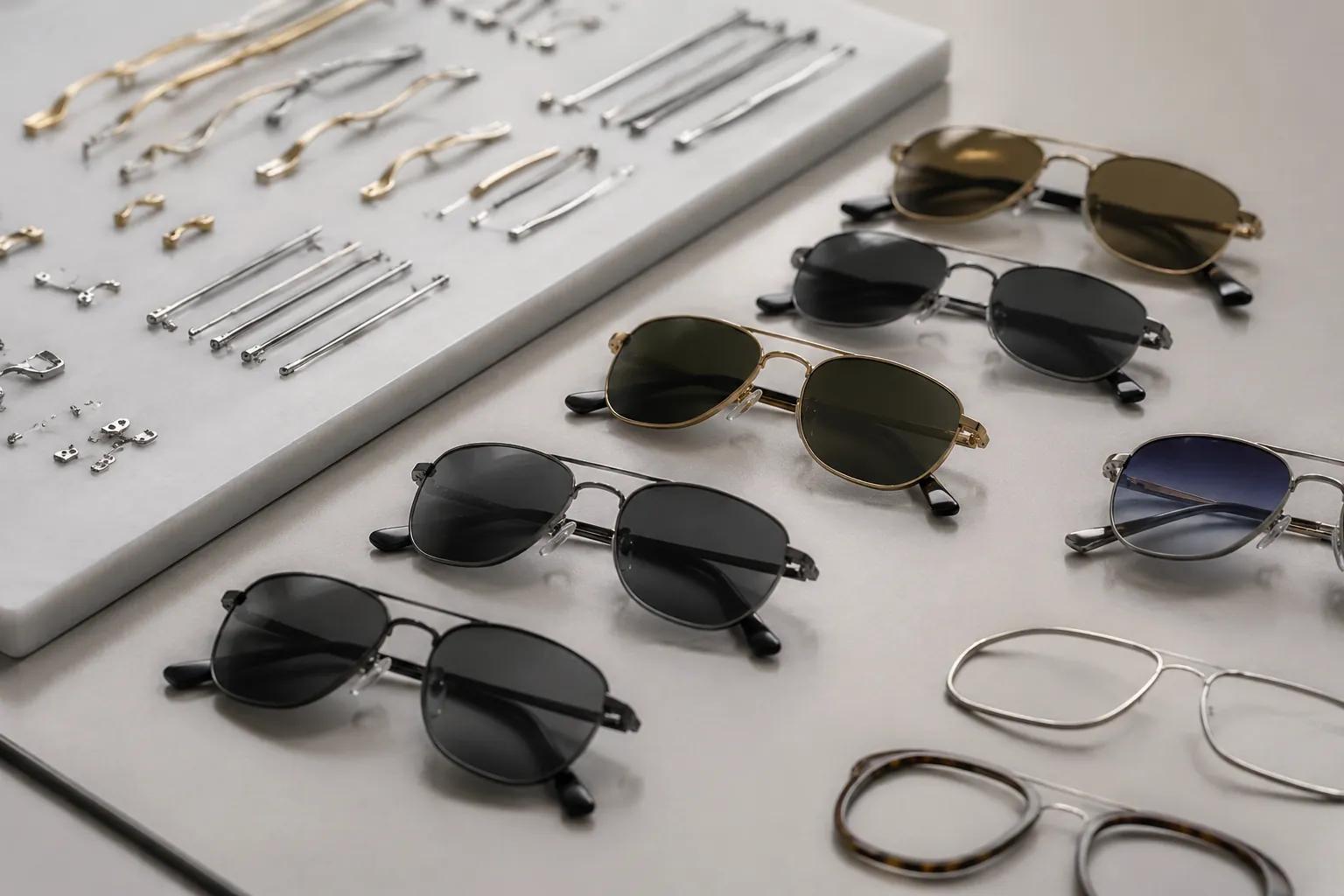
If you buy sunglasses or eyewear in volume, the alloy you choose affects cost, weight, corrosion resistance, finish quality, and yield. This guide is for brands, importers, distributors, and retailers sourcing metal frames with fewer surprises. It covers the common alloys, how they behave in production, which finishes hold up, and where each material fits commercially. It also shows how LumiShades handles metal frame production, MOQ, lead time, and compliance so the material choice is tied to the actual order plan, not just the concept render.
1) Start With the Channel
The right alloy depends less on the word "metal" and more on where the product will be sold, how often it will be worn, and what price point the SKU must hit. A fashion chain selling seasonal drops can tolerate a very different durability profile than an optical distributor targeting daily wear. Wrong channel. Wrong material. That leads to defects, claims, returns, and markdowns.
For most B2B buyers, the first split is commercial. If the frame is a low-cost fashion item, zinc alloy often gives the best shape freedom and decoration options. If the frame must stay light and resist sweat, stainless steel or titanium should move higher on the list. Aluminum can work for lightweight modern styles, but it is not the default choice for high-impact, highly adjustable, or heavily plated programs.
Decide the alloy before drawing approval. A supplier can build the same front shape in zinc, steel, or titanium, but the hinge style, temple thickness, plating stack, polishing sequence, and reject rate will not be the same. LumiShades supports metal frame production in Wenzhou with in-house decoration and quality control, so the material choice can be locked against the intended channel before sampling starts. That matters because a sample delivered in 7-10 days is only useful if it is built in the final material and finish from the beginning.
Value channels reward cast detail, lower tooling risk, and fast decoration. Mid-tier retail rewards stable forming, repeatable plating, and low returns. Premium optical and premium sunwear reward weight reduction, sweat resistance, and better edge control. Start with the channel. The engineering choice gets easier.
2) Common Alloys and What They Mean in Production
Buyers often ask for "metal" as if all alloys behave the same. They do not. The base material drives the production route, which drives the finish quality, hinge fit, handwork, and final commercial outcome. Once you know the alloy, the trade-offs are easier to predict.
| Alloy | Main strength | Main weakness | Typical buyer fit | Production note |
|---|---|---|---|---|
| Zinc alloy | Good casting detail and shape freedom | Heavier than steel or titanium; finish quality depends heavily on surface prep and plating control | Fashion sunglasses, volume programs, decorative frames | Well suited to die-cast fronts and temples with complex surface detail; polishing and plating must be tightly controlled to reduce edge wear |
| Stainless steel | Good corrosion resistance and slim-profile stability | Harder forming; welding and hinge work need discipline | Mass retail, daily wear, unisex core programs | Well suited to wire, sheet, and slim front constructions; spring-back and hinge alignment must be managed carefully |
| Titanium | Very light, strong, and highly corrosion resistant | Higher material and processing cost; more demanding supply chain | Premium optical, high-margin sunwear, comfort-led lines | Best when weight and skin comfort justify higher cost; welding, forming, and polishing require experienced operators |
| Aluminum | Lightweight, clean modern look | Surface damage and coating control matter; not ideal for every design | Selected fashion or lightweight concepts | Best only with coating systems that protect against scratch and oxidation; not ideal for aggressive daily wear |
Zinc alloy gives designers more freedom. It handles chunky temples, sculpted fronts, and metal-logo decoration without fighting the material too much. That means a lower barrier for novelty shapes and stronger visual impact at the retail shelf. Stainless steel is the safer workhorse if the frame needs slimmer lines and better wear resistance. It is usually the better choice when the customer will open and close the frame repeatedly, or when the product faces heat, humidity, and sweat.
Titanium is the premium option, but only if the retail price can carry it. It is usually selected for higher-margin programs where weight, comfort, and corrosion resistance are part of the value story. Aluminum sits in a narrower lane. It can look clean and modern, but the finish needs protection, and the design should avoid over-stressing the hinges and bridge.
Material choice also affects tolerance stack. A well-run metal frame program aims for consistent temple symmetry, controlled hinge alignment at critical fit points, and stable left-right lens alignment after assembly. The more decorative and heavily plated the frame is, the more careful the supplier must be about heat, polishing, and assembly order.
3) How Material Choice Changes Your Cost
Metal frame cost is not just raw material. It includes tooling, forming or machining, hinge hardware, polishing, plating, labor, defect rate, rework, packaging, and the cost of maintaining a consistent appearance across the run. Zinc may look cheap on paper, but heavy plating, thick polishing cycles, and hand rework can erode margin quickly. Stainless steel can cost more to process, but lower corrosion risk often reduces returns and warranty exposure. Titanium is usually the highest total cost because of both material price and processing difficulty.
MOQ logic matters as much as unit cost. At LumiShades, MOQ starts at 50 pairs per design. That is enough for a true sample-to-mini-run test, but not enough to fully dilute setup cost across a larger production cycle. Commercial breakpoints improve as order size increases because tooling, polishing setup, plating baths, labor preparation, and packaging cost are spread across more units. In volume programs, the target unit cost can fall, but it depends on shape, finish, lens package, and decoration. Treat any price target as project-specific.
- At 50 pairs, expect sample-style pricing with higher per-unit labor and finish loss.
- At 300 pairs, tooling and setup begin to spread, so the first meaningful price break often appears.
- At 1000+ pairs, finishing efficiency, material purchasing, and assembly flow matter more than one-time setup.
- At 5000+ pairs, stable repeat orders can support the lowest commercial pricing if the spec remains unchanged.
A practical way to think about pricing is this: zinc often wins when shape and decoration matter more than weight; stainless steel wins when durability needs to justify a mid-market price; titanium wins when the brand can charge for comfort and premium positioning. If your frame will land in a discount or fast-fashion channel, over-specifying the alloy usually hurts margin. If your frame sits in optical or premium retail, under-specifying the alloy usually hurts return rate.
Also budget for finish-dependent cost jumps. A simple polished plating stack is usually the least expensive route. Multi-step color coatings, PVD-style treatments, brushed effects, or custom logo plates add process time, yield risk, and inspection load. Small design changes can move a frame from an easy run to a difficult one very quickly.
4) Durability: What Fails First
Metal frames rarely fail in dramatic ways. They fail in small ways first: plating chips at edges, nose pads loosen, hinge screws back out, bridge alignment drifts, or sweat darkens a weak finish. After that, the return rate rises and the product stops behaving like a stable SKU.
The common failure modes depend on the alloy. Zinc alloy can show finish wear sooner on sharp corners if the plating stack is thin or surface prep is inconsistent. That is especially true on temple ends, bridge edges, and logo recesses where polishing pressure is uneven. Stainless steel resists rust better, but weld quality, spring action, and hinge fit still need control. If the hinge is too loose, the customer notices it quickly; if it is too tight, the temple can twist or misalign over time. Titanium handles sweat and daily wear very well, but poor finishing or weak assembly can still damage the user experience. Aluminum is light, but dents and scratches show faster if the coating is weak or if the design includes exposed edges that take impact.
For overseas buyers, the sample stage should test the real wear points, not just appearance. Ask for hinge cycling, temple alignment, nose pad stability, and finish at contact edges. A frame can look clean in photos and still fail after repeated handling or repeated open-close cycles. Confirm consistent hinge action, no visible binding, and no major looseness after repeated manual cycling. Each temple should return evenly. The front should stay square.
In production, the smallest spec drift can become a big problem. If plating thickness varies, edges may look darker or wear faster. If screw torque varies, one batch may arrive with loose hinges. If polishing changes the surface too much, the coating may not bond evenly. Those are process problems, not material myths.
For volume orders, the cheapest frame is the one that does not come back.
LumiShades runs quality control in-house. That helps because metal frame problems are often process problems. When a supplier controls polishing, plating, final assembly, and inspection in one workflow, the alloy choice has a better chance of performing as intended. If those steps are split across vendors, the risks multiply.
5) Finishing Options That Matter in Production
Metal alloy frames are judged by finish as much as by structure. Buyers should specify the finish early because it changes both the look and the reject rate. For metal sunglasses, the usual options include electroplating, painting, PVD-style surface treatment where applicable, polishing, laser engraving, pad printing, and metal logo plates. Each method affects sequence, cost, and durability.
LumiShades handles decoration in-house, including laser engraving, pad printing, and metal logo plates. That matters because decoration is not just branding; it changes process order. If engraving happens before plating in one design and after plating in another, the cost and the visual result change. The same is true for logo plates: they can look premium, but they add parts, assembly time, and failure points if adhesive or rivet control is weak.
Lock the finish before sample signoff. A polished silver frame and a brushed gunmetal frame may share the same geometry, but the line behavior is different. Polished finishes show scratches more easily in packing and transit, while brushed or matte finishes may hide wear better but require more control to keep them visually even. In plating, buyers should ask about coverage at the nose bridge, temple tips, and hinge edges, because those are the areas where thin coverage shows first.
- Confirm base alloy and hinge style first.
- Lock the surface finish before sample signoff.
- Check whether logo work happens before or after plating.
- Test nose pad adhesion, screw retention, and edge wear.
- Approve packaging only after the final assembled sample passes inspection.
For value programs, simple polished plating often wins because it keeps process count down and reduces rejection risk. For premium retail, a better logo treatment, cleaner edge finishing, and more consistent gloss or matte control usually justify the added cost. The key is to choose a finish system that matches both the SKU margin and the channel expectations.
6) Compliance and Test Planning
Do not treat compliance as a box to tick after the design is done. Build it into the material choice and the finish choice from the start. A frame that looks fine on a planner's desk can still fail a market test if the finish chemistry, hinge torque, labeling, or lens package is wrong. Connect the compliance route to the exact SKU before mass production.
LumiShades states the following certifications and registrations: CE EN ISO 12312-1, FDA registration, ANSI Z80.3, AS/NZS 1067, REACH, ISO 9001, and BSCI. Buyers should still confirm which of those apply to the target market and the specific product configuration. For example, CE EN ISO 12312-1 is relevant for sunglasses sold into the EU, ANSI Z80.3 for the U.S. market, AS/NZS 1067 for Australia and New Zealand, and REACH for chemical compliance in applicable markets.
Metal alloy choice also affects the test plan. Plating chemistry, nickel exposure concerns, corrosion resistance, and surface contact points can all create issues. A sample that is visually correct but built in a non-final finish can be misleading. If the final frame will be plated, brushed, coated, or lacquered, the test sample should reflect that finish rather than a plain uncoated mock-up.
Ask about test timing relative to production. If compliance tests are run only after bulk build, a failure can create expensive rework or shipment delays. If the supplier can support pre-production testing on the exact alloy and finish, the risk is lower. Align alloy, finish, lens spec, and packaging before the compliance route is confirmed.
For metal frames, the most common avoidable issues are finish inconsistency, corrosion problems in humid climates, and hardware looseness. Those are easier to catch when the sample is built from the same process as the production lot.
7) How LumiShades Runs a Metal Frame Order
Buyers care about process because process predicts whether the order lands on time and whether the repeat order behaves like the first one. LumiShades manufactures in Wenzhou, Zhejiang, and has been shipping to 60+ countries since 2009. The key point is not the marketing summary itself, but whether the production sequence is disciplined from sample to shipment.
A typical metal alloy sunglass order follows a straightforward path: confirm drawings or reference samples, lock alloy and finish, build sample sets, approve packaging, place the bulk order, then move through production and final quality control. Samples usually take 7-10 days. Bulk production is typically 25-35 days, depending on design complexity, plating, and order size. The tighter the finish and the more decorative the frame, the more likely the schedule moves toward the upper end of that range.
In-house capabilities reduce handoff risk. LumiShades lists injection molding for plastic components, acetate cutting where mixed-material styles need it, CNC milling, lens tinting, decoration, and quality control. In practical terms, that means the supplier is not just assembling outsourced parts. It is controlling the points where metal frames usually go wrong: fit, finish, and final assembly.
The buyer should expect schedule logic to work like this: a simple zinc style with standard plating and standard packaging can move faster; a stainless steel or titanium style with custom finishing, mixed materials, and branded hardware will need more process checks. If the order includes a logo plate, custom temple end, or special coating, assume extra time for proofing and inspection.
| Order stage | Typical timing | Buyer decision | Risk if rushed |
|---|---|---|---|
| Sample development | 7-10 days | Confirm alloy, finish, hinge style, logo method | Wrong look, wrong feel, avoidable re-sampling |
| Bulk production | 25-35 days | Approve final spec and packaging | Finish defects, delayed shipment |
| Repeat order | Depends on stock and change level | Keep the same spec or change only one variable | Color drift, inconsistent plating, new fit issues |
That flow works best when the buyer sends clear target pricing, target channel, and target finish early. A supplier can optimize for cost, speed, or premium presentation, but not all three at the same time without compromise.
8) Which Alloy Fits Which Buyer
There is no universal best alloy. There is only the right alloy for your channel, margin, lead time, and return tolerance. Treat frame material as a commercial decision, not a design afterthought. If you choose the material based on the sales model, the program is easier to scale and easier to repeat.
- Choose zinc alloy if you need lower tooling barriers, bold shapes, and decoration-heavy fashion frames.
- Choose stainless steel if you want a stronger daily-wear option with better corrosion resistance and a cleaner retail story.
- Choose titanium if your program can support higher cost and you need light weight and premium positioning.
- Choose aluminum only when the design, coating, and channel all fit the lighter, more specific use case.
Do not let one sample decide the whole program. A showpiece sample can hide weak plating, soft hinges, or assembly drift. Ask for the production spec, not just the display sample. Then keep the alloy choice tied to the SKU's actual selling channel. That is how you avoid overbuilding a cheap retail item or underbuilding a premium one.
If you are sourcing custom sunglasses at volume, the cleanest decision order is simple: start with the sales channel, then the material, then the finish, then the test route. That sequence saves time, reduces re-sampling, and gives procurement a clearer cost model. It also makes it easier to compare suppliers because every quote is measured against the same commercial target.
For most buyers, the sweet spot looks like this: zinc for trend-led value programs, stainless steel for stable mass retail, titanium for premium comfort-driven lines, and aluminum only when the design brief genuinely needs it. The right material is the one that survives the channel you actually sell into.
Have a custom sunglasses project in mind?
Send us your styles, target market and quantities and we will return a detailed quote with MOQ, lead time and a sample plan.
Get a QuoteWhy source this from Wenzhou with LumiShades
Wenzhou in Zhejiang Province is widely regarded as China’s eyewear manufacturing capital, producing a large share of the world’s sunglasses. That concentration matters to buyers: a deep local supply chain for acetate sheet, hinges, lens blanks, plating and packaging means shorter component lead times, easier color and material matching, and a workforce with decades of eyewear-specific skill. LumiShades has manufactured in this ecosystem since 2009, and our vertical integration — in-house injection molding, acetate cutting, CNC milling, lens tinting, decoration and quality control — means no part of your order is quietly subcontracted to a workshop you cannot audit.
For international buyers, that vertical control translates into accountability. When a single factory owns every step, defects are traced and fixed at source rather than bounced between vendors, and your specifications survive intact from first sample to bulk. We back this with 15+ years of experience, shipments to 60+ countries, more than 5 million pairs produced per year and a 98.5% on-time delivery rate. Our certifications — CE EN ISO 12312-1, FDA registration, ANSI Z80.3, AS/NZS 1067, REACH, ISO 9001 and BSCI audit — mean the compliance documentation your market requires already exists. Explore our manufacturing capabilities and quality control process to see how this works in practice.
Frequently asked questions
Which metal alloy is best for low-cost custom sunglasses? Zinc alloy is usually the most practical low-cost option for shaped fashion frames, especially when you need complex fronts or decorative finishes. It is not the best choice for every use case, but it often fits lower retail tiers because casting detail, tooling, and decoration are easier to manage. If you are buying for a price-sensitive channel, ask the supplier to quote zinc, stainless steel, and titanium against the same drawing so you can compare real landed cost rather than assumptions.
Are stainless steel frames better for sweat and corrosion? Usually yes. Stainless steel is a strong default for daily wear, warm climates, and programs that need better resistance to rust-related complaints. You should still check the finish system, hinge design, and assembly quality, because poor polishing, weak plating, or loose hardware can still create failures even when the base alloy performs well. For buyer review, ask for salt-spray expectations if the supplier offers them and inspect hinge movement after repeated opening and closing.
Can titanium frames be made at low MOQ? Yes. If a supplier supports low MOQ production, titanium can be sampled in small quantities, but the unit cost will still be higher than zinc or many stainless steel builds. The key buyer question is not whether titanium can be made at low MOQ, but whether the margin can support the higher material and processing cost. Request a sample in the final finish and confirm the lead time, because titanium often needs more careful finishing than value-market materials.
What should I check in a metal frame sample? Check hinge action, temple alignment, nose pad stability, edge feel, plating uniformity, and logo durability. Also confirm that left-right symmetry stays consistent, screw retention is stable, and the finish holds up at corners and hinge edges. If the frame is meant for daily wear, repeat the open-close test several times and make sure the temples return evenly and the front stays square. A sample should match the final material and finish, not just the appearance of the concept render.
How long does a custom metal sunglasses order take? Typical sample time is 7-10 days and bulk production is 25-35 days. The real schedule depends on the alloy, finish, hardware, and approval speed. Complex coatings, special logo work, mixed materials, or large-volume orders can extend the timeline, especially if the sample needs more than one approval round. For accurate planning, ask the supplier to quote timing separately for sampling, pre-production confirmation, and bulk build.
Which compliance documents should I ask for? Ask for the market-relevant route for your destination: CE EN ISO 12312-1 for EU sunglasses, FDA registration and ANSI Z80.3 for the U.S., AS/NZS 1067 for Australia and New Zealand, REACH where chemical compliance applies, and the supplier's ISO 9001 and BSCI information if you need factory-system documentation. Do not treat a document list as universal proof for every market. Confirm the exact SKU, finish, and destination country before approving production so the testing route matches the order.
Ready to start?
Explore our rimless sunglasses or request a quote — our sales team replies within 12 hours.
Request a Quote