
Metal-Alloy vs Stainless Steel vs Titanium Frames
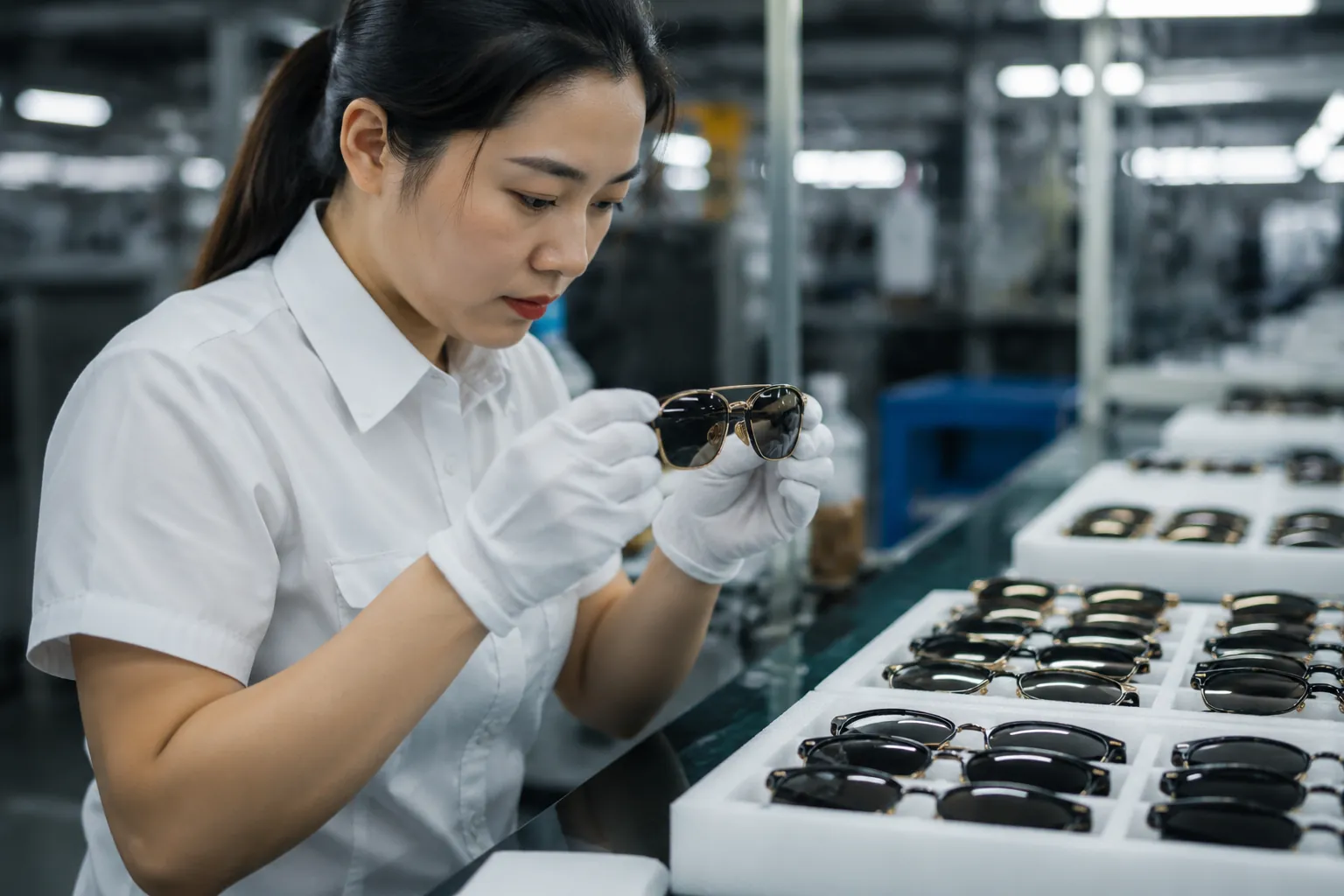
If you buy sunglasses in volume, frame metal is not just a style choice. It affects landed cost, rejection risk, corrosion performance, and where the product can sit on shelf. This comparison is for brands, importers, distributors, and retailers that need a frame material to match target price, expected use, and compliance requirements. The right answer depends on the retail price point, the required finish quality, and how much process risk your margin can absorb.
What each material means in production
Buyers often say "metal frame" as if that were one category, but in production the material determines the tooling, the defect profile, and even the way the product should be merchandised. Metal-alloy usually refers to zinc alloy or a similar cast alloy used for front frames, decorative bridges, or fashion-led silhouettes with more visual mass. Stainless steel is usually sheet-based or wire-based, so it can be thinner, more precise, and easier to use for modern rectangular, rimless, or semi-rimless shapes. Titanium sits in a different bracket: it is lighter, more corrosion resistant, and more demanding to cut, bend, weld, and finish.
In production, the process path changes materially with each substrate. Metal-alloy front frames typically start with die casting, then go through trimming, deburring, tumbling, surface leveling, plating, assembly, and final QC. Dimensional drift after casting is normal, so factories usually allow for post-cast correction and inspect critical points like bridge width, lens groove consistency, and hinge seat alignment. Stainless steel frames are commonly stamped or wire-formed, then bent, welded, polished, and fitted with hinges and temples. Titanium requires tighter control in forming and welding because springback is higher, the scrap cost is higher, and the material is less forgiving when heat or pressure is off by even a small amount.
In practical sourcing terms, alloy is often the easiest way to get visual weight at the lowest entry cost. Stainless steel is the strongest middle-ground when the brand wants a cleaner premium look, lighter wear, and better corrosion resistance without moving into full titanium economics. Titanium is the right answer when the product story is about low weight, comfort, and long-life wear, but it usually adds cost at every step: raw material, forming, polishing, fixturing, and yield loss.
The manufacturing behavior matters more than the marketing label. Alloy tolerates broad styling freedom but can show plating weakness quickly if surface prep is poor. Stainless steel supports thin profiles and repeatable geometry, but welded joints and laser-etched surfaces need control. Titanium delivers the strongest technical story, but the supply chain needs discipline; if a factory does not understand its springback and weld behavior, the customer can end up paying premium price for mediocre execution.
Quick comparison by cost, weight, and durability
The fastest way to compare the three materials is to look at how they behave on the line and on the shelf. The table below is the short version buyers usually need before requesting quotes or samples.
| Material | Typical price position | Weight feel | Corrosion resistance | Typical tolerances and process notes | Common use case |
|---|---|---|---|---|---|
| Metal-alloy | Lowest | Medium to heavy | Moderate; plating and seal quality matter a lot | Cast parts may vary by around ±0.2-0.4 mm before finishing; plating thickness must be specified and verified against the finish system used | Fashion-led frames, promo programs, aggressive price points |
| Stainless steel | Middle | Light to medium | Good | Stamped or wire-formed parts can hold tighter geometry, often around ±0.1-0.2 mm on critical bends if tooling is stable | Mainstream premium retail, daily wear, cleaner silhouettes |
| Titanium | Highest | Light | Very good | Springback must be compensated; final fit checks often need more frequent adjustment because small bend errors are visible immediately | Premium collections, long-wear products, travel and active positioning |
Pricing in production is not fixed by material name alone. Geometry, temple length, hinge type, lens size, engraving method, surface finish, and packaging all move cost. As a sourcing rule, volume pricing usually improves at 300, 1,000, and 5,000+ pairs because tooling setup, plating runs, and labor absorption become more efficient. A simple fashion alloy frame may land below stainless steel at scale, while a stainless steel frame typically sits above alloy because of material and forming time. Titanium remains above both because the raw input, scrap management, and processing time are all more expensive.
MOQ varies by factory and by design complexity. For custom programs, a lower MOQ can be useful for testing a market, but it does not change the unit economics of the material itself. In a small run, setup, calibration, and handling overhead are still real. If the goal is to lower cost per pair, the real levers are stable specifications, shared components, fewer finish changes, and higher repeat volume.
Lead time follows the same pattern. A simple alloy or stainless concept with fixed lens tint and standard decoration can move through sample approval in about 7-10 days and bulk in about 25-35 days when the specification is stable. Titanium often takes longer because forming and finishing are slower, and any late adjustment can require rework on specialized tooling. If a buyer changes bridge width, hinge style, or logo method after approval, the schedule usually moves.
Perceived value at retail is not the same as cost
Metal-alloy can look expensive if the plating, color, and silhouette are managed well. The problem is that the product can also feel heavier and more generic if the bridge shape is common or the finish is thin. Stainless steel usually presents better in the hand because it enables a slimmer profile, more precise edges, and a cleaner visual line. Many retailers use that to justify a middle-to-upper retail tag. Titanium creates the strongest technical value perception because customers feel the weight difference immediately, and the frame often communicates "engineered" rather than merely "styled."
That said, value perception depends on the customer segment and the selling environment. A fast-fashion chain may perform better with a polished alloy frame that looks trend-led and keeps the opening price low. A premium optical, travel, or outdoor retailer can justify titanium because shoppers are buying comfort, durability, and brand confidence, not just a shape. Stainless steel often wins in the broad middle because it delivers a premium impression without forcing the retail price into the titanium tier.
There is also a merchandising angle that gets overlooked. A frame that feels light in hand may photograph as subtle, which can be a disadvantage for impulse retail but a strength in premium channels where product education matters. Conversely, a heavier alloy frame can look richer in a display tray but may disappoint once worn. The buyer needs to know which experience drives conversion in that channel. A good frame material can support margin, but only if the story, display, and staff script match the material.
Do not assume "premium" always means titanium. A carefully finished stainless steel frame with the right lens tint, balanced temple thickness, and a clean logo application can outperform a poorly designed titanium frame. Retail positioning has to match product story, display training, return expectations, and price architecture. The frame material is part of the value equation, not the entire equation.
Durability, corrosion, and failure modes
Each material fails differently, and those failure modes matter more than broad claims like "strong" or "durable." Metal-alloy is the easiest to dent, bend badly, or show finish wear if the plating stack is weak. In humid, coastal, or high-sweat environments, low-grade plating can start to dull around hinges, nose pad arms, drilled points, or laser-engraved areas. Stainless steel performs better against daily moisture, sweat, and light chemical exposure, but welded joints still need clean control and the finishing process needs to avoid scratching or heat discoloration. Titanium resists corrosion extremely well, including in travel-heavy and high-humidity conditions, but poor hinge design, loose screws, or bad tolerance management can still cause failures.
For overseas buyers, the practical question is where the product will be sold and how it will be used. Beach markets, sports-adjacent retail, and tropical shipping routes put more pressure on corrosion resistance. In those cases, stainless steel or titanium usually makes more sense than a cheaper alloy. If the product is fashion-led and short lifecycle, alloy may still be acceptable, but only if the buyer is honest about service life and warranty expectations. A frame that is expected to survive months of daily use should not be spec'd like a one-season promotional item.
Factory QC should be tied to likely failure points. For alloy, that means plating adhesion, edge smoothing, and hinge seat integrity. For stainless steel, it means weld quality, bend repeatability, and finish consistency. For titanium, it means dimensional accuracy after forming, hinge alignment, and screw retention after assembly. Common checks include hinge cycling, temple-open force, lens groove uniformity, pad-arm symmetry, and visual inspection under controlled light. If a frame passes appearance only, that is not enough. A small alignment error can look trivial on paper and feel obvious on the face.
QC should be built around the approved product, not just the sample photo. Buyers should ask for inspection criteria, not just inspection promises. The most useful controls are measurable: hinge position, temple symmetry, bridge width, lens opening, finish coverage, and screw retention. A supplier that can explain those controls clearly is easier to scale with than one that only says the product is "good quality."
How production changes by material
Buyers often ask for the same silhouette across all three materials and expect the same lead time. That is unrealistic because the process load changes from the first operation onward. The same bridge line, lens aperture, and temple geometry do not behave identically in cast alloy, stainless steel, and titanium. Even if the product looks similar at shelf distance, the internal manufacturing path is different.
- Metal-alloy: die casting, trimming, deburring, tumbling, polishing, plating, assembly, and finish inspection.
- Stainless steel: stamping or wire forming, bending, welding, polishing, temple fit, and surface check.
- Titanium: precision cutting, controlled forming, welding, deburring, polishing, and tighter dimensional inspection.
For alloy, the most important process control is post-cast cleanup and plating. A weak base polish can show through the final finish, and a thin or uneven plating layer may pass initial visual inspection but fail after handling or humidity exposure. For stainless steel, the main challenge is controlling bend repeatability and welding distortion. A stable fixture helps, but weld heat still moves the part slightly, so experienced factories compensate with tooling and final adjustment. Titanium requires even tighter control because it springs back more and marks more easily during polishing.
Mixed-material builds need coordination. Metal fronts often pair with acetate temples, lens color, logo placement, and finish matching. If you want a metal front with acetate temples, the fit tolerances need to be checked before final plating and assembly, not after. A mismatch of even a small amount at the hinge junction can turn into a visible lean or an uneven temple angle once the frame is worn.
For premium sunglasses, the most common non-negotiables are bridge symmetry, temple alignment, hinge flushness, and clean plating at the contact points. A sample that looks good but has a hinge sitting off center will not improve in production unless the cause is corrected. Buyers should insist on a controlled sample stage, then lock the approved spec before bulk begins. The approval should include the material grade, finish reference, hinge style, logo method, and a tolerance sheet so the factory knows what "approved" means.
Compliance and why the material choice affects it
Material choice does not replace compliance. It changes what needs to be controlled. For sunglass frames and finished sunglasses, the relevant certifications and standards depend on the destination market and the product claim. Common references include CE EN ISO 12312-1, ANSI Z80.3, AS/NZS 1067, REACH, FDA registration, ISO 9001, and BSCI.
REACH matters for restricted substances in materials and finishes, which means alloy composition, plating chemicals, coatings, and decoration inks cannot be treated casually. Stainless steel and titanium are not automatically compliant just because the base metal sounds cleaner. Surface treatments, solder, pads, screws, adhesives, and decorative parts still need control. For example, a titanium front with a poorly chosen nose pad or low-grade screw can still create a compliance or durability problem even though the frame body itself is excellent.
Buyers should think in terms of test efficiency. A material with a stable supply chain and consistent plating or finishing is more likely to pass the test package on the first round. That matters because every re-test adds time and cost. If a supplier cannot identify the plating system, the surface coating method, or the material designation, the buyer is taking avoidable risk. A cheaper frame that fails compliance or finish durability is not cheap; it is inventory loss plus delay.
Practical compliance also includes traceability. Buyers should request the approved BOM, material declaration, finish specification, and destination-market test plan before bulk. If the frame uses mixed metals, decorative inserts, or surface coloring, those details should be written down because those are often where restricted substances or inconsistent performance show up. Compare materials on pass probability, not just raw material cost.
Which frame should you choose by retail strategy
Choose based on the shelf, not the catalog photo. The right frame is the one that supports the retail margin, customer expectation, and product use case without forcing the factory to hide weak choices behind finish tricks.
- Pick metal-alloy if your target is entry premium, fast fashion, promo-driven volume, or a low opening price. It gives the most flexibility on shape and finish, but you must control plating, edge quality, and corrosion risk.
- Pick stainless steel if you want a clearer premium feel without jumping to titanium cost. It suits retail programs that want lighter wear, sharper lines, and better resistance to daily moisture.
- Pick titanium if the product must justify a higher ticket through comfort, low weight, and a stronger durability story. Use it where the customer understands the material and is willing to pay for the difference.
A workable commercial rule is simple: alloy for price, stainless steel for balance, titanium for performance. That is blunt, but it prevents expensive misalignment. If the brand plan cannot support the retail markup, do not force titanium into it. If the product is meant to survive heavy daily use, do not hide behind cheap alloy and hope the finish carries the story. The material has to match the channel, the claim, and the expected wear pattern.
For volume buyers, the smartest move is to test one silhouette in one material first, then expand. A lower MOQ can help brands validate shape, fit, finish, and customer reaction before scaling. Typical sample timing is about 7-10 days, then about 25-35 days for bulk once the material, lens tint, decoration method, and QC checkpoints are locked. If the buyer changes the metal after approval, the design is no longer the same program; it becomes a new one with new risk, new timing, and usually new cost.
When comparing quotes, ask for the unit price at 50, 300, 1,000, and 5,000 pairs, plus what changes at each step: packaging, plating batch size, hinge spec, and decoration cost. That tells you more than a single headline price. A supplier that can explain the step-down logic clearly is usually easier to scale with than one that only gives a flat number.
Sample order checklist before you commit
Before placing a bulk order, ask for these items in writing and on the sample itself. The more specific the sample, the fewer surprises in bulk production.
- Exact base material specification, including alloy grade or titanium/stainless designation where applicable.
- Plating or surface finish method, target color reference, and finish thickness target if available.
- Hinge type, spring action if used, screw size, and target open-close cycle expectation.
- Temple length, front width, lens base curve, nose bridge width, and key fit tolerances.
- Decoration method: laser engraving, pad printing, metal logo plate, or embossing.
- Compliance target for the destination market: CE EN ISO 12312-1, ANSI Z80.3, AS/NZS 1067, REACH, FDA registration, as applicable.
- Inspection points for alignment, finish consistency, hinge cycling, and plating adhesion.
Do not approve a sample based only on appearance. Confirm fit, finish, repeatability, and the effect of repeated handling. A frame that looks good in one sample can become a different product in production if welding, polishing, or plating is not controlled. Ask the factory what the acceptable deviation is at the bridge, the lens rim, and the temple joint, and make sure the answer is written into the approved spec.
For volume buyers, the right supplier is the one that can explain the process without hiding behind adjectives. Ask how the frame is made, where the finish is vulnerable, what happens if the hinge tolerance drifts, and which step is most likely to create scrap. If the answers are vague, the bulk will be vague too. If the answers are concrete, the production usually is too.
Have a custom sunglasses project in mind?
Send us your styles, target market and quantities and we will return a detailed quote with MOQ, lead time and a sample plan.
Get a QuoteWhy source this from Wenzhou with LumiShades
Wenzhou in Zhejiang Province is widely regarded as China’s eyewear manufacturing capital, producing a large share of the world’s sunglasses. That concentration matters to buyers: a deep local supply chain for acetate sheet, hinges, lens blanks, plating and packaging means shorter component lead times, easier color and material matching, and a workforce with decades of eyewear-specific skill. LumiShades has manufactured in this ecosystem since 2009, and our vertical integration — in-house injection molding, acetate cutting, CNC milling, lens tinting, decoration and quality control — means no part of your order is quietly subcontracted to a workshop you cannot audit.
For international buyers, that vertical control translates into accountability. When a single factory owns every step, defects are traced and fixed at source rather than bounced between vendors, and your specifications survive intact from first sample to bulk. We back this with 15+ years of experience, shipments to 60+ countries, more than 5 million pairs produced per year and a 98.5% on-time delivery rate. Our certifications — CE EN ISO 12312-1, FDA registration, ANSI Z80.3, AS/NZS 1067, REACH, ISO 9001 and BSCI audit — mean the compliance documentation your market requires already exists. Explore our manufacturing capabilities and quality control process to see how this works in practice.
Frequently asked questions
What is the best metal for premium sunglasses if I need a middle-market retail price? Stainless steel is usually the safest choice. It gives a lighter, cleaner look than alloy, holds tighter geometry than cast materials, and stays below titanium on cost. For many programs, it also gives the best balance of perceived quality and sell-through risk. If you want to validate this choice, compare one stainless sample against your alloy sample on weight, bridge comfort, and finish consistency under normal store lighting.
Is titanium always worth the extra cost? No. Titanium makes sense when comfort, low weight, corrosion resistance, and a premium technical story are part of the selling point. If the retail price cannot support that margin, stainless steel is usually the better commercial decision. Before choosing titanium, ask the factory to confirm the material grade, the hinge system, and whether the finish can be maintained through the expected wear cycle.
Can metal-alloy pass compliance for export markets? Yes, but only if the alloy, plating, coatings, and final product testing are controlled for the target market standards such as CE EN ISO 12312-1, REACH, ANSI Z80.3, AS/NZS 1067, and FDA registration where applicable. The base material alone does not guarantee compliance. Ask for the BOM, finish specification, and test plan before you approve bulk so the supplier can show exactly how the frame will be tested and documented.
What MOQ should I expect for custom metal sunglasses? MOQ depends on the factory and the design, but a useful starting point is a small pilot order for validation and then a scale-up once fit and finish are confirmed. If a supplier offers 50 pairs per design, use that to test the silhouette, color, and retail response before committing to larger volume. Ask for price breaks at 300, 1,000, and 5,000 pairs so you can see how setup, plating, and assembly costs change with scale.
How long do samples and bulk production take? A stable, simple alloy or stainless project often takes about 7-10 days for samples and about 25-35 days for bulk after approval. Titanium, mixed-material builds, or complex finishes can take longer because forming and finishing are more sensitive. To keep timing predictable, freeze the material, finish, hinge, logo method, and lens tint before sample approval.
What should I ask for before approving the first order? Lock the base material, finish method, hinge detail, decoration method, target compliance standard, and QC checkpoints. Also confirm the key tolerances for bridge width, temple alignment, and lens opening before you approve bulk. The most useful follow-up question is: what are the three most likely failure points in production, and how will the factory inspect them?
Ready to start?
Explore our rimless sunglasses or request a quote — our sales team replies within 12 hours.
Request a Quote