
Which Lens Add-Ons Belong on One Sunglass SKU?
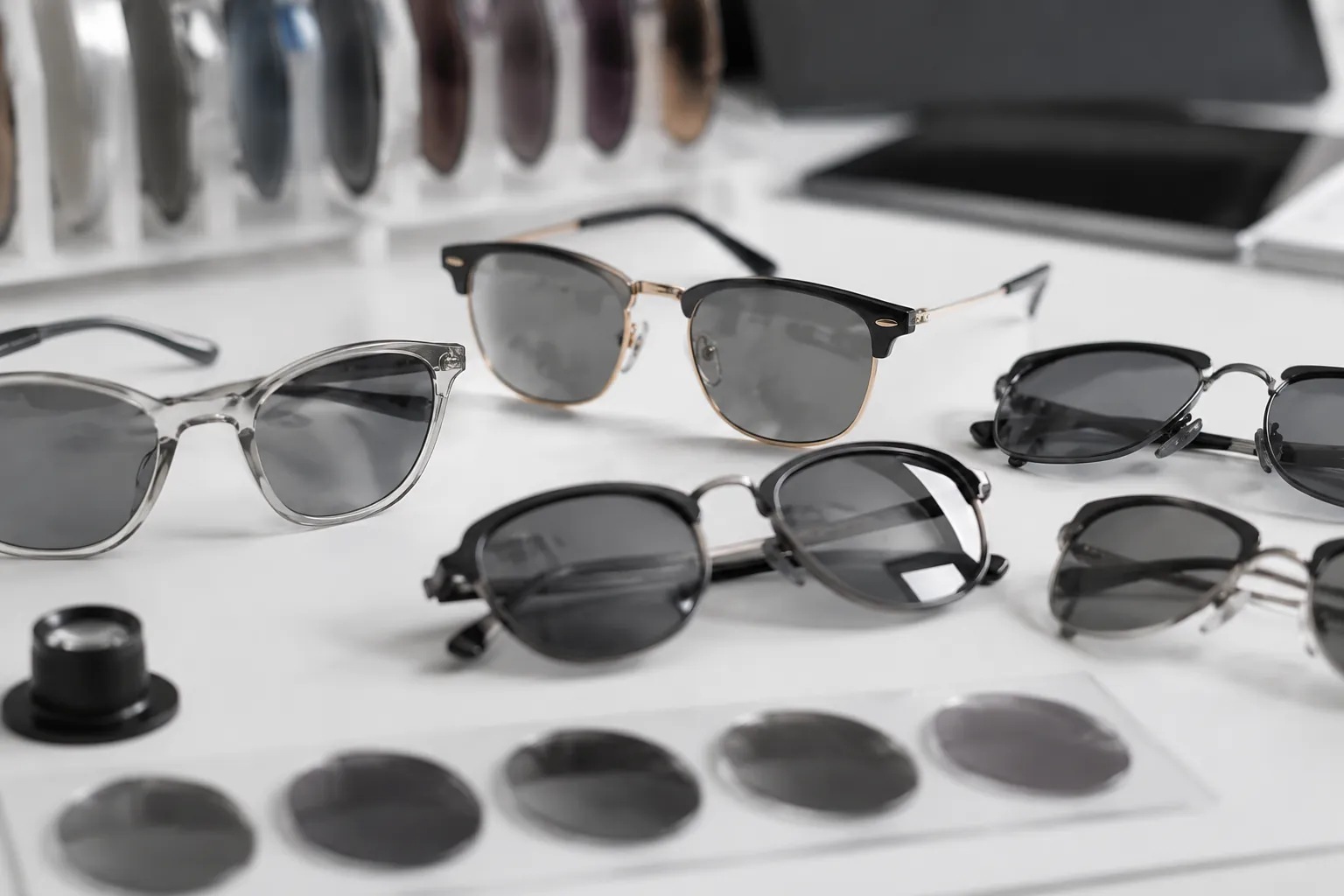
This guide is for brand owners, importers, distributors, and retail buyers building sunglass SKUs around a target price, sales channel, and compliance need. The real sourcing question is not whether UV400, polarization, mirror coating, and hard coating are useful on their own. It is whether they belong on the same lens for the target market, price point, and product story. In OEM and private-label programs, stacking features can raise perceived value and cut some complaint risk. It can also add process steps, sample rounds, and arguments over appearance or performance if the spec is loose. A good lens package does three things: gives the factory a clear brief, keeps approval under control, and gives the end market a feature set it can understand and pay for.
Start With the Selling Environment, Not the Feature List
Many buyers start with the same instruction: make the lens UV400, polarized, mirrored, and scratch-resistant. It sounds thorough. It often is not.
A better approach is to start with the use case and retail setting, then build the lens spec backward. Ask four basic questions first: where will the product be sold, what retail price must it hit, how much handling abuse will it face, and how much explanation can the retailer give at shelf level? A low-price fashion program should not be specified like a driving, marine, or outdoor SKU sold on function.
UV400 is usually a baseline in export sunglass programs, not a premium feature. Polarization is different. It adds value when reflected glare is part of the reason to buy, such as on roads, water, sand, or other bright flat surfaces. Mirror coating changes the look first. In many channels, that is its main selling job. Hard coating is less visible at point of sale, but often matters more in reducing scratches during packing, shipping, unpacking, shelf handling, and normal wear.
These features do different jobs. Do not treat them as equal.
- UV400: baseline ultraviolet protection requirement for most commercial sunglass programs.
- Polarization: functional upgrade for glare-heavy use cases, not just a hangtag claim.
- Mirror coating: visual differentiation and possible light-management effect, with added cosmetic-control requirements.
- Hard coating: durability upgrade that can reduce surface-marking complaints in high-handling channels.
Once features are combined, the process stack gets more sensitive. A polarized mirrored lens is not one feature with extra labels. It is a sequence of material, coating, and inspection steps that still has to meet the approved transmission range, cosmetic standard, and optical target in the finished product.
What Each Add-On Does to Cost, Yield, and Risk
Every add-on changes four things at once: piece cost, process time, production yield, and claim risk after sale. Buyers who look only at the surcharge per pair usually miss the bigger commercial effect of stacked features.
UV400 is often the least disruptive because ultraviolet protection can be built into the lens material, tint system, or coating package. Still, it should be checked on the finished lens after all tint and mirror adjustments. Raw material data is not enough.
Polarization adds complexity because it needs either polarized lens material or a laminated polarizing structure, plus orientation control. If the axis is inconsistent or the left and right lenses do not match, the result can be uneven visual performance or incoming-inspection failure. Mirror adds another yield variable. Coating color must stay even across the lens surface, and minor cosmetic defects stand out more on mirrored lenses. Hard coating usually improves abrasion resistance, but it adds another process step and can expose adhesion or cleanliness problems if surface prep is weak.
| Feature | Typical Factory Effect | Commercial Cost Impact | Main Production Risk | Best Commercial Fit |
|---|---|---|---|---|
| UV400 | Usually integrated into material or dye system | Usually low relative impact | Underperformance after lens-color or process changes | Almost all export sun SKUs |
| Polarization | Material upgrade plus orientation control | Moderate to high relative impact | Axis mismatch, optical inconsistency | Driving, fishing, marine, outdoor |
| Mirror | Extra coating step with cosmetic control | Moderate relative impact | Color variance, rub marks, yield loss | Fashion, beach, sport-fashion |
| Hard coating | Additional coating and cure cycle | Low to moderate relative impact | Adhesion defects, dust points | Chain retail, travel retail, high handling |
The exact cost effect depends on lens material, color, order size, factory setup, and how the supplier prices setup, tooling, and quality control. At low volumes, each extra step carries a heavier approval burden. At higher volumes, the economics usually improve, and the buyer has more room to split lens packages by channel or market.
The practical lesson is blunt: post-sale claim cost can erase small savings in the lens spec. Removing a protective step may lower the quote, but if the product is handled hard in distribution or retail, returns and disputes can cost more later.
Lens Combinations That Usually Make Sense
Some feature stacks work again and again because the value is clear to the customer and manageable for the factory.
- UV400 only: best for opening-price fashion, promotional programs, fast-turn trend styles, and channels where staff will not explain lens technology.
- UV400 + hard coating: strong for chain retail and broad-volume basics where handling damage matters more than a premium performance story.
- UV400 + polarization: best for driving, fishing, boating, and outdoor categories where glare reduction matters in actual use.
- UV400 + polarization + hard coating: often one of the safest premium stacks because it adds practical value without leaning mainly on fashion color claims.
- UV400 + mirror: strong in youth, beach, seasonal, and festival collections where appearance drives fast purchase decisions.
- UV400 + polarization + mirror + hard coating: useful for premium sport-fashion, marine, and travel retail, but only when the retail price, frame quality, and approval discipline support it.
The full stack is not automatically the best stack. If the shopper buys in a few seconds based on looks, mirror may do most of the selling while polarization adds cost the customer will not notice. On the other hand, if the product is used in glare-heavy conditions, polarization is easier to justify, and hard coating may be sensible protection against handling and wear.
Material choice matters too. TAC polarized lenses are common in commercial programs, but lamination quality and edge handling need control. PC lenses are common in sport-oriented products because of impact-related performance characteristics, yet mirror and hard-coat results still depend on correct surface prep and curing. AC lenses can work in lower-cost fashion programs, but buyers should be careful about loading premium add-ons onto a product whose overall construction does not support the claim.
Where Buyers Overspec and Lose Margin
One common mistake is adding polarization to fashion mirror styles sold mainly on lens color, frame shape, and impulse appeal. The product costs more. The user may not feel enough glare-related benefit to justify it. Margin disappears fast.
Another mistake is skipping hard coating on programs that will be touched repeatedly. This shows up in discount chains, travel retail, convenience channels, and promotional programs packed and repacked in volume. A lens can pass outgoing inspection and still trigger complaints later if the surface marks too easily during replenishment or shelf handling.
A third mistake is putting a premium lens package into an entry-level frame. If the frame shows basic finishing, molding marks, or weak overall presentation, the customer notices that first. The buyer then pays for lens features the product as a whole does not support.
Use a simple filter before approving the four-feature stack:
- Can the shopper understand the value without staff training?
- Does the target retail price leave room for the added lens cost?
- Will the product be used in glare-heavy conditions often enough to justify polarization?
- Is the channel likely to create scratch complaints through handling?
- Does the frame construction support a premium claim in fit, finish, and decoration?
If the answer is no to most of those questions, simplify the stack. In many low-price fashion programs, polarization is the first feature to question. On practical driving SKUs, mirror may be the feature that adds visual complexity without adding equal functional value.
Compliance and Testing After Features Are Stacked
Every lens stack still has to meet the destination-market requirement. Mirror and polarization do not replace compliance work. They make it more sensitive, because more variables affect the finished lens.
For export buyers, the product references commonly cited are CE EN ISO 12312-1 for Europe, ANSI Z80.3 in the US market context, and AS/NZS 1067 for Australia and New Zealand, depending on the program and destination. Buyers should also separate management-system, social-audit, chemical, and product requirements. ISO 9001 relates to quality-management systems. BSCI relates to social-audit structure. REACH is relevant to chemical compliance. FDA registration may appear in US supply-chain paperwork. None of these replaces testing and approval of the actual finished sunglass SKU.
In production terms, stacked features create more approval points. Mirror color can affect visible light transmission category. Polarization requires left and right lens consistency. Hard coating changes the final process stack and can introduce cosmetic or adhesion issues if control is weak. UV400 performance should be confirmed on the final finished lens, not assumed from a raw material claim.
Before bulk starts, buyers should lock these points clearly:
- Visible light transmission category approved for the destination market and intended use.
- UV400 performance confirmed on the final finished lens configuration.
- Polarization consistency checked on both left and right lenses.
- Mirror appearance approved against a retained sample under defined viewing conditions.
- Scratch-resistance claim language defined carefully, because hard coating improves resistance but does not make a lens scratch-proof.
That last point matters. Many disputes start with bad claim wording, not a proven factory defect. If a buyer markets hard-coated lenses as scratch-proof, the claim itself creates avoidable risk.
Lead Time, MOQ, and Sampling Logic for Multi-Feature Lenses
Feature stacking usually affects approval complexity more than buyers expect. The sample and bulk timeline depends on factory capacity, material availability, order size, and the number of approval rounds. More variables mean more chances for delay.
Each late change has a cost. If a buyer adjusts tint depth after approving mirror color, the mirror look may shift. If a logo is added after lens approval, the full product may need to be reviewed again as the final visual standard. On a simple UV400 lens, those changes are easier to absorb. On a polarized mirrored lens with decoration, they are more likely to cause rework, delay, or disagreement.
| Order Size | Best Lens Logic | Commercial Reason | Approval Risk |
|---|---|---|---|
| 50 pairs/design | UV400, UV400 + hard coating, or UV400 + mirror | Lower setup burden and easier approval path | High if too many variables are added |
| 300 pairs/design | UV400 + polarization or UV400 + hard coating | More room to justify a functional upgrade | Moderate with retained-sample control |
| 1000 pairs/design | Channel-specific lens stacks under one style family | Better ability to absorb process complexity | Manageable with fixed specs |
| 5000 pairs/design | Full segmentation by market and colorway | Best leverage for supply planning and consistency work | Lower relative unit risk but stricter QC discipline needed |
A practical development sequence is simple: approve frame and base lens color first, add polarization only if the use case requires it, add mirror only after the base visual is stable, confirm hard coating in the final process stack, then approve the exact final lens and decoration combination. Approve out of order, and shade disputes come quickly.
A Buyer Decision Framework by End Market
Different channels reward different lens stacks. Smart buyers do not force one spec across every market. The same frame can support multiple lens packages if the price architecture is planned early.
| End Market | Recommended Lens Stack | Why It Works | Watch-Out |
|---|---|---|---|
| Entry fashion retail | UV400 or UV400 + mirror | Fast visual sell with controlled cost | Do not add premium features the customer is unlikely to notice |
| Chain retail basics | UV400 + hard coating | Good compliance base with lower handling-complaint risk | Keep scratch-resistance claims realistic |
| Driving and outdoor | UV400 + polarization | Clear functional value in actual use | Need consistent polarized lens quality on both sides |
| Marine, fishing, travel premium | UV400 + polarization + hard coating | Strong practical value plus better durability | Frame quality must support the lens claim |
| Sport-fashion premium | UV400 + polarization + mirror + hard coating | Combines visual appeal and premium function | Higher cost, tighter QC, and more sample discipline |
The rule is simple: add features only where the market pays for them through clearer functional value, stronger visual appeal, lower complaint risk, or a mix of those factors. If a feature does not support sell-through, reduce claims exposure, or strengthen product position in a way the buyer can explain, question it.
The Spec Sheet That Prevents Trouble
Most lens disputes start with vague purchase orders. Terms like "polarized mirror UV400 lens" describe a concept, not a production spec. Factories need measurable targets, approved visual references, and a clear compliance brief.
A usable spec sheet for a combined-feature sunglass SKU should include lens material, base lens color, UV requirement on the final lens, polarization requirement, mirror color reference, hard-coating requirement, target market standard, and packaging expectations. If the product includes decoration, specify that with the same precision. Pad printing, screen printing, hot stamping, laser engraving, and metal logo plates do not create the same visual result, cost profile, or approval risk.
- Lens material: AC, PC, TAC, nylon, or other specified substrate.
- Base color: approved against retained sample or other agreed visual standard.
- UV requirement: state UV400 on the final finished lens.
- Polarization requirement: confirm type and left/right consistency expectation.
- Mirror color: tie to an approved sample, not only a verbal color name such as blue or silver.
- Hard coating: specify requirement on both lenses and align cosmetic standard after curing.
- Compliance target: list CE EN ISO 12312-1, ANSI Z80.3, or AS/NZS 1067 as applicable.
- Decoration method: pad print, laser, foil, or metal part confirmed on final approval sample.
- Packing standard: define lens protection if surface-marking risk is high.
Buyers should also request a retained approval sample and define cosmetic tolerance before bulk starts. For mirrored lenses, some batch-to-batch appearance variation may still need to be managed, so the acceptable range should be agreed in advance. The more features stacked onto one SKU, the less room there is for verbal assumptions.
Have a custom sunglasses project in mind?
Send us your styles, target market and quantities and we will return a detailed quote with MOQ, lead time and a sample plan.
Get a QuoteWhy source this from Wenzhou with LumiShades
Wenzhou in Zhejiang Province is widely regarded as China’s eyewear manufacturing capital, producing a large share of the world’s sunglasses. That concentration matters to buyers: a deep local supply chain for acetate sheet, hinges, lens blanks, plating and packaging means shorter component lead times, easier color and material matching, and a workforce with decades of eyewear-specific skill. LumiShades has manufactured in this ecosystem since 2009, and our vertical integration — in-house injection molding, acetate cutting, CNC milling, lens tinting, decoration and quality control — means no part of your order is quietly subcontracted to a workshop you cannot audit.
For international buyers, that vertical control translates into accountability. When a single factory owns every step, defects are traced and fixed at source rather than bounced between vendors, and your specifications survive intact from first sample to bulk. We back this with 15+ years of experience, shipments to 60+ countries, more than 5 million pairs produced per year and a 98.5% on-time delivery rate. Our certifications — CE EN ISO 12312-1, FDA registration, ANSI Z80.3, AS/NZS 1067, REACH, ISO 9001 and BSCI audit — mean the compliance documentation your market requires already exists. Explore our manufacturing capabilities and quality control process to see how this works in practice.
Frequently asked questions
Should every export sunglass SKU have UV400? In most B2B sunglass programs, UV400 is treated as the baseline requirement rather than an upgrade. A buyer should still ask the supplier to confirm UV performance on the final finished lens configuration, especially if lens color, mirror coating, or material changes during development. The practical step is to write the UV400 requirement into the PO and approval sample record, then link it to the destination-market standard used for the product.
Does polarization always justify the added cost? No. Polarization is most defensible when the product is intended for driving, marine use, fishing, or outdoor wear where reflected glare is part of the use case. For fashion-led or impulse-price programs, the buyer should ask a direct question: will the customer notice and value the glare reduction enough to support the higher price or lower margin? If the answer is unclear, request two sample versions of the same style, one polarized and one non-polarized, and compare retail position, landed cost, and expected sell-through before locking the spec.
Is hard coating necessary on mirrored lenses? It is often a sensible requirement, especially when the product will move through broad retail distribution or frequent handling. Mirrored surfaces can make rub marks and fine surface defects more visible, so hard coating can help reduce complaint risk. The buyer should specify hard coating as a process requirement on the final lens, define the cosmetic standard at approval, and avoid using the term scratch-proof in packaging or sales claims.
Will adding all four features slow production? It can, because each added feature creates another approval point and another chance for interaction between color, coating, and appearance. The biggest delays usually come from late changes to base tint, mirror shade, or decoration after the lens was already approved. A practical control method is to approve in sequence: frame and base lens first, then polarization if needed, then mirror, then hard coating in the final stack, and finally the exact decorated production sample.
How should I handle MOQ for a new lens combination? Keep the first order simple if the quantity is low or the product is untested in the market. At small MOQs, choose the feature stack that is easiest to approve and least likely to create avoidable variation. As volume becomes more stable, buyers can separate lens packages by channel and justify more complex combinations. The practical step is to ask the factory to quote the same frame with two or three lens-stack options side by side, including approval assumptions, so the commercial trade-off is visible before sampling starts.
Ready to start?
Explore our shield & oversized sunglasses or request a quote — our sales team replies within 12 hours.
Request a Quote