
TAC vs PC vs Nylon Polarized Lenses for Buyers
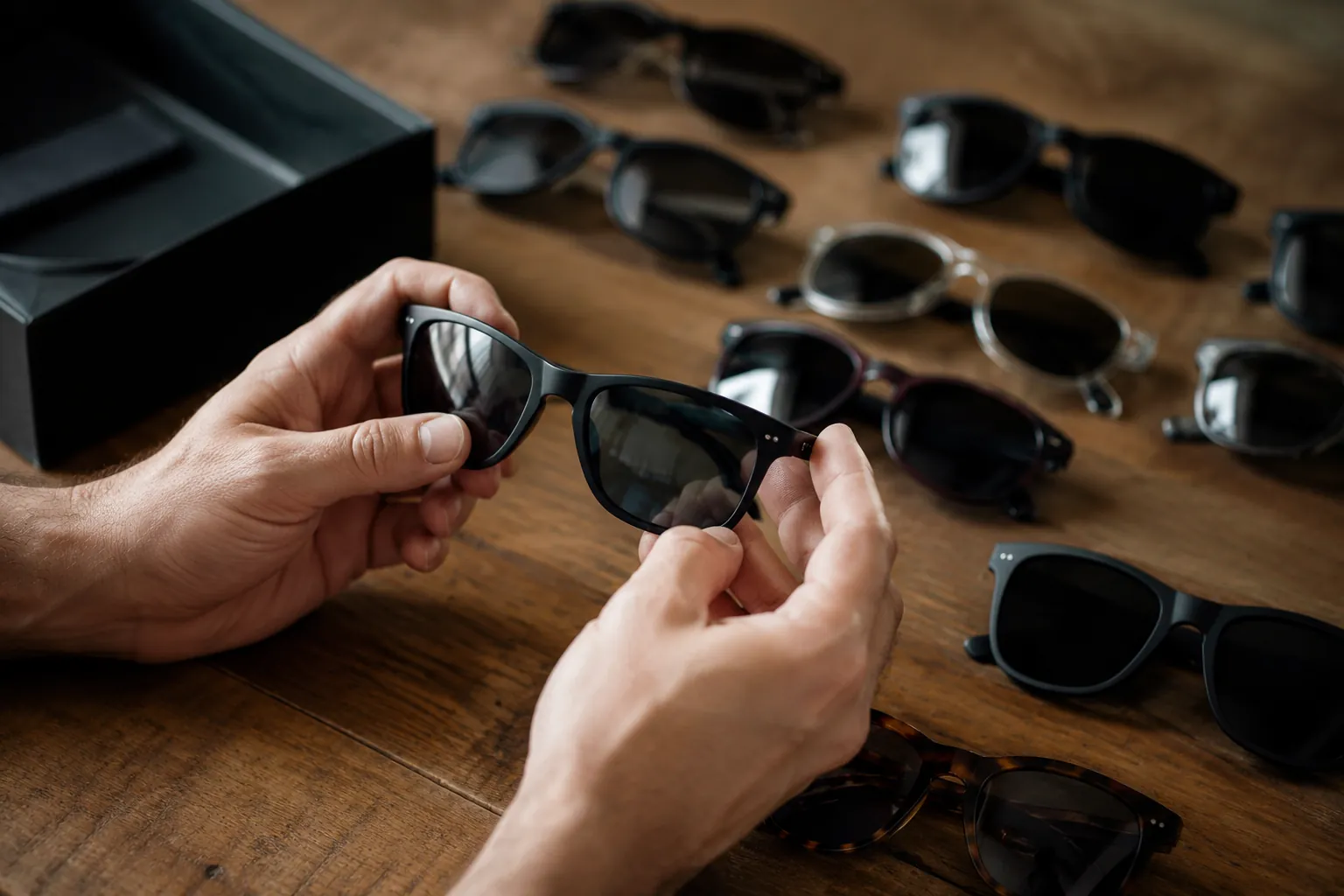
This guide is for brand owners, importers, distributors, and retail buyers choosing polarized lenses for a sunglass line. Lens choice affects more than material cost. It shapes optical quality, scratch complaints, breakage risk, production yield, compliance planning, and retail positioning. Get it wrong and the problems show up fast: remakes, lot inconsistency, failed testing, or a target price that no longer works. Get it right and the product is easier to quote, approve, build, and reorder. The right lens depends on end use, frame shape, coating requirements, destination-market standards, and product position. Below is a practical B2B comparison of TAC, PC, and nylon focused on sourcing decisions buyers can specify, check, and manage in production.
Start with channel, use case, and compliance
Many buyers start with a copied competitor spec: "nylon polarized lens" or "PC polarized lens." That is a weak starting point. Lens material only makes sense in context: sales channel, wear conditions, return tolerance, and destination-market requirements.
A fashion retailer selling price-sensitive sunglasses may care most about consistent appearance, acceptable optics, controlled cost, and low remake risk. TAC is common in that type of program. A sports retailer or outdoor brand may care more about impact resistance, low weight, and active-use durability. That usually puts PC or nylon on the shortlist. Premium collections are less tolerant of visible distortion, haze, or uneven finishing, so nylon often gets more attention there.
Before approving any lens construction, answer four basic questions:
- What is the main use case: fashion, driving, fishing, cycling, hiking, or general outdoor wear?
- What is the target ex-factory cost for the full product, and how much room is there for a lens upgrade?
- How sensitive is the channel to returns caused by scratching, breakage, distortion, or cosmetic inconsistency?
- Which standards or market requirements apply: CE EN ISO 12312-1, ANSI Z80.3, AS/NZS 1067, and any chemical compliance request such as REACH?
Those answers affect more than material choice. They also shape lens thickness, base curve, edging method, coating route, tint specification, and QC checkpoints.
TAC, PC, and nylon side by side
The fastest way to compare these options is with a sourcing table. This summary reflects common commercial and production tradeoffs, not absolute performance claims for every supplier or every lens build.
| Lens type | Typical strengths | Main weaknesses | Best-fit channels | Relative cost |
|---|---|---|---|---|
| TAC polarized | Widely used in sunglasses, commercially efficient, suitable for many fashion and mid-market polarized programs, broad supplier availability | Performance depends heavily on lamination quality and conversion quality; may be less suitable where high impact resistance is required | Fashion retail, promotional, chain stores, mid-market private label | Low to mid |
| PC polarized | High impact resistance, lightweight, often used in active and wrap styles | Scratch resistance depends strongly on hard-coat quality; optical refinement may be less favored in some premium applications | Sports, kids, outdoor, active-use programs | Low to mid |
| Nylon polarized | Often selected for good optical quality, toughness, and performance positioning | Higher material and processing cost; tighter production control may be needed | Premium sport, outdoor specialty, higher-end branded collections | Mid to high |
TAC is not a single monolithic lens material in the way buyers often describe PC or nylon. In sunglass sourcing, TAC usually refers to a laminated lens construction. So adhesive stability, film quality, and edge conversion matter. PC is usually chosen where impact resistance and low weight are the main requirements. Nylon is often requested where the product story leans on optical performance and a premium wear feel.
Do not rely on generic thickness assumptions. Finished lens thickness depends on frame groove design, base curve, standard requirements, and the supplier's process. Put the thickness on the drawing, approved sample, or production spec.
No lens type is best for every program. The right one is the one that fits the use case, meets the standard, and still works commercially.
Performance tradeoffs that drive returns
Buyers often compare lens materials by piece price first. That is too narrow. Most returns and warranty costs come from scratching, distortion complaints, delamination, cracking at the groove area, assembly stress, or visible variation across a production lot.
TAC: TAC can work well in fashion and general-use polarized programs if lamination and edging are controlled. The main risk points are usually conversion-related: chipped edges, edge lift, haze, or cosmetic defects after mounting. Ask how the supplier controls lamination quality, edging quality, and heat stability during storage and shipping.
PC: PC is a common choice where impact resistance matters. It is widely used in active styles, youth lines, and wrap frames. The tradeoff is surface performance. It depends heavily on the hard coat and on handling discipline in production. Ask what abrasion test method is used, how lenses are protected between operations, and what cosmetic inspection standard applies.
Nylon: Nylon is often selected for premium sport or outdoor lines because buyers associate it with strong clarity, toughness, and a more performance-oriented visual experience. The tradeoff is cost. Processing control also matters more. It usually makes sense only when the channel can support the added cost and the product story can justify it.
- If the main risk is impact or breakage, start with PC.
- If the main risk is visual quality and premium positioning, evaluate nylon.
- If the main priority is commercial efficiency for broad retail, TAC is often the first option to review.
Those are starting points. Not rules. Final selection should still be based on approved samples, test requirements, and the actual frame-lens combination.
Cost, MOQ, and quote logic
Lens choice affects cost, but it never acts alone. Frame material, hinge construction, decoration, packaging, testing, and rejection rate all shape the final ex-factory price. Still, polarized lens construction is one of the biggest quote variables. Specify it early.
MOQ and price breaks vary by factory and by product structure. For the supplier program described in this draft, MOQ starts at 50 pairs per design. Verify how that MOQ is defined: by color, by lens color, by logo version, or by total style. Small runs are useful for pilot launches, market testing, or channel approval samples. They are usually less cost-efficient. Setup and QC are spread across fewer units.
As volume rises, pricing usually improves. That part is simple. The exact breakpoints and savings are not. Confirm them in writing on the quotation instead of assuming them from a rule of thumb.
Typical cost logic follows a predictable pattern:
- TAC is often the easiest route for opening-price or mid-market private-label targets.
- PC often fits sport or youth lines where impact resistance is part of the product requirement.
- Nylon usually needs a higher retail ladder or a technically informed sales channel that can explain the value.
Decoration changes both cost and defect exposure. Common methods include pad printing on temples, laser engraving on lenses or metal parts, hot stamping, and metal logo plates. Ask which decoration is included in the quote, what tooling or setup charges apply, and how logo durability is checked.
The real comparison is total program cost. Not lens cost in isolation. A cheaper lens can become the expensive option if it drives rework, higher rejection, or more complaints after launch.
Lead time, process steps, and production risk
Lead time is not just a capacity question. It is also a process-risk question. The more operations that can damage the lens before packing, the more chances there are for delay.
For the supplier information in this draft, samples are typically stated as 7 to 10 days, and bulk production as 25 to 35 days after sample approval, deposit, and final specification confirmation. Treat those figures as supplier-specific estimates. Confirm whether they include packaging approval, lab testing time, and peak-season loading.
The production flow often includes frame production, lens preparation, tint or coating confirmation, edging, assembly, logo application, cleaning, inspection, and packing. Every handoff matters.
| Lens type | Common production risk | What buyers should confirm | Lead-time sensitivity |
|---|---|---|---|
| TAC | Lamination defects, edge chipping, cosmetic haze, possible heat-stability concerns depending on construction | Approved sample retention, edge finish standard, lamination consistency, heat-stability check | Moderate |
| PC | Scratch performance tied to coating quality, surface marks during handling, cosmetic scuffing | Hard-coat specification, abrasion test method, protection between operations, cosmetic inspection standard | Low to moderate |
| Nylon | Optical consistency control, processing yield sensitivity, fit issues in high-wrap frames if tolerance is loose | Base curve approval, distortion check method, lens-to-frame fit tolerance, final assembly verification | Moderate to higher |
Be specific on tolerances. If lens thickness, color tolerance, or assembly fit is left undefined, the supplier will apply its own commercial standard. Where fit is critical, ask for agreed control points: lens thickness tolerance, color reference against the approved sample, and acceptable assembly condition without visible stress or looseness.
Keep a retained production-reference sample on both sides. Simple step. Useful safeguard.
Compliance is a design input, not a paperwork step
For export programs, compliance should be built into material selection and sample approval from the start. Common sunglass standards include CE EN ISO 12312-1, ANSI Z80.3, and AS/NZS 1067. Chemical compliance requests may include REACH. Some U.S. buyers also ask about FDA registration status. Factory-management credentials such as ISO 9001 and BSCI may matter for supplier qualification, but they do not replace product-level compliance testing.
The key question is not whether a supplier has generic documents on file. The key question is whether the exact frame-and-lens combination being sold meets the requirement for the destination market. Lens transmittance category, UV performance, frame coverage, base curve, and lens construction can all affect the final compliance result.
Three mistakes show up often:
- Changing lens tint after sample approval without rechecking visible light transmittance and category.
- Moving from a flatter fashion shape to a higher-wrap sports shape without reassessing optical behavior under the relevant standard.
- Finalizing packaging before warning labels, user information, and market-specific claims are confirmed.
Testing timing also matters. If pre-production samples are tested but bulk uses a different tint, thickness, coating route, or component source, the earlier test file may no longer represent the shipment. Compliance is not just a document set. It is a design-control and change-control issue.
A practical buying framework
If the team is undecided, use this six-step filter.
- Set the channel: fashion chain, online DTC, sports retail, outdoor specialty, distributor, or promotional.
- Define the wear conditions honestly: low, normal, or heavy. Kids, fishing, cycling, and wrap sport are not low-abuse categories.
- Fix the price window: set a target retail and an ex-factory ceiling before discussing upgrades.
- Choose the primary driver: lowest cost, highest impact resistance, or best optical presentation.
- Confirm the compliance path: CE EN ISO 12312-1, ANSI Z80.3, AS/NZS 1067, and any chemical requirement such as REACH.
- Approve the correct sample: not only color and logo, but lens construction, thickness, coating, polarization appearance, and fit in the actual frame.
Typical buying outcomes are straightforward:
- Choose TAC for broad retail, fashion-focused polarized programs, and tighter cost control.
- Choose PC for sport, youth, and active outdoor use where impact resistance is a priority.
- Choose nylon for premium sport or outdoor lines where the product story and price point support an optics-driven upgrade.
Keep the decision simple enough to execute. Vague sourcing decisions get expensive fast.
What to put in the RFQ
Many lens quotations are not truly comparable because the RFQ is too vague. If one supplier prices TAC with a basic coating and another prices PC with a stronger coating stack, the material comparison is misleading. The RFQ should define the lens and the process clearly enough that suppliers are quoting the same product and the same risk level.
Your RFQ should include at least:
- Lens material: TAC, PC, or nylon
- Polarization requirement and lens color reference
- Lens thickness or acceptable range
- Base curve or frame wrap style
- Coating expectations, especially scratch-resistance requirements
- Target market and compliance requirement
- Frame material and construction type
- Decoration method: pad print, laser engraving, hot stamp, or metal logo plate
- Packaging standard and any transit-test expectation
- Target MOQ and expected reorder volume
If a supplier claims in-house control of processes such as molding, acetate cutting, CNC work, lens tinting, decoration, or QC, ask which steps are truly internal and which are outsourced. That matters. Defects often show up at handoff points: tint mismatch after reprocessing, logo damage during handling, or stress marks caused by poor lens-to-frame fit.
A strong RFQ cuts quote noise, shortens sampling rounds, and reduces disputes after order placement. For B2B buyers, that is the difference between a nominal quote and a usable sourcing decision.
Have a custom sunglasses project in mind?
Send us your styles, target market and quantities and we will return a detailed quote with MOQ, lead time and a sample plan.
Get a QuoteWhy source this from Wenzhou with LumiShades
Wenzhou in Zhejiang Province is widely regarded as China’s eyewear manufacturing capital, producing a large share of the world’s sunglasses. That concentration matters to buyers: a deep local supply chain for acetate sheet, hinges, lens blanks, plating and packaging means shorter component lead times, easier color and material matching, and a workforce with decades of eyewear-specific skill. LumiShades has manufactured in this ecosystem since 2009, and our vertical integration — in-house injection molding, acetate cutting, CNC milling, lens tinting, decoration and quality control — means no part of your order is quietly subcontracted to a workshop you cannot audit.
For international buyers, that vertical control translates into accountability. When a single factory owns every step, defects are traced and fixed at source rather than bounced between vendors, and your specifications survive intact from first sample to bulk. We back this with 15+ years of experience, shipments to 60+ countries, more than 5 million pairs produced per year and a 98.5% on-time delivery rate. Our certifications — CE EN ISO 12312-1, FDA registration, ANSI Z80.3, AS/NZS 1067, REACH, ISO 9001 and BSCI audit — mean the compliance documentation your market requires already exists. Explore our manufacturing capabilities and quality control process to see how this works in practice.
Frequently asked questions
Is TAC always the cheapest polarized option? Usually, TAC is one of the most commercially accessible polarized options for fashion and mid-market sunglasses, but it is not automatically the lowest total-cost choice. Final pricing depends on lens construction, thickness, coating, frame design, logo method, packaging, and rejection risk. To compare accurately, ask each supplier to quote the same lens thickness, coating expectation, frame, packaging, and compliance target.
For sports sunglasses, should I choose PC or nylon? Start with the product requirement. If impact resistance, rough handling, youth use, or wrap-style wear is the priority, PC is often the first material to evaluate. If the line is positioned as premium performance eyewear and the buyer is prioritizing optical presentation and a higher-end wear experience, nylon is often the stronger candidate. In practice, request both options in the same frame, review weight, surface performance, visual quality, and fit, then decide against the target market requirement and retail price.
How fast can I get samples and bulk production? The supplier information in this draft states samples in 7 to 10 days and bulk production in 25 to 35 days after final sample approval, deposit, and order confirmation. Treat that as a factory estimate, not a universal market standard. Before committing, confirm whether the timeline includes logo tooling, packaging approval, lab testing, peak-season loading, and any delay caused by changes after sample sign-off.
What minimum order should I plan for a new design? The MOQ stated in this draft is 50 pairs per design, but buyers should confirm how the supplier defines a "design." Ask whether MOQ is split by frame color, lens color, logo version, or packaging version. Also ask at what volume price breaks begin and whether repeat orders can combine colors or replenish only top sellers. Those details affect the real cost of launching a new style.
Do I need to retest if I change lens color after approval? In many cases, yes. A color or tint change can alter visible light transmittance and may affect the product category or compliance result under the destination standard. You should also review retesting if you change lens thickness, base curve, coating route, or frame geometry. The safest approach is to ask the testing lab or compliance lead whether the exact change affects the validity of the original test file before shipment.
Which compliance documents are relevant for sunglasses export? Common product standards include CE EN ISO 12312-1, ANSI Z80.3, and AS/NZS 1067. Chemical compliance may include REACH where requested. Some buyers also ask about FDA registration status, and supplier-qualification documents may include ISO 9001 and BSCI. The key point is that factory certificates do not prove that a specific sunglass model complies. Buyers should confirm that the exact frame-and-lens combination, including tint and geometry, is assessed for the target market.
Ready to start?
Explore our square sunglasses or request a quote — our sales team replies within 12 hours.
Request a Quote