
Sunglass Lens Base Curve: Fit, Tooling, Reorders
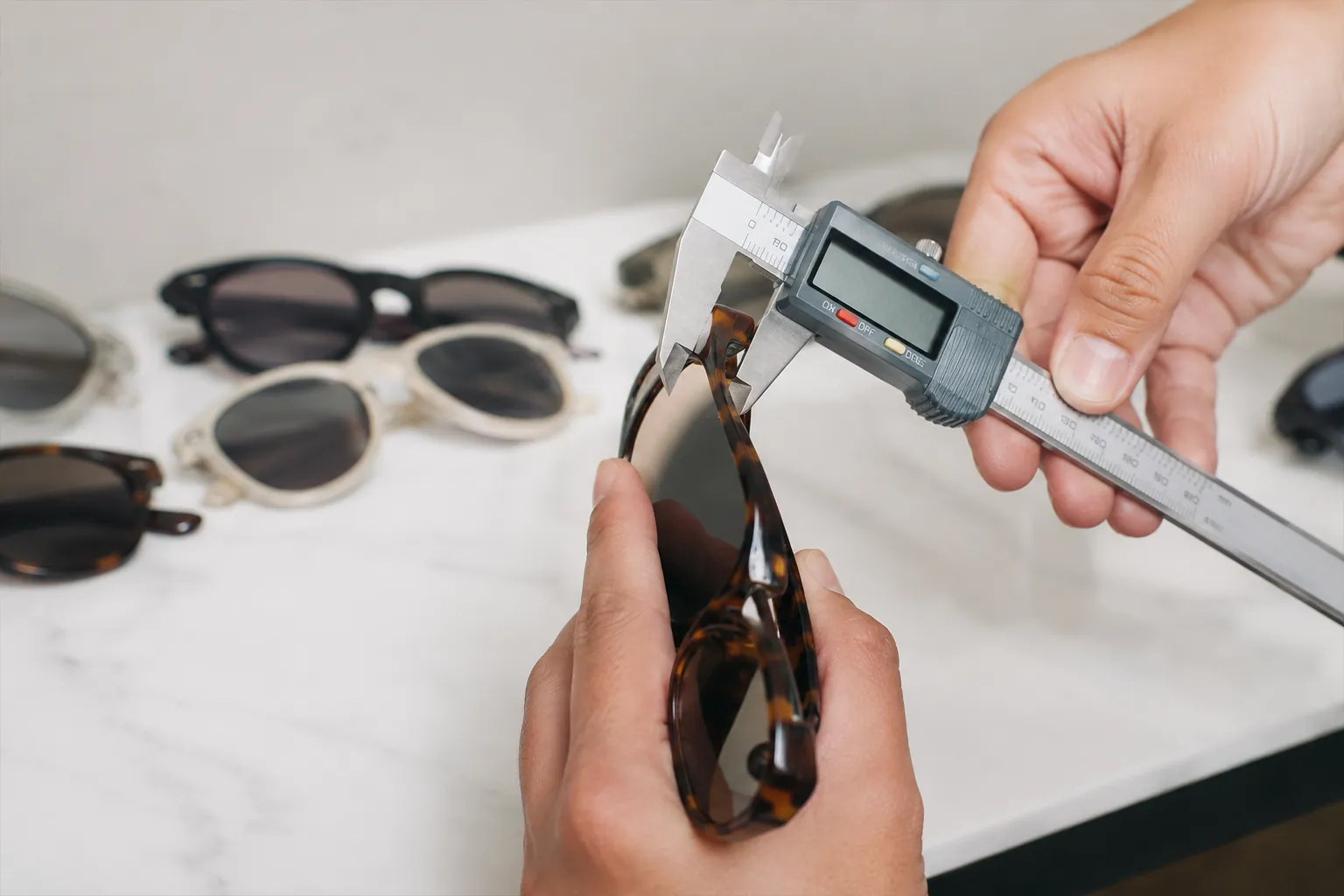
This guide is for brand owners, importers, distributors, and retail buyers sourcing custom sunglasses at volume. Lens base curve may look like a small spec, but it affects wrap, comfort, side profile, lens supply, decoration placement, assembly stress, and whether a reorder matches the approved sample. Define it early. If buyers lock base curve at RFQ and sampling stage, they cut remake risk, approval disputes, extra sample rounds, and avoidable QC failures.
Start with the buying decision, not the drawing
Base curve is the front-to-back curvature of the lens surface or lens blank, usually described as 4-base, 6-base, or 8-base. In sourcing, it is not just a drawing note. It is a product decision. It affects four linked outcomes: visual identity, face wrap, construction options, and reorder control.
Review base curve together with frame front curve, bridge geometry, endpiece angle, temple opening angle, bevel design, and lens insertion method. A 4-base lens usually looks flatter and more fashion-led. A 6-base is common in lifestyle sunglasses because it balances appearance, fit, and manufacturability. An 8-base creates a stronger wrap and a sport profile, but it also leaves less room for error in tooling, edging, fitting, and appearance control.
Ask one early question: Is this style meant to read as a flat fashion front, a standard sunglass front, or a wrap front? Decide that before CAD is frozen and before lens prep is confirmed.
Curve mismatches often hide in renders. They show up later during lens fitting, frame heating or forming, hinge alignment, temple closing, or final appearance inspection. That is why buyers should ask the supplier to confirm the intended base curve against the actual production route: frame material, lens material, edging method, and decoration plan. If frame and lens preparation are handled by different parties, the risk goes up. So does the chance of a dispute. Document the decision.
What 4-base, 6-base, and 8-base actually change
| Base curve | Typical visual effect | Fit and wrap | Production detail | Common use |
|---|---|---|---|---|
| 4-base | Flatter front, cleaner fashion look | Less side wrap, more open field feel | Usually easier to align decoration on flatter surfaces; requires frame geometry that supports lower wrap | Fashion sunglasses, optical-sun hybrids, city/lifestyle programs |
| 6-base | Balanced sunglass profile | Moderate wrap with broad wearer acceptance | Often offers a practical balance of lens availability, assembly stability, and side profile for commercial programs | Core commercial sunglasses, unisex styles, private-label basics |
| 8-base | Strong wrap, sport-led profile | Closer side coverage and more face-hugging fit | Requires tighter control of front curve, bevel design, lens edging, and folded temple clearance; reflective finishes may show stronger edge appearance changes | Sport, outdoor, active wraparound styles |
These numbers are not just style labels. They change construction risk and approval risk. As base curve increases, wrap usually increases too. So does the chance that a buyer likes the front view, then rejects the side profile when the physical sample arrives.
Lens appearance can also shift with curvature. On higher-wrap lenses, solid tints, flash mirrors, and other reflective coatings may look different near the edges because the viewing angle changes across the surface. That may be normal. Not a defect. For ecommerce-driven programs, request approval photos from the front, 45-degree, and side view, plus an on-face video. The record should show how the product actually looks in use.
For many new private-label launches, 6-base is a sensible starting point. It looks like a sunglass. It does not automatically push the style into sport-wrap territory. It is also easier to control than 8-base in most commercial programs.
Failure modes that trigger sample rework
Base-curve issues usually show up in five repeat failure modes:
- Lens-to-frame mismatch: the lens seats under too much stress, then distorts, sits unevenly, or does not fit the groove consistently.
- Bad face wrap: the CAD looked balanced, but the assembled frame sits too flat or too aggressively curved on real wearers.
- Temple closing interference: after wrap is increased, folded temple tips touch the lens back surface or press against the frame front.
- Visual imbalance: logos, top bars, trims, or brow lines look misaligned because decoration or trim placement was developed for a flatter front.
- Reorder drift: a later production run uses a different lens blank, different edging compensation, or a changed front-forming condition and no longer matches the approved sample.
Different constructions fail in different ways. Injection-molded fronts depend on mold accuracy, material behavior, and process control during molding and cooling. Small front-curve variation can change lens seating stability. Acetate fronts can move during heating, forming, polishing, and assembly. Metal constructions may hold front curve more predictably, but lens retention and nose-pad setting become more sensitive as wrap increases.
So keep more than approval photos. The approval record should include approved base curve, lens material, key size data, decoration method, and any critical fit or side-profile notes. A sealed golden sample should be kept by both buyer and factory. Without that, reorders get judged from memory or informal comparison. That is a weak system.
How base curve affects comfort, coverage, and acceptance
Buyers often approve sunglasses for style first and hear about pressure points later. Base curve is part of that outcome. A flatter 4-base front usually feels less enclosing and is often easier for general-fashion customers to accept. An 8-base can improve side coverage and retention, but only if bridge fit, nose contact, temple spread, and overall width are balanced properly.
Comfort does not come from curve alone. It comes from the full geometry and the material. A high-wrap front with a narrow bridge can create concentrated nose pressure. A flatter front with long temples may slide because the frame gets less retention from side wrap. A stiff temple material can also feel tighter on a wrapped frame than a more adjustable construction with similar nominal dimensions.
A basic internal wear test should be standard before bulk approval. Use at least three wearers with different face widths and nose heights. Check these points:
- Does the frame pinch at the temples after 10 minutes of wear?
- Does the lower rim or lens edge touch the cheeks when smiling?
- Does the bridge sit evenly or rock left to right?
- Does the field of view feel too enclosed on higher-wrap versions?
- When folded, do temple tips clear the lenses without contact?
Keep comfort testing separate from compliance testing. CE EN ISO 12312-1, ANSI Z80.3, and AS/NZS 1067 address product and lens performance requirements, but passing those standards does not prove broad consumer fit acceptance. A product can comply and still generate returns if the wrap geometry is wrong for the target customer.
Production checkpoints that keep reorders on spec
- Lock the curve during sampling. Do not approve from a sketch, silhouette, or loosely similar sample. The approved physical sample should represent the actual lens and frame geometry intended for production.
- Record the lens source and blank specification. A substitute lens with a similar tint or coating may still change appearance or fit if the curve or edge profile differs.
- Define the approved lens construction. Record lens material, finish, and the approved thickness specification or tolerance used for the sample.
- Control edging tolerance. On wrapped styles, small edging variation becomes visible fast and can affect seating stress. Ask the supplier what lens-shape tolerance is actually controlled in production and how it is checked.
- Check frame-front symmetry. Left/right curve mismatch should be part of factory QC because wrapped fronts make asymmetry easier to spot.
- Retain two golden samples. One stays sealed at buyer side and one at factory side, both labeled with style code, colorway, approval date, and revision level.
- Inspect folded clearance and side profile in QC. These are common drift points on 8-base and semi-wrap styles and should be part of incoming inspection, not only final shipment review.
Material behavior matters at every step. Injection plastics can move after molding and assembly operations. Acetate can move after heating and polishing. Metal-rim constructions may hold the intended front curve well, but lens rim tension and pad setting can become more sensitive as curvature increases. Decoration also interacts with curve: pad printing is generally easier on flatter surfaces, while curved temples and strongly wrapped fronts may require tighter placement control for stable visual alignment.
Discuss lead time impact early. If base curve changes after sample approval, the supplier may need to revise lens preparation, edging settings, fitting jigs, and appearance standards. That can add delay. The exact timing depends on the construction and the supplier's process setup, so ask for a written revision-impact assessment before approving any late geometry change.
Cost and MOQ: where curve choice starts to matter
Base curve is rarely quoted as a separate line item, but it affects cost through tooling difficulty, lens sourcing limits, reject risk, and assembly time. A standard 6-base lifestyle program is often easier to quote and control than an 8-base wrapped style that needs tighter front-curve consistency and more careful lens fitting.
| Order size | Commercial logic | Curve advice | Cost sensitivity |
|---|---|---|---|
| 50 pairs | Trial launch, market test, influencer capsule | Keep geometry conservative; avoid combining high wrap with multiple new finishes | Development and revision cost has a large impact on margin |
| 300 pairs | Small retail rollout or distributor test buy | Reasonable point to lock a specific 4-base or 6-base target | Development cost spreads better, but rejects still matter |
| 1000 pairs | Core private-label or chain-store program | Document exact curve, lens source, and QC checkpoints in the tech pack | Process stability starts to matter more than small nominal unit-price differences |
| 5000+ pairs | Repeat program with multiple markets or seasons | Golden-sample control becomes essential; do not rely on visual matching alone | Small geometry drift can create large financial exposure across the run |
MOQ structure matters because low-volume runs leave less room to absorb extra development work, special lens sourcing, or repeated approvals. At higher volume, the cost of documenting and controlling geometry is easier to justify because the cost of reorder inconsistency is much larger.
The buyer logic is simple:
- At very low MOQ, keep the construction simple and reduce variables.
- At mid-volume, invest more time in precise curve approval because the development effort spreads across more units.
- At high volume, write curve and geometry into the purchase specification and QC standard; do not leave them open to interpretation.
A poor base-curve decision does not always raise the ex-factory price directly. More often, it creates hidden cost: extra sample rounds, launch delay, higher incoming QC rejection, or field complaints that force discounting or replacement.
A practical RFQ and tech-pack spec for base-curve control
If buyers want comparable quotations and fewer misunderstandings, the RFQ or tech pack should define base-curve intent in plain commercial language and measurable production terms. Include:
- Target base curve: 4-base, 6-base, 8-base, or approved reference sample
- Frame material: injection plastic, acetate, metal, TR, or combination
- Lens material and finish: PC, TAC polarized, nylon, CR-39, tinted, gradient, mirrored, flash, hard coat, AR if applicable
- Key size data: front width, eye size, bridge, temple length, and if available, face-form angle target
- Desired visual message: flat fashion front, balanced sunglass curve, or sport wrap
- Decoration method: pad print, silk screen, hot foil, laser engraving, metal logo plate, or inlay
- Compliance market: CE EN ISO 12312-1, ANSI Z80.3, AS/NZS 1067, REACH, FDA registration relevance if applicable, and any required market paperwork
- Approval method: physical sample, photography set, fitting video, retained golden sample, and revision record
Be explicit about reorders. If the first run is approved from a 6-base reference, state that future lots must match the approved sample and recorded production file, not just a similar look. For private-label programs sold across multiple countries, ask the supplier to link that geometry to one stable style code and one approved BOM. ISO 9001 and BSCI can support process discipline, but they do not replace a precise buyer specification.
Buyer scenarios: matching curve choice to the program
Scenario 1: fashion retailer launch. The priority is broad appeal, clean photography, and low fit complaints. Start around 4-base or 6-base. Keep the silhouette modern and avoid accidental sport-wrap appearance. Approve with front, side, and on-face images together with the physical sample.
Scenario 2: outdoor distributor. Coverage and active appearance matter more. Compare 6-base and 8-base versions on the same frame family where possible. Stronger wrap may suit the category better, but only if lens seating, folded clearance, and temple pressure stay stable in production samples.
Scenario 3: established brand planning reorders. The priority is consistency across countries, seasons, and replenishment cycles. Lock the approved base curve in the product file, retain a golden sample, and make side-profile match and lens fit part of incoming QC. This is where disciplined buyers usually get stricter. They should.
Simple rule: if the sunglasses sell on fashion image, do not over-wrap them by accident. If they sell on coverage and active use, do not approve a flat front just because the render looked cleaner.
That is the commercial reality. Base curve is not an engineering footnote. It is a design, production, and reorder-control decision with direct business impact.
Have a custom sunglasses project in mind?
Send us your styles, target market and quantities and we will return a detailed quote with MOQ, lead time and a sample plan.
Get a QuoteWhy source this from Wenzhou with LumiShades
Wenzhou in Zhejiang Province is widely regarded as China’s eyewear manufacturing capital, producing a large share of the world’s sunglasses. That concentration matters to buyers: a deep local supply chain for acetate sheet, hinges, lens blanks, plating and packaging means shorter component lead times, easier color and material matching, and a workforce with decades of eyewear-specific skill. LumiShades has manufactured in this ecosystem since 2009, and our vertical integration — in-house injection molding, acetate cutting, CNC milling, lens tinting, decoration and quality control — means no part of your order is quietly subcontracted to a workshop you cannot audit.
For international buyers, that vertical control translates into accountability. When a single factory owns every step, defects are traced and fixed at source rather than bounced between vendors, and your specifications survive intact from first sample to bulk. We back this with 15+ years of experience, shipments to 60+ countries, more than 5 million pairs produced per year and a 98.5% on-time delivery rate. Our certifications — CE EN ISO 12312-1, FDA registration, ANSI Z80.3, AS/NZS 1067, REACH, ISO 9001 and BSCI audit — mean the compliance documentation your market requires already exists. Explore our manufacturing capabilities and quality control process to see how this works in practice.
Frequently asked questions
Can I change base curve after approving the first sample? Yes, but treat it as a formal design revision. Ask the supplier to confirm in writing what will change: frame front geometry, lens specification, edging setup, folded temple clearance, side profile, and any new compliance-test requirement for the revised sample. Do not approve the change by email description alone. Request a new physical sample, update the tech pack and BOM, and assign a new revision level so the factory does not build bulk from mixed specifications.
Which base curve is safest for a new private-label sunglass program? For most general-market lifestyle sunglasses, 6-base is the safest starting point. It usually gives a familiar sunglass appearance, moderate wrap, and fewer production constraints than an 8-base. If the brief is strongly fashion-led, compare 4-base and 6-base. If the brief is sport or outdoor, compare 6-base and 8-base. In all cases, confirm the decision from a physical sample and side-view approval, not from the front render alone.
Does a higher base curve always mean better comfort? No. Higher wrap can improve side coverage and retention, but comfort depends on the full geometry: bridge fit, front width, temple spread, lower-rim clearance, and material stiffness. To evaluate it properly, run a simple wear test on different face shapes, record pressure points and cheek contact, and compare wearer feedback before approving bulk. Do not assume that more wrap equals better fit.
How should I document base curve for reorders? At minimum, record the approved base curve, frame material, lens material, lens finish, key size data, approved sample date, style code, colorway, and revision level. Keep one sealed golden sample at buyer side and one at factory side. Add side-profile match, lens seating, and folded temple clearance to your QC checklist. If the supplier changes lens source, mold, or forming method, require re-approval before bulk production.
Will base curve affect compliance testing? Indirectly, yes. Base curve is a geometry decision, but geometry can affect lens construction, edge stress, and final product behavior. The finished sunglasses still need to meet the applicable requirements for CE EN ISO 12312-1, ANSI Z80.3, AS/NZS 1067, REACH, and any required market paperwork. If you make a curve change after testing or approval, ask your compliance partner or laboratory whether the revised product needs to be retested or re-documented before shipment.
Ready to start?
Explore our round sunglasses or request a quote — our sales team replies within 12 hours.
Request a Quote