
When Nylon Lenses Pay Off—and When They Don't
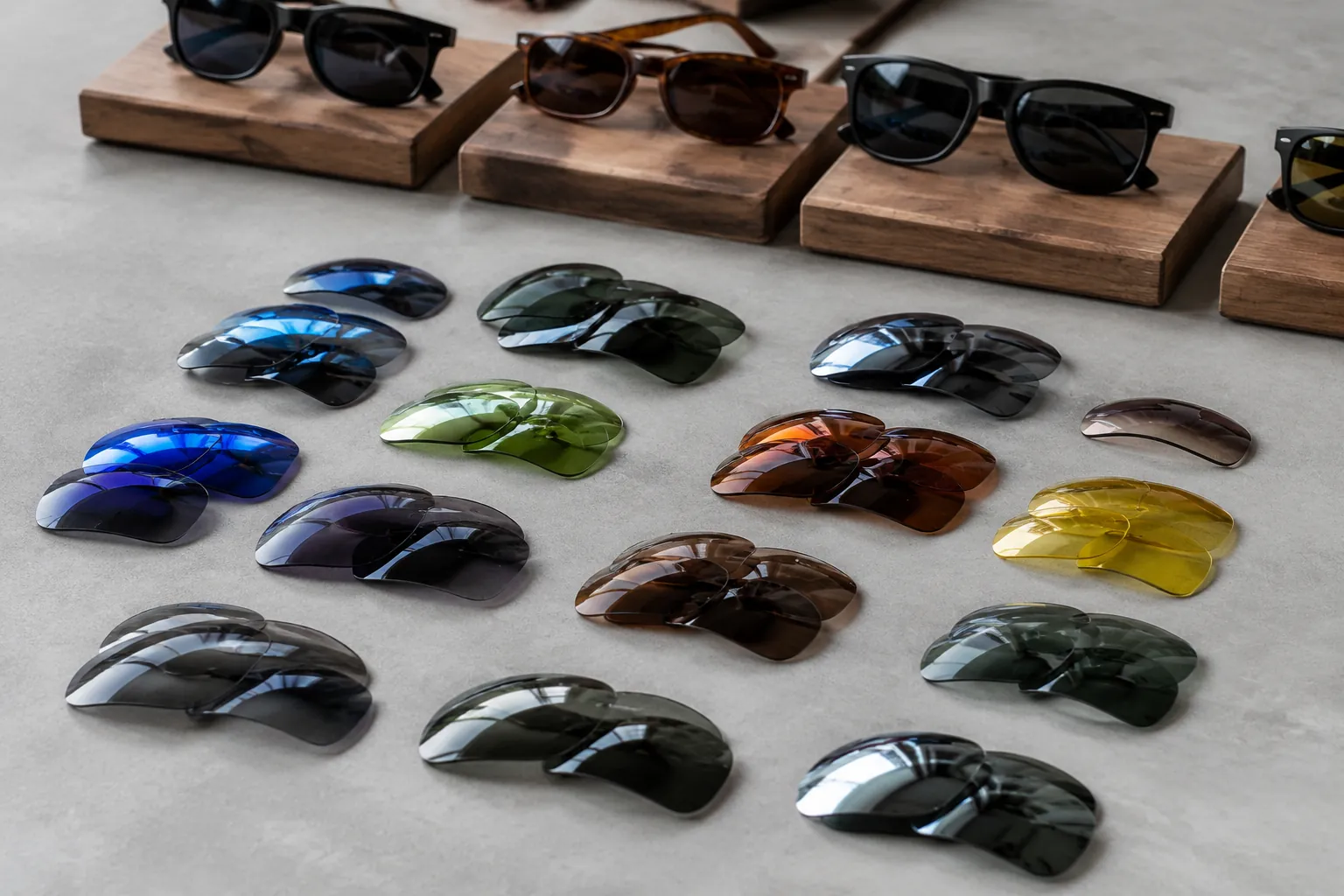
This guide is for brand owners, importers, distributors, and retail buyers deciding whether nylon lenses are worth the extra cost in a custom sunglasses program. The aim is not to present nylon as universally superior. It is to show where nylon can create measurable product and commercial value, and where polycarbonate or TAC is the more rational choice. If you are balancing target retail, margin, breakage risk, compliance, MOQ, and remake exposure, use this as a decision framework rather than a marketing checklist.
Start with the buying decision, not the material
Nylon lenses are not the default answer on most B2B sunglass programs. They are a higher-spec option that tends to make sense only when the product brief genuinely benefits from what nylon is commonly chosen for: good optical performance in wrapped geometries, lower perceived weight in larger lens shapes, and a premium-looking finish when tint and coating quality are well controlled.
Buyers usually make better decisions when they ask four commercial questions in order.
- What is the use case? Nylon is easiest to justify in wrapped sport and outdoor frames such as cycling, running, golf, fishing, and performance lifestyle styles, especially in base-6, base-8, or shield constructions. On flatter fashion frames, the end user may not notice enough difference to support the added cost.
- What is the target retail position? If the finished product is for a low-ticket, promotional, or fast-fashion channel, a lens upgrade can reduce margin without improving sell-through. If the line is positioned as premium sport or premium outdoor, nylon may support the price architecture more credibly.
- How demanding is the frame geometry? Deep curves, large one-piece shields, and tighter groove tolerances increase the importance of lens consistency and assembly control. Those conditions make lens choice more consequential than on a simple straight-front frame.
- What claims must the product support? If the product must be sold with market-specific performance and labeling requirements in mind, such as CE EN ISO 12312-1, ANSI Z80.3, or AS/NZS 1067, then visible light transmission, lens category, labeling accuracy, and production consistency matter as much as appearance.
The useful question is not "Is nylon better?" It is "Where does nylon improve the finished product enough to justify the additional cost and process control?" That is the real buying decision.
What nylon does well on real sunglass programs
In commercial eyewear programs, nylon usually earns its place in three areas: wrapped-frame optics, premium lens appearance, and wearing comfort on larger lens shapes.
- Wrapped-frame optics. In strongly curved sunglasses, optical distortion becomes more noticeable as wrap increases. Nylon is often selected for higher-wrap sport products because it can perform well in those geometries when the lens design and processing are executed correctly.
- Premium lens appearance. Mirror, flash, gradient, and performance-tint programs reveal defects quickly. Haze, waviness, coating inconsistency, and edge stress are easier to see on premium-looking lenses, so material choice and process control matter more when the lens is a visible selling feature.
- Wearing comfort on large lenses. On oversized lenses and shields, reducing weight can improve balance and long-wear comfort. Buyers may not market that benefit explicitly, but wearers can feel it.
That said, resin choice alone does not guarantee a strong result. The production process matters just as much. Buyers should ask how the factory controls tint consistency, coating adhesion, edging accuracy, and lens insertion on wrapped frames. A nylon lens can still fail commercially if process control is weak and leads to remakes, color variation, or visible assembly stress.
Nylon also makes the most sense when the frame is meant to be a serious product in its own right. If the frame is a low-cost injection style intended for entry-price retail, the customer may not perceive enough added value from a premium lens specification to justify the cost increase.
Where nylon is usually the wrong commercial choice
There are many programs where nylon is technically acceptable but commercially unnecessary. Short-life fashion drops are a clear example. If the frame supplies most of the style value and the product is designed for one season, TAC or polycarbonate will often protect margin better.
The same logic applies to promotional orders, giveaways, and many broad mass-market casual styles where landed cost is the main buying driver. It can also apply to kids programs or entry-price active styles where durability is important but the retail story does not support a premium lens claim. On flat or only mildly curved frames, the customer often will not see enough optical improvement from nylon to justify the extra spend.
MOQ economics reinforce this point. Small orders carry a higher setup burden in sampling, color approval, and QC. In low-quantity runs, even a small number of rejected units can distort the effective unit cost quickly. As order size increases, setup cost and process variation usually become easier to manage across the program.
Practical rule: if the buyer cannot explain in one clear sentence why the lens needs to be nylon, the program probably does not need nylon.
That reason should be specific, such as "base-8 running frame needs better optics in a wrapped geometry" or "oversized shield needs lower weight and premium mirror finish." "Nylon sounds more premium" is not a sufficient reason on its own.
Head-to-head: nylon vs polycarbonate vs TAC
| Lens material | Best-fit applications | Commercial upside | Process and performance trade-offs | Typical buyer logic |
|---|---|---|---|---|
| Nylon | Sport wrap, technical outdoor, premium shields, premium fashion with demanding lens appearance | Can deliver strong optical performance in curved forms, lighter feel on large lenses, and a premium finish when processed well | Higher material cost, tighter control needed for tinting and coatings, less room for avoidable scrap or assembly mistakes | Use when lens performance is part of the selling story and the retail price can support the upgrade |
| Polycarbonate | Mass-market active, kids, practical sport, casual performance styles | Broad availability, good impact resistance, commercially efficient across many frame geometries | Can show more optical compromise than nylon in aggressive wrap; surface performance depends heavily on hard-coat quality | Use for value-conscious active programs that still need durability and broad manufacturability |
| TAC | Fashion sunglasses, polarized value programs, casual lifestyle collections | Competitive cost, common for polarized programs, effective for straightforward fashion constructions | Less suitable for aggressive curves and technical sport optics; usually a weaker fit for high-performance positioning | Use when price, polarization, and seasonal breadth matter more than sport-performance claims |
For many B2B programs, polycarbonate is the middle-ground material because it serves a wide range of use cases without pushing cost too high. TAC often works well in polarized fashion programs where buyers want a clear commercial story at competitive pricing. Nylon becomes more compelling as wrap increases, lens appearance becomes more important, and the wearer is more likely to notice the difference.
The technical rule is straightforward: as geometry becomes more demanding, the case for nylon can become stronger. The commercial rule is equally straightforward: only pay for that advantage when the market can reward it.
Cost logic: where the lens upgrade helps margin and where it hurts
Treat nylon as a margin decision, not just a material decision. Start with your target ex-factory cost and intended retail structure, then test whether the lens upgrade is likely to preserve gross margin after freight, duty, defects, and potential remakes are considered.
The exact cost difference between nylon and other lens materials depends on the full bill of materials, including lens curvature, tint, mirror or AR coating requirements, polarization, thickness, and frame construction. Because of that, buyers should request a quote against a defined specification rather than estimate the upgrade informally from a visual concept.
- Very small runs: hardest point at which to justify nylon unless the order is a premium sample run, dealer presentation set, or tightly targeted market test.
- Mid-size runs: often the most practical range for premium capsules, specialty accounts, and focused sport launches where the lens benefit is clear.
- Larger runs: easier to absorb the material premium if retail pricing, replenishment plans, and approval standards are already established.
Hidden cost matters as much as quoted cost. Higher-spec lenses increase rejection cost if the frame groove is inconsistent, if a wrapped front distorts during assembly, or if insertion stress leaves visible edge whitening, pressure marks, or gaps. That is why process capability matters commercially. The more control a supplier has over lens processing, frame production, decoration, and final QC, the easier it is to identify dimensional problems before shipment rather than after delivery.
Decoration choices also affect cost and risk. Pad printing is typically cost-efficient for simple logos, laser marking can offer cleaner permanence on some builds, and metal logo plates can increase premium perception but add parts, alignment, and assembly steps. Those choices should be approved early enough that they do not interfere with lens-and-frame fit validation.
Lead time and failure points buyers should plan for
Nylon does not automatically require a longer lead time, but it does leave less room for loose approvals and late changes. In practice, the most common delays are not caused by the material itself. They come from approval drift, fit mismatch, decoration changes, and late compliance-related revisions.
The most common delay points are predictable and usually preventable.
- Color approval drift. A buyer approves a render or a photo reference, then rejects production because no physical standard, tolerance, or approved range was documented. This is especially risky on premium tint and mirror programs.
- Frame-lens fit mismatch. Wrapped frames with inconsistent groove dimensions can create insertion stress, visible edge gap, or uneven seating. Small dimensional errors become more serious as lens curvature increases.
- Decoration timing. Pad printing, laser marking, hot stamping, and metal logo plates all add coordination steps. If logo size, position, or finish changes after the lens is approved, assembly timing can slip.
- Compliance retest exposure. If visible light transmission, lens category, mirror level, polarization status, or labeling changes late, the program may require renewed verification for the intended market.
For nylon programs, buyers should insist on a true pre-production sample built with the final lens material, final tint, final coating stack, and actual frame geometry. A visual mock-up is not enough. That checkpoint catches many of the highest-cost problems before bulk production begins.
Buyers should also ask how first-article approval is separated from bulk repeatability. A sample that looks correct once is not the same as a process that can hold appearance and fit across an entire production run.
Compliance is not optional, and material choice affects pass risk
Serious buyers should connect lens material choice to compliance at the start of the brief. Depending on the target market and product positioning, sunglasses may need to be aligned with CE EN ISO 12312-1, ANSI Z80.3, or AS/NZS 1067. Chemical compliance and supply-chain documentation may also involve REACH, while some suppliers reference FDA registration, ISO 9001, and BSCI as part of their documentation profile. These documents and standards are not interchangeable, and buyers should avoid treating them as if they prove the same thing.
The practical issue is simple: every product claim creates documentation work. If you specify a lens category, visible light transmission range, polarized construction, mirror finish, or a market-specific labeling claim, the production lens must match the records used to support that claim. A late material change can trigger renewed checking of transmittance, labeling, and test alignment.
Ask for these controls in writing:
- approved lens material, nominal thickness, and curvature or base specification
- target visible light transmission range and lens category for the intended market
- polarization requirement and verification method, if applicable
- coating stack used, including hard coat, mirror treatment, or other relevant surface treatments
- final QC sampling method, cosmetic defect criteria, and packaging-label check
ISO 9001 and BSCI can be useful at the management-system and social-compliance level, but they do not replace product-specific testing. Likewise, FDA registration should not be treated as equivalent to sunglass performance certification. Buyers should request product-specific evidence for the exact lens configuration being shipped.
A simple decision framework for three common buyer scenarios
Scenario 1: performance sport line. You are building wrapped cycling or running sunglasses at medium to premium retail and expect repeat orders. Quote nylon first, especially for base-6 to base-8 fronts or shield styles. Require a real pre-production sample, review the optical result in final geometry, and lock tint and coating before bulk. Here, nylon can support both product performance and price positioning.
Scenario 2: fashion chain private label. You need multiple styles, broad colorways, fast seasonal turnover, and a tight target cost. Nylon is usually unnecessary unless one SKU is intentionally positioned as a premium hero style. TAC or polycarbonate will more often protect margin while still delivering acceptable performance for casual wear.
Scenario 3: outdoor specialty distributor. You need a mixed line with both lifestyle and technical products. Split the BOM by SKU instead of over-specifying the whole collection. Use nylon on high-wrap or technical units, then use polycarbonate or TAC on companion lifestyle frames. Many buyers overspend by carrying the premium lens material across every style when only a minority of SKUs truly need it.
The most commercially sound use of nylon is selective, not automatic. Put it where the user can see or feel the difference, where frame geometry increases the value of the material, and where the retail channel can support the upgrade. Keep the brief specific, approvals documented, and compliance tied to the final shipped configuration.
Have a custom sunglasses project in mind?
Send us your styles, target market and quantities and we will return a detailed quote with MOQ, lead time and a sample plan.
Get a QuoteWhy source this from Wenzhou with LumiShades
Wenzhou in Zhejiang Province is widely regarded as China’s eyewear manufacturing capital, producing a large share of the world’s sunglasses. That concentration matters to buyers: a deep local supply chain for acetate sheet, hinges, lens blanks, plating and packaging means shorter component lead times, easier color and material matching, and a workforce with decades of eyewear-specific skill. LumiShades has manufactured in this ecosystem since 2009, and our vertical integration — in-house injection molding, acetate cutting, CNC milling, lens tinting, decoration and quality control — means no part of your order is quietly subcontracted to a workshop you cannot audit.
For international buyers, that vertical control translates into accountability. When a single factory owns every step, defects are traced and fixed at source rather than bounced between vendors, and your specifications survive intact from first sample to bulk. We back this with 15+ years of experience, shipments to 60+ countries, more than 5 million pairs produced per year and a 98.5% on-time delivery rate. Our certifications — CE EN ISO 12312-1, FDA registration, ANSI Z80.3, AS/NZS 1067, REACH, ISO 9001 and BSCI audit — mean the compliance documentation your market requires already exists. Explore our manufacturing capabilities and quality control process to see how this works in practice.
Frequently asked questions
Are nylon lenses always better than polycarbonate for sunglasses? No. Nylon is not universally better; it is often better suited to specific applications. Buyers should favor nylon when the frame has a demanding wrap, the lens is a visible premium feature, or the product is positioned for technical sport or outdoor use. Polycarbonate is often the stronger commercial choice for broad-volume active styles, kids programs, and value lines because it offers good impact resistance and wider cost flexibility. To decide, compare the two materials on the actual frame geometry, intended retail tier, and compliance needs rather than by material reputation alone.
At what MOQ does nylon start to make commercial sense? There is no single universal MOQ threshold because the answer depends on retail price, frame geometry, coating complexity, and expected remake risk. In practice, nylon becomes easier to justify once setup cost, approvals, and defect exposure are spread across a stable program rather than a very small run. For small quantities, use nylon mainly when the order is a premium sample set, a dealer presentation, or a focused test with a clear performance story. Ask the factory for side-by-side quotations in nylon and polycarbonate or TAC on the same BOM, and compare not just unit price but also approval cost, scrap risk, and target margin.
Will nylon lenses increase lead time? Not necessarily, but they do increase the importance of disciplined approvals. Lead time usually slips because color standards are vague, fit validation is incomplete, decoration changes arrive late, or compliance-related details change after approval. To keep timing under control, approve a physical pre-production sample made in the final material, lock the tint and coating stack, confirm the exact frame-lens fit, and freeze artwork and labeling before bulk starts. Buyers should also ask the supplier to identify which steps are on the critical path so late changes can be avoided.
What compliance documents should I discuss with the factory for nylon lens sunglasses? Discuss the exact market requirements for the product and ask for documentation tied to the shipped configuration. That may include alignment with CE EN ISO 12312-1, ANSI Z80.3, or AS/NZS 1067 depending on the destination market, plus REACH where relevant for chemical compliance. If the supplier references FDA registration, ISO 9001, or BSCI, treat those as separate from product performance certification and ask what each document actually covers. In practical terms, confirm the lens material, nominal thickness, curvature, visible light transmission range, lens category, polarization status, coating stack, labeling content, and any test reports or verification records used to support the final product claim.
Can I mix nylon and non-nylon lenses in the same collection? Yes, and many buyers should. A mixed-material collection is often the most rational commercial strategy. Use nylon only on SKUs where the wearer is likely to notice the benefit, such as wrapped sport frames, shields, or premium outdoor models. Keep polycarbonate or TAC on price-sensitive lifestyle and fashion styles where the performance gain would be less visible. To execute that approach cleanly, define lens tiers by SKU, align the retail story with each tier, and make sure the compliance and labeling details match the specific lens construction used in each style.
Ready to start?
Explore our wayfarer sunglasses or request a quote — our sales team replies within 12 hours.
Request a Quote