
Polarized Lens Delamination: Buyer Checks Before Bulk
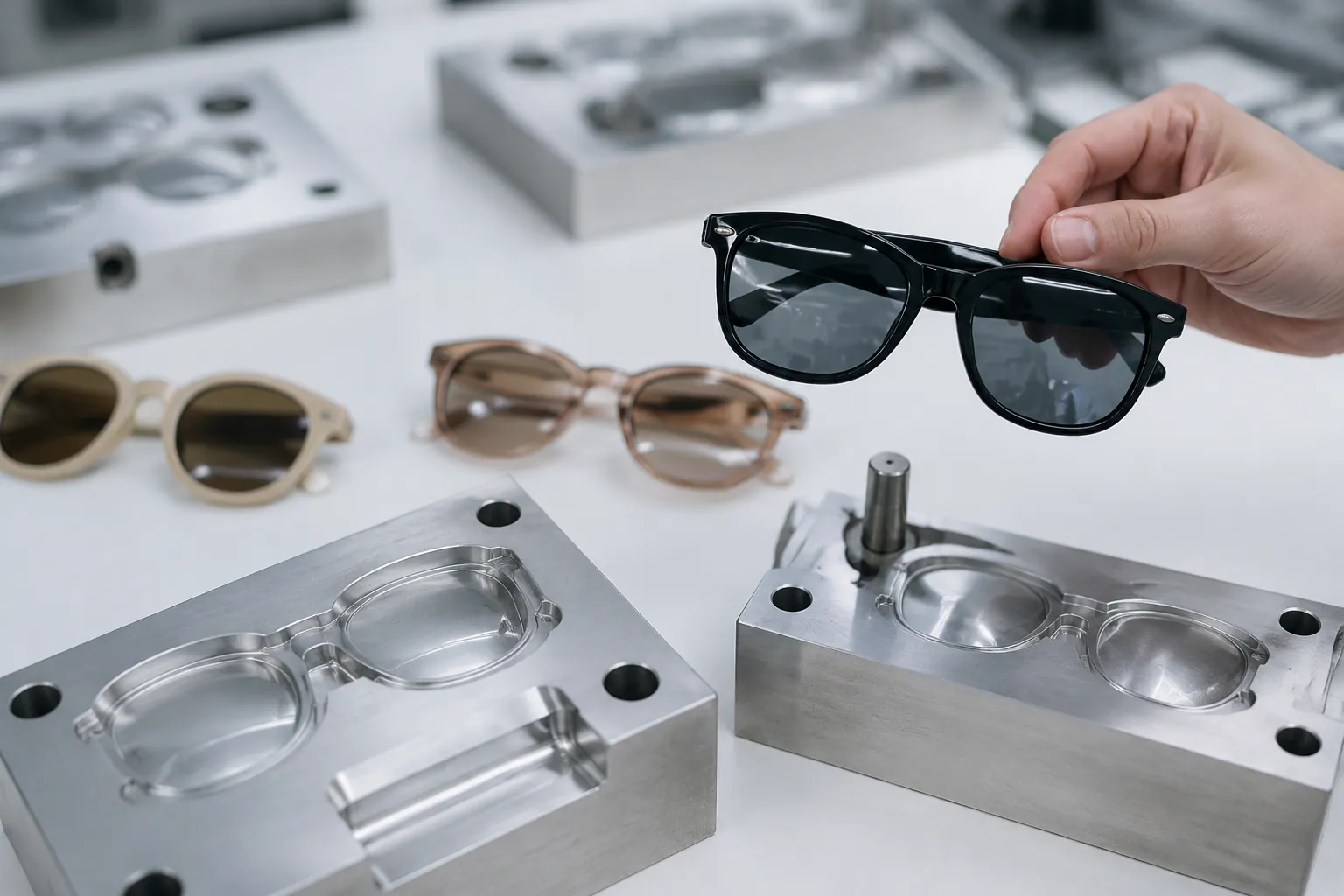
This guide is for brand owners, importers, and retail buyers sourcing polarized sunglasses at volume. Delamination is expensive because it often shows up after shipment, not during routine final inspection. The goal here is simple: understand how polarized lenses fail, which controls reduce risk, and what to verify before you place a purchase order. If a supplier cannot explain the lens construction, frame fit, and test method clearly, treat that as a sourcing risk.
Start with the failure mode, not the sales claim
Polarization is not the problem. Construction is. Risk comes from how the lens is made, edged, fitted into the frame, and then exposed to heat, moisture, and chemicals over time. Many polarized sunglass lenses use a polarizing film inside a laminated structure. Delamination starts when part of that structure loses adhesion and begins to separate.
Early signs are easy to miss: edge whitening, a fine bubble line, haze under angled light, or clouding near a drilled area or frame pressure point. These are not minor cosmetic issues. They often signal a field failure in progress. A shipment can pass sample approval and pre-shipment inspection, then fail later in freight, storage, or consumer use, especially in high heat.
That is why risk review has to happen before bulk production. Ask the supplier to explain the lens stack in plain language: base material, where the polarizing layer sits, how the lens is bonded or laminated, what edge-finishing steps are used, and how the lens spec matches the frame design. If the answer stops at "polarized TAC" or "polarized PC," it is not enough.
Also ask for the approved lens thickness, base curve, and frame-lens fit specification used for production. Those values should appear on a controlled spec sheet or BOM. No document, no control. And no reliable sample-to-bulk match.
Where polarized lenses usually fail
Most failures fall into four buckets. Each one links back to design, process control, or both.
- Heat exposure. High temperature can weaken a poorly controlled bond or speed up aging in a marginal lens structure. Problems may appear after freight, warehouse storage, or consumer use such as leaving sunglasses inside a car.
- Edge ingress. If the edge is chipped, rough, or poorly finished, moisture, sweat, salt, or cleaning fluid can enter from the perimeter. Once separation starts at the edge, it often spreads inward.
- Mechanical stress from the frame. Too much rim pressure, poor groove control, or aggressive insertion can preload the lens. Common stress points are corners near the bridge, hinge side, and high-wrap areas.
- Chemical attack. Sunscreen, alcohol-based cleaners, cosmetics, and harsh cleaning agents can damage coatings or expose weakness in the bond line. Surface damage can turn into laminate separation later.
A capable supplier should be able to show rejected lenses and explain the cause: lamination defect, edge defect, assembly stress, or chemical damage. Vague statements like "we improved QC" do not help. Ask what changed, where the check was added, and how the correction was documented.
Ask one more direct question: is the polarized lens laminated in-house or bought from an outside lens vendor? If the lens source is external, define who owns failure analysis and whether retained samples are kept from each production lot.
Lens construction choices and how they change risk
Not all polarized lenses carry the same risk profile. Buyers often compare color, cost, and MOQ first. They should also compare material behavior, fit sensitivity, and sample-to-bulk consistency.
| Lens option | Typical use case | Delamination risk | Buyer trade-off |
|---|---|---|---|
| TAC polarized lens | Fashion sunglasses, price-sensitive programs | Can be sensitive to heat, edge quality, and frame stress if process control is weak | Lightweight and cost-effective, but construction details and finishing matter |
| PC polarized lens | Sport frames, impact-focused styles | Can show problems at stress points if lens fit or curvature control is poor | Useful for impact-oriented designs, but frame-lens compatibility is critical |
| Sample approved with one lens construction, then bulk changed later | Fast sampling or cost-down projects | High risk because approved appearance does not confirm bulk durability | May save time early, but increases claim risk unless the final BOM is re-approved |
| Metal frame with high-wrap polarized lens | Fashion wrap or sport wrap styles | Higher risk if curve control, edging, or lens retention details are inconsistent | Strong styling effect, but less tolerant of dimensional drift |
The main issue is compatibility. A lens may perform well in one frame and fail in another. If you are sourcing wrap styles, tight full-rim frames, or constructions with narrow insertion tolerance, ask for production-fit validation on actual tooling, not just a hand-made sample.
Also check how many parties control the build. If frame making, lens supply, and final fitting are split across multiple subcontractors, root-cause analysis gets slower and harder. If the factory works under ISO 9001, ask how lens complaints are logged, traced, and closed through corrective action. If the factory shows BSCI, treat that as a social compliance reference, not a product-quality guarantee.
Process controls that reduce claims
Delamination prevention is mostly about control. Not slogans. Buyers should look for visible checkpoints in the production flow.
- Incoming material checks: verify that the lens material and polarized lens specification match the approved BOM. Ask how the factory confirms thickness, color consistency, and surface condition on receipt.
- Controlled lamination or bonding process: whether the lens is made in-house or purchased, there should be a documented method with defined parameters and traceability. The supplier does not need to share proprietary settings, but it should confirm that the process is standardized and lot-controlled.
- Edge finishing: chipped, rough, or overheated edges can become failure starting points. Ask what edge-quality standard is used and whether edge defects are checked before assembly.
- Frame fit control: lens outline, groove condition, and insertion method should be controlled so the lens is secure without excessive stress. Ask whether fit problems are checked during pilot run and bulk assembly, not only at final inspection.
- Environmental checks: a room-temperature visual check is not enough. Ask whether the supplier performs any internal heat or humidity observation on finished goods or retained samples, and request the method in writing.
- Post-decoration review: decoration and branding steps should not damage the lens or increase local stress. If logos, foil details, or other finishing steps are applied near the lens area, ask how the supplier verifies they do not affect lens performance.
Then clarify ownership. Which steps are in-house? Which are outsourced? If the lens is outsourced and final assembly is internal, responsibility for failure analysis still needs one clear owner. One accountable party, one controlled BOM, and one retained sample set make claims easier to manage.
What to ask during sampling and pilot orders
Do not approve a style on appearance alone. Sampling should confirm construction too.
- Ask whether the sample lens construction is identical to the planned bulk construction. If not, the sample is not a durability reference.
- Request a pilot run using production materials, production tooling, and production assembly methods. A pilot should test whether the frame-lens combination is stable, not just whether the style looks right.
- Ask for the actual dimensional spec: lens thickness, base curve, frame opening or groove reference, and any fit-control standard the factory uses. If these details are missing, process control is harder to verify.
- Specify market requirements before approval: CE EN ISO 12312-1 for Europe, ANSI Z80.3 for the US, AS/NZS 1067 for Australia and New Zealand, and REACH where chemical compliance is required. FDA registration may support US importer documentation, but it does not replace product-performance compliance.
- Ask for pass criteria in writing: appearance under angled light, pair matching, polarization consistency, lens retention, and any internal heat or humidity observation method used before release.
- Freeze the approved spec sheet before bulk: lens material, lens source, tint, coating, polarization orientation, frame material, logo method, packaging, and labeling.
For higher-risk programs, keep retained samples from both sample approval and bulk production. If a complaint shows up later, those references help you determine whether the cause was a construction change, a process shift, or post-shipment exposure.
How price, MOQ, and lead time can raise risk
Delamination risk is not only technical. Commercial pressure can create it. Aggressive target pricing, compressed timelines, or late design changes often lead to substitutions that were never fully re-approved.
| Order size | Typical commercial effect | Quality implication to check | Lead time reference |
|---|---|---|---|
| Small pilot order | Used to validate style and construction before scale-up | Confirm the pilot uses the same lens source and BOM planned for bulk | Varies by supplier and build |
| Mid-volume order | Better cost efficiency and more stable line planning | Lot consistency becomes more important than hand-selected sample quality | Varies by supplier and season |
| Large-volume order | Stronger leverage on pricing and scheduling | Requires strict BOM control, retained samples, and substitution approval rules | Varies by supplier capacity |
| Multi-color or mixed-material rollout | More complex sourcing and planning | Greater risk of inconsistent lens sourcing or uneven field performance between SKUs | Often longer due to coordination complexity |
Low pricing is not automatically a red flag. Unexplained pricing changes are. If a supplier offers a meaningful reduction after sample approval, ask what changed: lens source, coating, packaging, inspection level, or production route. Then get written confirmation if nothing changed.
Also confirm whether all colorways and all production lots will use the same approved lens construction. Mixed sourcing is a common cause of uneven market performance, especially when styles look identical but are built from different lens inputs.
A pre-shipment checklist that actually helps
Pre-shipment inspection cannot guarantee that no latent delamination will appear later. It can, however, catch visible defects, weak process control, and mismatches between the approved sample and the goods being shipped. So the checklist needs to go beyond cosmetics.
- Appearance under angled light: check for bubbles, haze, edge whitening, and any visual irregularity between left and right lens.
- Edge review: inspect the full perimeter for chips, rough areas, or clouding that may indicate poor edging or early separation.
- Frame stress points: inspect lens corners near the bridge, hinge side, and wrap zones after full assembly.
- Pair matching: verify tint uniformity, lens alignment, and polarization-axis consistency between the two lenses.
- Retained-sample comparison: compare shipment goods against the approved reference sample and confirm the same lens construction is documented for the shipping SKU.
- Compliance file check: confirm that test reports, declarations, and material-compliance documents correspond to the exact style and construction being shipped.
For regulated markets, paperwork matters. CE EN ISO 12312-1, ANSI Z80.3, and AS/NZS 1067 apply to finished sunglasses in their tested configuration. REACH documentation should match the actual materials used. FDA registration can support importer records in the US, but it is not proof that the sunglasses meet optical or performance requirements.
If the supplier cannot tie the shipping SKU to the approved BOM, retained sample, and compliance file, treat that as a release risk.
If your inspection team can access production records, verify lot traceability for the lenses used in the shipment. Traceability will not prevent defects. It will make containment and root-cause analysis much easier if claims appear later.
Red flags buyers should not ignore
Most claim-heavy programs show warning signs early. Buyers miss them because the quote looks good or the launch calendar is tight.
Watch for these: the supplier changes lens source after sample approval; the lens is described only in generic terms with no controlled specification; assembly marks appear around the lens edge on approval samples; the factory cannot distinguish lamination failure from frame-stress failure; inspection happens only at end of line; or compliance documents are generic and not tied to the shipped model.
Be careful with vague process language too: "same as sample," "similar material," or "our usual standard." Those are not specifications. You need a controlled build description, a clear owner for the lens stack, and records showing what was actually produced.
Reliable suppliers are usually direct. They can explain whether lens fitting is in-house, whether they work under ISO 9001 procedures, how corrective actions are tracked, and how incoming and outgoing lots are linked. If they also show BSCI, keep it in the right bucket. It supports social-audit expectations. It does not verify lens durability.
The practical approach is simple. Ask specific questions. Freeze the build. Require traceability. Keep retained samples. That is how you reduce polarized-lens delamination claims before they hit your market.
Have a custom sunglasses project in mind?
Send us your styles, target market and quantities and we will return a detailed quote with MOQ, lead time and a sample plan.
Get a QuoteWhy source this from Wenzhou with LumiShades
Wenzhou in Zhejiang Province is widely regarded as China’s eyewear manufacturing capital, producing a large share of the world’s sunglasses. That concentration matters to buyers: a deep local supply chain for acetate sheet, hinges, lens blanks, plating and packaging means shorter component lead times, easier color and material matching, and a workforce with decades of eyewear-specific skill. LumiShades has manufactured in this ecosystem since 2009, and our vertical integration — in-house injection molding, acetate cutting, CNC milling, lens tinting, decoration and quality control — means no part of your order is quietly subcontracted to a workshop you cannot audit.
For international buyers, that vertical control translates into accountability. When a single factory owns every step, defects are traced and fixed at source rather than bounced between vendors, and your specifications survive intact from first sample to bulk. We back this with 15+ years of experience, shipments to 60+ countries, more than 5 million pairs produced per year and a 98.5% on-time delivery rate. Our certifications — CE EN ISO 12312-1, FDA registration, ANSI Z80.3, AS/NZS 1067, REACH, ISO 9001 and BSCI audit — mean the compliance documentation your market requires already exists. Explore our manufacturing capabilities and quality control process to see how this works in practice.
Frequently asked questions
Can delamination show up months after delivery even if pre-shipment inspection passed? Yes. Delamination can develop after shipping if heat, moisture, frame stress, or chemical exposure acts on a marginal lens structure. To reduce this risk, ask the supplier to document the lens construction used in bulk, confirm whether any internal heat or humidity observation is performed on finished goods, and keep retained samples from the approved run and the shipped lot for comparison if claims arise.
Is TAC polarized always riskier than PC polarized? No. TAC and PC have different performance characteristics, but neither is automatically the safer choice in every frame. The better question is whether the specific lens construction has been validated in the intended frame design. Ask for the approved lens material, thickness, base curve, and evidence that the sample and bulk use the same lens source and construction.
What compliance documents should I ask for on polarized sunglasses? Ask for documents based on the destination market and the exact product being shipped: CE EN ISO 12312-1 for Europe, ANSI Z80.3 for the US, AS/NZS 1067 for Australia and New Zealand, and REACH where chemical compliance is required. If the supplier mentions FDA registration, use it only as supporting importer documentation for the US, not as proof of sunglass performance compliance. Also confirm that the reports or declarations match the final style, lens, and frame configuration.
How can I use a pilot order to reduce risk? Use the pilot to validate production reality, not just showroom appearance. Require production materials, production tooling, and the same lens source planned for bulk. During the pilot, check lens edge quality, fit in the frame, pair matching, polarization consistency, and any visible change after the supplier's internal environmental observation method. Then freeze the BOM before scaling up.
What is the most useful question to ask a supplier about polarized lens durability? Ask: "Will the bulk order use exactly the same lens construction, lens source, and frame-fit specification as the approved sample, and can you show that on the controlled BOM?" This question forces the supplier to address the main risk factors: construction consistency, traceability, and sample-to-bulk match. If the answer is unclear or undocumented, delay approval until the build is fully defined.
Ready to start?
Explore our round sunglasses or request a quote — our sales team replies within 12 hours.
Request a Quote