
How Lens Transmission Shapes Sunglass Market Fit
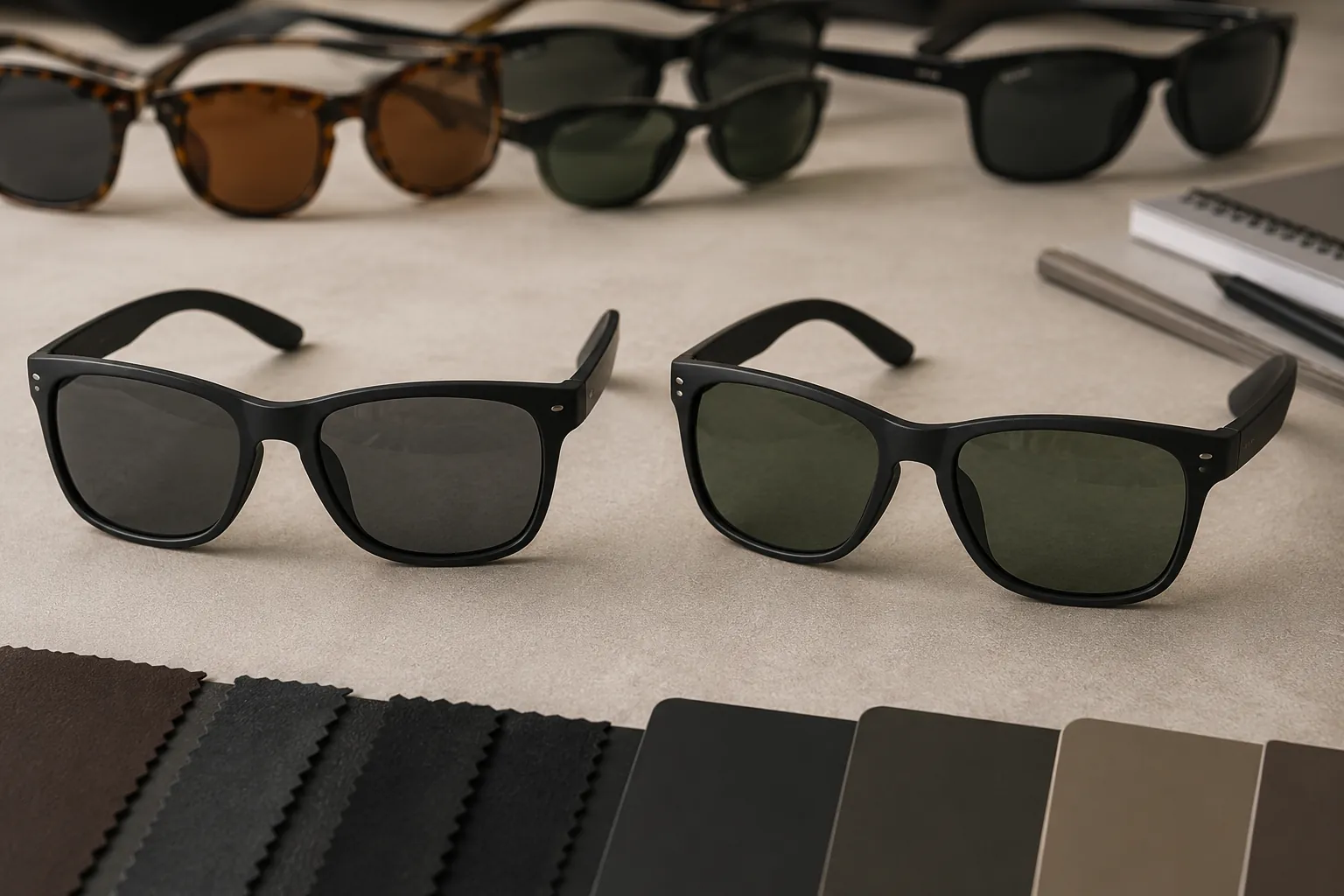
Buyers do not choose lens darkness in a vacuum. They buy for climate, use case, price point, and the standards their market expects. This guide explains how visible light transmission affects product fit, how it shifts by channel, and how to specify tint clearly so sampling stays on track.
Start With The Number Buyers See
Lens transmission percentage, also called visible light transmission or VLT, is the share of visible light that passes through the lens. Lower numbers mean darker lenses. Higher numbers mean lighter lenses.
That sounds simple. It is not.
A 10% lens and a 50% lens serve different shoppers. They also suit different climates, price points, and selling channels. A buyer has to match the tint to the actual use case, not just to a visual preference.
As a buying guide, many sunglass programs sit between 8% and 18% VLT for strong sun, 18% to 40% for general fashion and mixed use, and above 40% for light tint or indoor-outdoor styling. Those are starting points, not hard rules. The right choice still depends on the destination market, product position, and applicable standard.
Lens color matters too. Grey is neutral. Brown often lifts contrast. Green sits between the two. Mirror and gradient finishes change the retail look, but they do not change the underlying transmission number. Start with the number. Then choose the finish.
Match Transmission To Market And Climate
Market fit starts with sun intensity and buying habit. A seller into Australia, the Middle East, or a high-glare coastal market usually needs darker lenses than a seller in northern Europe. Bright sun changes expectations. So does daily routine.
In hot, high-glare regions, 8% to 15% VLT often sells more easily because the benefit is immediate. In milder or cloudier markets, 20% to 40% often moves better because shoppers still want style without the lens feeling too dark.
Climate changes the feel of the product. Desert and beach markets tend to favor darker grey or brown lenses. Urban fashion accounts often accept lighter tints, especially with oversized frames or trend-led shapes. If you are selling to retailers, ask what local customers do most often: driving, beach use, walking, commuting, or outdoor sport. That answer is more useful than a mood board.
| Transmission | Typical Use Case | Buyer / Market Fit | Sales Risk |
|---|---|---|---|
| 5%–10% | Very bright sun, glare-heavy outdoor use | Beach, desert, high-sun regions, fashion statements | Can feel too dark for daily retail if not positioned clearly |
| 11%–18% | Strong sun, general sunglasses | Broad consumer appeal in hot climates and standard retail | Usually the safest commercial range |
| 19%–40% | Mixed light, fashion, driving, everyday wear | Urban fashion, shoulder-season sell-through, milder climates | May be seen as not dark enough for "real sunglasses" in some markets |
| 40%+ | Light tint, styling, reduced harshness | Fashion-first programs, indoor-outdoor wear, some kids or comfort lines | Can be mistaken for weak sun protection if communication is poor |
If you are building a multi-market line, split the range. Use one darker core SKU for sunny regions and one mid-tint SKU for fashion and broader retail. Fewer slow movers. Less dead stock.
Use Case Decides The Right Darkness
The same lens can underperform in one channel and sell well in another. Sport buyers want function first. Fashion buyers will accept more trade-offs if the frame shape and color story work. Retail chains want simple assortment logic. Distributors want broad appeal and low complaint risk.
- Driving: Many buyers prefer 15%–30% VLT with grey or brown lenses because it balances glare control and visibility.
- Beach and resort: 8%–15% VLT is common because darker lenses feel practical in strong sun.
- Fashion retail: 20%–40% VLT often works better because the product looks lighter and more wearable.
- Sport and outdoor activity: Lower VLT can help in bright conditions, but the exact choice should match the activity and any market-specific requirement.
Do not ignore lens color. Brown is often chosen for contrast-oriented outdoor use. Grey is neutral and easy to explain. Green sits in between. If the customer base is price-sensitive, a simple tinted lens with consistent coating quality usually sells more reliably than a complex mirror package with uneven optical performance.
LumiShades can run injection molding, acetate cutting, CNC milling, lens tinting, and decoration in-house. That helps keep lens darkness aligned with frame style without pushing the job across too many suppliers. Tint control is a process issue. Not just a color decision.
Compliance Sets The Dark-Light Boundary
Transmission percentage is not only a sales decision. It also affects compliance, especially when the product is sold as sunglasses rather than fashion eyewear. Buyers should check the destination market standard before approving final tint levels.
The relevant certifications and standards for this article are CE EN ISO 12312-1, ANSI Z80.3, AS/NZS 1067, REACH, FDA registration, ISO 9001, and BSCI. They matter because the same lens can be acceptable in one market and wrong in another if the category, labeling, or product claims are off.
In some markets, the key issue is not the exact VLT number alone, but whether the product meets the correct sunglasses safety and labeling requirements. In others, the material and coating chemistry also matter. REACH affects chemical restrictions. FDA registration is relevant to the U.S. supply chain context. ANSI Z80.3 and AS/NZS 1067 are important reference points for product expectations in those markets.
Buyers should not treat tint as decoration only. If the lens is too light for the claim, or if the copy promises sun protection the product cannot support, the problem becomes commercial and regulatory at the same time.
Build A Tint Assortment That Sells
The cleanest assortment is usually three steps: one darker option, one mid option, and one lighter fashion option. That gives buyers room to match climate and channel without building too many near-duplicate SKUs.
- Pick the core market first. Decide whether the line is for hot climates, urban fashion, or mixed retail.
- Set one primary VLT band. For example, 8%–15% for high sun, or 20%–30% for general retail.
- Add one secondary band. Use it as the backup for another season or channel.
- Lock frame color and lens color together. Grey, brown, and green can look equally "dark" by percentage but sell differently in store.
- Approve under real light. Check samples outdoors, not only under indoor white lighting.
Sample approval should include a measured VLT target, not just "looks dark enough." If you do not define the target, factories will interpret the request by eye. By-eye approval varies from person to person. That is how resampling starts. Clear specs save time.
Cost And Lead Time Move With Complexity
Transmission choice can affect cost in small but real ways. A plain dyed lens is usually simpler than a mirrored or multi-layer package. A deeper tint may require tighter color matching and more inspection time. Add logo plates, laser engraving, or pad printing, and the process stack gets more complicated.
| Program Type | Typical VLT Range | Cost Pressure | Lead-Time Impact |
|---|---|---|---|
| Basic fashion sunglass | 20%–40% | Lower if frame and lens are standard | Shortest if tooling is already ready |
| Core retail sun line | 11%–18% | Moderate due to tint consistency and QC | Usually standard bulk cycle |
| Sport or high-glare line | 5%–15% | Higher if coating control or mirror finish is added | May require more sample checks |
| Premium decorated line | Varies | Higher because of engraving, printing, or metal logo parts | Can add setup time |
For planning, LumiShades lists MOQ starting at 50 pairs per design. Pricing improves at 300, 1000, and 5000+ pairs, with volume pricing from about $2.10 per pair. That makes transmission variants easier to manage when order size supports separate tint runs. Three VLT options in one program are possible, but the unit economics change fast when each one is a small run.
Bulk production is listed at 25-35 days. If you change tint, lens color, and decoration at the same time, plan for the longer end of that range. Build that into the launch calendar. Do not assume every variation will move at the same speed.
Keep Tint Consistent In Production
Transmission is a process control issue. If the dye bath drifts, the lens cure changes, or the base material batch shifts, the finished product can look different even when the formula stays the same. That is why in-house production helps.
LumiShades states that it handles injection molding, acetate cutting, CNC milling, lens tinting, decoration, and QC in-house. A shorter handoff chain makes it easier to keep a second run close to the approved sample. For buyers, that means fewer surprises between first order and reorder.
- Check tint against a target sample, not against memory.
- Inspect left/right lens matching; uneven pair appearance is a valid rejection point.
- Confirm logo decoration after tinting if lens color affects visibility.
- Verify packaging and labeling against the destination market before shipment.
On-time delivery matters too. LumiShades states 98.5% on-time delivery and shipping to 60+ countries. Those figures do not make a weak spec acceptable, but they do help buyers plan replenishment once the order is technically frozen.
Check These Details Before You Order
Before approval, ask for the details that protect margin and reduce disputes. Skip generic "dark lens" language.
- Exact VLT target or range for each SKU.
- Lens color, base material, and finish: clear, smoke, brown, green, mirror, or gradient.
- Destination market and required standard: CE EN ISO 12312-1, ANSI Z80.3, or AS/NZS 1067 where relevant.
- Decoration method: laser engraving, pad printing, or metal logo plate.
- MOQ per design and whether each tint counts as a separate design.
- Sample and bulk timing in writing: 7-10 days for samples, 25-35 days for bulk, if those are the supplier's stated timings.
If the supplier cannot speak in those terms, keep looking. "Dark," "medium," and "fashion tint" are not enough for a serious order. The buyer carries the risk.
Have a custom sunglasses project in mind?
Send us your styles, target market and quantities and we will return a detailed quote with MOQ, lead time and a sample plan.
Get a QuoteWhy source this from Wenzhou with LumiShades
Wenzhou in Zhejiang Province is widely regarded as China’s eyewear manufacturing capital, producing a large share of the world’s sunglasses. That concentration matters to buyers: a deep local supply chain for acetate sheet, hinges, lens blanks, plating and packaging means shorter component lead times, easier color and material matching, and a workforce with decades of eyewear-specific skill. LumiShades has manufactured in this ecosystem since 2009, and our vertical integration — in-house injection molding, acetate cutting, CNC milling, lens tinting, decoration and quality control — means no part of your order is quietly subcontracted to a workshop you cannot audit.
For international buyers, that vertical control translates into accountability. When a single factory owns every step, defects are traced and fixed at source rather than bounced between vendors, and your specifications survive intact from first sample to bulk. We back this with 15+ years of experience, shipments to 60+ countries, more than 5 million pairs produced per year and a 98.5% on-time delivery rate. Our certifications — CE EN ISO 12312-1, FDA registration, ANSI Z80.3, AS/NZS 1067, REACH, ISO 9001 and BSCI audit — mean the compliance documentation your market requires already exists. Explore our manufacturing capabilities and quality control process to see how this works in practice.
Frequently asked questions
What VLT should I choose for a general sunglasses line? A practical starting point is 11%–18% VLT for a broad retail sunglasses line. It usually gives a clear sunglasses feel without making the product too dark for everyday wear. If your target market is especially bright or glare-heavy, ask the supplier for a sample in the lower part of that range and check it outdoors before approving the final spec.
Is a darker lens always better for sales? No. Darker lenses can be the right choice in strong sun, but they can sell more slowly in milder markets where shoppers want style and visibility. Choose the tint for the customer's real use case, not for maximum darkness. Match VLT to climate, channel, and claim.
Does the same transmission work in every market? No. Climate, consumer habit, and compliance expectations vary by market. A tint that works well in Australia may not be the best fit for northern Europe or an urban fashion chain. Ask for samples, compare them under outdoor light, and confirm the destination standard before placing the order.
How does tint choice affect MOQ and price? If you split a program into multiple VLT versions, each version usually behaves like a separate SKU or design for production planning. That can affect MOQ and unit price. If the supplier offers tiered pricing, compare the total cost of one larger tint run versus several smaller tint variants before finalizing the assortment.
What should I ask for in samples? Ask for the exact VLT target or range, lens color, coating or finish, and the destination standard you need. Then review the sample outdoors in the intended use environment and compare left/right lens appearance. If possible, keep the approved sample as the reference for bulk production.
Can LumiShades support compliance-focused orders? LumiShades states support for CE EN ISO 12312-1, ANSI Z80.3, AS/NZS 1067, REACH, FDA registration, ISO 9001, and BSCI. For a compliance-focused order, ask the supplier to confirm which standard applies to your destination market, what documentation is available, and how the final labeling should read before production starts.
Ready to start?
Explore our shield & oversized sunglasses or request a quote — our sales team replies within 12 hours.
Request a Quote