
How Buyers Verify UV400 Claims Before Shipment
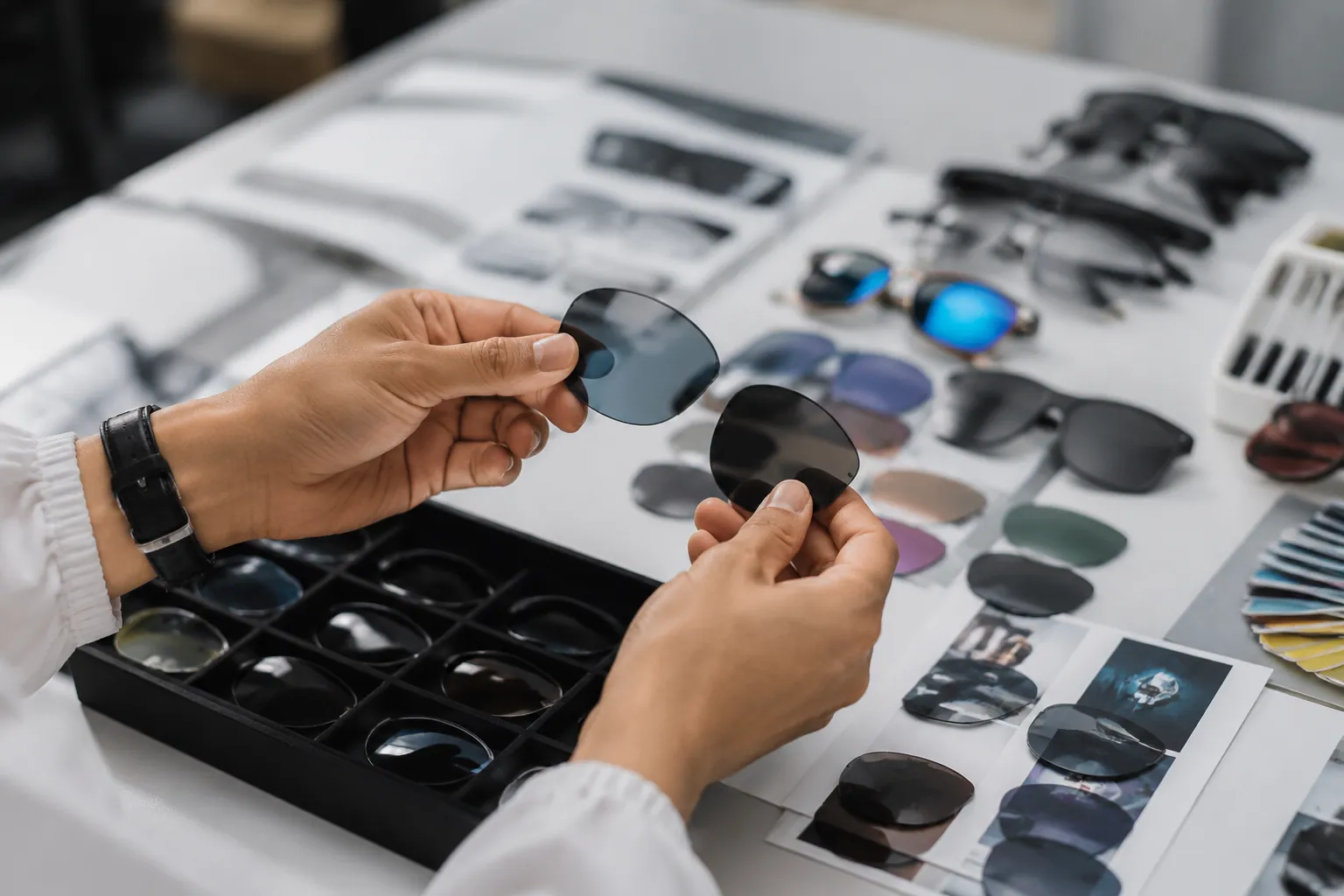
This guide is for brand owners, importers, distributors, and retail buyers sourcing sunglasses in volume. It explains what a UV400 claim should mean, how factories usually verify it during production, which documents matter, and where supplier controls often break down. The goal is simple: before you approve shipment and release payment, make sure the lens protection claim is backed by current testing and lot-level quality records.
What a UV400 claim should actually mean
UV400 is a performance claim. Not a trim detail. Not a sales line. In practical terms, it means the lens is intended to block ultraviolet radiation up to 400 nanometers, covering the UVA and UVB range that matters in sunglass safety. A dark lens alone proves nothing. The claim needs optical test data showing very low UV transmission across the relevant range.
That distinction matters because visible darkness and UV protection are different properties. A lens can look dark and still be wrong for a UV400 claim if the material, absorber package, lamination, or coating is not controlled. The reverse is also true. A lighter or fashion-tinted lens can still meet UV400 if the lens system is designed and tested properly.
For buyers, a credible UV400 claim usually depends on three controls working together:
- Raw material control: the approved resin, semi-finished lens, or coating system comes from a defined source.
- In-process verification: lenses are checked during production, not only during development.
- Final documentation: the records match the actual lens construction and shipment lot.
Applicable standards may include EN ISO 12312-1 for many CE-market sunglasses, ANSI Z80.3 in the US, and AS/NZS 1067 for Australia and New Zealand. These standards cover more than a generic "UV pass" statement. They also address transmittance classification, labeling, and other performance requirements. Keep optical performance separate from other compliance topics. REACH deals with restricted substances. FDA registration, if raised in US sourcing discussions, is not proof of UV blocking. The document must match the claim.
Where the UV protection comes from
Most sunglasses achieve UV-blocking performance through one of three routes. Each route has its own control points and risks.
| UV-control route | Typical materials | Main advantage | Main risk in production |
|---|---|---|---|
| UV absorber built into raw resin | Injected PC, some nylon and other plastics | Can be stable when the resin source and formulation stay fixed | Performance can change if the resin source or additive formulation changes |
| UV absorber in dyed or laminated lens layer | CR-39, TAC, layered constructions | Useful for fashion colors and laminated lens programs | Layer consistency, dye control, and supplier variation can affect results |
| Surface coating adds UV resistance | Coated plastic lenses, some mirrored products | Can support certain constructions and finishes | Coating consistency, cure, adhesion, and wear can affect reliability |
Buyers do not need a chemistry lesson. They need one clear answer: where does the UV protection come from in this exact lens construction? If a supplier cannot answer that directly, the control plan behind the claim is hard to trust. This matters even more with mirrored, gradient, photochromic, polarized, or lightly tinted lenses, where appearance changes often come with construction changes.
The key is consistency. The supplier should be able to identify the lens material, the source, and the UV-control mechanism, then show how that construction stays the same from approved sample to bulk output. If the lens source changes, old test evidence may no longer be enough.
The control points that matter in production
UV400 verification is not one certificate. It is a control chain. If one link is weak, the final claim is weak too.
- Approved lens specification: lock the material, lens color, transmittance target, coating stack, and destination standard before bulk production starts.
- Incoming material check: confirm that the received lens material or semi-finished lens matches the approved bill of materials.
- First-off sample test: check early production samples before the full run is released.
- In-process spot checks: recheck after any step that could affect lens performance, such as tinting, lamination, or coating.
- Final QC sampling: verify packed-lot samples and tie them to lot or carton identification.
- Document release: issue internal QC records and supporting reports before shipment approval.
Weak suppliers often lean on an old report from a similar lens and assume later output is covered. That is not enough if the lens color changes, the mirror stack changes, the material source changes, or a different laminated or polarized lens source is used.
A disciplined factory does more than keep an old pass report on file. It keeps the approved lens construction fixed, checks production output against that construction, and maintains records tied to the goods being shipped. For private-label orders, this matters more because custom programs often change several variables at once, including lens color, coatings, logo method, and packaging.
What gets tested and how to read it
UV verification is usually done with a spectrophotometer or similar optical test equipment that measures transmission across wavelengths. The useful output is not just "pass" or "fail." It is a transmission curve or data set showing how much radiation passes through the lens in the UV and visible ranges.
For buyers, the most useful checkpoints are these:
- Exact identification: the report should identify the lens material, color, coating stack, style, or internal sample code.
- Standard referenced: the report should name the applicable standard, such as EN ISO 12312-1, ANSI Z80.3, or AS/NZS 1067.
- UV range covered: the result should support the UV400 claim for the tested lens construction.
- Visible light transmission: the result should fit the intended lens category and product use.
- Report date and construction relevance: if the lens construction changes, an older report may stop being relevant.
Then ask a basic question: was the tested sample taken from development, pilot production, or actual bulk output? A hand-made prototype result can be useful, but it does not replace production control on the shipment lot. Also confirm that the tested sample matches the final left and right lens construction, especially for gradient, mirrored, or laminated styles where variation can occur.
The standards above cover more than UV transmission alone. They may also include transmittance classification and labeling-related requirements. So if a supplier says only "UV400 passed," that answer is incomplete. Ask the next question: which standard, which sample, and which exact lens construction?
Practical rule: a sales certificate or declaration is not the same as a test report showing measurable results for the lens construction you are buying.
Which documents matter and which do not
Buyers are often sent a mixed file set and expected to treat it as proof. Do not. Some documents support management systems. Some cover restricted substances. Some support optical performance. They are not interchangeable.
| Document or standard | What it actually supports | What it does not prove by itself |
|---|---|---|
| EN ISO 12312-1 / CE-linked test report | Sunglasses performance and safety requirements for the tested construction, including optical criteria | That every future batch automatically passes without ongoing QC |
| ANSI Z80.3 report | US-relevant sunglass performance requirements for the tested sample | REACH chemical compliance or social audit status |
| AS/NZS 1067 report | Australia/New Zealand eyewear performance requirements | That your private-label style was tested unless the identification matches |
| REACH documentation | Restricted chemical substances in materials and components | UV400 optical performance |
| FDA registration | A regulatory registration point sometimes raised in US market discussions | That lenses block UV to 400 nm |
| ISO 9001 | Quality management system structure | Actual lens compliance results for your order |
| BSCI or similar social audit | Social compliance or labor-audit framework | Any optical, UV, or transmittance claim |
A simple buyer shortcut helps here: ask the supplier to sort documents under four headings: optical performance, chemical compliance, quality system, and social compliance. If they cannot do that clearly, there is a good chance they are using unrelated paperwork to fill gaps in real evidence.
A practical pre-shipment plan for custom orders
If you are placing a new style or changing the lens construction, use a staged check plan. It controls risk earlier and more cleanly than waiting until the goods arrive.
- Development sample: confirm appearance, fit, logo placement, and lens color direction. Do not treat this as final compliance proof.
- Pre-production approval: lock the lens material, color, coating, polarization requirement, and target standard before mass production begins.
- Bulk production control: require first-off and in-process checks on the approved lens construction.
- Pre-shipment sample pull: request retained samples, internal QC records, and confirmation that labels match the destination market requirement.
- Third-party verification when risk is high: use it for first orders, unusual lens constructions, sensitive retail programs, or whenever the supplier changes a key lens input.
Final inspection should happen on finished goods, not only on partly assembled parts. Late-stage handling can still introduce scratches, coating damage, or part mix-ups after the lens has been fitted. So pre-shipment review should cover finished product condition, supporting test evidence, and lot traceability together.
The aim is not to manage the factory for them. It is to make sure the supplier's quality records, the tested lens construction, and the packed goods all point to the same product.
Common failure modes behind false confidence
Most UV400 problems do not start with an obvious fake claim. They usually start with weak document control, poor traceability, or production changes that were never rechecked.
- Using an old report for a new lens: the frame may be the same, but the lens construction is different.
- Changing material source mid-run: appearance may stay close while optical performance shifts.
- Confusing darkness with protection: a darker lens does not automatically mean better UV blocking.
- Coating variation: inconsistent application or poor durability can affect the final lens system.
- No lot traceability: the tested sample cannot be linked back to shipped cartons or production lots.
- Testing only a development sample: the prototype passes, and bulk output is assumed to match without evidence.
Ask direct operating questions. Is the lens source fixed for the purchase order? Can the supplier identify which lot was tested? If a mirrored, gradient, or laminated lens is used, was the final construction checked rather than only the base lens? Clear answers usually point to real control. Vague answers usually mean the UV400 claim is being handled as paperwork, not as a production requirement.
Vertical integration may help coordination, but it proves nothing on its own. A factory may mold frames, process lenses, and decorate products in-house and still keep weak records. The real issue is whether the supplier can show consistent control of the exact lens construction being shipped.
What to ask for before you release shipment
If you want one practical checklist before approving shipment, use this:
- Approved lens specification sheet showing material, color, coating stack, and target standard.
- Current test report tied to the actual lens construction, not a similar style.
- Internal QC record showing first-off, in-process, and final checks for the production lot.
- Lot traceability linking tested samples to packed goods or carton identification.
- REACH or other required chemical documentation if your market or retailer asks for it.
- Confirmation of correct labeling for the destination market and applicable lens category.
If the order is a first run, or if the lens is unusual, add time for outside verification before payment release. It is easier to hold goods at origin than to explain an unsupported UV claim after arrival.
You do not need to supervise the factory floor. You do need to know the difference between a current, construction-specific control file and a generic promise. UV400 is easy to print on packaging. Proving that the packed lot matches the claim is the hard part.
Have a custom sunglasses project in mind?
Send us your styles, target market and quantities and we will return a detailed quote with MOQ, lead time and a sample plan.
Get a QuoteWhy source this from Wenzhou with LumiShades
Wenzhou in Zhejiang Province is widely regarded as China’s eyewear manufacturing capital, producing a large share of the world’s sunglasses. That concentration matters to buyers: a deep local supply chain for acetate sheet, hinges, lens blanks, plating and packaging means shorter component lead times, easier color and material matching, and a workforce with decades of eyewear-specific skill. LumiShades has manufactured in this ecosystem since 2009, and our vertical integration — in-house injection molding, acetate cutting, CNC milling, lens tinting, decoration and quality control — means no part of your order is quietly subcontracted to a workshop you cannot audit.
For international buyers, that vertical control translates into accountability. When a single factory owns every step, defects are traced and fixed at source rather than bounced between vendors, and your specifications survive intact from first sample to bulk. We back this with 15+ years of experience, shipments to 60+ countries, more than 5 million pairs produced per year and a 98.5% on-time delivery rate. Our certifications — CE EN ISO 12312-1, FDA registration, ANSI Z80.3, AS/NZS 1067, REACH, ISO 9001 and BSCI audit — mean the compliance documentation your market requires already exists. Explore our manufacturing capabilities and quality control process to see how this works in practice.
Frequently asked questions
Is a CE report enough to confirm UV400 for every repeat order? No. A report linked to EN ISO 12312-1 supports the tested lens construction, not every future batch by default. For repeat orders, confirm that the lens material, tint, coating, polarization layer, and supplier source have not changed. If any of those change, ask for updated test evidence or at least current production QC records tied to the new lot before shipment approval.
Can a clear or lightly tinted lens still meet UV400? Yes. UV blocking and visible darkness are different properties. A clear or lightly tinted lens can meet a UV400 claim if the material or lens system is designed for that performance and the result is confirmed by testing. Do not judge by appearance alone. Ask for the report, and make sure it identifies the exact lens construction.
Should I request third-party testing on every order? Not necessarily. It is most useful for first orders, new lens constructions, unusual coatings or laminations, retailer-sensitive programs, children's lines, sport products, or any order where a failure would be costly. For stable repeat programs, buyers often rely on internal QC plus periodic outside verification, but only if the supplier can show consistent lot traceability and no uncontrolled lens changes.
What is the fastest warning sign that a supplier does not control UV claims well? A generic certificate with no exact lens identification, no current date, and no clear standard reference is a strong warning sign. Another is when the supplier uses REACH, FDA registration, ISO 9001, or BSCI paperwork as if it proves UV performance. Ask for one current optical test report and one lot-linked QC record for the actual lens construction. If they cannot provide both clearly, slow the approval process.
Does mirror coating improve UV protection? Not by itself. Mirror coating mainly affects appearance and may influence glare characteristics, but it does not automatically prove UV400 performance. UV protection usually comes from the substrate, absorber package, or a defined lens-layer system. Treat a mirrored lens as its own final construction and ask for test evidence that applies to that finished lens, not just to the uncoated base lens.
Ready to start?
Explore our square sunglasses or request a quote — our sales team replies within 12 hours.
Request a Quote