
Polarized Lens QC Checks Before Bulk Production Approval
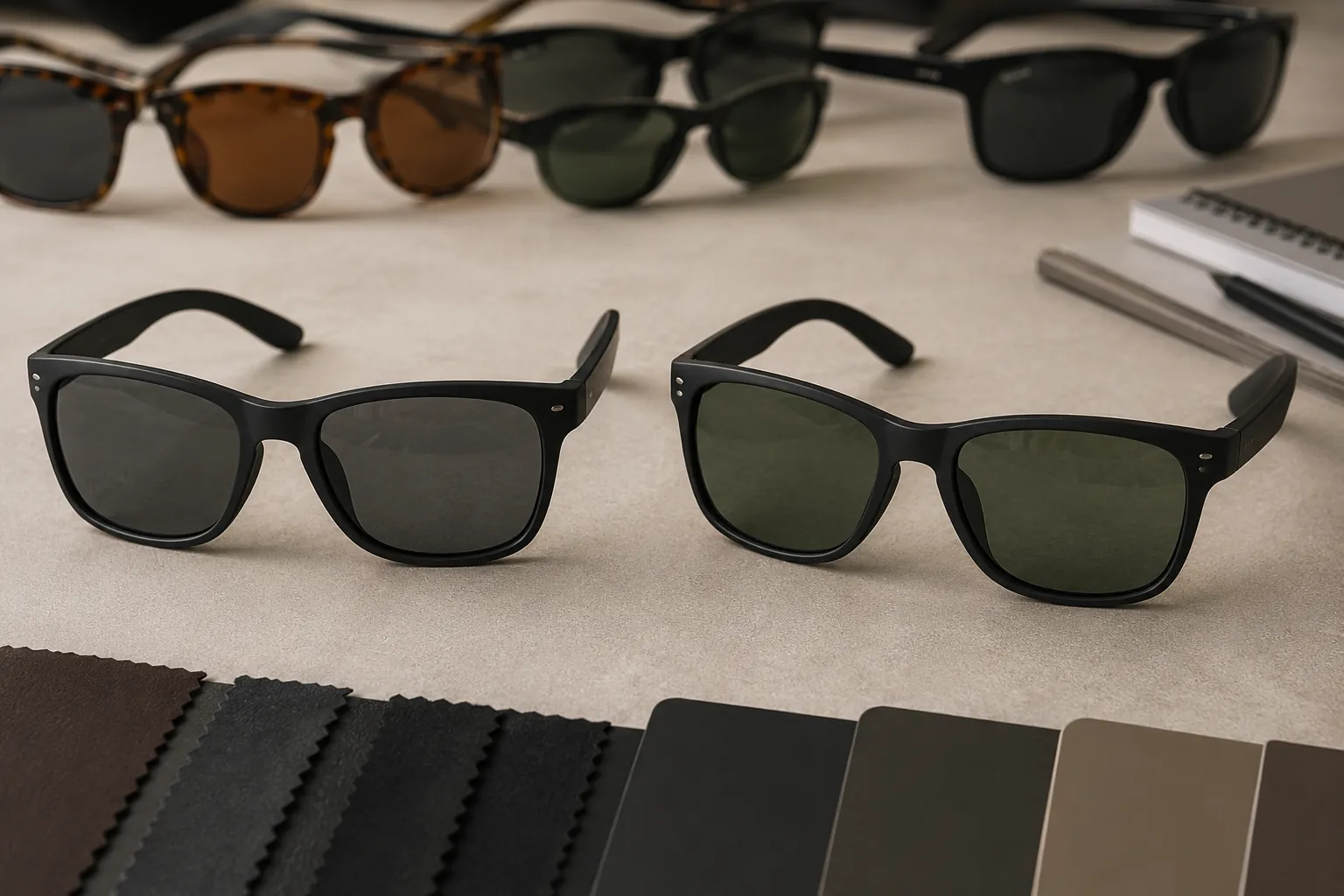
This guide is for brands, importers, distributors, and retailers sourcing custom polarized sunglasses at volume. The aim is simple: catch weak polarization, left-right mismatch, tint variation, and assembly-related defects before bulk production starts. In eyewear manufacturing, the approved sample becomes the benchmark for production and inspection. If that benchmark is vague, results drift. A structured pre-production lens review cuts disputes, rework, and avoidable claims.
Start with failure modes, not the sales sheet
Most polarized-lens problems in bulk orders are predictable. They usually come from the same handful of issues: weak polarization, inconsistent lens orientation, tint variation, optical defects, coating faults, or stress introduced during edging and assembly.
Start there. Not with a polished sales sample.
Before you approve production, ask the supplier to explain the lens construction in plain language and in writing. The description should identify the base material, polarization method, tint method, coating system, and key inspection steps. The factory should be able to state whether the lens is a TAC laminated lens, a polarized polycarbonate lens, or a nylon polarized lens, and explain how that construction is processed in the selected frame. If they cannot explain the build clearly, do not assume production will be consistent.
- Weak polarization efficiency: the lens is sold as polarized, but practical glare reduction is limited.
- Axis inconsistency: left and right lenses behave differently when rotated against an LCD or test card, which can indicate orientation mismatch.
- Color drift: the approved grey, brown, green, or mirrored look shifts between sample and production.
- Optical defects: haze, bubbles, pits, flow marks, waviness, coating streaks, contamination, or stress patterns.
- Edge damage after assembly: whitening, chipping, cracking, or delamination near grooves, drill points, or tight frame channels.
- Compliance mismatch: the approved sample is sold with a transmission or standards claim that the production lot does not support.
These are the risks to build into the approval process. A nice sample helps. It is not a quality plan.
Specify exactly what you are buying
A purchase order should not rely on the phrase polarized TAC lens alone. That wording is too broad to control production. Attach a lens specification to the tech pack, sample approval record, and purchase order.
- Lens material: TAC laminated, polycarbonate polarized, or nylon polarized. Record the nominal thickness or build relevant to the style.
- Visible light transmission: define the target and acceptable tolerance for the approved color. If the supplier uses a test report, make sure it matches the actual lens specification and market claim.
- Polarization orientation: require left and right lenses to be matched and assembled consistently. If the supplier keeps internal test records, ask them to retain those records for the approved run.
- Color standard: approve against a physical retained sample under consistent lighting, ideally daylight-equivalent lighting, not a phone image or edited render.
- Surface and coating requirements: define hard coat, mirror or flash finish if any, backside cleanliness, and what level of minor edge marking is acceptable after insertion.
- Defect criteria: define what is rejectable at an agreed viewing distance and under agreed lighting. A mark outside the visible wearing area should not be judged the same way as a defect in the primary viewing zone.
It also helps to tie the lens specification to the order stage. For a small development order, keep variables tight. For a larger commercial order, lock the color, transmission, cosmetic standard, and polarization matching before release. If the supplier handles lens processing, decoration, and assembly in-house, use that to assign standards and responsibility early.
Use a pre-production test pack, not one sample
One sample is not enough to approve a polarized program. Ask for a pre-production test pack made with the intended lens source and the intended bulk-production process. The goal is repeatability, not just appearance.
Your test pack should include:
- 1 fully assembled approval sample
- 2 to 3 extra loose lenses from the same batch or process lot
- 1 decorated sample if print, hot stamping, or laser marking is close to the lens area
- Shade range examples if the supplier expects controlled tint variation and wants that range pre-approved
Then run basic buyer checks:
- LCD rotation test: view a phone, tablet, or monitor through each lens and rotate the lens. A polarized lens should show a clear change in light transmission relative to screen orientation.
- Left-right comparison: compare both lenses against the same LCD source. They should darken in a similar way and at a similar angle. A visible difference can indicate orientation mismatch.
- Distortion check: look at straight lines, such as tiles or a printed grid, through the lens and move it slowly. Obvious waviness or image instability needs review.
- Surface inspection: inspect under bright, consistent light for pits, scratches, bubbles, coating streaks, contamination, stress patterns, and edge damage.
- Tint comparison: compare all sample pieces to the approved standard under controlled lighting. Small color differences often look bigger when the product is worn than when the lens is sitting loose on a desk.
These checks do not replace lab testing. They are screening tools. If inconsistency is already visible in a small test pack, stop there and fix it before bulk production starts.
Choose lens construction based on use, not habit
Different polarized lens constructions behave differently in optics, impact performance, weight, processing risk, and cost. The right choice depends on the frame design, target channel, and intended use.
| Lens type | Typical thickness / build | Common use | Main advantages | Main risks |
|---|---|---|---|---|
| TAC laminated polarized | Usually a laminated structure in fashion and general-use sunglass programs | Fashion sunglasses, private label retail, mid-volume programs | Widely available, broad color options, competitive cost, generally good appearance | Lamination quality must be checked; some constructions are more sensitive at edges, grooves, or drill areas |
| PC polarized | Often used in molded sport-lens formats | Sport, kids, lightweight styles | Low weight and good impact resistance for many applications | Can show molding or stress-related optical issues if process control is weak |
| Nylon polarized | Performance-oriented lens construction | Higher-end sport and technical frames | Lightweight, durable, suitable for wrap designs, often selected for performance use | Higher cost and usually tighter processing requirements |
Material choice should match frame construction. A low-base fashion frame creates different lens stress than a wrapped sport frame. Rimless and semi-rimless styles add risk around drill holes, grooves, and polished edges. If the factory recommends a cheaper lens type, ask how it performs in that exact frame geometry and assembly method.
For many entry-level and mid-level private label programs, TAC is a common commercial choice. For active-use ranges or youth styles where impact resistance matters more, polycarbonate may fit better. Do not default to the supplier's standard option. Match the construction to the job.
Control consistency across tinting, decoration, and assembly
Approving a lens is not about whether one sample looks fine. The real question is whether the supplier can repeat that result across material lots, tint batches, and assembly runs. Ask for the control plan for polarized-lens production.
A workable control plan should cover these stages:
- Incoming material check: confirm material identity, color, thickness, visible defects, and batch traceability before production starts.
- Tint batch control: compare each tint batch to the approved standard and document how variation is reviewed and released.
- Orientation control during cutting and mounting: maintain left-right consistency through cutting, edging, and insertion so polarization direction is preserved.
- Decoration review: if decoration is applied on or near the lens, confirm placement, cosmetic quality, and that the process does not damage the coating or create visible contamination.
- In-process inspection: inspect after edging and again after assembly, because some defects only appear after the lens is mounted.
- Final random QC: verify cosmetic quality, lens matching, labeling, and packing condition on finished goods.
Decoration method matters. Screen printing, pad printing, hot stamping, and laser marking create different cosmetic and durability risks. If decoration sits close to the wearer's field of view, require that exact execution in the approval pack.
For repeat programs, keep two references: a golden sample that shows the approved standard and a limit sample that shows the maximum acceptable minor variation. That gives both buyer and supplier the same inspection baseline and reduces subjective disputes later.
Tie lens testing to compliance and labeling
Polarization is not the same as compliance. A lens can be polarized and still fail the legal or commercial requirements of the target market if the transmission category, product construction, labeling, or supporting documents are wrong. Review compliance before you release production.
Standards and systems buyers often ask about include CE EN ISO 12312-1, ANSI Z80.3, AS/NZS 1067, REACH, FDA registration, ISO 9001, and BSCI. They are not interchangeable. CE EN ISO 12312-1, ANSI Z80.3, and AS/NZS 1067 relate to sunglass product requirements in their markets. REACH relates to chemical compliance. FDA registration is often discussed for U.S. market access, but it is not a substitute for product performance testing. ISO 9001 and BSCI relate to management systems or social compliance, not sunglass optical performance.
Practical buyer checks should include:
- Confirm the intended lens category and visible light transmission claim for the approved color.
- Match packaging claims, hangtags, and markings to the actual approved lens specification.
- Request the relevant product test report for the target market when required by your importer, retailer, or marketplace.
- Confirm chemical compliance requirements, such as REACH, when applicable to the market and materials used.
Be careful with dark fashion lenses, mirrored lenses, and gradients. Teams often assume a transmission category based on appearance alone. That is a mistake. If the market requires a specific standard or report, make sure the document is current and product-specific for the SKU being shipped.
Build the approval gate around MOQ, price, and lead time
One common sourcing mistake is approving too early because the delivery date is tight. Lead times vary by supplier, season, construction, and packaging detail, so confirm the schedule case by case. More important is a clear approval gate before the factory starts bulk production.
| Order stage | Typical quantity | What to verify | Commercial logic |
|---|---|---|---|
| Development sample | 1-3 pcs | Frame shape, basic lens color, first polarization check | Confirms concept only; not enough to judge process stability |
| Pre-production test pack | 3-6 pcs plus loose lenses | Lens matching, tint range, cosmetic defects, decoration impact, approval standard | Best stage to stop unclear specs before mass production |
| Pilot / MOQ run | About 50 pairs | Repeatability, packing, early market feedback, real-use complaints | Useful for new styles or uncertain channels; limits exposure |
| Volume production | 300 / 1000 / 5000+ pairs | Lot consistency, QC records, pre-shipment inspection, carton labeling | Larger orders increase the cost of any unresolved quality issue |
Use order size to set the approval standard. At very small quantities, the goal may be proof of concept. At 300 pairs and above, written lens criteria are advisable. At 1,000 pairs or more, a golden sample, signed defect limits, and a pre-shipment inspection plan should be standard practice. On larger runs, ask how the supplier records lot information and how they handle mid-run variation if tint or lens matching starts to drift.
Price should be judged together with quality risk. A lower FOB price does not mean lower total cost if the order later needs sorting, relabeling, replacement, or claim handling. Compare price against the clarity of the spec, the control plan, and the supplier's ability to document what was produced.
Use this sign-off checklist before release
Before you release bulk production, make sure the following points are confirmed in writing and attached to the order file:
- Lens material confirmed: TAC, polycarbonate, or nylon, with intended build or nominal thickness.
- Polarization verified on the assembled sample and on extra loose lenses.
- Left and right lenses compared for consistent behavior during a rotation test.
- Tint approved against a physical retained sample under controlled lighting.
- Visible defects defined with accept and reject examples.
- Frame construction reviewed for lens stress risk, especially on wrapped, grooved, drilled, rimless, or semi-rimless styles.
- Decoration method confirmed if printing, foil, or laser marking is close to the lens area.
- Relevant compliance documents matched to the destination market and the actual SKU.
- Golden sample retained by both buyer and supplier.
- Final QC plan includes lens-specific checks, not only cosmetic inspection and packing count.
Short rule: if the lens specification is vague, the bulk result is more likely to vary.
Specific buyers get better outcomes. Most good factories prefer that clarity because it reduces disagreement later. Use the sample stage to answer the practical questions: How is tint variation controlled? How is lens orientation preserved during assembly? What happens if the frame puts stress on the lens edge? A disciplined approval process costs less than solving field complaints after shipment.
Have a custom sunglasses project in mind?
Send us your styles, target market and quantities and we will return a detailed quote with MOQ, lead time and a sample plan.
Get a QuoteWhy source this from Wenzhou with LumiShades
Wenzhou in Zhejiang Province is widely regarded as China’s eyewear manufacturing capital, producing a large share of the world’s sunglasses. That concentration matters to buyers: a deep local supply chain for acetate sheet, hinges, lens blanks, plating and packaging means shorter component lead times, easier color and material matching, and a workforce with decades of eyewear-specific skill. LumiShades has manufactured in this ecosystem since 2009, and our vertical integration — in-house injection molding, acetate cutting, CNC milling, lens tinting, decoration and quality control — means no part of your order is quietly subcontracted to a workshop you cannot audit.
For international buyers, that vertical control translates into accountability. When a single factory owns every step, defects are traced and fixed at source rather than bounced between vendors, and your specifications survive intact from first sample to bulk. We back this with 15+ years of experience, shipments to 60+ countries, more than 5 million pairs produced per year and a 98.5% on-time delivery rate. Our certifications — CE EN ISO 12312-1, FDA registration, ANSI Z80.3, AS/NZS 1067, REACH, ISO 9001 and BSCI audit — mean the compliance documentation your market requires already exists. Explore our manufacturing capabilities and quality control process to see how this works in practice.
Frequently asked questions
How can I check polarization quickly without lab equipment? Use an LCD screen or a polarization test card. Hold one lens in front of the screen and rotate it slowly. A polarized lens should show a clear change in light transmission as the angle changes. Then test the second lens the same way and compare the two. If one lens darkens differently or at a noticeably different angle, ask the supplier to check lens orientation and matching before production. Record photos or video during the review so the result is documented in the approval file.
Is one approved sample enough for a bulk polarized order? No. One sample can confirm styling, but it does not show whether the lens result is repeatable. Ask for a pre-production pack with an assembled sample, extra loose lenses, and any decorated version that will go into production. Compare tint, inspect for surface defects, and check that left and right lenses behave consistently in a rotation test. If the supplier expects an acceptable shade range, require that range to be shown and approved before bulk production starts.
What lens type is usually the safest for entry-level private label orders? For many entry-level private label sunglass programs, TAC laminated polarized lenses are a common commercial choice because they are widely available and support a broad range of looks. But there is no universal safest option. The right choice depends on frame construction, intended use, and quality control. If the style is wrapped, semi-rimless, or drilled, review edge performance and assembly stress carefully. If the product is meant for active or youth use, polycarbonate may deserve closer review because of its impact characteristics.
Do polarized lenses automatically meet CE or ANSI requirements? No. Polarization refers only to glare reduction by filtering light orientation. It does not by itself confirm compliance with CE EN ISO 12312-1, ANSI Z80.3, or AS/NZS 1067. Compliance depends on the full product and the applicable market requirements, including visible light transmission category, labeling, and test documentation. Ask for the report that matches the actual SKU and destination market, and check that packaging claims match that report.
At what order size should I require a stricter QC plan? The need for stricter QC rises with commercial exposure. Once you move beyond a development order, use written lens criteria. At around 300 pairs and above, define tint standard, defect limits, and lens matching requirements in writing. At 1,000 pairs or more, require a golden sample, a clear pre-shipment inspection plan, and documented checks for lens-specific issues such as tint consistency, cosmetic defects, and left-right matching. For larger repeat orders, ask the supplier to keep lot traceability and internal QC records so any issue can be isolated quickly.
Ready to start?
Explore our rimless sunglasses or request a quote — our sales team replies within 12 hours.
Request a Quote