
PC vs TAC Polarized Lenses: Cost, Risk, Returns
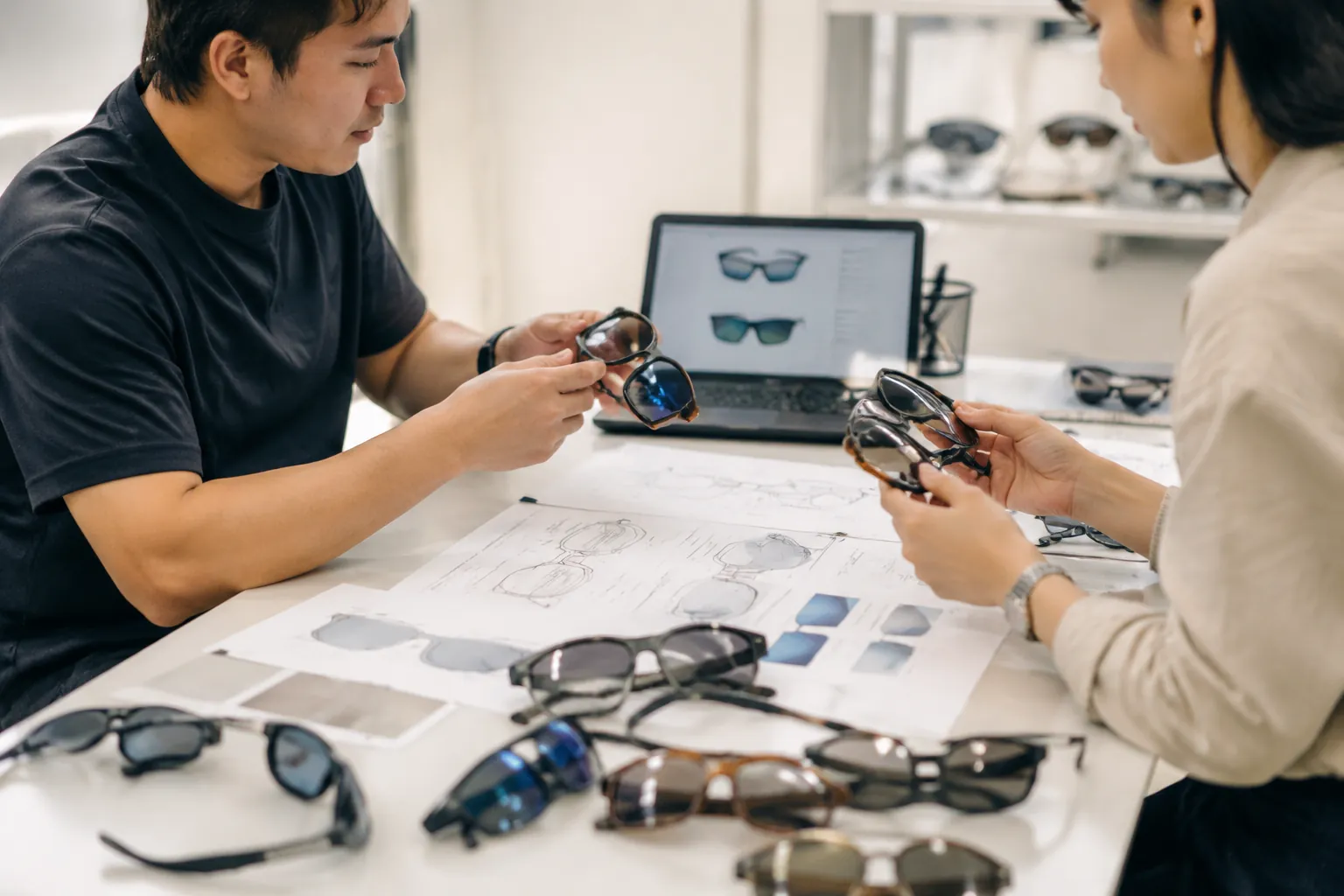
This guide is for brand owners, importers, and retail buyers choosing polarized lenses for a custom sunglass program. The lens choice affects more than the first sample. It can change breakage risk, visual complaints, remake cost, and how reliably the finished style meets market requirements. This article compares polycarbonate (PC) and TAC polarized lenses from a sourcing and quality-control standpoint, with a focus on real differences in construction, production risk, compliance, and buyer decision-making.
Start with the use case, not the lens name
Many buyers ask for polarized lenses first and sort out the material later. That creates avoidable risk. PC and TAC can both be polarized, but they differ in construction, processing, and failure patterns.
Start with four buyer-side questions:
- Who is the end user? Sport, youth, outdoor, and travel-retail customers usually put more mechanical stress on sunglasses than occasional lifestyle users.
- What retail position are you targeting? Entry-price promotional sunglasses and mid-price lifestyle sunglasses are judged by different standards for durability, appearance, and visual comfort.
- How hard will the product be used? Bag storage, beach handling, heat exposure in cars, and heavy try-on traffic can all change the safer lens choice.
- Which complaint hurts most in your channel? Breakage, cosmetic defects, and optical dissatisfaction each point to different material risks.
As a rule, PC makes more sense where impact resistance and mounting tolerance matter most, such as sport products, youth styles, and wrapped frames. TAC is often chosen when buyers want cleaner visual presentation and a more premium viewing feel, provided the frame design and assembly process suit a laminated lens.
At production level, the routes are different. PC is a thermoplastic lens material that can be molded or machined, then coated and finished. TAC polarized lenses are laminated structures built around a polarizing film, then cut and edged to fit the frame. Different build. Different control points.
- For PC: optical consistency, coating performance, surface quality, and dimensional stability.
- For TAC: lamination quality, film alignment, edge finishing, and stress during frame insertion.
This matters because some returns that look like frame problems actually start with the lens build or lens-to-frame fit. A style can pass sample review and still fail later if the lens is under mounting stress or if the laminated structure is weak.
What PC and TAC are, and where production risk shows up
Polycarbonate (PC) is a single-piece thermoplastic lens material known for high impact resistance and low weight. In sunglasses, it is common in sport, youth, and value-to-mid-price programs. Its strength is toughness. Its weak point is usually optical, not mechanical. Visual sharpness, surface quality, and coating performance can vary a lot by resin grade and process control.
TAC, commonly used in the eyewear trade to describe a triacetate cellulose-based polarized laminated lens, is a layered construction rather than one solid substrate. The exact layer structure varies by supplier, but it usually includes protective outer layers and a polarizing film in the center. Good TAC lenses are often chosen for clean visual presentation and competitive cost in polarized programs. Poor TAC lenses tend to fail at the lamination or edge level: distortion, edge whitening, or separation risk under heat or mounting stress.
| Factor | PC Polarized | TAC Polarized | Buyer Impact |
|---|---|---|---|
| Optical clarity | Can range from acceptable to very good depending on resin grade, tooling, and coating quality | Often perceived as cleaner in everyday sunglass use when lamination is well controlled | Judge by approved samples and test data, not material name alone |
| Impact resistance | High | Lower than PC in typical sunglass use | PC is often preferred for rough handling, sport, and youth-oriented programs |
| Curve and wrap tolerance | Generally more tolerant in higher-wrap or sport shapes | More sensitive to edge stress if fit or curve is not well controlled | Wrapped fronts require closer lens-to-frame engineering with TAC |
| Common defect mode | Surface marks, coating inconsistency, or weaker optical performance in lower-grade builds | Lamination-related distortion, edge stress marks, or delamination risk | QC checkpoints should be material-specific |
| Unit cost at volume | Often competitive, but depends on coating, polarization method, and geometry | Also cost-sensitive to lamination quality, finishing, and yield | Request quotes on the exact finished style before assuming one is cheaper |
| Heat sensitivity in use | Performance depends on material quality and process control | Laminated construction can be more vulnerable if bonding quality is weak | Heat exposure risk should be reviewed during style validation |
So the key sourcing question is not which lens is better in theory. It is which lens fits the channel, frame geometry, and quality target with the lowest total commercial risk.
Cost logic: compare landed risk, not the lens upcharge
On a quotation sheet, the difference between PC polarized and TAC polarized lenses may look small against the total sunglass cost. That tempts buyers to treat the lens choice as a minor line item. It is not minor if one option is wrong for the style or the end user.
The real comparison is not just lens material cost. It is expected total cost after you factor in:
- Replacement exposure: how often the likely failure mode leads to a claim or remake
- Inspection burden: how much incoming and pre-shipment checking is needed to control cosmetic and optical consistency
- Channel sensitivity: whether your buyers or end users are more likely to complain about breakage, scratches, distortion, or finish defects
- Reputation cost: whether visible defects or weak durability are likely to trigger poor reviews or retailer pushback
That is why one buyer chooses PC for a lower-risk sport program while another chooses TAC for a driving or lifestyle collection. The decision depends on what type of failure is most likely, how visible that failure is, and how expensive it is to fix after goods are in market.
A practical rule: ask the factory to quote the exact same style with both lens options when the design allows it. Then compare more than the FOB difference. Check:
- sample appearance under normal wear conditions
- fit performance in the actual frame
- coating and surface consistency
- test status for the target market
- expected inspection and return risk by channel
That is a better buying method than choosing by habit or by the assumption that one material is always more premium or always cheaper.
Failure modes that drive returns, and the controls that cut them
Most polarized-lens complaints fall into a few repeat categories. Buyers should review them before approving bulk production.
- Delamination or layer separation: a TAC-specific concern if lamination quality is weak or if the lens sees too much stress or heat.
- Edge stress whitening, cracking, or chipping: often tied to lens edging tolerance, frame groove design, or too much insertion force.
- Optical distortion: can come from uneven TAC lamination, poor curvature control, or low-grade processing in either material.
- Scratch complaints: both PC and TAC need effective hard-coat performance and careful handling during packing and shipment.
- Coating defects: mirror, flash, and hard-coat defects can trigger immediate cosmetic rejection even when the lens otherwise performs acceptably.
These problems usually start at one or more of five production points: raw-material quality, polarization alignment, lens edging tolerance, frame insertion stress, or packaging protection.
Practical controls should include:
- Lens cutting tolerance: confirm that lens size and frame groove dimensions match so the lens seats securely without excessive force.
- Polarizing direction check: verify left-right alignment before or during assembly so visual performance stays consistent.
- Frame groove review: pay extra attention to wrapped or high-base styles, where laminated TAC edges may be less forgiving.
- Hard-coat inspection: inspect under suitable lighting for surface defects, uneven coating, and visible cosmetic flaws.
- Packing control: prevent lens-to-lens and pair-to-pair rubbing during transit through sleeves, pouches, or other protective separation.
Buyers should also define cosmetic acceptance criteria in writing before production starts. Be specific. If scratches, edge marks, coating specks, or minor wave are not covered in the approved standard, disputes usually show up later because the factory and buyer are using different thresholds.
If you sell online or supply detail-sensitive retail accounts, cosmetic consistency matters almost as much as technical performance. A lens can pass testing and still fail commercially if the customer sees a visible flaw the moment the package is opened.
Compliance and testing: validate the finished style, not just the lens
"Polarized" describes a lens function. It is not a compliance claim. Buyers should confirm which requirements apply to the destination market and intended use of the finished sunglasses.
Common references in international sunglass sourcing include CE EN ISO 12312-1, ANSI Z80.3, and AS/NZS 1067. Chemical compliance may also require REACH controls for relevant materials and finishes. At supplier level, buyers may also review process and social-compliance credentials such as ISO 9001 and BSCI, while FDA registration can be a relevant supplier-side item in some US market discussions.
The practical point is simple: test and validate the actual finished sunglass style, not only the named lens material. Lens color, visible light transmission, coatings, frame wrap, and final assembly can all affect whether the finished product meets the intended market standard.
Buyers should ask for confirmation of:
- Applicable market standard by destination
- Finished-style test alignment, not just a material-level statement
- Target visible light transmission by lens color and filter category where relevant
- Chemical conformity for coatings, inks, and decorative components where required
This matters even more if you change lens type during development. A style first developed in PC should not be assumed compliant in TAC, or the reverse, without confirming the final build.
Lead time, sampling, and where projects slip
Lens selection can affect development timing more than buyers expect, especially if the project also includes color matching, custom decoration, or a frame shape that has not been fully validated.
Most delays are not caused by the lens material itself. They come from approval-sequence mistakes, such as:
- changing from PC to TAC after the first sample because the visual effect was not defined early enough
- approving the frame shape before verifying real lens fit and mounting stress
- requesting polarization before locking lens color and transmission target
- adding decoration late, which can change handling, packing, or final inspection needs
- changing packaging after lens protection requirements have already been planned
A disciplined development path is:
- Confirm frame structure and curve
- Confirm PC or TAC lens construction
- Confirm lens color, polarization, and finish
- Approve decoration placement and method
- Approve packaging and lens protection method
- Release bulk after final signoff
This sequence helps prevent a common sourcing mistake: approving a good-looking sample before the lens/frame combination has been checked for durability, appearance consistency, and market suitability.
A practical decision framework by channel, price target, and frame type
Use this as a working shortcut when comparing polarized options for a custom program.
| Buyer scenario | Recommended lens | Why | Watch-outs |
|---|---|---|---|
| Sports, beach kiosks, youth, travel retail, promo-heavy programs | PC polarized | Higher impact resistance and generally better tolerance for rough handling | Specify coating quality and packing protection to reduce scratch and cosmetic complaints |
| Fashion boutiques, resort, driving, lifestyle collections | TAC polarized | Often chosen for cleaner perceived visual quality and a more premium everyday feel | Control lamination quality, edge finish, and frame insertion stress |
| Aggressive wrap frames or high-base sport shapes | PC polarized | Usually more forgiving in higher-curve applications | Check optical consistency across the curve and verify coating performance |
| Mid-price online DTC where reviews matter | Depends on customer promise | TAC may support a visual-quality message; PC may support a durability-first message | Choose based on expected complaint pattern, not only on sample appearance |
If the product will be handled hard or mounted in a demanding wrapped shape, PC is often the lower-risk option. If the brand promise centers on visual comfort and better everyday wear, TAC may be the better fit, provided the style is engineered and validated for it.
What buyers should put on the RFQ before asking for a final quote
A vague RFQ leads to weak sample alignment and avoidable rework. Send a lens-specific brief before requesting final pricing.
- State the lens construction clearly: PC polarized or TAC polarized.
- State the destination market: for example EU, US, or Australia/New Zealand.
- Define color and finish: such as smoke, brown, green, gradient, mirror, flash, or no mirror.
- Confirm frame type and base curve: especially important for wrapped fronts and sport shapes.
- Set cosmetic acceptance points: scratches, edge marks, coating defects, and visible distortion tolerance.
- Request compliance confirmation: based on the actual finished style for the target market.
- State quantity by colorway: because yield, handling, and finishing cost can vary with order structure.
- Include decoration method early: such as pad printing, laser engraving, or metal logo components if used.
Also ask how the lenses will be protected during packing and shipment. A technically acceptable lens can still create claims if it arrives with visible rubbing or surface damage. If the project is margin-sensitive, ask the supplier to quote both the preferred lens and a realistic alternative so you can compare performance risk against cost before approving production.
Blunt advice: do not choose between PC and TAC on sample appearance alone. Choose based on the end user, frame geometry, complaint risk, compliance target, and the cost of fixing failures after delivery.
Have a custom sunglasses project in mind?
Send us your styles, target market and quantities and we will return a detailed quote with MOQ, lead time and a sample plan.
Get a QuoteWhy source this from Wenzhou with LumiShades
Wenzhou in Zhejiang Province is widely regarded as China’s eyewear manufacturing capital, producing a large share of the world’s sunglasses. That concentration matters to buyers: a deep local supply chain for acetate sheet, hinges, lens blanks, plating and packaging means shorter component lead times, easier color and material matching, and a workforce with decades of eyewear-specific skill. LumiShades has manufactured in this ecosystem since 2009, and our vertical integration — in-house injection molding, acetate cutting, CNC milling, lens tinting, decoration and quality control — means no part of your order is quietly subcontracted to a workshop you cannot audit.
For international buyers, that vertical control translates into accountability. When a single factory owns every step, defects are traced and fixed at source rather than bounced between vendors, and your specifications survive intact from first sample to bulk. We back this with 15+ years of experience, shipments to 60+ countries, more than 5 million pairs produced per year and a 98.5% on-time delivery rate. Our certifications — CE EN ISO 12312-1, FDA registration, ANSI Z80.3, AS/NZS 1067, REACH, ISO 9001 and BSCI audit — mean the compliance documentation your market requires already exists. Explore our manufacturing capabilities and quality control process to see how this works in practice.
Frequently asked questions
Is TAC always better than PC for polarized sunglasses? No. TAC is not automatically better, and PC is not automatically lower grade. TAC is often selected for its clean perceived visual presentation in everyday lifestyle sunglasses, while PC is widely chosen for higher impact resistance and better tolerance in demanding shapes. Ask the supplier for both options in the actual frame, then compare optical appearance, fit stress, coating quality, and test status before deciding.
Which lens type is safer for wrapped sport frames? PC is usually the safer starting point for wrapped or high-base sport frames because it generally tolerates shaping and mounting stress better than a laminated TAC lens. If you want to use TAC in a wrapped frame, require sample validation of edge fit, insertion stress, and optical consistency in the exact finished style before approving bulk production.
Can both PC and TAC polarized lenses meet CE EN ISO 12312-1 or ANSI Z80.3? Yes, both can be used in finished sunglasses intended to meet standards such as `CE EN ISO 12312-1` or `ANSI Z80.3`, provided the full product is designed and manufactured correctly. Do not accept a generic claim based only on lens material. Ask for confirmation tied to the final style, including lens color, transmission, coatings, frame shape, and assembly.
At what order volume does lens choice matter most on cost? It matters at every volume because the wrong material choice can create defects, rework, or returns regardless of order size. On smaller orders, the impact is often felt through sample revision and unit-cost sensitivity. On larger orders, the bigger risk is scale: a small process problem can affect a large quantity. For that reason, compare lens options by total commercial risk, not only by unit price.
How can I reduce return risk on polarized programs? Approve against a written specification, not only a photo or one sample. Define the lens material, color, finish, frame curve, cosmetic acceptance standard, packing method, decoration method, and target-market compliance requirements before bulk release. For TAC, pay particular attention to lamination quality and edge fit. For PC, pay close attention to optical consistency and coating performance. In both cases, verify the finished style rather than relying on a material-level promise.
Ready to start?
Explore our round sunglasses or request a quote — our sales team replies within 12 hours.
Request a Quote