
How to Choose Sunglass VLT for Bulk Orders
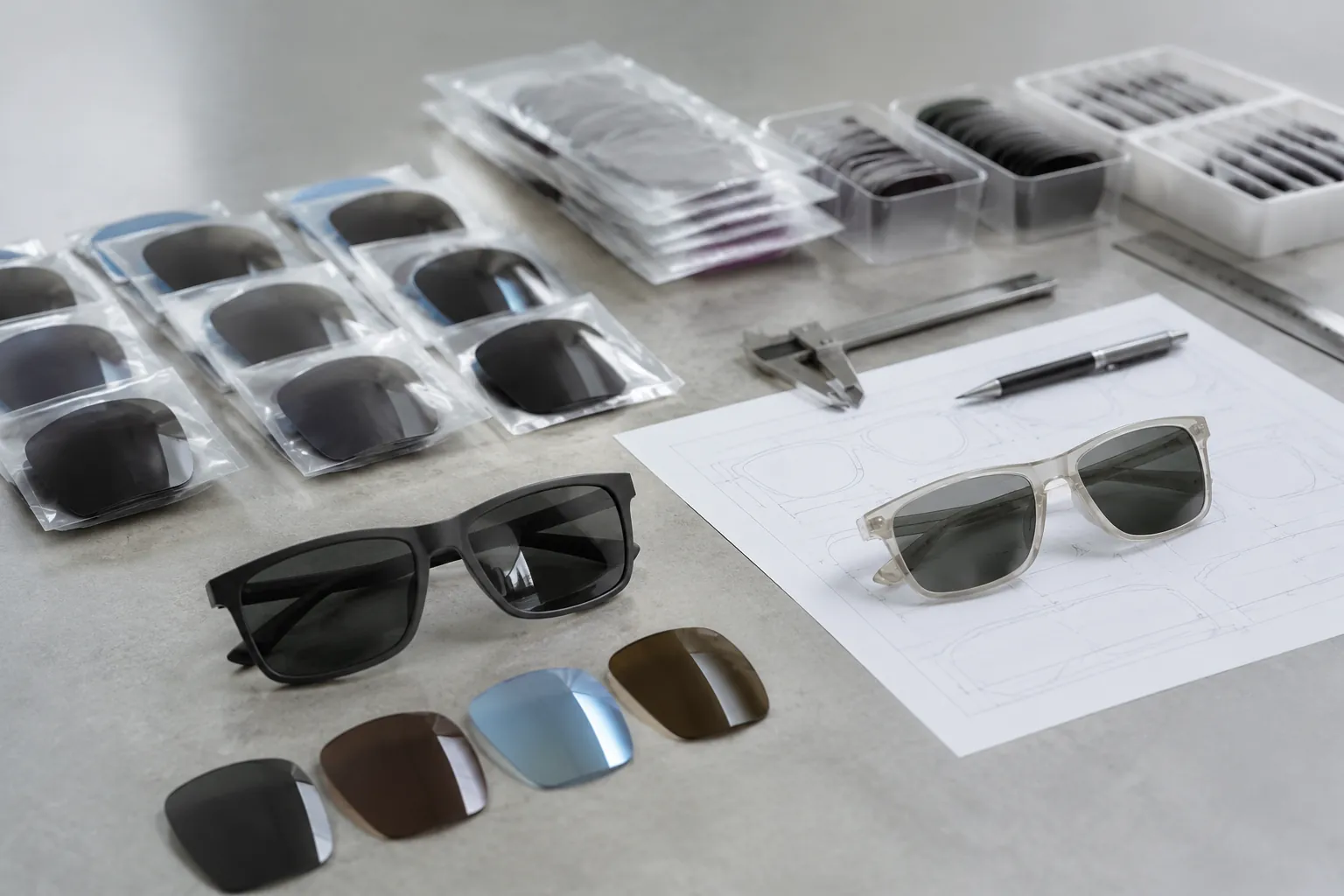
This guide is for brand owners, importers, distributors, and retail buyers sourcing sunglasses in volume. The job is not to approve a lens that looks good in a sample box. The job is to set a visible light transmission target that fits the sales channel, matches customer expectations, and can be controlled in production with a clear acceptance standard. VLT looks like a small lens detail. It is not. It affects wearer perception, product-page accuracy, quality approvals, and repeat-order consistency. If lens darkness is chosen by color name alone, problems usually show up later in sampling, inspection, and sell-through.
Start with the sales channel, not the lens color
VLT means visible light transmission: the percentage of visible light that passes through the lens. Lower VLT means a darker lens. Higher VLT means a lighter lens. For sourcing teams, that number is usually more useful than a color description. Grey, green, brown, and fashion tints can all work or fail depending on where and how the product will be sold.
Many buying discussions start with appearance: smoke, brown fade, rose, mirror blue. That is understandable. It is also the wrong first step. A lens that looks strong in a product photo may feel too light in a beach or resort channel. A lighter fashion tint may suit an urban boutique but disappoint shoppers in outdoor-heavy channels that expect immediate glare reduction on first try-on.
Start with channel conditions. Airport gift stores, surf shops, sporting goods retailers, fashion boutiques, optical chains, and online DTC brands do not need the same lens darkness. In many programs, high-sun channels lean toward lower VLT. Trend-led collections may accept lighter tints if style is the main selling point.
Before development starts, ask four practical questions:
- What light conditions will the end user expect: strong sun, city walking, driving, or mixed indoor-outdoor wear?
- Should the first try-on feel clearly protective and dark, or lighter and more style-led?
- Will the item be sold from open display, assisted retail, or online photography where lens darkness may be misread?
- What destination-market testing, labeling, and documentation will be required before shipment?
Those questions usually narrow the VLT target faster than debating tint names. In B2B eyewear, VLT is first a commercial and technical decision. Styling comes after.
The VLT bands buyers actually use
Most sunglass programs do not need dozens of lens-darkness options. A few workable bands cover most commercial needs. That is easier to sample, easier to inspect, and easier to repeat.
| VLT range | Visual effect | Best fit | Typical materials | Buyer risk |
|---|---|---|---|---|
| 8% to 12% | Very dark appearance | Strong-sun environments and outdoor-focused programs | PC, nylon, TAC polarized | May feel too dark for mixed indoor-outdoor use and can narrow broad-market appeal |
| 13% to 18% | Dark standard sunglass look | Core assortments, mass retail, broad export programs | PC, TAC polarized, nylon | Generally manageable if the target and tolerance are clearly defined |
| 19% to 30% | Medium tint | Fashion retail, mixed daily wear, seasonal programs | PC, nylon, fashion-tint constructions | Some end users may expect a darker sun-lens feel than the product delivers |
| 31% to 43% | Light fashion tint | Trend collections, style-led capsules, photo-driven programs | PC, nylon, gradient and fashion tint lenses | Higher expectation risk if marketed like a conventional dark sunglass |
For many private label programs, the mid-dark range is the most flexible starting point because it reads clearly as a sunglass across many channels. But there is no default answer. The right target depends on use case, market position, and product claims.
If the team is undecided, compare two nearby VLT points in the same color rather than two different colors at the same VLT. For example, smoke at 15% versus smoke at 25% will tell you more about functional fit than smoke versus brown at the same darkness. One variable at a time. That is how you get cleaner approvals.
For first programs, approve a target value together with an acceptance tolerance. One practical example is a 15% target with an agreed production tolerance of plus or minus 2%. For lighter fashion lenses, this matters even more. Small shifts can be visible. They can also change how the product should be described to retailers or end users.
How VLT changes sell-through by market
The same frame can behave like a different product when only the lens VLT changes. That is why VLT matters commercially. It lets a buyer adapt a proven frame shape for different markets without changing frame tooling.
In warm-weather retail and travel retail, lower VLT often matches shopper expectations better. Customers test sunglasses in bright ambient light and make a quick judgment: does this feel protective enough or not? In urban fashion channels, where wearers move in and out of buildings all day, a medium tint can be easier to wear and better aligned with the styling brief.
Online selling needs tighter control. Product photography can make a lighter lens look darker than it is, depending on lighting, retouching, background, and model styling. That creates expectation gaps. If a customer receives a fashion tint after seeing what looked like a standard dark sun lens online, return risk goes up even if the frame quality is fine. If the lens is materially lighter than a conventional dark sunglass, say so clearly on the product page and include the VLT range where appropriate.
Distributor programs need broader planning. One SKU may be resold into multiple climates and retail formats. If a distributor serves several regions from one inventory pool, a middle-ground VLT is often easier to commercialize than an extra-dark lens or a very light fashion tint. The less control the buyer has over the final selling environment, the more important it is to stay close to a broadly acceptable darkness target.
A practical rule: if the item will move through mixed wholesale channels, avoid experimental VLT unless there is a clear market reason. If the item will be sold through a tightly controlled DTC story, lighter or more specialized tint positions are easier to support.
Where orders go wrong: sample approval versus bulk reality
Most VLT disputes do not start with lab failure. They start with vague approval language. A buyer approves a showroom sample by eye, writes "dark grey lens" on the purchase order, and expects bulk production to match memory. Then production arrives visibly lighter or darker. Now both sides are arguing from impression instead of an agreed measurement standard.
Lens tinting and lens construction both affect repeatability. Polycarbonate (PC) is common in commercial programs, but base material tone, coatings, and processing conditions can influence the final result. Nylon is widely used in higher-performance or premium categories and can behave differently from PC in tinting and appearance. TAC polarized lenses add more complexity because the laminate structure and film tone contribute to the finished visual effect.
Gradient lenses need extra control because appearance changes from top to bottom. The buyer and supplier should define where measurement applies and what visual balance is acceptable across the lens. Mirrored lenses create another common misunderstanding. A flash or full mirror can make the lens look darker from the outside, but the control point is still the measured finished-lens VLT.
Frame design can also shift perceived darkness after assembly. A thick dark front, strong wrap shape, or deep brow line may make the finished product look darker than the loose lens sample. Branding details such as laser logos, foil logos, metal temple parts, pad printing, or hot stamping do not change VLT, but they can change the overall impression during approvals.
To reduce disputes, use a written lens specification. At minimum, record the target VLT, the measurement basis used by the supplier or test lab, and the acceptable production tolerance. Keep one approved counter-sample with the buyer and one with the factory. Simple. Effective.
Compliance planning by destination market
VLT is not just a styling choice. It affects compliance planning, and that planning should start before bulk production. The exact route depends on destination market, lens construction, product classification, and the claims made in labeling or sales copy.
For many export programs, buyers work with standards and requirements such as CE EN ISO 12312-1, ANSI Z80.3, and AS/NZS 1067 depending on where the goods will be sold. REACH may also apply for chemical compliance in relevant markets, and FDA registration or related importer documentation may be part of the workflow where applicable. ISO 9001 and BSCI can matter as factory-management or social-compliance credentials, but they do not replace product testing or market-specific documentation.
The key point is alignment. The claimed product type, actual lens performance, and labeling language need to match the goods being purchased. Light fashion tints need particular care. If a product is relatively light, review the testing path, sales copy, and warning or usage language early so the item is not described in a way that overstates its use case.
At purchase-order stage, a good factory brief should specify:
- Destination market or markets
- Lens construction such as PC, nylon, TAC polarized, mirrored, or gradient
- Target VLT and tolerance
- Required test report path and labeling language
- Packaging inserts, warning text, and carton-level compliance documents
Factories familiar with CE EN ISO 12312-1, ANSI Z80.3, AS/NZS 1067, REACH, FDA registration workflows, ISO 9001, and BSCI can usually respond more efficiently, but they still need complete buyer instructions. Compliance works best when requirements are fixed at quotation or sampling stage, not after appearance approval alone.
What VLT does to cost, MOQ, and lead time
VLT choice does not usually change frame tooling cost by itself, but it can affect sample rounds, QC attention, and approval delays. That is where cost and lead time start to move.
| Program choice | Sample impact | Bulk impact | Commercial note |
|---|---|---|---|
| Standard dark tint, single color, 13% to 18% VLT | Often simpler to approve | Typically lower process complexity | Common choice for repeatable volume programs |
| Medium tint, 19% to 30% VLT, exact visual target | May require additional visual comparison | Moderate attention to lot consistency | Useful for fashion-led programs if the spec is clear |
| Light fashion tint, 31% to 43% VLT | More likely to trigger approval discussion | Greater sensitivity to visible variation | Needs strong alignment between imagery, copy, and actual wear experience |
| Gradient or mirrored lens with defined VLT target | Typically more complex to approve | More inspection points and appearance checks | Best used when design value justifies the added complexity |
MOQ and pricing are supplier-specific, but the basic principle stays the same: standard constructions with clearly defined VLT targets are easier to quote, approve, and repeat than visually sensitive fashion-tint projects. Buyers should focus less on headline MOQ and more on how lens complexity may affect development time, rejection risk, and repeat-order stability.
Schedule delays are often caused less by manufacturing speed than by unresolved approval criteria. If the team keeps asking for visual adjustments under changing lighting conditions without agreeing on a measured target and tolerance, the project stalls. Buyers who approve against defined VLT criteria usually move faster than buyers approving only by memory or photo impression.
The spec sheet and workflow that prevent arguments
If the goal is repeatable production, the lens must be documented as a technical component, not a mood reference. A note such as "dark smoke lens" is not enough. It leaves too much room for interpretation during tinting, assembly, and final inspection.
A working sunglass lens spec sheet should include the following:
- Lens material and construction: PC, nylon, TAC polarized, or another agreed build.
- Target VLT as a percentage and an acceptable production tolerance, such as 15% plus or minus 2%.
- Lens color reference by retained sample or approved swatch, not by photo only.
- Surface details: solid tint, gradient, mirror, flash mirror, polarized, hard coating, or other treatment.
- Destination market and the standard path required for that item.
- Branding and decoration notes if the frame style affects perceived darkness, such as thick acetate fronts, plated metal rims, or deep wrap shapes.
- Packaging, labeling, barcode, warning text, and customer-facing product description requirements.
For first orders, use a locking workflow. If the channel is not fully defined, sample two VLT points in the same color. Approve one physical counter-sample and confirm that the factory retains the same reference. Confirm the compliance path before production starts. During pre-production, request confirmation that the lens construction and VLT target still match the approved standard. At final inspection, verify that the lot remains within the agreed lens band and that labeling and construction match the approved brief.
For repeat orders, keep the item master stable. Small untracked VLT changes from one purchase order to the next can create inconsistency in retail presentation and increase claim risk. Once the specification is fixed, reordering is usually faster and easier for both buyer and supplier.
Have a custom sunglasses project in mind?
Send us your styles, target market and quantities and we will return a detailed quote with MOQ, lead time and a sample plan.
Get a QuoteWhy source this from Wenzhou with LumiShades
Wenzhou in Zhejiang Province is widely regarded as China’s eyewear manufacturing capital, producing a large share of the world’s sunglasses. That concentration matters to buyers: a deep local supply chain for acetate sheet, hinges, lens blanks, plating and packaging means shorter component lead times, easier color and material matching, and a workforce with decades of eyewear-specific skill. LumiShades has manufactured in this ecosystem since 2009, and our vertical integration — in-house injection molding, acetate cutting, CNC milling, lens tinting, decoration and quality control — means no part of your order is quietly subcontracted to a workshop you cannot audit.
For international buyers, that vertical control translates into accountability. When a single factory owns every step, defects are traced and fixed at source rather than bounced between vendors, and your specifications survive intact from first sample to bulk. We back this with 15+ years of experience, shipments to 60+ countries, more than 5 million pairs produced per year and a 98.5% on-time delivery rate. Our certifications — CE EN ISO 12312-1, FDA registration, ANSI Z80.3, AS/NZS 1067, REACH, ISO 9001 and BSCI audit — mean the compliance documentation your market requires already exists. Explore our manufacturing capabilities and quality control process to see how this works in practice.
Frequently asked questions
What VLT range is safest for a general retail sunglass program? A mid-dark commercial range is usually the safest starting point for broad retail because it tends to match customer expectations for a standard sunglass without becoming too specialized. The practical step is to define one target VLT, add an acceptance tolerance in writing, and confirm that the target fits the intended sales channel before sampling begins.
Can two lenses with the same color look different in use? Yes. Color name alone does not control wearer experience. Two smoke lenses can feel very different if their VLT differs. For buying decisions, ask the supplier for the measured VLT of each sample, compare samples under similar lighting, and retain one approved counter-sample so bulk can be checked against the same reference.
Does a mirrored coating make the lens darker for the wearer? Not automatically. Mirror coatings mainly change the outward appearance of the lens. The correct control point is the measured VLT of the finished lens, not how dark the front of the lens looks in photos or on display. If mirror matters to the design, request both a visual approval sample and the finished-lens VLT result.
Should I use light fashion tints for online sales? You can, but only if the product page describes them accurately. Use clear wording such as light fashion tint or lighter-than-standard sunglass lens, include the VLT range where appropriate, and make sure the photography does not imply a darker lens than the customer will receive. This is important for reducing expectation-based returns.
At what stage should compliance documents be discussed with the factory? At quotation or sampling stage. Give the factory the destination market, lens construction, target VLT, and intended product description before you approve appearance alone. That allows the correct test path, labeling plan, and documentation set to be defined early, which reduces the risk of relabeling, shipment delay, or failed retailer review later.
Ready to start?
Explore our shield & oversized sunglasses or request a quote — our sales team replies within 12 hours.
Request a Quote