
Polarized Lens Approval: Questions Before Bulk Orders
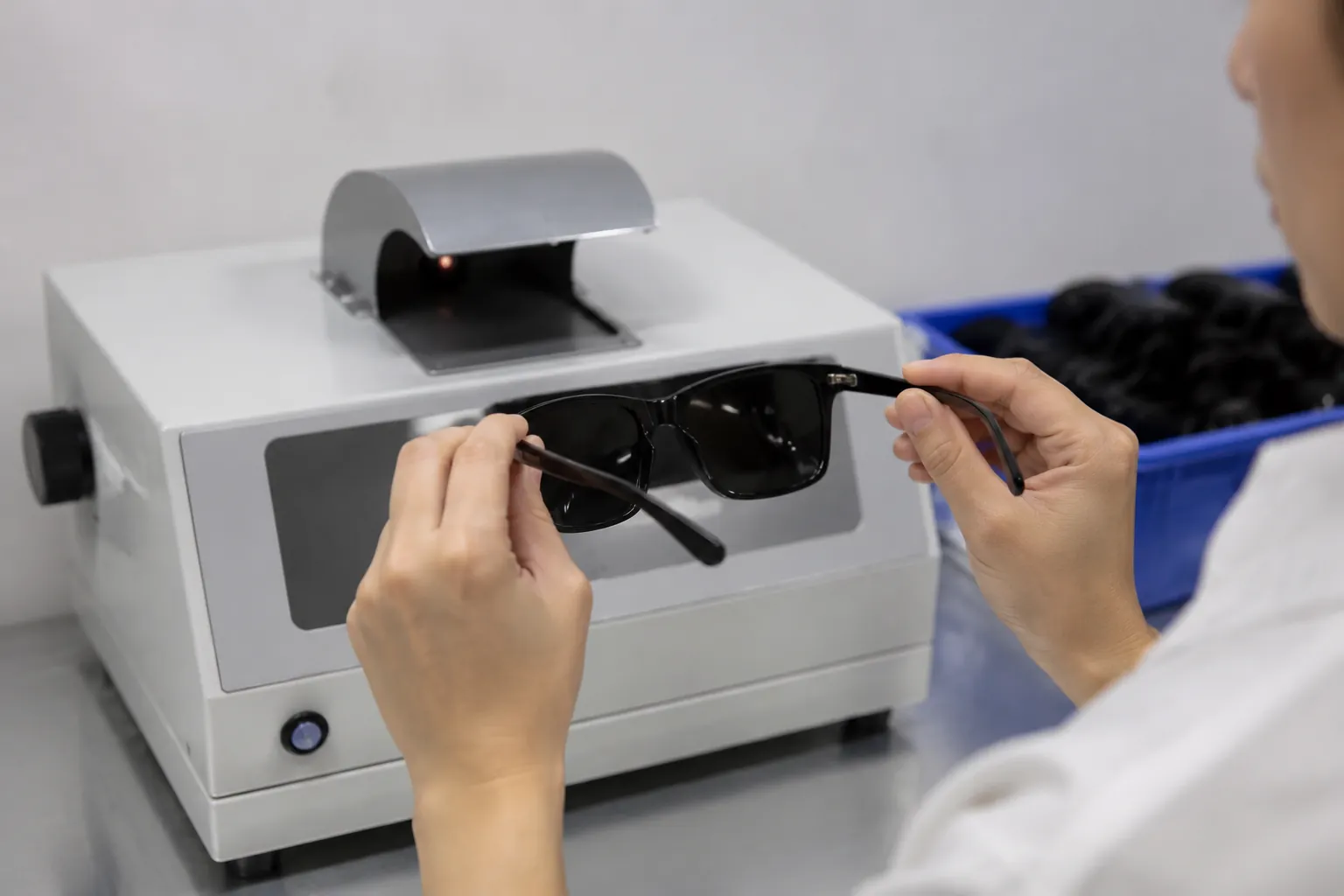
This guide is for brands, importers, distributors, and retailers approving polarized sunglasses before bulk production. The aim is practical: fewer rejected shipments, fewer customer complaints, and a tighter technical specification before ordering 300, 1000, or 5000+ pairs. A polarized sample is not approved just because it looks dark. Approval should cover glare reduction, film axis alignment, optical distortion, lens material, frame fit, decoration durability, market documents, MOQ logic, and lead time risk. If the sales channel cannot explain why polarization matters to the end user, the buyer may be paying for a feature that does not help sell the product.
Start With The Buyer Decision, Not The Lens Label
Polarized lenses reduce glare from horizontal reflective surfaces: water, wet roads, snow, car hoods, and polished stone. That matters for fishing, boating, driving, marina retail, travel, outdoor sports, and some premium lifestyle programs. It matters much less for low-price festival frames, novelty giveaways, costume sunglasses, or fashion programs where the customer mainly wants shape, color, logo placement, and packaging.
Define the commercial reason first. Will the product page say "polarized"? Will the hangtag explain glare reduction? Will the distributor sell into fishing shops, optical stores, gas stations, beach retail, or promotional channels? Each channel has a different tolerance for cost, lens darkness, distortion, documentation, and packaging quality.
Weak polarization can pass a casual desk check. So can poor axis alignment. The failure usually does not appear as one dramatic complaint. It shows up as returns, uncomfortable-wear reviews, or disputes about whether bulk production matched the approved sample.
Polarized projects need tighter inspection than basic tinted lens programs because the function depends on film quality, axis direction, tint category, lens processing, and final assembly. MOQ may begin with a small validation run, but price and production stability usually improve at higher quantities such as 300, 1000, and 5000+ pairs. Do not approve polarization as a loose feature. Put it into the specification sheet with measurable checks and named documents.
The Seven Approval Questions That Prevent Most Failures
- What polarization performance is required? Ask how the factory checks the lens. A simple test card can confirm that a lens is polarized, but it does not prove consistency, optical quality, or market compliance.
- What visible light transmission category is being supplied? Many general-purpose outdoor sunglasses are category 3 under common sunglass standards, but the correct category depends on use and destination market. Driving products must not be too dark for the claimed use.
- How is film axis alignment controlled? Both lenses should darken and lighten at the same rotation angle when checked against a polarized reference. Agree on the method and tolerance before bulk production.
- What distortion limit is acceptable? Lens curvature, film lamination, injection temperature, edging pressure, and frame groove pressure can introduce waves. High-wrap frames and shields need stricter checks than flat fashion frames.
- Which lens material is being used? TAC, PC, nylon, and CR-39 behave differently under impact, heat, tinting, coating, edging, and assembly pressure.
- Which decoration process is approved? Laser engraving, pad printing, hot stamping, metal logo plates, and temple inlays have different durability, cost, tooling, and lead-time effects.
- Which compliance path applies? Ask whether the shipment needs CE EN ISO 12312-1, ANSI Z80.3, AS/NZS 1067, REACH documentation, FDA registration support, ISO 9001 factory documentation, BSCI audit documentation, or a combination based on the destination market and buyer requirements.
Put these questions in the purchase order, sample approval sheet, or technical file. A message saying "make it polarized like the sample" is weak control. It leaves room for substitutions in film grade, lens thickness, coating, tint, and assembly method.
Polarization Performance And Tint Category
Polarization performance means the lens reduces glare in the polarized direction while still allowing useful visible light through. For buyers, the key approval points are repeatable performance, correct tint category, left-right consistency, and channel fit. A fishing lens with weak glare reduction has failed. A fashion lens that is too dark may cause complaints indoors, on shaded streets, or during late-afternoon use.
Ask the manufacturer to check samples with a polarized test card, LCD screen method, transmission meter, or third-party laboratory test where required. A quick screen check can catch obvious errors. It does not replace the documents required for the target market. CE EN ISO 12312-1, ANSI Z80.3, and AS/NZS 1067 apply in different regulatory or commercial contexts. One report or mark is not automatic clearance for every country.
| Buyer use case | Typical lens target | Approval detail to confirm | Risk if ignored |
|---|---|---|---|
| Fishing and boating | Strong glare reduction, usually a dark outdoor sunglass category | Consistent polarization, stable tint, correct category information, UV protection claim support | Customer still sees water glare and rejects the product claim |
| Driving sunglasses | Appropriate VLT and low distortion for driving use | Transmission range, color recognition requirements, central optical clarity | Lens feels too dark, affects signal recognition, or causes visual fatigue |
| Fashion retail | Consistent color and cosmetic finish | Tint match, mirror coating, logo position, moderate glare reduction if claimed | Buyer pays for polarization the customer does not value |
| Sports wrap frames | Controlled optics across curved zones | Base curve, edge distortion, lens retention after assembly | Peripheral waves during movement |
| Promotional sunglasses | Cost-controlled function | Confirm whether non-polarized tinted lenses are commercially better | Feature cost crowds out packaging, logo quality, or fit |
Be direct about value. If the buyer will not advertise polarization and the end user will not pay more for glare reduction, use a good non-polarized tinted lens. Spend the budget on fit, hinges, logo quality, pouch, case, or retail packaging.
Film Axis Alignment: Small Rotation, Big Problem
A polarized lens works because the film has an axis. If that axis rotates during cutting, molding, lamination, edging, or assembly, glare reduction can drop. If the right and left lenses do not match, the wearer may notice uneven darkening, strange screen visibility, or visual discomfort.
Flat and low-base lenses are easier to control. High-base wrap frames and one-piece shields are harder. Heat, pressure, edging, and assembly stress can all affect the film or lens. A tight groove, screw tension, or poor fixture can turn an acceptable loose lens into an unacceptable finished pair.
Set a batch routine. Rotate the finished frame in front of a polarized test card or LCD screen and confirm that both lenses darken and lighten at the same angle. For stricter programs, define an axis tolerance with the supplier using a method the factory can repeat. The tolerance should match the frame design, lens material, and product positioning.
If one supplier controls lens tinting, cutting, frame production, assembly, and finished-frame inspection, ask how each stage prevents axis error and distortion. Fewer handoffs can reduce risk. Only documented checks make that useful.
Approval note: keep one signed golden sample and, where practical, one approved loose lens standard at the factory. Finished frames alone are not enough because frame color, mirror coating, and office lighting can hide alignment problems.
Distortion Checks: Do Not Approve A Photo
Polarized samples often look fine in a product photo. That proves very little. Distortion appears when the wearer moves, looks through the lens edge, or views straight lines through the lens. High-wrap frames, oversized fashion shapes, shield lenses, and strong base curves need extra attention.
Ask for a grid test or line distortion check before approving bulk. Place the lens or finished frame in front of a printed grid and move it slowly. Straight lines should not bend sharply, ripple, or jump between lens zones. Inspect after assembly, not only as a loose lens. Rim pressure can create stress. Screws can pull the lens. A poorly cut groove in an injected frame can deform the lens edge.
Set the acceptance level by channel. For low-price fashion sunglasses, minor edge distortion outside the central viewing area may be acceptable if the lens looks clean and the wearer is not using it for performance. For driving, sports, fishing, and optical-store programs, be stricter on central clarity, left-right consistency, and edge wave. Optical-store distributors may ask tougher questions because staff can check lenses against a grid or lensmeter.
Confirm sample lead time before the order. It depends on available frame molds, lens material, color, coating, decoration, and packaging. Tie bulk production time to clear approvals: signed sample, confirmed materials, approved packaging files, required documents, and deposit. Finding distortion during sample review is cheap. Sorting cartons after shipment is not.
Lens Material Compatibility: TAC, PC, Nylon, And CR-39
The polarizing film does not work by itself. It must suit the lens material, frame design, tint, coating, market, and price point. The lowest-cost option may work for a promotional program. It may be wrong for a sport frame, hot-climate retail program, or product making impact-resistance claims.
| Material | Common buyer reason | Process behavior | Watch point |
|---|---|---|---|
| TAC polarized | Cost-effective polarized sunglasses and broad retail use | Lightweight and common for laminated polarized lenses | Can be sensitive to edge stress, moisture exposure, and poor lamination control |
| PC polarized | Sports positioning and impact-resistance claims | Tough material but more prone to optical stress if processed poorly | Confirm distortion control, coating adhesion, and the exact standard behind any impact claim |
| Nylon polarized | Wrap frames, lighter performance designs, premium outdoor use | Flexible and suitable for certain curved lens applications when correctly processed | Higher cost; confirm color, mirror coating, and coating limits early |
| CR-39 polarized | Optical clarity for certain fashion or optical-style frames | Good optical clarity and tintability | Heavier and less impact resistant than PC; not suitable for every sports claim |
Frame material matters too. An injected PC or TR-style sport frame may put more pressure on the lens edge than an acetate frame with a well-cut groove. Metal frames need screw tension control. Rimless and semi-rimless constructions need early checks for hole position, notch shape, and crack resistance.
Ask for lens material, thickness, base curve, tint category, coating stack, mirror color, polarization requirement, UV protection claim, and compliance target in one specification sheet. Lens thickness should come from the actual frame design, lens curve, material, and safety requirement. If any item is missing, the approval is incomplete.
Decoration, MOQ, Price, And Lead Time
Polarized lenses add cost through film material, lens sourcing control, alignment checks, higher inspection needs, and possible yield loss. The price gap is not only the film. It is the control around the film.
Decoration also affects the quote and schedule. Laser engraving on the lens or temple is clean and durable but needs position approval. Pad printing is flexible for logos and colors but requires ink adhesion checks, especially on coated temples. Hot stamping depends on foil adhesion and surface compatibility. Metal logo plates add perceived value but require tooling, placement tolerance, and extra assembly. Mirror lenses can make a product look more premium, but coating color variation must be controlled between sample and bulk.
- Small validation run: useful for market testing, distributor samples, fit checks, color review, logo placement, and lens choice. Unit price is higher because setup time and inspection time are spread over fewer pairs.
- 300 pairs: practical entry point for small retail runs or distributor pilots. Material purchasing and production planning may become more stable at this level, depending on the frame and lens.
- 1000 pairs: better for packaging setup, carton planning, color control, and freight efficiency. This is often where buyers should lock stricter inspection rules.
- 5000+ pairs: strongest pricing potential, but only after lens tests, signed samples, decoration proofs, packaging files, and required documents are approved. Price still depends on frame construction, lens material, coating, decoration, packaging, inspection level, and freight terms.
Quote the timeline against the real specification. Add time for new mold work, custom metal parts, special packaging, third-party testing, tint corrections, or document review. Do not chase the lowest polarized price before confirming the channel and technical requirements. A small unit saving means nothing if the lens has distortion, weak glare reduction, poor logo durability, or a compliance gap in the destination market.
Bulk Approval Checklist For Buyers
Before paying the bulk deposit, treat approval as a production gate. Keep it specific and written. The factory should know exactly what is copied from the sample and what is controlled by measurement, document, or inspection.
- Confirm frame code, color, material, hinge type, temple length, bridge, lens width, lens height, and lens base curve.
- Confirm lens material, polarization, tint color, visible light transmission category, thickness, coating, mirror finish, and UV protection claim.
- Check polarization alignment on both lenses using a reference card, LCD method, or agreed measuring device.
- Check distortion with a grid, including central and edge zones after assembly.
- Confirm logo process: laser engraving, pad printing, hot stamping, metal logo plate, temple inlay, or lens mark, including position tolerance and color.
- Confirm decoration durability checks, such as tape test, rub test, or alcohol resistance where relevant to the finish.
- Confirm market documents: CE EN ISO 12312-1 for relevant EU programs, ANSI Z80.3 for US sunglass performance, AS/NZS 1067 for Australia and New Zealand, REACH for chemical restrictions, FDA registration where applicable, and ISO 9001 or BSCI documentation if required by the buyer.
- Approve packaging, barcode position, warning text, cleaning cloth, pouch, case, polybag, inner box, master carton, carton count, and carton markings.
- Keep signed golden samples and define AQL or inspection rules before production starts.
Final inspection should include cosmetic defects, hinge movement, temple alignment, lens fit, screw tightness, logo placement, packaging, carton count, and a sampling check for polarization. For higher-risk orders, use pre-production sample approval, in-line inspection, and final random inspection. Do not leave lens function to the last few minutes before loading.
Have a custom sunglasses project in mind?
Send us your styles, target market and quantities and we will return a detailed quote with MOQ, lead time and a sample plan.
Get a QuoteWhy source this from Wenzhou with LumiShades
Wenzhou in Zhejiang Province is widely regarded as China’s eyewear manufacturing capital, producing a large share of the world’s sunglasses. That concentration matters to buyers: a deep local supply chain for acetate sheet, hinges, lens blanks, plating and packaging means shorter component lead times, easier color and material matching, and a workforce with decades of eyewear-specific skill. LumiShades has manufactured in this ecosystem since 2009, and our vertical integration — in-house injection molding, acetate cutting, CNC milling, lens tinting, decoration and quality control — means no part of your order is quietly subcontracted to a workshop you cannot audit.
For international buyers, that vertical control translates into accountability. When a single factory owns every step, defects are traced and fixed at source rather than bounced between vendors, and your specifications survive intact from first sample to bulk. We back this with 15+ years of experience, shipments to 60+ countries, more than 5 million pairs produced per year and a 98.5% on-time delivery rate. Our certifications — CE EN ISO 12312-1, FDA registration, ANSI Z80.3, AS/NZS 1067, REACH, ISO 9001 and BSCI audit — mean the compliance documentation your market requires already exists. Explore our manufacturing capabilities and quality control process to see how this works in practice.
Frequently asked questions
Is a polarized test card enough to approve bulk production? No. A polarized test card is useful for quick screening because it can show whether the lens has a polarizing effect. It is not enough for bulk approval. Buyers should also confirm left-right axis alignment, visible light transmission category, distortion after assembly, lens material, coating, UV protection claim, decoration durability, packaging, and the documents required for the destination market, such as CE EN ISO 12312-1, ANSI Z80.3, AS/NZS 1067, REACH, or FDA registration where applicable.
Can polarized lenses be used in every sunglasses frame shape? Polarized lenses can be used in many frame shapes, but the risk level changes by design. Flat and low-base frames are usually easier to control. High-wrap frames, shield lenses, rimless designs, semi-rimless designs, and tight injected frames need more checking because curvature, edging, drilling, screw tension, and groove pressure can create distortion or uneven polarization. Approve the actual finished frame and lens together, not only a loose lens.
What is the minimum order for custom polarized sunglasses? MOQ depends on the frame mold, lens material, color, coating, decoration, packaging, and whether the supplier already has suitable components available. A small validation run can be useful for checking fit, tint, logo placement, and polarization before a larger order. For commercial pricing, ask for quote breaks at realistic quantities such as 300, 1000, and 5000+ pairs, using the same specification at each quantity.
How long should polarized sunglasses samples take? Sample timing depends on whether the frame, lens material, tint, mirror coating, logo method, and packaging are already confirmed. Stock-based or standard custom samples are faster than new mold work, special lens colors, custom metal logos, or third-party testing. Ask the supplier to quote sample time and bulk production time separately. The bulk timeline should start only after signed sample approval, material confirmation, packaging approval, required document confirmation, and deposit.
Which certifications or documents should I ask for when importing polarized sunglasses? Ask based on destination market and product claim. Common documents include CE EN ISO 12312-1 for relevant EU sunglass programs, ANSI Z80.3 for US sunglass performance, AS/NZS 1067 for Australia and New Zealand, REACH for chemical restrictions, and FDA registration where applicable. ISO 9001 and BSCI relate to factory management or social compliance, not lens performance. Do not ask for documents that are not tied to your market, buyer requirement, or product claim.
Should every retail sunglasses program use polarized lenses? No. Use polarization when the channel can sell glare reduction, such as fishing, boating, driving, travel, marina retail, outdoor sports, or premium lifestyle retail. For low-price fashion, event, costume, or novelty products, a good non-polarized tinted lens may be the better commercial choice. Compare the added lens cost against what the customer will actually notice: fit, hinge feel, logo quality, packaging, color consistency, and comfort.
Ready to start?
Explore our shield & oversized sunglasses or request a quote — our sales team replies within 12 hours.
Request a Quote