
UV400 Sunglasses Lenses: Buyer QC Checklist
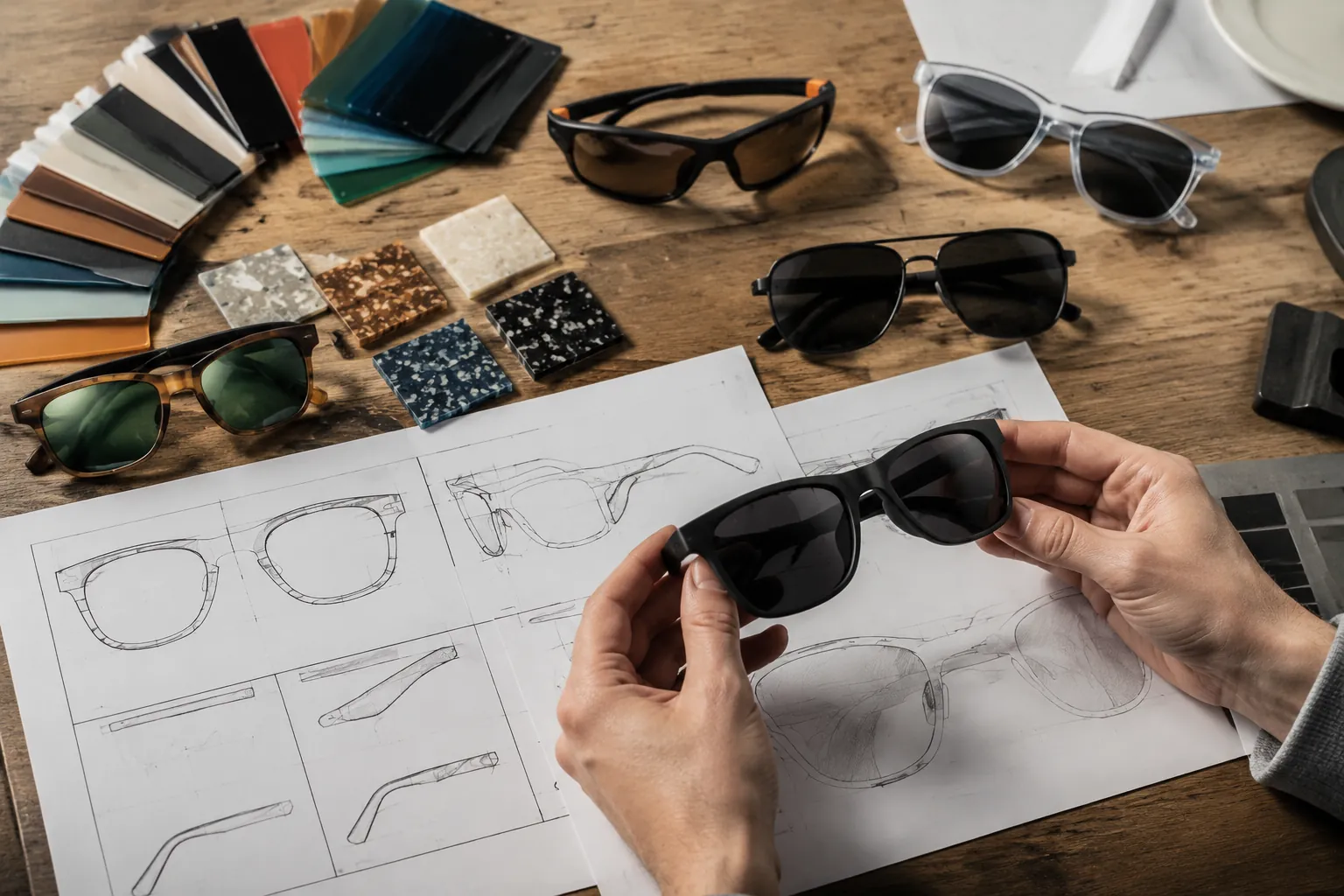
A UV400 mark on a lens, pouch, or hangtag is not proof. Importers, private-label brands, distributors, and retail sourcing teams need evidence for the finished sunglasses: lens material, tint, coating, visible light transmission category, labeling, and the destination-market standard. This checklist shows how to verify UV400 sunglasses lenses before shipment, read supplier documents, spot production risks, and set incoming inspection rules for custom sunglasses.
Define The UV400 Claim Before Sample Approval
UV400 usually means the lens blocks ultraviolet radiation up to 400 nm. In a buyer file, that claim must be tied to measurable UV transmittance results under the applicable sunglass standard. Treat it as a compliance claim, not artwork.
Keep three issues separate: UV protection, visible light transmission, and glare reduction. UV protection concerns ultraviolet wavelengths. Visible light transmission, usually shown as VLT, determines how dark the lens appears and which lens category applies. Polarization reduces reflected glare. It does not prove UV blocking. A polarized TAC lens still needs UV evidence. A non-polarized PC, nylon, CR-39, or other sunglass lens can provide UV protection if the material, tint, and coating system are designed and verified for it.
Write the requirement in measurable terms. A stronger purchase order states the destination market, applicable standard, finished lens material, lens color, coating, polarization if any, target lens category, label requirements, and required test evidence. Example: finished sunglasses lens, UV400 claim supported by the applicable sunglass standard, target Category 3 unless otherwise approved, final coated lens tested or covered by a report linked to the ordered SKU.
Buyer rule: if the supplier cannot provide UV transmittance evidence and identify the applicable standard, UV400 is still an unverified marketing claim.
Match The Product To The Right Standard
Markets use different sunglass requirements. They are not identical. Most still require controlled optical performance, correct category labeling, and traceable technical evidence. Ask the supplier which standard the product is built and labeled against. Then check that the report, product file, and packaging all point to the same market.
| Market or use | Relevant standard or requirement | Buyer verification point |
|---|---|---|
| European Union | CE EN ISO 12312-1 | Confirm UV transmittance, lens category, optical quality, traffic-signal suitability where relevant, warning statements, and required product information. |
| United States | FDA registration and ANSI Z80.3 | Understand that FDA registration is an establishment or regulatory-status matter, not a UV performance test. Request ANSI Z80.3 optical and UV data for the relevant model, lens family, or SKU. |
| Australia and New Zealand | AS/NZS 1067 | Verify lens category, UV performance, labeling, and use restrictions, including driving limitations for very dark lenses where applicable. |
| EU chemical compliance | REACH | Check relevant materials and components, including frame, lens, coatings, nose pads, temple tips, logo plates, inks, adhesives, and plating where applicable. |
| Factory management and social compliance | ISO 9001 and BSCI | Use these as factory-management or social-compliance references. They do not prove that a specific lens blocks UV. |
Use each document for its proper purpose. CE EN ISO 12312-1, ANSI Z80.3, and AS/NZS 1067 relate to sunglass performance in their markets. REACH addresses restricted substances. FDA registration does not replace lens testing. ISO 9001 and BSCI do not replace a product test report. The core evidence for a UV400 claim is still a sunglass test report or batch verification tied to the finished product being ordered.
Read The Test Report Against The PO
A test report is useful only if it matches the product being purchased. Many buyers collect PDFs but do not check whether the tested sample is the same material, tint, coating, construction, and intended market as the current order. A report for a smoke PC lens should not automatically approve a brown TAC polarized lens, a gradient pink lens, or a green mirror lens. That is a common gap.
Read the report line by line. Check the applicant, manufacturer, test lab, sample description, model or SKU reference, lens material, lens color, coating, polarization, lens category, standard version, test date, and result. For repeat orders, ask whether the lens resin, tint formula, film supplier, coating supplier, or production process has changed since the report was issued. An older report may support history. It should not automatically approve a changed construction or a different destination market.
- Model link: the report should identify the frame, lens family, or SKU clearly enough to connect it to the purchase order, inspection record, and packing list.
- Material: PC, TAC, nylon, CR-39, and other lens constructions should not be treated as interchangeable unless the report scope clearly covers them.
- Color and treatment: solid tint, gradient tint, mirror coating, AR coating, flash coating, and polarized film should be listed in the report or traceable through the factory file.
- Category: the report should show VLT or lens category, not only a general UV pass statement.
- Date and scope: request retesting or batch verification when the construction, tint recipe, component supplier, label claim, or destination market changes.
For mixed-color orders, do not accept one generic report unless the scope clearly explains which materials, colors, coatings, and constructions are covered. A practical approach is to verify each material and tint family, then add separate evidence for mirror, gradient, polarized, or unusually light lenses. Those versions can have different optical and labeling results.
Control Category, VLT, And Material Behavior
Lens category is based mainly on visible light transmission. It is not the same as UV protection. A very dark lens can still fail UV requirements if the material or coating system does not block ultraviolet radiation. This is a serious risk. Dark lenses reduce visible light, so the buyer and end user may assume UV protection is present.
Specify both the UV400 claim and the target lens category. Category 2 is commonly used for medium-tint fashion sunglasses. Category 3 is commonly used for general sunwear. Category 4 is very dark and is not suitable for driving in many markets. Clear or very light lenses can still have UV protection, but the labeling must not imply strong sun-glare protection if VLT is high.
| Lens construction | Typical process behavior | Buyer control point |
|---|---|---|
| PC injection lens | Impact resistance and optical performance depend on resin grade, molding conditions, tint, UV absorber package, and coating process. | Lock resin grade, color code, coating, and approved sample; check for flow marks, stress, distortion, and UV consistency by batch. |
| TAC polarized lens | Layered film construction; polarization, UV performance, and durability depend on film quality, adhesive, lamination, cutting, and edging. | Verify polarization and UV separately; inspect for delamination, bubbles, edge defects, and axis consistency after cutting and assembly. |
| Nylon lens | Often used for sport and wrap styles; resin grade, base curve, tinting, and assembly stress affect optical consistency. | Confirm resin grade, base curve, tint stability, optical quality, and stress marks after assembly. |
| CR-39 lens | Known for optical clarity, with different impact, thickness, and processing characteristics from PC. | Confirm thickness, coating, edging quality, impact-related requirements where applicable, and finished-lens category result. |
| Mirror or gradient lens | Final appearance, VLT, and category can shift after coating or gradient tinting. | Test or verify the final coated lens, not only the base lens; inspect top and bottom zones on gradient styles. |
Put category and VLT expectations into the purchase order. Example: Category 3 target, no Category 4 unless approved in writing, required warning statements applied where relevant, and UV400 maintained after final coating. Do not approve lens darkness by photo. Camera exposure and screen settings can make one category look like another.
Watch Process Points Where Claims Drift
UV performance depends on material control, process discipline, and traceability. Relevant production steps may include injection molding, acetate cutting, CNC milling, lens tinting, coating, decoration, assembly, and final QC. In-house production can improve control. It does not replace written checkpoints, retained samples, and inspection records.
For PC injection lenses, the factory should control resin grade, drying conditions, color masterbatch, UV absorber system, mold temperature, and cycle stability. Resin substitution, mixed material, or uncontrolled regrind can create inconsistent results. For TAC polarized lenses, the film stack, adhesive, lamination process, cutting direction, and edge finishing matter. For nylon lenses, resin grade, base curve, and tint conditions are important. For acetate sunglasses using cut lenses, edging and fitting should avoid coating chips, stress marks, and lens swaps during rework.
- Approve pre-production lenses by material, color, coating, category, and UV requirement before bulk production.
- Keep two sealed approval samples: one at the factory and one with the buyer, inspector, or sourcing team.
- Confirm the lens color code, coating code, polarization requirement, and category target on the production order.
- Run pilot checks before full assembly for new colors, mirror coatings, gradient lenses, polarized constructions, or changed component suppliers.
- Inspect finished sunglasses after assembly because rework, lens swapping, and mixed bins can introduce wrong lenses.
- Keep batch records linking lens material, tint date, coating lot, production quantity, inspection result, and release decision.
Decoration usually does not change UV performance, but it can affect chemical compliance, durability, and appearance. Laser engraving, pad printing, hot stamping, metal logo plates, rhinestones, electroplated trim, temple plaques, and lens printing should be listed in the product file. REACH checks may need to cover inks, adhesives, plating, and metal parts, not only the frame body.
Use MOQ And Lead Time For Verification
Testing discipline should match order size, construction risk, and destination-market requirements. Treat a small pilot order as validation, not just sales stock. Use it to confirm fit, lens color, category, UV evidence, packaging, barcode placement, carton marks, and retailer documentation before larger production starts.
At higher quantities, specification control and sampling discipline matter more. One wrong lens color, coating lot, or label can affect many units. Split inspection and document review by SKU, lens color, and production batch instead of treating the full shipment as one lot. Mixed-color orders need clear traceability from test evidence to the cartons being shipped.
Lead time matters because third-party testing and document review can happen only after the relevant sample is available. If the buyer waits until final cartons are packed to request UV evidence, shipment pressure can drive weak decisions. Use a simple sequence: sample build, sample review, lab or document verification, purchase order confirmation, pilot or bulk production, final inspection, shipment release.
Set Incoming Inspection Rules Before Shipment
Define pre-shipment or incoming inspection rules before production starts. The plan should cover carton count, SKU verification, lens color, frame color, decoration position, label text, pouch or case, barcode, optical appearance, polarization if applicable, and UV spot checks. Low-cost UV demonstration cards are not enough for acceptance decisions. Use a calibrated UV transmission meter suitable for eyewear screening, or send samples to a qualified lab when results affect compliance claims.
For production inspection, define an AQL plan or a fixed sampling plan by SKU. Do not average different colors together. If green mirror passes and brown gradient fails, hold the brown gradient lot. For smaller orders, a fixed inspection count may be more practical than a full AQL table. For larger orders, split sampling by SKU, lens color, carton range, and production batch where relevant.
Write tolerances in operational terms. Lens color must match the approved sample within the agreed visual range. Logo placement should match the artwork file or signed sample. Lens category should match the product label and test evidence. UV screening must meet the buyer-defined threshold or be escalated to lab retesting. Carton marks must match the packing list. A correct test report is not useful if the wrong SKU ships.
When UV screening fails, stop release for that color, SKU, or batch. Ask for batch records, isolate suspect cartons, and retest retained samples or finished goods through an independent lab. Do not accept a general factory statement that all lenses are UV400 when inspection evidence indicates a possible failure.
Build A Retailer-Ready Document Pack
A serious sunglasses order should ship with a document pack that is traceable, plain, and complete. A marketplace, retailer, customs broker, or internal compliance team must be able to connect the product in the carton to the applicable standard, report, label, and factory QC record.
- Purchase order stating destination market, standard, UV400 requirement, material, lens color, coating, polarization if any, category, packaging, labeling rules, and inspection acceptance rules.
- Approved pre-production sample record with photos, signed comments, and sealed-sample reference.
- Third-party or qualified lab report for CE EN ISO 12312-1, ANSI Z80.3, or AS/NZS 1067 as required by the destination market.
- FDA registration information for US shipments where applicable, understood as regulatory registration information rather than proof of UV performance.
- REACH report or declaration for relevant EU materials and components, including decoration parts where required.
- Factory QC report showing production lot, quantity inspected, defects found, UV screening result, and inspector signoff.
- Packing list linking SKU, lens color, category, carton marks, and quantity.
- Artwork file or decoration record for laser engraving, pad printing, metal logo plates, temple plaques, and lens printing.
Keep documents by SKU and season. If a retailer asks for the black frame with green mirror Category 3 lens, a brown lens report from a previous order is not enough unless the report scope clearly covers that product. A defensible UV400 program is built on matching evidence: samples, standards, reports, batch records, labels, and inspection results all pointing to the same finished sunglasses.
Have a custom sunglasses project in mind?
Send us your styles, target market and quantities and we will return a detailed quote with MOQ, lead time and a sample plan.
Get a QuoteWhy source this from Wenzhou with LumiShades
Wenzhou in Zhejiang Province is widely regarded as China’s eyewear manufacturing capital, producing a large share of the world’s sunglasses. That concentration matters to buyers: a deep local supply chain for acetate sheet, hinges, lens blanks, plating and packaging means shorter component lead times, easier color and material matching, and a workforce with decades of eyewear-specific skill. LumiShades has manufactured in this ecosystem since 2009, and our vertical integration — in-house injection molding, acetate cutting, CNC milling, lens tinting, decoration and quality control — means no part of your order is quietly subcontracted to a workshop you cannot audit.
For international buyers, that vertical control translates into accountability. When a single factory owns every step, defects are traced and fixed at source rather than bounced between vendors, and your specifications survive intact from first sample to bulk. We back this with 15+ years of experience, shipments to 60+ countries, more than 5 million pairs produced per year and a 98.5% on-time delivery rate. Our certifications — CE EN ISO 12312-1, FDA registration, ANSI Z80.3, AS/NZS 1067, REACH, ISO 9001 and BSCI audit — mean the compliance documentation your market requires already exists. Explore our manufacturing capabilities and quality control process to see how this works in practice.
Frequently asked questions
Is UV400 the same as CE compliance? No. UV400 is a UV-blocking claim. CE compliance for sunglasses in the EU is broader and should be supported by applicable EN ISO 12312-1 evidence, including UV transmittance, lens category, optical properties, labeling, and safety-related warnings. Ask for the report, standard version, SKU or model link, and label information, not only a UV400 statement.
Can one UV test report cover every lens color in my order? Only if the report scope clearly covers those materials, colors, coatings, and constructions. Do not assume one smoke lens report covers mirror, gradient, polarized, light-tint, or different-material lenses. Ask the supplier to map each SKU to the report scope. If the mapping is unclear, request additional testing or batch verification before shipment.
Should buyers test samples or finished bulk sunglasses? Use both steps. Verify pre-production samples before approval so the order starts with the correct lens material, tint, coating, category, and label claim. Then screen finished goods by SKU, lens color, and batch because assembly, rework, lens swapping, or mixed cartons can create failures after sample approval.
Does polarization prove UV protection? No. Polarization reduces reflected glare. It does not prove UV protection. A polarized lens should be checked for polarization performance and UV transmittance separately. Require UV evidence under the relevant sunglass standard, and do not accept polarization as a substitute for UV400 verification.
What should be written on the purchase order? State the destination market, applicable standard, UV400 requirement, lens material, lens color, coating, polarization if any, target lens category, required warnings, packaging and label rules, approved sample reference, required document pack, and inspection acceptance rules. The PO should also state when retesting or buyer approval is required, such as a change in tint, coating, film supplier, resin, or production process.
What should a buyer do if incoming UV screening fails? Stop release for the affected SKU, color, or batch. Isolate the cartons, compare them with the approved sample and packing list, request batch records from the supplier, and send retained samples or finished goods to a qualified lab if the result affects compliance. Do not ship or sell the lot under a UV400 claim until the failure is resolved with traceable evidence.
Ready to start?
Explore our rimless sunglasses or request a quote — our sales team replies within 12 hours.
Request a Quote