
PC vs TAC Polarized Lenses: Buyer Guide
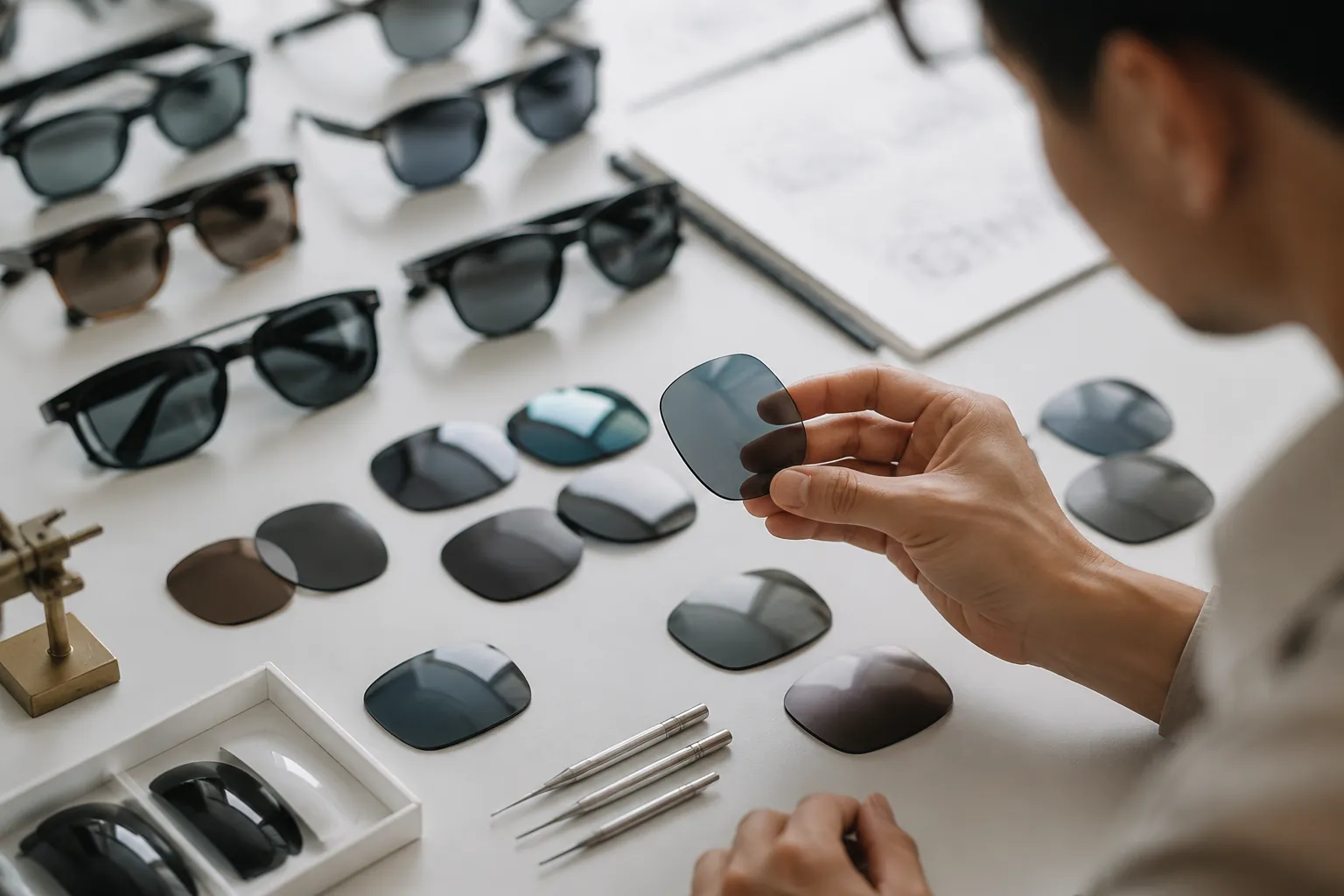
This guide is for brands, importers, distributors, and retail buyers quoting polarized sunglasses in volume. The decision is not just whether the lens is polarized. It is whether the lens construction fits the frame design, price point, sales channel, compliance target, product claim, and expected handling conditions. PC and TAC polarized lenses can both be right. They carry different costs, durability limits, processing risks, inspection points, and after-sales exposure. If the lens choice is vague at RFQ stage, suppliers may quote different materials, thicknesses, coatings, and test assumptions. The result is messy price comparison, weak sampling control, and avoidable rework.
The Short Version Buyers Need First
PC and TAC are common polarized lens choices in custom sunglasses programs. They are not interchangeable. PC, short for polycarbonate, is usually selected when impact resistance, flexibility, and active-use durability matter. It suits sports sunglasses, kids' sunglasses, wrap frames, outdoor retail, and products sold with durability claims.
TAC, short for triacetate cellulose, is a laminated polarized lens construction. It is widely used in fashion sunglasses, promotional programs, travel retail, beach retail, and private-label basics where cost control and visual comfort matter most.
The sourcing mistake is simple: asking for "polarized lenses" and letting each supplier quote its default. One supplier may quote 1.0 mm TAC. Another may quote 1.1 mm TAC with a different polarizing film. A third may quote PC with hard coating. Those prices do not compare cleanly. Lens construction affects raw material cost, coating needs, edging behavior, color consistency, assembly pressure, inspection criteria, packaging, and claim risk.
Define the lens before sampling. Specify material, thickness, base curve, lens color, visible light transmission category, UV requirement, mirror or non-mirror finish, coating requirement, polarization performance, and target test standard. A clear lens specification lets the supplier quote the same product you intend to approve, test, and sell.
Construction: What You Are Buying
A TAC polarized lens is usually laminated. A polarizing film is bonded between TAC sheets. The blank is then cut, coated where needed, and edged to match the frame shape. Common sunglass lens thicknesses for many value and fashion programs are around 0.8 mm, 1.0 mm, and 1.1 mm. Thicker options may be used when the frame groove, design style, or buyer reference sample requires them.
TAC is light, economical, and suitable for daily fashion wear. Its weak points are lower impact resistance than PC and higher sensitivity to heat, humidity, poor lamination, aggressive edging, and poor storage conditions.
A PC polarized lens uses polycarbonate as the main lens body, with polarization added through the lens supplier's production route. PC is tougher and more flexible than TAC. It resists cracking during assembly and is better suited to active-use sunglasses. Common PC sunglass lenses may run from roughly 1.2 mm to 2.0 mm, depending on frame design, base curve, and test requirement.
PC still needs control. Stress marks, rainbow patterns under polarized inspection, coating adhesion issues, and optical distortion can appear if molding, cutting, coating, or assembly pressure is poorly managed.
For buyers, the key difference is risk. TAC saves cost and works well when the frame is correctly designed and the product claim is modest. PC costs more, but it gives better abuse resistance and is more forgiving when the finished product is bent, dropped, or handled roughly. Neither material fixes a bad frame fit, weak hinge, loose lens groove, incorrect base curve, or poor final inspection.
| Factor | PC Polarized Lens | TAC Polarized Lens |
|---|---|---|
| Typical use | Sports, kids, wrap frames, outdoor retail, durability-led programs | Fashion, promo, retail basics, gift sets, travel programs |
| Common thickness range | About 1.2-2.0 mm depending on curve and frame | About 0.8-1.1 mm for many value and fashion programs |
| Impact resistance | Higher than TAC in comparable sunglass applications | Lower than PC; acceptable for many fashion and value programs |
| Cost position | Usually higher material, coating, and processing cost | Usually lower material and processing cost |
| Processing risk | Stress distortion, coating scratches, tension in wrap frames | Edge chipping, delamination, wave distortion, heat sensitivity |
| Best buyer priority | Durability and reduced breakage risk | Price control and clean visual comfort |
Cost, MOQ, and Price Logic
Lens material is only one part of sunglass cost. Still, it can move the final quote enough to affect margin on volume programs. TAC normally has the lower cost position because laminated TAC blanks are widely available and efficient to process for standard fashion shapes.
PC often adds cost through thicker lens blanks, hard coating, more careful edging, higher rejection risk in curved designs, and stricter visual inspection.
MOQ and price should be confirmed by design, lens specification, decoration, packaging, and test requirement. Low-volume custom development may be possible for selected designs. Commercial price breaks usually improve when material purchasing, tooling setup, printing fixtures, packaging purchases, and QC labor are spread across larger quantities.
Do not compare a TAC quote and a PC quote as if the only difference is a material name. The quote should state lens material, thickness, coating, lens color, VLT category, UV requirement, packaging, and compliance documents included.
Also calculate replacement and complaint cost. If sunglasses are sold as low-price beach retail or event merchandise, TAC may be commercially correct. If the product is sold for cycling, fishing, kids, outdoor use, or workwear-adjacent channels, PC may be the better total-cost choice. Broken lenses, scratched lenses, and durability complaints can cost more than the lens upgrade.
- Use TAC for price-sensitive fashion, event merchandise, gift-with-purchase, travel retail basics, and simple private-label sunglasses.
- Use PC when the product will be bent, dropped, worn during sports, sold to kids, or marketed with durability language.
- Do not over-spec PC for a short-life promo item unless the buyer has a real impact, safety, or brand-risk reason.
- Do not under-spec TAC for a premium active line. Edge chipping, lens flex, and coating failure are noticed quickly in higher-price channels.
Durability, Tolerances, and Assembly
Many lens failures start before the consumer opens the carton. Common factory-floor problems include chipped lens edges, stress marks near the rim, loose seating, coating scratches, uneven mirror color, visible color difference between left and right lenses, and lens movement after drop or vibration testing.
PC and TAC fail in different ways. Control them differently.
TAC lenses can chip, split, or delaminate when the edging wheel is too aggressive, the lens is too thin for the frame groove, the frame opening is tight, or the finished pair is exposed to excessive heat or moisture. For many plastic sunglasses, the practical target is a controlled snap-in fit. The lens should seat without forcing the rim out of shape.
If the lens edge is oversized, assembly pressure may create hidden stress that appears after transport or temperature cycling. If it is undersized, the lens may rattle or pop out during handling. Buyers should ask the supplier to control the edging file, lens curve, and frame groove together. The lens is not a separate commodity once it is assembled.
PC is tougher, but it is not failure-proof. A wrap frame with the wrong base curve can load tension into the lens after assembly. Under polarized inspection, that tension may show rainbow stress patterns. PC also scratches more easily if left without suitable surface treatment, so hard coating is normally recommended for retail products.
Mirror-coated PC needs careful handling. Small marks that are easy to miss on smoke lenses can be obvious on blue, silver, green, red, or other mirror finishes.
Approve finished pairs, not loose lenses only. Groove depth, lens curve, bridge tension, temple pressure, edging dimensions, hinge alignment, and packaging pressure all affect final performance. A lens that looks acceptable before assembly can still fail after it is installed in the frame.
Optics and Compliance Checks
Many buyers approve a polarized lens by looking at a phone screen or a polarization test card. That only confirms that polarization exists. It does not confirm optical quality, UV protection, color consistency, visible light transmission, labeling suitability, or market compliance.
A poor polarized lens can still reduce glare.
For both PC and TAC, buyers should define UV400 or the applicable UV transmittance target, VLT category, lens color, coating, and reference standard. Fashion sunglasses are commonly classified by filter category based on visible light transmission. The correct category depends on the destination market and intended use.
Very dark lenses, gradient lenses, and mirror lenses need extra attention. VLT, driving suitability, and traffic-signal recognition requirements can affect labeling and claims. Relevant standards and documents may include CE EN ISO 12312-1, ANSI Z80.3, AS/NZS 1067, REACH, FDA registration, ISO 9001, and BSCI, depending on destination market and buyer requirement.
The useful question is not which logo can be printed on packaging. The useful question is which test, registration, audit, or declaration applies to the finished product, market, and claim.
PC can deliver strong optical performance, but poor molding or assembly stress may create distortion. TAC can deliver clean optics at a good price, but low-grade laminated material may show waves, uneven polarization, delamination risk, or poor color matching. Check samples in daylight, indoor light, and with a polarized tester. Evaluate both eyes together. One clean lens and one slightly warmer, lighter, darker, or more distorted lens still make a failed pair.
Buyer rule: approve lenses by material, test requirement, and finished-pair performance, not by the word "polarized" on a quote sheet.
Decoration, Coating, and Finish
Lens choice affects the decoration and finishing route. Most logos are not printed directly on polarized lenses unless the design requires it and the supplier confirms adhesion, position tolerance, and durability. Decoration is usually placed on the temple, lens corner, metal badge, end piece, pouch, box, or cleaning cloth.
Common options include pad printing, silk-screen printing, laser engraving on suitable temple materials, hot stamping, metal logo plates, epoxy badges, molded logos, and printed packaging inserts.
For TAC fashion programs, buyers often choose smoke, brown, G15 green, gradient, or mirror finishes, paired with pad-printed temple logos and a microfiber pouch. This keeps cost and lead time under control.
For PC sports programs, buyers may request hard coating, mirror coating, rubberized temple tips, nose pads, injected color contrast, and more protective packaging. Every added finish creates another control point. Mirror coating needs color approval and scratch inspection. Rubber parts need material and color matching. Metal plates need tooling or fixture confirmation. Laser engraving needs a test on the actual temple material because the mark changes by substrate.
Packaging matters. A soft pouch may be enough for TAC promotional sunglasses. A mirror PC lens sold at retail may need a better pouch, paper sleeve, clamshell, or custom box to reduce transit scratches. Saving a few cents on packaging can create higher claim risk if the lens surface marks easily.
Lead Time and Sampling Control
For custom sunglasses, lens choice affects the sampling route. Sampling and bulk lead times should be quoted against a confirmed specification, not assumed from a previous project. Material availability, lens color, mirror coating, custom decoration, packaging, testing, and approval cycles can all change the schedule.
Start with frame material and lens construction: PC polarized or TAC polarized. Then lock lens color, VLT category, UV requirement, coating, mirror finish, thickness, and base curve. Next, confirm the decoration method, such as laser engraving, pad printing, metal logo plates, molded logos, or printed packaging.
Samples should be checked for lens seating, optical distortion, logo placement, hinge function, temple alignment, packaging fit, and carton pressure. If third-party testing is required, plan it before bulk production. Testing after finished goods are packed leaves little room to fix anything.
If a buyer changes from TAC to PC after reviewing samples, the project is not a small revision. Lens thickness, groove fit, base curve, coating, cost, and sometimes the frame file may change. The same applies when a buyer approves smoke TAC, then asks for blue mirror PC in bulk. That is a new lens program, not a color swap.
The practical route is to re-sample, approve a new signed factory control sample, and update the purchase order and QC checklist before bulk production.
Program Fit and RFQ Details
The right lens depends on channel, retail price, claim language, abuse level, and destination market. A distributor selling low-price festival sunglasses does not need the same lens as a brand selling polarized fishing eyewear.
Mixed collections often use both materials. PC can be used for active and kids' models. TAC can be used for fashion and value models. That keeps the line commercially realistic without forcing every SKU into the same cost structure.
| Program Type | Better Starting Choice | Reason | Watch Point |
|---|---|---|---|
| Promotional sunglasses | TAC | Lower cost, light weight, acceptable glare reduction | Keep claims modest and packaging simple |
| Fashion retail line | TAC or PC | TAC controls price; PC supports premium durability | Check color consistency across SKUs |
| Sports wrap frame | PC | Better impact resistance and flex tolerance | Inspect stress marks after assembly |
| Kids' sunglasses | PC | More forgiving under bending and dropping | Confirm market-specific safety and labeling rules |
| Outdoor workwear-style channel | PC | Durability matters more than lowest unit cost | Do not imply safety certification unless tested for it |
| Gift sets or travel retail basics | TAC | Good price-to-function balance | Control storage and avoid weak lamination |
A useful RFQ removes guesswork. Include order quantity by design, frame material, lens construction, lens thickness or approved reference sample, lens color, VLT category, UV requirement, mirror or non-mirror finish, hard coating requirement, base curve, hinge type, logo method, packaging, destination market, and target ship date.
If CE EN ISO 12312-1, ANSI Z80.3, AS/NZS 1067, REACH, FDA registration, ISO 9001, or BSCI documentation is required, state that before sampling. A supplier can control production only against a fixed specification, signed sample, and agreed inspection standard.
Have a custom sunglasses project in mind?
Send us your styles, target market and quantities and we will return a detailed quote with MOQ, lead time and a sample plan.
Get a QuoteWhy source this from Wenzhou with LumiShades
Wenzhou in Zhejiang Province is widely regarded as China’s eyewear manufacturing capital, producing a large share of the world’s sunglasses. That concentration matters to buyers: a deep local supply chain for acetate sheet, hinges, lens blanks, plating and packaging means shorter component lead times, easier color and material matching, and a workforce with decades of eyewear-specific skill. LumiShades has manufactured in this ecosystem since 2009, and our vertical integration — in-house injection molding, acetate cutting, CNC milling, lens tinting, decoration and quality control — means no part of your order is quietly subcontracted to a workshop you cannot audit.
For international buyers, that vertical control translates into accountability. When a single factory owns every step, defects are traced and fixed at source rather than bounced between vendors, and your specifications survive intact from first sample to bulk. We back this with 15+ years of experience, shipments to 60+ countries, more than 5 million pairs produced per year and a 98.5% on-time delivery rate. Our certifications — CE EN ISO 12312-1, FDA registration, ANSI Z80.3, AS/NZS 1067, REACH, ISO 9001 and BSCI audit — mean the compliance documentation your market requires already exists. Explore our manufacturing capabilities and quality control process to see how this works in practice.
Frequently asked questions
Is PC always better than TAC for polarized sunglasses? No. PC is tougher and better for sports, kids, wrap frames, outdoor use, and programs where durability is part of the product claim. TAC is often the better commercial choice for cost-controlled fashion, promotional, travel retail, and basic private-label sunglasses where impact resistance is not the main selling point. Choose PC when breakage risk or active handling matters. Choose TAC when price, light weight, and standard visual comfort matter more.
Can TAC polarized lenses pass CE EN ISO 12312-1 or ANSI Z80.3? Yes. TAC polarized lenses can be used in sunglasses that meet CE EN ISO 12312-1 or ANSI Z80.3, but the material alone does not prove compliance. The finished sunglass must meet the applicable requirements for UV transmittance, visible light transmission, optical quality, filter category, labeling, and intended use. Buyers should specify the destination market and required standard before sampling, then test the finished pair, not just the loose lens.
How much does lens choice affect MOQ and price? It depends on lens thickness, coating, color, mirror finish, frame design, packaging, and testing requirements. TAC normally keeps the quote lower because material and processing costs are usually lower. PC usually increases cost, especially with hard coating, mirror finish, wrap curves, thicker lenses, or stricter inspection. To compare quotes fairly, ask each supplier to state the same lens material, thickness, VLT category, UV requirement, coating, packaging, and compliance documents.
Should I request hard coating on PC polarized lenses? Usually yes for retail products. PC has good impact resistance, but its surface can scratch if it is not protected by an appropriate coating. Hard coating adds cost, but it reduces handling marks, visible lens damage, and customer complaints. It is especially important for mirror lenses, sports sunglasses, kids' sunglasses, and products expected to receive rough handling.
Can I switch from TAC to PC after sample approval? You can, but treat it as a specification change, not a minor edit. PC and TAC may require different lens thickness, base curve, edging settings, groove fit, coating route, inspection criteria, and cost calculation. Re-sample, approve a new signed control sample, and update the purchase order and QC checklist before bulk production.
What should I send in an RFQ for polarized sunglasses? Send quantity by design, frame material, PC or TAC lens choice, lens thickness or reference sample, lens color, VLT category, UV requirement, coating requirement, mirror or non-mirror finish, base curve, logo method, packaging, destination market, required compliance documents, and target delivery date. If possible, include a physical reference sample and state whether the product is for fashion, sports, kids, outdoor retail, promotional use, or another channel. This lets the supplier quote against the actual performance requirement instead of guessing.
Ready to start?
Explore our sport wrap sunglasses or request a quote — our sales team replies within 12 hours.
Request a Quote