
TAC vs PC Polarized Lenses: Cost and Return Risk
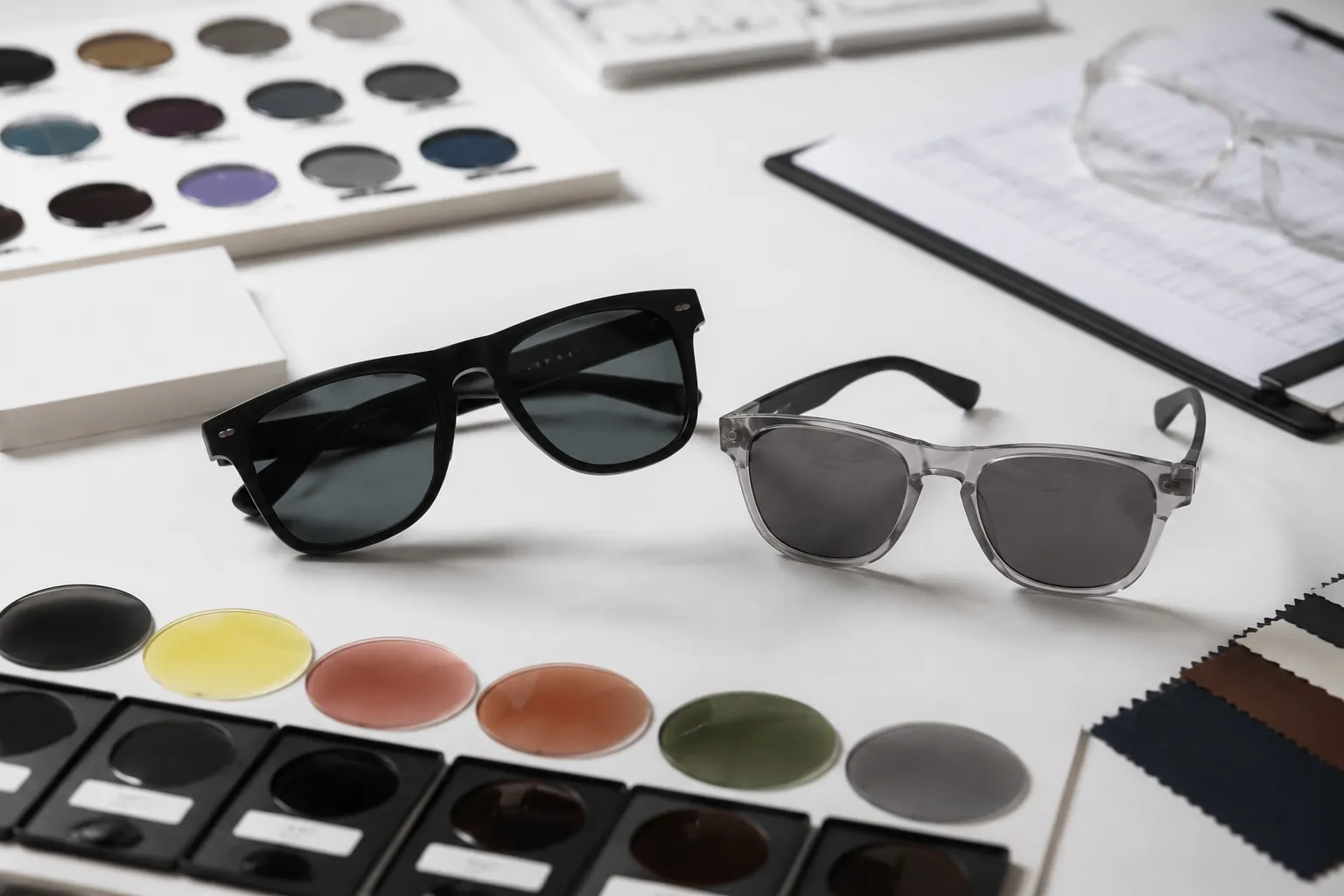
This guide is for brands, importers, distributors, and retailers buying custom sunglasses in volume. It compares TAC and PC polarized lenses by the numbers that affect sourcing decisions: quoted cost, assembly yield, optical consistency, frame fit tolerance, compliance control, and return exposure after shipment. The right choice is not material alone. It depends on frame design, sales channel, handling conditions, packaging, and how tightly the supplier controls the full lens-to-frame process.
Start with failure risk, not the lens label
Buyers often ask whether TAC or PC is better. That is the wrong first question. Ask this instead: which lens construction gives the lowest total cost per sellable pair for this frame, sales channel, packing method, and quality target?
TAC polarized lenses are usually laminated constructions with a polarizing film between protective layers. PC polarized lenses use polycarbonate as the lens substrate, with polarization added through the supplier's chosen construction method. That difference matters because many failures do not come from poor polarization on day one. They come from edging, insertion stress, heat exposure, transport vibration, repeated cleaning, long storage, or rough handling after sale.
For wholesale sunglasses, review risk in four buckets:
- Assembly risk: edge chipping, cracking, insertion marks, stress whitening, bevel damage, or lens movement during fitting.
- Visual consistency risk: haze, left-right tint mismatch, visible stress patterns, polarization misalignment, coating marks, or bevel defects that cause QC rejection.
- Storage and transit risk: heat-related warping, pressure marks from packing, carton compression, lens-to-frame movement, or surface damage caused by pouch, case, or paper contact.
- After-sales risk: returns caused by breakage, warping, delamination, peeling, optical complaints, loose lenses, or visible appearance change after normal use.
At quote stage, TAC often has the lower lens cost. PC is usually chosen when impact resistance, assembly tolerance, and handling tolerance matter more. Neither material is automatically cheaper in the finished program. A low lens quote can become expensive if reject rates, remake rates, service tickets, or replacements rise after assembly and shipment.
The rule is simple. Match the lens to the frame geometry and the abuse level of the channel. A low-wrap fashion frame sold on a retail display does not carry the same risk as a sport frame, a kids style, a soft-pouch travel program, or an e-commerce program where every replacement adds freight and service cost.
Compare cost, yield, durability, and complaints
| Factor | TAC Polarized | PC Polarized | Buyer impact |
|---|---|---|---|
| Typical construction | Multi-layer laminated lens with polarizing film | Polycarbonate substrate with polarized construction | Construction affects edging behavior, assembly tolerance, impact performance, and long-term failure mode |
| Typical quote position | Often lower | Often higher | Initial quote advantage does not predict finished-program cost by itself |
| Impact resistance | Generally lower than PC | Generally higher | PC is often preferred for active, youth, outdoor, and rough-handling programs |
| Assembly yield on stressed frames | Can be more sensitive to tight grooves, wraps, sharp corners, and insertion pressure | Often more forgiving during fitting | PC may reduce remakes on demanding frame designs |
| Delamination risk | Relevant because of laminated construction | Usually lower in this specific failure mode | TAC requires close review of edge condition, bonding quality, storage response, and heat response |
| Optical consistency risk | Depends on lamination quality, tint control, film flatness, and polarization alignment | Can show stress-related birefringence if molding, edging, or frame fit is poorly controlled | Both need visual inspection under normal light and polarized light before approval |
| Surface and coating review | Check haze, coating uniformity, cleaning response, and edge appearance | Check coating adhesion, surface marks, tint uniformity, and molded optical quality | Material choice does not remove the need for finished-product inspection |
| Typical channel fit | Fashion, promo, gift-with-purchase, value-driven programs | Outdoor, active, youth, travel, replacement-sensitive programs | Channel economics often influence the final choice as much as lens cost |
If the target landed cost is tight, TAC is often considered first because it can support lower opening price points. But lens price is only one line in the model. Buyers also need to account for assembly yield, finished-goods rejection, transit damage, complaint rate, replacement burden, and the cost of holding extra units for service.
PC usually carries a higher material cost. The premium can still be justified when handling is rough, frame stress is high, or replacement is operationally expensive. This is especially relevant for:
- wrap frames with higher assembly stress
- sports frames with snap-in or tight eyewire geometry
- kids sunglasses where drops, bending, and twisting are common
- travel retail or export channels where replacement is slow
- e-commerce programs where each return creates product, freight, and customer-service cost
- private-label programs where a visible defect can affect retailer scorecards or chargebacks
Do not compare TAC lens price with PC lens price in isolation. Compare TAC delivered sellable pair with PC delivered sellable pair.
Where TAC works, and where it needs proof
TAC is widely used because it is practical and cost efficient for many fashion and value-oriented sunglasses programs. On lower-stress shapes, standard full-rim constructions, moderate lens curves, and controlled-use channels, TAC can be the right choice. But validate the exact lens in the exact frame before approving bulk production.
TAC needs more proof when the design has a tight groove, sharp lens corner, high base curve, thin rim, heavy decoration near the eyewire, or a packing method that puts pressure on the lens. A loose TAC lens may look acceptable on the inspection table and still fail once it is edged, inserted, packed, and shipped.
- Lamination quality: poor bonding may appear as edge lift, bubbles, haze, whitening, film lines, or local separation, especially after heat exposure or storage.
- Edging sensitivity: aggressive beveling, dull tooling, or poor edge finishing can create chipping or local separation near the lens edge.
- Frame pressure: high-wrap fronts, narrow eyewires, and tight insertion points can overstress a laminated lens, especially around corners and high-load areas.
- Heat and chemical exposure: storage temperature, transport conditions, sunscreen, sweat, and incompatible cleaners can reveal weaknesses that are not obvious in a loose-lens review.
- Packaging contact: soft pouches, printed inserts, cleaning cloths, and case pressure can create rub marks or pressure marks if the finished pair is packed too tightly.
Ask for assembled samples in the production frame. Loose lenses are not enough. For practical pre-approval checks, request at least:
- High-temperature review: inspect the lens after controlled heat exposure appropriate to the program, packaging, and shipping route.
- Insertion and removal trial: fit and remove the lens multiple times in the actual frame to check for edge damage, whitening, and retention strength.
- Packed-sample handling review: inspect for edge change, lens movement, pouch marks, case pressure marks, or cosmetic damage after packing and vibration handling.
- Tint and alignment review: compare left-right consistency under standard light and inspect polarization alignment under polarized light.
- Cleaning response review: wipe the lens with the approved cloth and normal cleaning method to check coating marks, haze, and surface sensitivity.
These checks do not replace formal testing. They catch common production and handling risks early. With TAC, a frequent buyer error is approving appearance only and skipping frame-specific assembly review.
Where PC earns the premium
PC polarized lenses cost more in many programs. Buyers choose them because they can improve toughness and reduce handling-related failures. Polycarbonate is widely used where impact resistance matters and where the frame design creates more assembly stress.
This matters most in frames with deeper wrap, snap-in assembly, thin injection fronts, rimless or semi-rimless details, and other geometries that demand more from the lens during insertion. In these cases, PC often gives better process tolerance. That can mean fewer remakes, less rework, fewer packing delays, and lower risk of one-pair failures after shipment.
PC is not automatically the better option. Buyers still need to control:
- Stress birefringence: visible rainbow patterns under polarized inspection if molding, edging, or frame fit is poorly controlled
- Optical distortion: especially on higher-curve designs, thicker lenses, or weakly controlled surfaces
- Surface quality: coating performance, tint uniformity, cleaning response, and cosmetic finish still require validation
- Coating adhesion: hard coating, mirror coating, and printed logo areas should be checked after handling and packing
- Frame fit: a tough lens can still create complaints if it is forced into a poorly matched groove or shifts during wear
Use PC when the product is likely to be dropped, flexed, packed in soft pouches, worn during sport, shipped long distances, or sold to users who will not handle the product gently. It is also a strong option for kids styles and replacement-sensitive programs where one-unit failures are costly to handle. In those channels, the lens premium may be easier to defend because field failure costs more than the material gap.
PC can also give the factory more tolerance during insertion. That does not remove the need for fit control. It only lowers the chance of assembly damage when the frame design is demanding.
Run the landed-cost math
Do not compare TAC and PC on ex-works lens cost alone. Build a simple cost model per delivered, sellable pair. Even a basic spreadsheet will produce a better decision than a lens-price comparison.
| Cost element | TAC tendency | PC tendency | What to estimate |
|---|---|---|---|
| Lens material cost | Often lower | Often higher | Quoted gap per pair at each order break |
| Assembly yield loss | Can rise on tight, wrapped, or sharp-corner frames | Often lower on stressed designs | Expected remake rate during fitting and the labor cost of rework |
| Final QC rejection | Watch lamination defects, tint mismatch, edge issues, haze, and coating marks | Watch stress marks, optical distortion, coating marks, and tint inconsistency | Rejected finished-goods percentage and whether rejected units can be reworked |
| Transit and warehouse damage | Review based on packing, heat exposure, route, and carton compression | Often chosen when breakage resistance is a priority | Damage rate by packaging type, route, warehouse time, and season |
| Consumer returns | Review closely in rough-use and high-heat channels | Often favored where replacement cost is high | Replacement product, freight, platform penalties, customer-service time, and refund burden |
| Retailer chargebacks | Possible if cosmetic or durability failures exceed agreed tolerance | Still possible if stress marks or optical complaints appear | Deduction rules, defect allowance, and inspection acceptance level |
Use your own data where possible: historical return reasons, assembly reject records, replacement cost by market, retailer deduction rules, and expected packaging conditions. If you do not have internal numbers, ask the supplier for style-specific sampling observations and any comparable production history. Then compare both lens options in the same frame.
A useful formula is:
Estimated commercial cost per sellable pair = quoted pair cost + assembly remake cost + QC rejection cost + transit damage cost + expected return cost + service handling cost.
For example, a TAC option that saves USD 0.25 per pair at quote stage can lose that advantage if it adds 3 percent remakes, 2 percent finished-goods rejection, or a return pattern that requires international replacement shipments. A PC option that costs more at purchase order stage may be cheaper if it reduces the failure rate on a high-wrap or youth frame.
Volume can change the answer. The lens cost gap may matter less when rework and returns are larger than the material difference. Lead time matters too. Sampling is the right point to compare both constructions under the same assembly and inspection conditions. Do not lock the lower quote too early.
Frame design can change the answer
The frame is half the lens decision. Buyers who choose lens material before locking frame geometry often create avoidable delay, remake cost, or post-shipment complaints.
- Full-rim fashion acetate: TAC is often workable if groove depth, bevel fit, lens curve, and insertion force are controlled.
- High-wrap sports injection frames: PC is often the safer starting point because fitting stress and use-case abuse are both higher.
- Thin metal with nylon cord or drill concepts: edge quality and stress control are critical; test both constructions against the exact retention method.
- Kids styles: PC deserves strong consideration because drops, twisting, and rough storage are routine.
- Oversized fashion styles: review lens flex, packing pressure, and optical distortion because a larger lens area can make defects easier to see.
- Rimless or semi-rimless styles: do not assume either material is acceptable until drilling, notching, and retention strength are tested.
Decoration and finishing can also affect reject risk. Review whether the factory uses:
- laser engraving on lenses or temples
- pad printing for logos
- metal logo plates inserted into acetate or injection parts
- hot stamping or foil details
- mirror coating, flash coating, or gradient tinting
- late-stage hand polishing or buffing near the eyewire
These processes may look unrelated to lens choice. They are not. They affect handling sequence, cosmetic standards, and how much rework a frame sees before packing. A lens inserted before a late-stage cosmetic process may face extra handling risk. Decorative hardware can also reduce fitting tolerance around the eyewire.
Ask how the supplier inserts lenses on your style: hand insertion, heated insertion, press fitting, or fixture-assisted fitting. Each method creates different stress patterns. That can change whether TAC is stable enough or PC is the better commercial choice.
Compliance does not remove return risk
Both TAC and PC polarized sunglasses can meet market requirements if the finished product is engineered and tested correctly. Compliance does not decide the better lens material.
Common references buyers may request include CE EN ISO 12312-1, ANSI Z80.3, AS/NZS 1067, and chemical compliance such as REACH. For supplier-system review, buyers may also ask about ISO 9001, BSCI, and FDA registration where relevant to the supplier's U.S. market process. These references are useful. They do not replace validation of the exact finished product.
The distinction is important. Compliance is the baseline, not the commercial finish line. A sample can meet a standard and still perform poorly in the field if frame fit is too tight, heat exposure is ignored, cleaning response is poor, or visual stress becomes visible in wear.
Buyer rule: approve the exact frame, exact lens construction, exact tint, exact logo method, exact packaging, and exact assembly process together. Do not approve components in isolation.
For bulk approval, ask the supplier to lock the production standard clearly: lens material, lens thickness, base curve, tint, polarization orientation, coating, logo placement, frame groove standard, packaging type, and agreed inspection standard. That lowers the risk of a technically compliant product that still fails commercially.
Documentation should be tied to the finished style whenever possible. A loose-lens test report, a report from a different model, or an expired report may not answer the real risk question for your shipment. Ask whether the report covers the same lens construction, same tint category, same frame type, and same market requirement.
Use a gated sourcing workflow
Use a short gated process. It reduces assumptions and gives purchasing, product, and QC a clearer basis for approval.
- Define the use case: fashion, active, kids, promo, travel, or replacement-sensitive program. Document expected abuse level, sales channel, packing method, and replacement cost.
- Shortlist both lens constructions: where practical, request TAC and PC in the same frame so the comparison is meaningful.
- Review frame stress: confirm groove depth, bevel profile, base curve match, retention method, insertion force, and any tight points around corners.
- Run visual checks: compare tint match, polarization alignment, haze, edge finish, coating marks, and stress patterns under polarized light.
- Run handling checks: review insertion and removal, controlled heat exposure, packed-sample handling, cleaning response, and cosmetic stability after transport simulation.
- Price by order break: compare both options at the actual order quantities you buy, then add estimated reject, remake, freight, service, and replacement burden.
- Lock a golden sample: fix lens material, tint, thickness, logo method, packaging, frame fit, and inspection criteria before bulk starts.
- Confirm inspection method: define acceptable limits for tint difference, scratches, coating marks, edge defects, stress patterns, lens movement, and packaging damage.
- Monitor the first shipment: review inspection records, carton condition, warehouse findings, and early market feedback fast enough to catch repeatable issues.
Good suppliers discuss production variables, not only sales claims. That means groove fit, bevel shape, base curve, tint control, logo process, packing method, and how the lens behaves in the frame during assembly.
If your team has low tolerance for after-sales issues, choose the lens construction that is more forgiving in the actual use case, even if the initial quote is higher. In cross-border programs, replacements are often far more expensive than a small material premium decided during development.
Supplier questions to ask before approval
Before you approve TAC or PC, ask questions that force the supplier to discuss the real production process. General answers such as "good quality" or "no problem" are not enough for a volume program.
- What is the exact lens construction, thickness, base curve, tint category, and coating stack?
- Is the polarizing film orientation checked on every batch, and how is left-right alignment verified?
- What edge-finishing process is used after cutting, and what defects have appeared during trial fitting?
- What is the expected assembly reject rate for this frame based on sample fitting?
- Will lenses be inserted before or after logo work, polishing, metal plate installation, or final cleaning?
- What packaging will touch the lens surface during shipment: pouch, case, card, polybag, tissue, or cleaning cloth?
- What inspection lighting and polarized-light checks will be used before shipment?
- Which test reports apply to the exact finished style, and which reports apply only to components?
- What changes require buyer approval after the golden sample is locked?
The goal is not to make the supplier write a long report. The goal is to prevent silent changes in lens source, tint, coating, thickness, curve, insertion method, or packaging. Those changes can move a program from acceptable to return-prone without changing the product name on the invoice.
Have a custom sunglasses project in mind?
Send us your styles, target market and quantities and we will return a detailed quote with MOQ, lead time and a sample plan.
Get a QuoteWhy source this from Wenzhou with LumiShades
Wenzhou in Zhejiang Province is widely regarded as China’s eyewear manufacturing capital, producing a large share of the world’s sunglasses. That concentration matters to buyers: a deep local supply chain for acetate sheet, hinges, lens blanks, plating and packaging means shorter component lead times, easier color and material matching, and a workforce with decades of eyewear-specific skill. LumiShades has manufactured in this ecosystem since 2009, and our vertical integration — in-house injection molding, acetate cutting, CNC milling, lens tinting, decoration and quality control — means no part of your order is quietly subcontracted to a workshop you cannot audit.
For international buyers, that vertical control translates into accountability. When a single factory owns every step, defects are traced and fixed at source rather than bounced between vendors, and your specifications survive intact from first sample to bulk. We back this with 15+ years of experience, shipments to 60+ countries, more than 5 million pairs produced per year and a 98.5% on-time delivery rate. Our certifications — CE EN ISO 12312-1, FDA registration, ANSI Z80.3, AS/NZS 1067, REACH, ISO 9001 and BSCI audit — mean the compliance documentation your market requires already exists. Explore our manufacturing capabilities and quality control process to see how this works in practice.
Frequently asked questions
Which lens is usually cheaper for a wholesale fashion sunglass program? TAC is often the lower-cost option at quote stage for fashion and value-oriented programs, especially in standard full-rim designs. Do not approve it on price alone. Ask for assembled samples in the final frame, review edge condition after insertion, compare left-right tint consistency, check polarization alignment, and confirm whether the supplier has seen whitening, chipping, haze, or delamination during assembly. If the frame is low-stress and the sample stays stable after handling, heat review, and packed-sample review, TAC may be the better commercial fit.
Which lens is better for sports or kids sunglasses? PC is often the safer starting point for sports, youth, and other rough-use programs because impact resistance is generally higher and the material is often more tolerant during assembly and daily handling. Still verify optical quality, stress patterns under polarized light, coating quality, and cosmetic stability in the exact frame. For an action-oriented or kids program, ask the supplier to provide the same frame with both TAC and PC if possible, then compare assembly damage, packed-sample condition, lens retention, and visible stress after handling.
Can both TAC and PC polarized sunglasses meet export compliance requirements? Yes. Both TAC and PC polarized sunglasses can be engineered to meet requirements such as CE EN ISO 12312-1, ANSI Z80.3, AS/NZS 1067, and REACH when the finished product is properly designed and tested. Request documentation for the exact finished style where required. Do not assume that a compliant loose lens guarantees a compliant finished pair. It is also reasonable to review supplier-side controls such as ISO 9001, BSCI, and FDA registration where relevant to the supplier's process and market.
What sample checks should I ask for before placing bulk? Ask for assembled samples in the final production frame and review them as finished products, not loose lenses. At minimum, check left-right tint match, polarization alignment, edge finish, visible stress under polarized light, insertion and removal stability, controlled heat exposure response, cleaning response, lens retention, and packed-sample condition after transport handling. Also confirm the locked construction details in writing: lens material, thickness, base curve, coating, tint, logo method, packaging, and inspection standard. That gives purchasing, QC, and the supplier one common approval target.
How should I compare TAC and PC on cost before I place the order? Use a per-sellable-pair comparison, not a lens-only quote comparison. Ask the supplier to quote both options in the same frame and at the same order quantity. Then add your internal cost assumptions for assembly remake, finished-goods rejection, transit damage, retailer deductions, and replacement handling. If you sell through e-commerce or export markets, include freight and service cost for one-unit replacements. The better decision is the option with the lower total commercial burden after assembly and shipment, not necessarily the lower initial lens price.
Ready to start?
Explore our aviator sunglasses or request a quote — our sales team replies within 12 hours.
Request a Quote