
Lens Thickness and Base Curve: Return Risk in Sunglasses
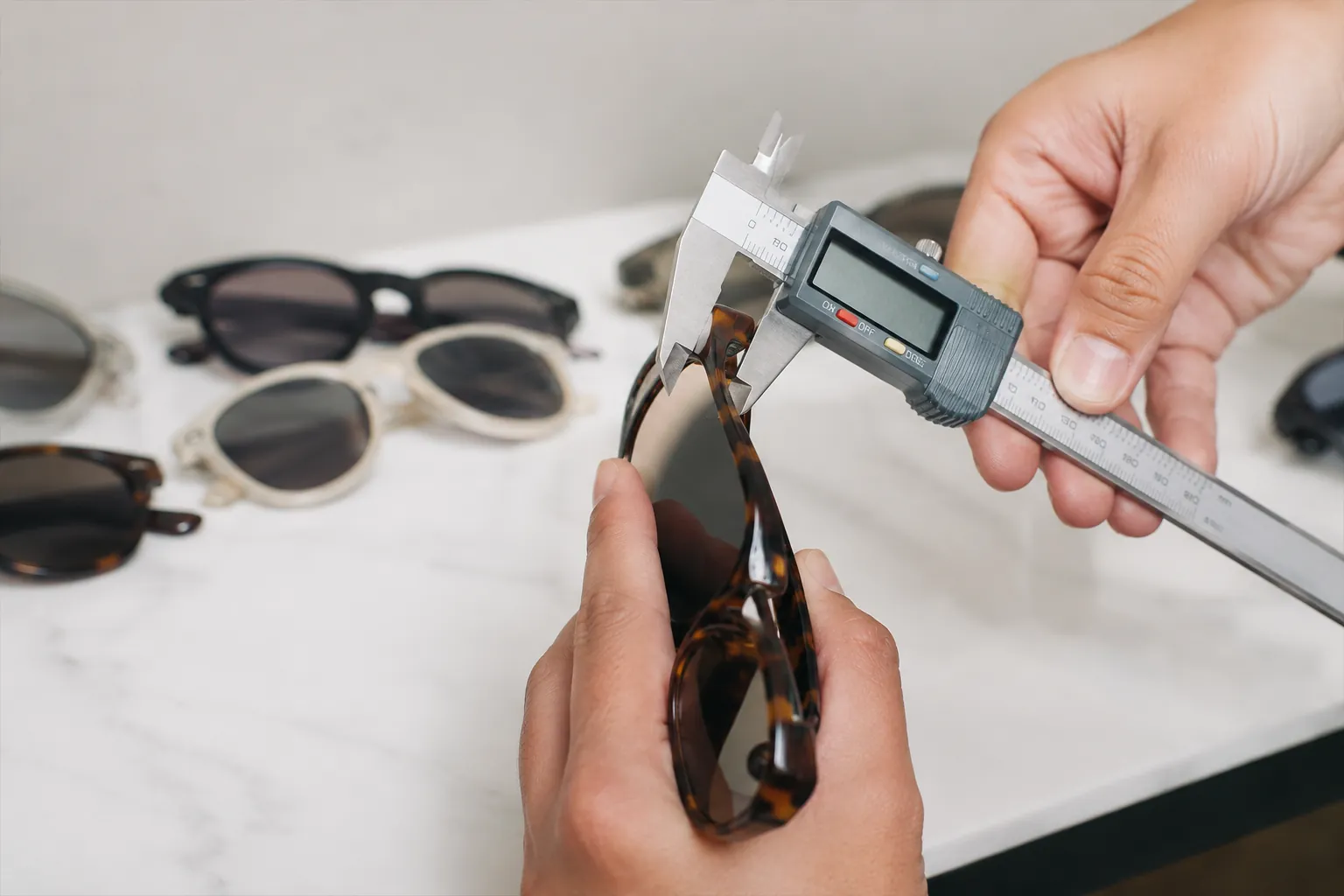
This guide is for brand owners, importers, distributors, and retail buyers sourcing custom sunglasses in volume. The commercial goal is simple: cut avoidable complaints about distortion, pressure points, loose lenses, poor face fit, and bulk orders that do not match the approved sample. Lens thickness and base curve are engineering details, but they directly affect assembly yield, wearer comfort, compliance risk, remake cost, and sell-through. Lock those specs during sampling, or you will pay for the mistake later.
The two lens specs buyers underestimate
Many sunglass returns blamed on "fit," "comfort," or "quality inconsistency" start earlier than final assembly. They often start when the approved sample does not clearly define two basic lens parameters: thickness and base curve.
Thickness is not one number. A proper sample review should separate center thickness from edge thickness. For plano sunglasses, the acceptable range depends on lens material, lens size, frame wrap, coating stack, and the target use case. A thicker lens can improve rigidity and retention. It also adds weight and may create a bulkier side profile. A thinner lens can reduce weight and cost. It also reduces process tolerance during edging and assembly.
Base curve is the front surface curve of the lens, usually described as Base 2, Base 4, Base 6, Base 8, and so on. Lower curves suit flatter fashion frames. Higher curves suit wrapped lifestyle or sport styles. The wrong curve causes three immediate problems: poor retention in the groove, visible edge mismatch, and wearer complaints about peripheral distortion or an odd visual feel.
At factory level, lens geometry affects mold selection, raw lens yield, CNC edging parameters, bevel angle, insertion force, and breakage risk during packing and transit. A sample can look fine on the desk and still fail at scale. The geometry has to match the frame.
Where return complaints really come from
Retailers often report returns with vague labels like "uncomfortable," "blurry," "cheap feeling," or "different from sample." Those labels hide the root cause. In many cases, lens geometry is part of the problem.
- Peripheral distortion: More likely with higher-wrap lenses, especially when a customer expects a flatter fashion sunglass rather than a wrapped outdoor style.
- Pressure at temples or the nose bridge: Often caused by a wrapped front combined with heavier edge build, which shifts weight forward and changes how the frame sits.
- Lens pop-out during store handling: Usually linked to mismatch among edge thickness, bevel shape, groove width, and frame curvature. A lens can pass insertion on the line and still loosen after repeated opening and closing of temples or after heat exposure in a parked vehicle.
- Uneven edge appearance: Most visible on oversized shields, gradients, and light tints, where one area may look thin and premium while another looks bulky.
- "Sample looked better than bulk" claims: Often caused by a sample made with one lens stock and bulk production using a different thickness or curve.
Buyers who approve only color, logo position, and overall shape are not controlling the specs that customers actually feel within minutes of wear. That is why geometry-related returns are so frustrating. The frame is not always formally defective, but the product still fails commercially.
A practical comparison buyers can use
There is no universal "best" lens setup. The right geometry depends on frame wrap, groove depth, end use, and price target. Some combinations are simply safer in bulk programs.
| Lens setup | Typical use | Main advantage | Main production concern | Commercial return risk if misused |
|---|---|---|---|---|
| Base 2 to Base 4, moderate thickness | Flat fashion acetate or metal sunglasses | Natural visual feel, clean fashion profile, easier wearer adaptation | Can look under-built in wrapped fronts; weaker retention if groove match is loose | Medium: appearance and retention complaints |
| Base 4 to Base 6, moderate thickness | Mainstream lifestyle sunglasses | Balance of wrap, coverage, visual comfort, and assembly stability | Needs controlled bevel alignment and edge finishing | Low to medium: usually the safest range for broad retail |
| Base 6 to Base 8, stronger edge build | Sport and high-wrap styles | Better side coverage and a more aggressive profile | Higher risk of peripheral distortion comments and edge bulk on large eyesizes | High if sold to general fashion users without wear testing |
| Large eyesize with thin stock | Price-driven fashion programs | Lower material cost and lighter nominal weight | More flex during edging, higher stress at corners, easier pop-out after transport or heat exposure | High: durability and assembly complaints |
For most private-label programs sold through general retail, Base 4 to Base 6 with moderate thickness is usually the safest commercial zone. It is not the most dramatic look. It is often the most forgiving in production and the least likely to trigger adaptation complaints from average consumers.
Thickness is not just weight
It changes assembly behavior. Buyers often ask for thinner lenses to save cost and keep the frame light. That can be reasonable, but very thin stock reduces process tolerance. On large fronts, wrapped styles, or injected frames with softer dimensional stability, the lens becomes less forgiving during edging and insertion.
In production, several details matter:
- Groove width and depth: If the groove is too shallow for the final edge build, insertion stress rises and the lens may sit proud or distort the rim.
- Bevel position: A bevel set too far forward or back changes retention force and can create visible gaps at the eyewire.
- Material response: PC is impact-resistant and widely used for sport sunglasses, but it can show stress marks if edging and insertion are poorly controlled. CR-39 offers good optical clarity but is more brittle than PC. TAC is widely used for polarized programs and can be cost-effective, but lamination quality and edge sealing matter.
- Heat behavior: A frame/lens fit that is acceptable at room temperature may loosen after short exposure to heat, especially in lower-cost injection materials.
A serious buyer should request actual numbers during sample review, not only verbal approval. Good practice is to record:
- Center thickness and edge thickness in millimeters.
- Base curve used on the approved sample.
- Frame groove depth and intended bevel profile.
- Results of a retention check after assembly and after short heat exposure.
If the factory handles frame and lens work in-house, it is easier to correct groove dimensions, edge profile, or lens stock during sampling than to coordinate changes across multiple vendors.
Base curve affects vision, fit, and customer adaptation
Base curve is often treated as a style spec only. It is also a wearer-experience spec. The more the front wraps, the more likely some users are to notice a change in side vision or spatial feel, especially if they are moving from flatter fashion sunglasses to a sport-inspired design.
That does not mean higher base curves are wrong. It means they must match the product brief. A beach, cycling, fishing, or outdoor utility frame can justify Base 6 to Base 8 for coverage and wind protection. A city fashion sunglass sold for all-day casual wear usually performs better with a flatter or moderate curve that requires less adaptation.
Fit is affected too. More wrap usually means more inward angle at the temples and different weight distribution across the nose. If the lens edge becomes thick at the outer corners, side profile bulk increases and comfort can drop on narrower faces.
The buyer-level point is plain. End customers do not know base curve. They do know that something feels off. They may call it blurry, dizzy, too tight, or uncomfortable. The unit may still pass basic inspection. The commercial outcome is still the same: return, markdown, or replacement.
Sample approval should include real wear testing, not only tabletop review. Put the frame on for at least 5 to 10 minutes. Walk outdoors. Turn your head left and right. Have at least 2 to 3 people with different face shapes try the sample. This catches more geometry problems than another round of email comments on appearance photos.
How to spec and test before bulk production
If you want fewer complaints, lens geometry must be part of the formal approval routine. It should appear on the sample record, not only in an internal message thread.
- Define the target use first: fashion, lifestyle, sport, kids, or promo. The acceptable curve range changes by use case.
- Approve the exact construction: same lens material, same polarization structure if applicable, same thickness, same base curve, same frame material, and same decoration stack-up.
- Review decoration impact: Flash mirror, revo mirror, hard coating, anti-scratch coating, hydrophobic coating, and gradient tint can all affect edge appearance and sample-to-bulk consistency.
- Check retention after assembly: hand pressure at lens corners, repeated temple opening and closing, and short heat exposure testing.
- Confirm paperwork matches the build: compliance should correspond to the actual production lens and frame combination, not a similar previous style.
A practical B2B sample plan is to request two geometry options when the frame design is borderline, for example one flatter Base 4 option and one more wrapped Base 6 option, each with recorded center and edge thickness. The extra sampling cost is usually far cheaper than one bulk remake.
For any program that requires compliance documentation, align the finished build with the relevant standard before approval. Common references include CE EN ISO 12312-1, ANSI Z80.3, AS/NZS 1067, REACH, and FDA registration where applicable. A factory quality system such as ISO 9001 can support process control, and BSCI may be relevant for social compliance audits, but none of these replace product-specific testing and documentation.
Cost, MOQ, and why the cheapest lens is often expensive
Lens geometry affects cost, but the ex-factory price difference is often smaller than the downstream cost difference. In many programs, moving from a marginal thin stock to a better-matched lens build adds a small amount per pair while reducing the chance of returns, replacements, and retailer complaints.
MOQ and pricing vary by factory, material, decoration, and packaging. Treat any quotation as style-specific, not as a universal market rate. What matters commercially is the tradeoff between unit cost and failure cost:
- At small trial quantities, buyers sometimes accept stock lens geometry to move fast. That can be reasonable for testing, but it is risky for a repeat line.
- At mid-size orders, it becomes worth locking the exact approved thickness and curve because inconsistency starts to cost more than the saving.
- At larger orders, every small issue multiplies across freight, retailer claims, replacement inventory, and lost margin.
Decoration methods also influence perception. A mirrored lens can hide some cosmetic variation from the front but make edge thickness more obvious from the side. A light gradient can look premium in a balanced build but expose uneven edge mass immediately if the curve is too aggressive for the frame.
The cheapest lens build is the wrong choice whenever it increases returns, rework, or retailer chargebacks. Buyers should evaluate the full complaint cycle, not only the pair cost at the factory gate.
For larger programs, ask for quotations using the exact approved lens specification, not a loosely similar sample. That gives a cleaner commercial comparison than approving one build and assuming the bulk can be "close enough."
The short checklist before final approval
Before releasing deposit on a custom sunglasses order, run this control list. It catches most geometry-driven problems while changes are still cheap.
- Confirm the exact base curve on the approved sample and in the bulk specification sheet.
- Record center and edge thickness in millimeters, not just lens material name.
- Match the lens geometry to frame wrap, eyesize, and target user.
- Wear-test the sample with multiple people and with head movement.
- Inspect edge thickness appearance on the final tint, mirror, or gradient option.
- Check lens retention after assembly and after short heat exposure.
- Verify compliance documents correspond to the actual lens and frame build.
- Lock the physical sample as the production standard before mass production begins.
This is not overengineering. It is routine process control for buyers who want fewer returns, cleaner retailer relationships, and better repeat-order rates. The factory can only manufacture what is approved. The real discipline is making sure the approved geometry is commercially right before bulk starts.
Have a custom sunglasses project in mind?
Send us your styles, target market and quantities and we will return a detailed quote with MOQ, lead time and a sample plan.
Get a QuoteWhy source this from Wenzhou with LumiShades
Wenzhou in Zhejiang Province is widely regarded as China’s eyewear manufacturing capital, producing a large share of the world’s sunglasses. That concentration matters to buyers: a deep local supply chain for acetate sheet, hinges, lens blanks, plating and packaging means shorter component lead times, easier color and material matching, and a workforce with decades of eyewear-specific skill. LumiShades has manufactured in this ecosystem since 2009, and our vertical integration — in-house injection molding, acetate cutting, CNC milling, lens tinting, decoration and quality control — means no part of your order is quietly subcontracted to a workshop you cannot audit.
For international buyers, that vertical control translates into accountability. When a single factory owns every step, defects are traced and fixed at source rather than bounced between vendors, and your specifications survive intact from first sample to bulk. We back this with 15+ years of experience, shipments to 60+ countries, more than 5 million pairs produced per year and a 98.5% on-time delivery rate. Our certifications — CE EN ISO 12312-1, FDA registration, ANSI Z80.3, AS/NZS 1067, REACH, ISO 9001 and BSCI audit — mean the compliance documentation your market requires already exists. Explore our manufacturing capabilities and quality control process to see how this works in practice.
Frequently asked questions
What base curve is safest for general fashion sunglasses? For broad fashion retail, Base 4 to Base 6 is usually the safest commercial range because it balances appearance, coverage, and wearer adaptation. Higher-wrap curves can work well, but they should be reserved for styles with a clear sport or outdoor use case and should be wear-tested before bulk approval. The final choice should also reflect frame wrap, lens size, and the target customer's expected wearing time.
Does a thicker lens always mean better quality? No. Thicker lenses can improve rigidity, retention, and perceived substance, but too much thickness adds weight and can make the front feel bulky or nose-heavy. The right thickness depends on lens material, frame wrap, groove design, eyesize, coating stack, and target price point. A good buyer checks whether the lens fits the frame cleanly and holds up after assembly, not just whether it feels substantial in hand.
Can lens geometry affect compliance testing? Yes. Compliance applies to the finished product, not just the nominal material. The actual lens material, coatings, frame material, and build must match the standard being claimed. For sunglasses, the relevant references commonly include CE EN ISO 12312-1, ANSI Z80.3, AS/NZS 1067, REACH, and FDA registration where applicable. ISO 9001 and BSCI are useful quality or audit references, but they do not replace product testing.
At what order size should we stop using stock lens geometry and lock a custom spec? Lock the geometry as early as possible if the style is meant to repeat. As a practical rule, once you move beyond a small pilot order, the cost of inconsistency usually outweighs the convenience of using whatever stock lens setup is easiest for the factory. The earlier the curve, thickness, and bevel are fixed in the sample record, the less likely the bulk run will drift from the approved build.
How many sample rounds are normal for solving lens fit issues? Usually one to two rounds is enough if the first sample is properly measured and the factory adjusts the groove, bevel, or lens stock based on actual readings. If the issue is not solved after the second round, the buyer should check whether the frame wrap, lens curve, and edge build are fundamentally mismatched for the intended use. Repeating the same sample request without changing the spec usually wastes time.
Ready to start?
Explore our sport wrap sunglasses or request a quote — our sales team replies within 12 hours.
Request a Quote