
Sunglass Lens Thickness: Fit, Weight, Cost, and QC
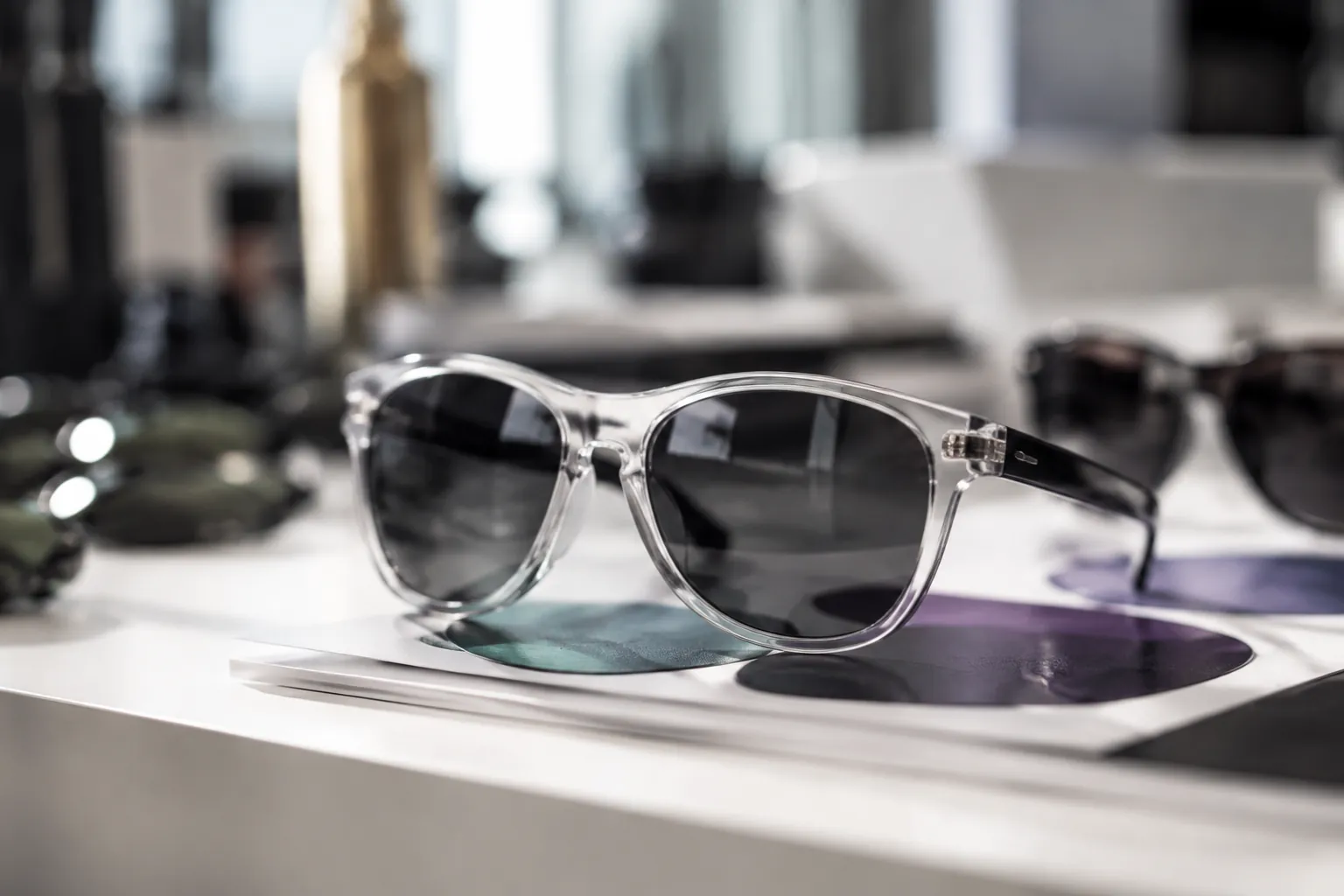
This guide is for brands, importers, retailers, and distributors choosing lens specifications for custom sunglasses. Lens thickness affects frame fit, finished weight, edge appearance, distortion risk, assembly yield, compliance testing, and unit cost. Get it wrong and problems show up fast: loose lenses, stressed corners, heavy fronts, rough edges, failed checks, or inconsistent bulk goods. The practical goal is simple. Choose a lens that fits the frame, supports the retail position, and can be measured consistently in production. Approve thickness together with material, base curve, tint, coating, frame groove, and finished-product compliance requirements.
Start With Channel, Price, and Frame Type
There is no single correct lens thickness for sunglasses. A festival giveaway, an entry-price retail style, a polarized travel program, and a premium acetate frame should not carry the same lens specification just because the drawing can accept it.
For low-cost promotional sunglasses, buyers usually prioritize light weight, fast assembly, low scrap, and a clear UV claim supported by test evidence. A 1.8 mm to 2.0 mm PC lens is often a practical starting point for simple full-rim frames, provided the finished sunglass meets the required optical, UV, impact, and labeling rules for the destination market. For mainstream fashion retail, 2.0 mm to 2.2 mm is a common working range. It can improve hand feel and edge appearance without adding too much weight. For heavier acetate, metal combination, or higher perceived-value programs, 2.2 mm to 2.4 mm may be appropriate. Only use it when the groove width, frame curve, screw tension, and edging program are designed around that lens.
Do not approve lens thickness from a rendering or product photo. Photos hide edge mass, nose weight, lens seating, bevel quality, and stress at corners. Ask for a physical sample in the target lens material, tint, coating, frame color, and decoration method. Transparent frames, brown lenses, smoke gradients, and mirror coatings expose lens defects more clearly than black frames with dark solid lenses.
Confirm lead time in the quotation and purchase order. It depends on tooling status, lens material, tint, coating, logo method, packaging, inspection level, and order quantity. A late change from 2.0 mm to 2.2 mm can trigger new edging trials, groove checks, retention checks, or another sample approval round.
Buyer rule: If the product is sold mainly by price, start with weight, yield, and required compliance. If it is sold mainly by shelf appearance, start with edge finish, tint depth, lens seating, and frame balance.
Material Behavior: PC, TAC, Acrylic, and Nylon
Thickness only makes sense when it is tied to material. A 2.0 mm PC lens, a TAC polarized lens, an acrylic lens, and a nylon lens do not behave the same during cutting, tinting, coating, assembly, drop testing, or final inspection.
| Lens material | Typical sunglass thickness | Best use | Buyer watchpoint |
|---|---|---|---|
| PC | Often 1.8-2.2 mm; heavier designs may use around 2.4 mm when the frame is designed for it | Promotional, kids, sports-inspired, general fashion, and programs needing higher impact resistance than acrylic | Needs suitable hard coating for scratch resistance; forced assembly can create stress marks or optical distortion |
| TAC polarized | Often built from laminated sheet structures; finished thickness varies by construction and supplier | Cost-controlled polarized retail sunglasses | Polarizing axis, lamination quality, edge sealing, clean edging, and delamination control matter more than nominal thickness alone |
| Acrylic | Often 1.8-2.0 mm for price-sensitive fashion or promotional styles | Simple low-cost designs where destination-market requirements can still be met | Impact performance is generally lower than PC; confirm the required standard before approval |
| Nylon | Often 1.8-2.2 mm for lightweight performance or higher-clarity programs | Sports, lightweight, premium, or optical-clarity-focused sunglasses | Higher material and processing cost; unnecessary for many basic fashion orders |
PC is a practical default for many custom sunglasses because it is moldable, tough, and cost efficient. It works well for injection frames and many fashion shapes. Still, it scratches more easily if the coating package is weak or mishandled. TAC is common when buyers want polarized sunglasses at retail-friendly cost, but the QC focus shifts to film direction, lamination quality, edge sealing, polarization efficiency, and finished-lens cleanliness. Acrylic can reduce material cost. Those savings disappear if the finished sunglass fails impact, optical, or retailer checks. Nylon can help when weight and clarity matter, but it raises cost and requires tighter process control.
During sampling, test material and thickness together on the complete sunglass. A loose lens that looks acceptable on a bench may behave differently after edging, coating, assembly, packing, and transport.
Fit Tolerances: The Groove Controls the Lens
Lens thickness is not an isolated line item. It must match the frame groove, rim stiffness, bridge shape, screw design, base curve, bevel geometry, and assembly method. Too thin, and the lens may rattle, shift, or pop out during handling or drop testing. Too thick, and it may widen the rim, crack the frame, deform the curve, or leave stress whitening near sharp corners.
For many full-rim plastic sunglasses, the lens edge must seat cleanly into a groove that is only slightly wider than the finished edge. As a production control, record the approved sample thickness and agree on a measurable tolerance with the supplier. Depending on material, lens shape, process, and inspection method, controlled lens thickness may be specified around +/-0.05 mm to +/-0.10 mm. Do not treat that as automatic. Confirm the final tolerance against actual production capability and the frame design. Check groove width, bevel shape, edge polish, and lens retention together.
For injection frames, the groove is largely fixed by the mold. Changing thickness after mold approval may require tool adjustment, a revised lens-edge program, or fresh retention testing. Acetate frames allow more hand fitting, but that does not remove risk. Tight cat-eye corners, deep bevels, and oversized square lenses can still create stress if the fitter has to force the lens into the rim.
- Measure center thickness: Record the approved sample value, measurement tool, measurement point, and tolerance.
- Check edge thickness: Compare left and right lenses, especially near corners and bridge-side edges.
- Confirm groove width: Measure the actual frame sample, not only the CAD value.
- Test lens seating: Look for proud edges, sinking, rattle, corner whitening, uneven rim gaps, and visible bevel mismatch.
- Run retention checks: Drop, flex, hinge cycling, and light pressure checks should be performed on complete sunglasses.
A 0.2 mm change can be visible at the edge and meaningful in production yield. On large acetate, oversized square, or shield-like frames, it can also change nose weight enough for consumers to notice during try-on.
Optics, Tint, and Visual Comfort
For non-prescription sunglasses, buyers sometimes assume thickness does not matter optically. That is only partly true. Plano sunglass lenses still need stable tint, acceptable optical quality, correct base curve, clean surface quality, and enough rigidity to sit in the frame without stress.
Thin lenses can flex during assembly, especially in large square, shield-like, rimless, semi-rimless, or high-wrap shapes. Flex can create stress patterns that may be visible under polarized inspection. Wearers may notice waviness through side zones if the curve is forced into a frame it was not designed for. A thicker lens can resist flex better. It will not correct a wrong base curve, poor mold, weak edging, uneven tint, or unsuitable coating.
Specify base curve, lens category, visible light transmittance target or range where required, tint color, UV claim, coating, and polarization requirement. For fashion sunglasses, the base curve may be relatively flat. For sports-inspired wrap styles, curve control matters more because distortion risk rises toward the edges. If the lens is polarized, control the polarizing axis consistently between left and right lenses. A mismatch may pass a quick visual check and still feel uncomfortable.
Tint can appear different by material and thickness. Transparent brown, smoke, green, amber, and gradient lenses can show deeper color near thicker edges. Mirrored lenses emphasize surface dust, coating pinholes, scratches, fingerprints, and wash marks. For gradient lenses, approve the actual top-to-bottom fade position on the finished sunglass, not only a loose lens sample.
For CE EN ISO 12312-1, ANSI Z80.3, and AS/NZS 1067 programs, the test issue is not thickness alone. The finished sunglass must meet the relevant optical, transmittance, UV, impact, traffic signal recognition, and labeling requirements for the claimed category and destination market.
Cost, MOQ, and Lead-Time Logic
Thicker lenses usually cost more. The increase does not come only from raw material. It can come from longer molding or forming control, higher scrap risk, more edging time, polishing, coating control, tint consistency, assembly yield, inspection time, and packing protection.
MOQ is a production and setup question, not just a sales number. Small trial orders are useful for market tests, influencer drops, retail capsules, and color trials. Keep the lens package practical unless the program needs more. As quantity increases, setup, tint trials, decoration setup, packaging work, and inspection planning are spread over more units. Exact price breaks and minimums must be confirmed by quotation because they depend on frame material, lens type, coating, logo method, packaging, inspection level, and order complexity.
| Order stage | Lens decision | Process detail | Buyer action |
|---|---|---|---|
| Small trial order | Use a practical standard thickness such as 1.8-2.0 mm PC for simple full-rim styles | Sampling, setup, and manual review can dominate unit cost | Test appearance, fit, UV claim, tint, and basic comfort before expanding |
| Initial retail order | Lock lens material, tint, coating, and thickness after sample approval | Decoration and packaging setup become more important | Approve a pre-production sample and written specification |
| Repeat or larger order | Control tolerance and compare multiple pairs, not one sample | Assembly yield and defect limits start to affect landed cost | Add thickness, edge, tint, coating, and retention checks to QC |
| High-volume program | Optimize thickness for cost, weight, compliance, and yield together | Small scrap changes can create meaningful cost differences | Approve a golden sample, AQL plan, measurement method, and defect limits before production |
Rank the program priorities before asking for price. A buyer who requests the thickest lens, polarized function, mirror coating, premium packaging, low MOQ, and the lowest possible unit cost in one brief is asking the supplier to guess which requirement should win. Decide what matters most: appearance, weight, polarization, compliance margin, delivery speed, or landed cost.
Decoration and Appearance Effects
Consumers may not know lens thickness in millimeters. They still notice cheap-looking edges, uneven tint, visible stress, and poor balance. A thin lens in a bold frame can look underbuilt. A heavy lens in a slim frame can look awkward and feel nose-heavy. Match lens mass to the design language, frame structure, and retail position.
Transparent frames expose lens edges. Crystal acetate, translucent PC, smoke, amber, bottle green, and gradient lenses make edge color variation easier to see. If the lens edge is visible through the frame, approve edge quality on a finished sunglass before bulk production. A rough, cloudy, chipped, or over-polished edge can make a good frame look cheap.
Decoration can change the lens decision even when it is not applied directly to the lens. Lens laser marking depends on coating, surface quality, mark position, and abrasion resistance. Pad printing on the temple does not change lens thickness, but it may raise the perceived retail level of the product. Metal logo plates, foil logos, heat-transfer marks, and custom temple inlays can make a very thin or poorly finished lens feel mismatched.
Mirrored lenses need extra handling control. The coating can emphasize small scratches, dust, fingerprints, and packing marks under retail lighting. For mirror programs, specify handling, cleaning, and packing requirements. For lens logos, approve position, size, contrast, and abrasion resistance on the finished lens. Then include those details in the QC checklist.
Compliance and Finished-Product Risk
Compliance is not a logo to print on a carton. It is a set of requirements tied to the finished sunglass and the market where it will be sold. Lens thickness can influence impact behavior, distortion, retention, and frame stress. It cannot compensate for the wrong lens category, weak UV evidence, incorrect labeling, or unsupported marketplace claims.
Common standards and compliance references for sunglasses include CE EN ISO 12312-1 for many European programs, ANSI Z80.3 for the United States, AS/NZS 1067 for Australia and New Zealand, REACH for EU chemical compliance, FDA registration where applicable for the U.S. business or establishment context, ISO 9001 for quality management systems, and BSCI for social compliance audits. Confirm which documents are relevant to the destination market and sales channel. Then write those requirements into the purchase order and QC checklist.
Be precise with claims. FDA registration is not the same as FDA product approval. ISO 9001 and BSCI describe management-system or audit status; they do not prove that a specific sunglass model passes optical or UV tests. UV400 or 100% UV claims must match test evidence. Category 0-4 requirements differ, and Category 4 lenses are not suitable for driving in many markets. REACH may apply to frames, coatings, colorants, nose pads, screws, decorations, and packaging inks depending on the buyer's compliance process.
Test complete sunglasses, not loose lenses only. A lens may pass a lab check by itself but fail in the selected frame because of stress, poor seating, incorrect curve, or weak retention after assembly.
What to Put on the Spec Sheet
A good spec sheet prevents the most common lens-thickness dispute: the sample looked right, bulk feels different, and nobody recorded what was approved. Keep the specification short, measurable, and tied to a physical golden sample.
For each design, include frame material, lens material, center thickness, allowed tolerance, measurement point, measurement tool, edge expectation, base curve, tint color, lens category, UV claim, coating, polarization requirement, decoration method, packaging, and approved sample reference. Add frame groove notes and inspection points. If the frame is injection molded, confirm whether the mold is being built around the chosen lens thickness. If the frame is acetate, confirm hand-fitting expectations, acceptable edge finish, and whether the lens edge should be polished, matte, or hidden in the rim.
For small trial orders, keep the lens package simple. Use sampling to decide whether 1.8 mm, 2.0 mm, or 2.2 mm fits the product position. For initial retail orders, lock the spec and packaging before production. For repeat or larger orders, run a stricter pre-production sample and check measurements across multiple pairs. For high-volume programs, approve a golden sample, measurement method, AQL criteria, defect limits, and packing standard before production starts.
- Define channel, target retail price, destination market, and required standard.
- Select frame material and lens material together.
- Sample two thicknesses if appearance, weight, distortion, or retention is uncertain.
- Test fit, distortion, tint, UV claim, polarization, coating, and lens retention on complete sunglasses.
- Approve one golden sample with measured center thickness and edge quality.
- Write the same measurement method, tolerance, defect limits, and QC checks into the purchase order.
This discipline costs less than sorting rejected cartons, replacing scratched lenses, or explaining inconsistent shelf appearance to a retailer after delivery.
Have a custom sunglasses project in mind?
Send us your styles, target market and quantities and we will return a detailed quote with MOQ, lead time and a sample plan.
Get a QuoteWhy source this from Wenzhou with LumiShades
Wenzhou in Zhejiang Province is widely regarded as China’s eyewear manufacturing capital, producing a large share of the world’s sunglasses. That concentration matters to buyers: a deep local supply chain for acetate sheet, hinges, lens blanks, plating and packaging means shorter component lead times, easier color and material matching, and a workforce with decades of eyewear-specific skill. LumiShades has manufactured in this ecosystem since 2009, and our vertical integration — in-house injection molding, acetate cutting, CNC milling, lens tinting, decoration and quality control — means no part of your order is quietly subcontracted to a workshop you cannot audit.
For international buyers, that vertical control translates into accountability. When a single factory owns every step, defects are traced and fixed at source rather than bounced between vendors, and your specifications survive intact from first sample to bulk. We back this with 15+ years of experience, shipments to 60+ countries, more than 5 million pairs produced per year and a 98.5% on-time delivery rate. Our certifications — CE EN ISO 12312-1, FDA registration, ANSI Z80.3, AS/NZS 1067, REACH, ISO 9001 and BSCI audit — mean the compliance documentation your market requires already exists. Explore our manufacturing capabilities and quality control process to see how this works in practice.
Frequently asked questions
What lens thickness should I choose for a low-cost promotional sunglass? For a simple full-rim promotional frame, 1.8-2.0 mm PC is often a practical starting point. Keep the lens shape simple, avoid high-risk finishes unless needed, and test the finished sunglass against the required UV, optical, impact, and labeling rules for the destination market. Ask the supplier to record the approved sample thickness, lens material, tint, coating, and tolerance in the purchase order.
Does a thicker sunglass lens always mean better quality? No. A thicker lens can improve stiffness, edge presence, and perceived value, but it does not fix poor curve control, weak coating, uneven tint, rough edging, or incorrect labeling. Judge quality on the complete frame-lens assembly: lens seating, distortion, UV evidence, coating quality, edge finish, retention, weight balance, and compliance with the relevant standard.
Can I use the same lens thickness across injection and acetate frames? Sometimes, but prove it by sample testing. Injection frames depend heavily on the molded groove, so a thickness change can require tooling or edging adjustments. Acetate frames allow more hand fitting, but tight corners and oversized lenses can still create stress. Check groove width, lens seating, corner whitening, edge finish, left-right consistency, and retention before approving bulk production.
Will changing from 2.0 mm to 2.2 mm affect lead time? It can. A 0.2 mm increase may require a revised lens-edge program, groove review, new assembly trial, updated retention check, or another pre-production sample. Before changing thickness, ask the supplier to confirm whether existing tooling, edging files, packaging, and QC limits still apply. Put any schedule impact in writing before approving the change.
Which compliance standards should overseas sunglass buyers ask for? Ask for the standards that match the destination market and sales channel. Common references include CE EN ISO 12312-1 for many European programs, ANSI Z80.3 and FDA registration considerations for the United States, AS/NZS 1067 for Australia and New Zealand, and REACH for EU chemical compliance. ISO 9001 and BSCI support supplier qualification, but they do not replace finished-product sunglass testing.
At what order quantity should I pay closer attention to lens thickness tolerances? Start during sampling. Even a small order should have an approved sample with recorded lens material, thickness, tint, and coating. For repeat, retailer, or larger-volume orders, tighten the process: approve a golden sample, define the measurement point and tool, set tolerance and defect limits, and include lens fit, edge finish, tint, coating, polarization if applicable, and retention checks in the QC plan.
Ready to start?
Explore our aviator sunglasses or request a quote — our sales team replies within 12 hours.
Request a Quote