
Choose Sunglass Lens Colors for Retail Sell-Through
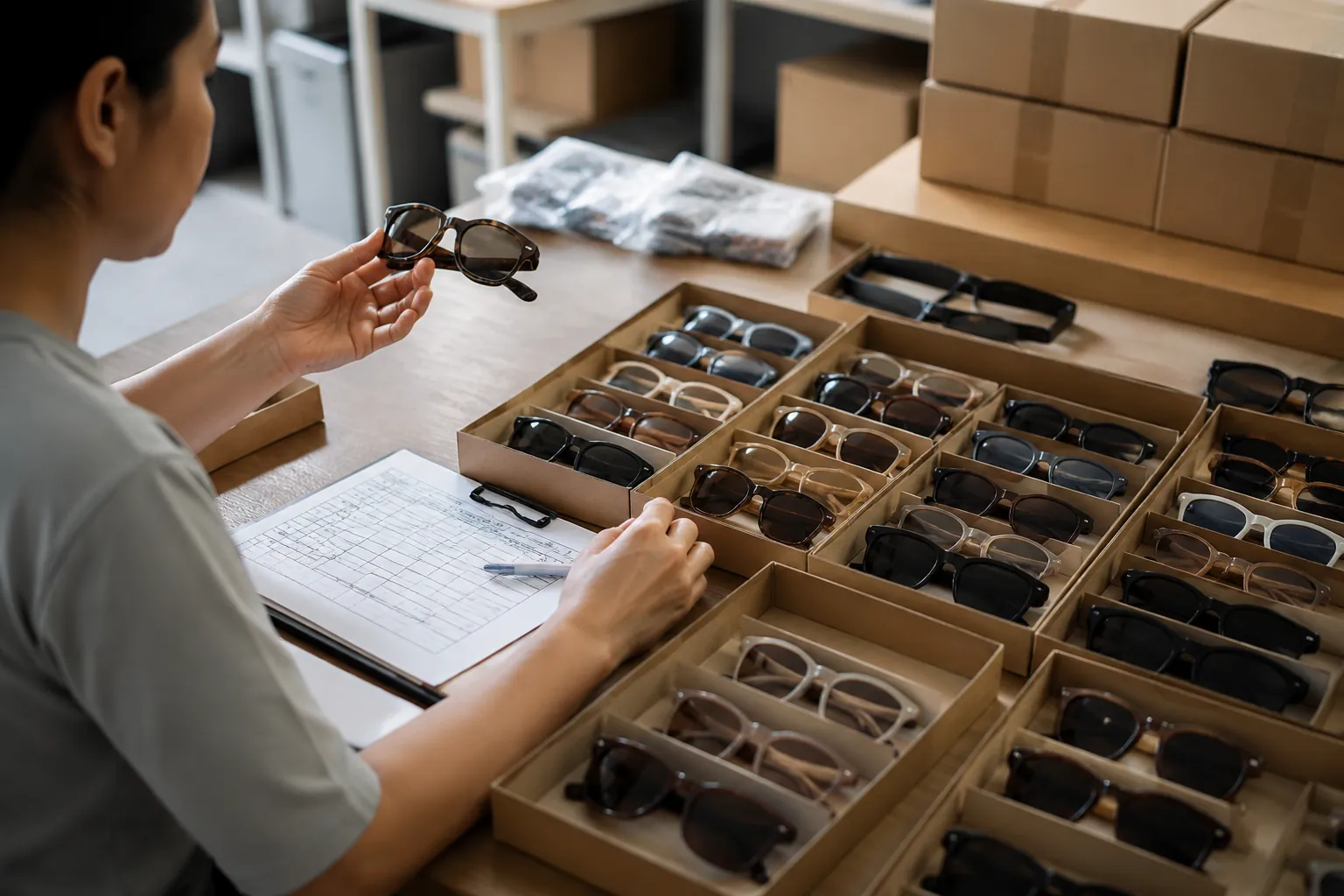
This guide is for brand owners, importers, distributors, and retail buyers choosing lens colors for custom sunglasses programs. The aim is practical: fewer weak SKUs, cleaner price tiers, stronger retail presentation, and reorders that match the approved sample. Lens color is not just a style choice. It affects visible light transmission, lens category, UV claims, coating risk, frame compatibility, inspection workload, packaging, and how confidently a buyer can repeat the product later.
Start with retail position, category, and market
Many buyers start with the color card: smoke, brown, blue mirror, green, pink, clear, or gradient. That is the wrong first step. Start with the retail position: entry promotional, fashion impulse, resort retail, outdoor lifestyle, sports accessory, optical-style fashion, or optical-adjacent retail. Then confirm the selling market and required lens category before approving the tint.
For low-price promotional frames, smoke gray or brown is usually safer than novelty color. These lenses match more frames, photograph predictably, and need less explanation in store. For a fashion capsule, transparent rose, yellow, blue, or green can work. Keep it narrow. A rose lens in polished acetate can look current. The same rose lens in a thin injection frame with poor finishing can look cheap.
For outdoor use, connect color to visible light transmission, or VLT. Dark sunglass lenses are often specified around Category 3 for bright sunlight. Lighter fashion tints may fall into Category 1 or 2, depending on transmission. Clear or very light lenses may still include UV protection, but they should not be sold as dark sun lenses unless testing supports that claim.
For regulated retail markets, check lens claims before bulk production. Common references include CE EN ISO 12312-1 for Europe, ANSI Z80.3 and FDA registration considerations for the United States, AS/NZS 1067 for Australia and New Zealand, and REACH for chemical restrictions. The point is simple. A lens color that looks good on the sample table still needs the right transmission, UV result, warning copy, and labeling for the market where it will be sold.
Lens color comparison for retail buyers
Use this table as a first filter before building a quotation sheet. It does not replace lab testing, local regulation, or a signed master sample. It does help prevent common mismatches between lens choice, retail channel, MOQ, and inspection workload.
| Lens choice | Best retail position | Typical control target | Main buyer benefit | Main risk | Reorder predictability |
|---|---|---|---|---|---|
| Smoke gray | Entry to mid-tier, travel retail, unisex, promotional programs | Stable tint density; left-right shade match checked against master sample | Neutral look, easy frame matching, broad customer acceptance | Can feel generic with weak frame colors or basic packaging | High when the same lens material, tint density, and supplier are repeated |
| Brown | Classic, outdoor lifestyle, driving-style collections | Brown tone controlled for red, yellow, or gray drift | Warmer retail look; strong with tortoise, champagne, olive, and metal frames | Batch variation is more visible than smoke | Medium to high with a retained physical master sample |
| Clear | Optical-style fashion, indoor accessory, frame-focused merchandising | UV claim, optical clarity, scratch visibility, and edge finish checked closely | Shows eyes and frame detail clearly in photos | Easy to overclaim as sunglasses if VLT and UV performance are not verified | High for color consistency, but cosmetic handling defects are easy to see |
| Colored transparent | Fashion capsules, festivals, youth retail, resort assortments | Color approved under daylight and indoor light; sample retained | Strong shelf impact and social media appeal | Higher markdown risk if the color story misses the channel | Medium because small tint shifts are obvious |
| Gradient | Women's fashion, resort, boutique retail | Fade position, smoothness, and left-right balance checked | Softer face appearance and higher perceived fashion value | Uneven fade looks cheap fast | Medium; requires stricter visual inspection |
| Mirror over smoke or brown | Sport, beach, outdoor, higher perceived value | Mirror coating color, pinholes, scratches, adhesion, and shade consistency checked | Clear price step-up and strong display impact | Coating defects and shade variation require tighter QC | Medium, especially for blue, gold, red, and rainbow mirror |
Clear lenses are a positioning tool
Clear lenses sell a different promise from dark sunglasses. They show the wearer's eyes, make the frame shape the main feature, and work well with transparent acetate, TR90, stainless steel, and thin metal styles. For retailers, clear lenses can bridge sunglass styling and optical fashion without prescription inventory.
The risk is copy and compliance. Do not describe a clear lens as a sunglass lens unless the actual specification supports the sun-protection claim. If the product is intended for sun protection, the lens must meet the relevant UV and transmission requirements for the selling market. If it is a fashion accessory with clear lenses, packaging, hangtags, and online copy should avoid language that suggests dark-sun protection.
Clear lenses also expose production quality. Finger marks, edge chips, stress marks, small scratches, dust, and poor lens-seat fit are easier to see than on smoke lenses. For clear-lens programs, approve the frame sample and the lens edge finish. Define the acceptable cosmetic defect level, cleaning standard, and whether the product needs a pouch, paper sleeve, or protective film during packing.
Clear lenses are strongest when the frame carries the value: polished acetate, clean CNC milling, consistent hinge setting, flush lens fitting, and accurate logo placement. If the frame is thin injection plastic with visible gate marks or weak surface finishing, a clear lens will make those faults more obvious.
Smoke and brown carry the volume business
Smoke gray and brown lenses are the workhorses of repeatable sunglass programs. They suit many face shapes, work across men's, women's, and unisex assortments, and reduce the need for store staff to explain the product. For buyers managing hundreds or thousands of pairs per design, that predictability matters.
Smoke gray is usually the easiest lens for a broad assortment. It keeps color perception relatively neutral and pairs with black, crystal, navy, gunmetal, silver, red, white, and printed frames. It is often the safest choice for distributors selling one SKU into several retail channels. If the buyer wants one lens color across several frame colors, smoke is usually the first candidate.
Brown is warmer and more sensitive. It makes tortoise and champagne frames look richer and fits classic, driving-inspired, and outdoor lifestyle positioning. The control issue is shade drift. A slightly red-brown, yellow-brown, or gray-brown lens can change the whole product impression. Approve a physical master sample and ask production to match against that retained sample, not only a Pantone reference or screen image.
Material matters too. PC lenses are common for lightweight, promotional, and sport-style programs. TAC polarized lenses can support a stronger outdoor story, but they require correct polarization alignment and lamination inspection. Nylon lenses are often used for higher-end sports or performance positioning, with a different cost structure. CR39 can offer good optical clarity, but it is less common for very low-cost fashion sunglasses. Select lens color together with material, frame construction, target price, and claim language. Do not leave it until the frame is already finished.
Colored, gradient, and mirror need SKU control
Colored transparent lenses can sell quickly in the right channel and stall in the wrong one. They work best in tight stories: a resort drop, a summer festival program, a youth fashion retailer, a capsule built around transparent frames, or an influencer-led color set. They are weak as the backbone of a general wholesale line because every added color raises inventory risk.
The common mistake is over-assortment. A buyer orders six lens colors across six frame colors, then each SKU is too shallow. Retailers cannot read the story. Reorders scatter. Leftover components become hard to use. A better first test is two frame colors and two lens colors, with enough quantity per SKU to measure sell-through.
- Pink and rose: strong for fashion photography and editorial styling, weaker for serious outdoor performance claims unless the tested lens category and UV result support the claim.
- Yellow and amber: useful for retro or sport-inspired stories, but buyers should confirm VLT and warning requirements because lighter lenses may not suit bright-sun positioning.
- Blue: works well with crystal, white, black, silver, and gunmetal frames; shade matching should be controlled tightly because small shifts are visible.
- Green: can look premium in classic frames, especially with tortoise or gold metal, but can look inexpensive if the tint is too bright or poorly matched.
- Gradient: useful for women's fashion and resort retail; inspection must check smooth fade, vertical position, and left-right consistency.
- Mirror: strong for sport, beach, and outdoor programs; inspection should check pinholes, coating scratches, uneven reflection, adhesion, and color shift between lenses.
Colored lenses need disciplined sampling. Ask for a daylight photo, an indoor-light photo, and a worn photo on a face, but approve by physical sample. Screens distort color. Factory lamps can distort color too. The final control point should be one retained approved sample at the factory and one with the buyer.
MOQ, price tiers, and lead-time logic
MOQ should match the purpose of the order. A small test order can work for market testing, influencer seeding, events, or a capsule launch. It should not be judged against replenishment pricing. Unit cost is usually higher on small orders because setup, lens matching, logo preparation, packing confirmation, and QC are spread across fewer pieces.
Price changes with quantity and specification. Separate simple smoke PC lens programs from products with mirror coating, polarized TAC lenses, custom gradient, metal logo plates, hard cases, barcode labels, special hangtags, or stricter inspection requirements. A transparent color trial and a large-volume smoke lens program are not the same product.
Lead time depends on frame tooling status, material availability, lens color, decoration method, packaging approval, and the number of sample revisions. Standard smoke and brown lenses are usually faster to stabilize than transparent colors, gradients, polarized lenses, and mirror coatings. Extra matching time may be needed if the buyer rejects the first shade, changes frame color after lens approval, or revises compliance copy late.
- Confirm target market and compliance requirement before lens development.
- Choose frame material and lens material together, because a premium frame with a weak lens lowers perceived value.
- Approve a physical lens color, lens material, and lens category, not only a rendering.
- Lock decoration method: laser engraving, pad printing, hot stamping, metal logo plate, or temple insert.
- Approve packaging, barcode label, hangtag copy, warning copy, and carton mark before bulk packing.
- Keep one approved master sample for future reorders.
- For reorder programs, repeat the same lens supplier, tint density, coating process, and inspection criteria where possible.
In-house production steps can reduce handoff delays, but they do not replace buyer decisions. Late changes to lens color, logo position, packaging artwork, or compliance copy still add time and may require a new sample approval.
Decoration and packaging must fit the lens story
Lens color changes how decoration reads. A smoke lens with a black frame can carry a subtle laser logo or small temple print. A clear lens on transparent acetate often needs cleaner logo placement because the full construction is visible. A mirror lens sends a stronger retail signal. Weak packaging can make it feel mismatched.
Decoration methods behave differently. Laser engraving is stable and repeatable, but contrast depends on frame material and surface color. Pad printing is flexible for color logos, but jigs must be controlled so the logo does not drift on curved temples. Hot stamping can look premium on acetate or case packaging, but foil color and pressure need approval. Metal logo plates add perceived value, but the recess must be clean and the plate must sit flat. For reorders, record logo size, color, location, process, and approved artwork version together with the lens sample.
Packaging should follow the lens position. A basic polybag or microfiber pouch can fit promotional smoke lenses if the channel accepts that level of presentation. A mid-tier brown, polarized, or mirror program may need a microfiber pouch, hard case, printed box, barcode label, instruction insert, and compliance hangtag. Packaging is not only presentation. It protects the lens surface during transport and affects carton quantity.
For visual merchandising, the lens color must read at one meter. Wall displays benefit from a controlled lens story: smoke for a clean block, brown for warmth, mirror for a sport or beach step-up, and clear for frame-focused fashion. Too many mirror or transparent colors in one display create noise. In bulk buying, that noise often becomes slow inventory.
QC points that protect reorders
Reorder predictability is where lens programs become profitable or hard to manage. The first order proves the look. The second order proves the system. Specify control points in writing before bulk production.
For lens color, QC should check tint density, left-right color match, visible defects, lens fitting, edge finish, and coating flaws where applicable. For sunglasses, UV protection and transmission must align with the claimed category and target regulation. For decorated frames, logo color and placement should be checked against the approved sample. Pad printing can shift if the jig is poor. Metal logo plates can look uneven if the recess is not clean. Laser engraving is stable, but contrast still depends on material and surface color.
A practical inspection flow includes incoming material checks, in-process checks after lens cutting or tinting, assembly inspection, cleaning inspection, and final inspection before packing. Agree on the sampling method and acceptable quality limits before production starts. For gradient lenses, inspectors should compare fade height and smoothness between left and right lenses. For mirror lenses, they should check coating scratches, pinholes, uneven reflection, adhesion, and obvious color difference. For clear lenses, they should inspect under strong light because dust, stress marks, and edge chips are easier to see.
Capacity claims mean little if the factory cannot repeat the approved item cleanly. Freeze specifications early enough for the production schedule to hold. Keep the approved sample, final carton mark, packaging artwork, lens category, compliance file, lens material, coating details, and decoration record together. Months later, nobody should be guessing which brown lens, mirror coating, warning copy, or packaging specification was used.
Have a custom sunglasses project in mind?
Send us your styles, target market and quantities and we will return a detailed quote with MOQ, lead time and a sample plan.
Get a QuoteWhy source this from Wenzhou with LumiShades
Wenzhou in Zhejiang Province is widely regarded as China’s eyewear manufacturing capital, producing a large share of the world’s sunglasses. That concentration matters to buyers: a deep local supply chain for acetate sheet, hinges, lens blanks, plating and packaging means shorter component lead times, easier color and material matching, and a workforce with decades of eyewear-specific skill. LumiShades has manufactured in this ecosystem since 2009, and our vertical integration — in-house injection molding, acetate cutting, CNC milling, lens tinting, decoration and quality control — means no part of your order is quietly subcontracted to a workshop you cannot audit.
For international buyers, that vertical control translates into accountability. When a single factory owns every step, defects are traced and fixed at source rather than bounced between vendors, and your specifications survive intact from first sample to bulk. We back this with 15+ years of experience, shipments to 60+ countries, more than 5 million pairs produced per year and a 98.5% on-time delivery rate. Our certifications — CE EN ISO 12312-1, FDA registration, ANSI Z80.3, AS/NZS 1067, REACH, ISO 9001 and BSCI audit — mean the compliance documentation your market requires already exists. Explore our manufacturing capabilities and quality control process to see how this works in practice.
Frequently asked questions
Which lens color is safest for a first custom sunglasses order? Smoke gray is usually the safest first order because it works across many frame colors, has broad customer acceptance, and is easier to reorder consistently. Brown is also strong if the brand has a classic, outdoor, or driving-style position. For a first buy, approve one physical master sample, confirm the lens category and UV claim for the selling market, and avoid spreading the order across too many lens colors.
Can I test colored lenses with a small MOQ? Yes, if the supplier offers a small MOQ for the chosen frame, lens, logo, and packaging specification. Use a small order for market testing, events, capsules, or influencer seeding, not as a benchmark for large-volume pricing. To make the test useful, keep the assortment tight, give each SKU enough quantity to measure sell-through, and record which lens color, frame color, and retail channel performed best.
Do clear lenses count as sunglasses? Only if the actual lens specification supports the sun-protection claim and meets the required standard for the selling market. Clear or very light lenses may have UV protection, but they should not be marketed as dark sunglasses unless VLT, UV performance, labeling, and warning copy support that position. Ask for the applicable test report or compliance file before approving packaging and online copy.
How do I avoid color drift on a reorder? Approve and retain a physical master sample, record the lens material, tint density, coating process, supplier reference, and inspection criteria, and ask production to match against that sample. For brown, colored transparent, gradient, and mirror lenses, physical sample control is more reliable than screen images. On the reorder PO, reference the approved sample and require left-right shade matching during inspection.
Which compliance standards should overseas buyers ask about? Ask based on the selling market. For Europe, check CE EN ISO 12312-1 and REACH. For the United States, ask about ANSI Z80.3 and FDA registration requirements where applicable. For Australia and New Zealand, ask about AS/NZS 1067. ISO 9001 and BSCI relate to factory management and social compliance; they do not replace product testing for UV protection, VLT, lens category, labeling, or warning copy.
Do mirror lenses increase lead time? They can. Mirror lenses add coating color approval and extra inspection points such as pinholes, scratches, adhesion, uneven reflection, and color difference between the left and right lenses. Build time into the schedule for physical sample approval, and avoid changing frame color after the mirror shade is approved because the same coating can look different on a different frame.
Ready to start?
Explore our aviator sunglasses or request a quote — our sales team replies within 12 hours.
Request a Quote