
Keeping Sunglass Lens Tints Consistent on Reorders
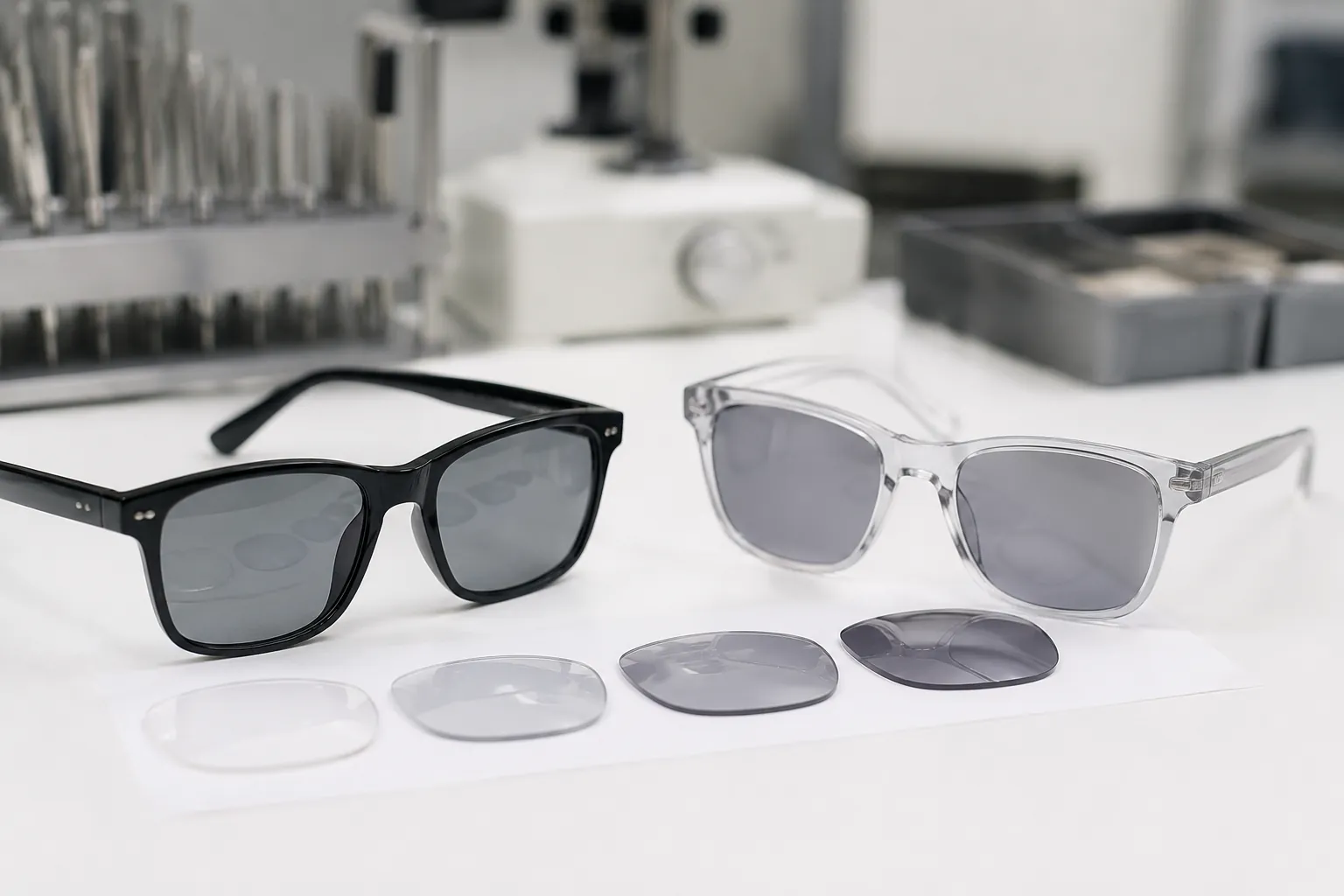
This guide is for overseas brands, importers, distributors, and retail buyers who reorder private label sunglasses and need lens shade, protection category, and retail appearance to stay consistent from shipment to shipment. A small tint shift can make a reorder look like a different SKU when old and new stock sit together. The control work is practical: approved physical samples, lab dips on the intended lens material, visible light transmission targets, written tolerances, retained samples, production batch records, and reorder approvals tied to the correct sample code.
Start With A Physical Tint Standard
The first control point is the approval standard. Do not approve lens color only from a phone photo, catalog render, or supplier mockup. Images help with discussion. They are not production standards. Camera white balance, monitor brightness, background color, lens angle, and mirror reflection can all change the apparent shade. A smoke lens can look blue on one screen and brown on another.
For private label sunglasses, the approval standard should be physical. Use an approved master lens, an approved finished sample, or a controlled color reference. Treat color chips and digital files as support only. The final approval should come from the actual lens construction. For solid tints, retain the full lens or finished pair. For gradient lenses, the reference must show top, center, and bottom density after cutting. For mirror lenses, retain the finished lens because the buyer is approving both the outside reflection and the wearer-side base tint.
A useful reorder file includes matched retained samples: one held by the buyer and one held by the factory or production office. Each sample should be labeled with model number, SKU, lens material, tint name or code, intended sunglass category, measured VLT result, order date, PO number, approval date, and approver name. The label should also state whether the sample is a lab dip, pre-production sample, first article, or final bulk reference.
Practical rule: use images to explain direction, then lock the shade with a physical sample and a written production record. If the supplier cannot identify the exact retained sample for the reorder, treat the tint as unconfirmed.
Match The Reference To The Lens Type
Different lens constructions need different controls. A solid grey PC lens is easier to repeat than a brown gradient TAC polarized lens with a blue flash mirror. Frame color also changes perception. A honey acetate frame can make a brown lens look warmer. A black TR90 frame can make the same lens appear colder or darker.
| Lens style | Best reference | Main drift risk | Suggested control point |
|---|---|---|---|
| Solid smoke, brown, or G15 green | Master lens plus measured VLT target | Dye concentration, bath condition, dip time, lens material variation | Approve shade and intended Category 2 or Category 3 result before bulk tinting |
| Gradient lens | Cut lens or finished pair showing top, center, and bottom density | Withdrawal speed, gradient height, lens size, lens curve | Define transition position and darkest/lightest zones before production |
| Mirror lens | Finished lens with base tint and mirror coating | Base tint shift, coating thickness, coating process, viewing angle | Approve front reflection and wearer-side color under fixed lighting and angle |
| Polarized TAC lens | Finished polarized lens or approved sheet/lens batch | Lamination tone, polarizing film color, axis alignment, VLT shift | Check tint, VLT, category, and polarization axis together |
| Transparent fashion tint | Physical lens reviewed on white, neutral grey, and skin-tone backgrounds | Small hue or density errors are highly visible | Set visual tolerance and confirm any product-page or label claims |
If a brand sells a core model every season, tint should be treated as a controlled component. Handle it with the same discipline as hinge type, lens curve, logo color, or temple length. The supplier should know the priority before sampling starts: fashion appearance, sun protection category, exact repeat of a previous shipment, or a retail-wall match across multiple frame colors.
Use Lab Dips To Define The Production Window
A lab dip is a controlled tinting trial before bulk production. It should not be a random set of attractive colors. It should be built around the buyer's target, the real lens material, the planned coating route, and the intended sunglass category. PC, TAC, nylon, acrylic, and CR39 do not absorb dye or transmit light in the same way. Lens thickness, base color, hard coating, curve, and supplier batch can also affect the final appearance.
A disciplined lab dip set usually includes three to five options: target, slightly lighter, slightly darker, and, where needed, warmer or cooler. For a reorder, compare lab dips against the previous approved sample, not only against a new design file. If the retained sample has aged, scratched, yellowed, or lost mirror brightness, record that condition before approval. The factory should not be asked to match a damaged reference without context.
- Confirm lens material, thickness, base color, curve, coating, and supplier route.
- Set the intended sunglass category before adjusting color.
- Run lab dips on the same material and coating route planned for bulk production.
- Review samples under D65 daylight simulation or another consistent, documented light source.
- Record dye formula or recipe code, concentration, bath temperature, dip time, withdrawal method, and drying method.
- Measure visible light transmission on the approved option using the agreed test method.
- Approve one sample as the bulk reference and record where buyer and factory retained samples will be stored.
For many commercial solid sunglass tints, buyers define VLT tolerance in percentage points around the approved sample. Use a stated target and an upper/lower range. The correct range depends on the category, product claim, market requirement, and brand tolerance. Gradients and mirrors also need visual approval criteria because one VLT reading may not describe the full lens appearance.
Sample timing should be confirmed by the supplier based on material availability, coating route, decoration method, and required testing. Complex samples can take longer. Polarized gradients, custom mirror colors, and paired frame-and-lens color matching all require more coordination because tint, coating, logo decoration, assembly, and inspection interact. Approve lab dips early, before bulk materials and production slots are locked.
Tie Shade Approval To Category And VLT
Lens color approval cannot be separated from visible light transmission. A lens may look right and still miss the intended protection category. That matters in regulated markets. It matters even more when product pages, hangtags, packaging, or retailer specifications make sun protection claims.
Sunglasses are often planned around Category 2 or Category 3 use, depending on the market and intended purpose. Category 2 lenses are generally lighter and often used for moderate sunlight or fashion-led styles. Category 3 lenses are darker and common for bright sunlight. Very light fashion lenses may fall below Category 2. Very dark lenses may require specific warnings or use restrictions. Darker is not automatically better. The measured result, product claim, warning label, and sales market must align.
Relevant compliance references include CE EN ISO 12312-1 for many European market sunglasses, ANSI Z80.3 for non-prescription sunglasses in the United States, and AS/NZS 1067 for Australia and New Zealand. REACH is relevant to chemical compliance for materials and coatings sold into the European market. FDA registration may be relevant to the US eyewear supply chain, but it is not a substitute for lens performance testing. ISO 9001 and BSCI relate to management system and social compliance documentation; they do not prove that a specific lens batch meets the required optical category.
For reorders, ask the supplier to record the approved sample's measured VLT result, intended category, and test method. Avoid instructions such as "dark smoke" or "same as last order" without a sample code. A stronger instruction is: "Model LS214, smoke PC lens, target Category 3, approved sample VLT 12%, agreed bulk range 10% to 14%, compare to retained sample LS214-2024A." That gives QC a measurable standard instead of a subjective color note.
Account For Material And Process Behavior
Lens material is one of the most common reasons a reorder shifts. PC is widely used for durable injection-molded sunglass lenses. TAC is common for polarized sunglasses and includes lamination layers that can influence tone. Nylon may be used for certain performance or flexible lens designs. CR39 has different optical and processing behavior. Do not assume a tint recipe will transfer cleanly from one material to another.
Coatings also matter. Hard coating can change dye absorption or final tone. Mirror coating depends on base tint, coating thickness, coating process settings, and viewing angle. A blue mirror over grey is not the same visual product as a blue mirror over brown. Anti-reflective, hydrophobic, or oleophobic treatments can slightly change final appearance. Approve the finished lens construction, not only an uncoated blank.
Decoration and frame finishing can affect how the tint is perceived in the final product. Review lens color after the frame color, logo method, and packaging or display environment are known. Common private label decoration methods include pad printing, heat transfer, metal logo inlay, laser marking, temple plaque, debossing, and color-filled engraving. A bright white temple logo beside a transparent fashion lens can make the lens look darker by contrast. A gold logo and warm acetate can make a brown lens look richer.
Acetate frames create a different visual setting than injected PC or TR90 frames because cutting, tumbling, polishing, and hand assembly affect the finished look. Metal plating can affect perceived lens warmth. Rimless and semi-rimless styles expose more of the lens, so small tint variation becomes easier to see. If lens color is part of the SKU identity, approve the production sample as a finished pair.
Build A Batch Record The Factory Can Repeat
A reorder succeeds when the production team can recreate the approved conditions. Lens tinting is process control, not just color selection. The batch record should be detailed enough for a different shift, operator, or production planner to run the job without relying on memory.
- Model number, SKU, frame color, lens code, order quantity, and PO number.
- Lens material, thickness, curve, coating, supplier, and supplier batch where applicable.
- Dye formula or tint recipe code, including concentration and adjustment notes.
- Bath temperature, dip time, withdrawal method, drying method, and bath change or maintenance schedule.
- Gradient position measured from lens top, lens center, datum line, or fitting reference point.
- Mirror coating color, coating supplier or process route, and approved viewing angle.
- Measured VLT result, intended sunglass category, test method, and agreed tolerance range.
- Approved sample location, approval date, approver name, and buyer comments.
- First article result, in-process check, final inspection result, carton batch code, and shipment reference.
When tinting, frame production, decoration, assembly, and QC are managed under one production system, the batch record should connect those steps. That record helps explain whether a later difference came from tinting, lens material, coating, frame color, decoration, or inspection conditions. It also gives the buyer usable evidence for the next reorder.
MOQ and price logic can affect tint control. Buyers may start with a small production run to validate a colorway, then move to larger quantities after sell-through is proven. Small runs can be easier to keep within one controlled tint batch but may carry a higher unit cost. Larger runs can improve unit cost because setup, material purchasing, decoration fixtures, and inspection time are spread across more pairs. They also need stronger in-process checks because production may run longer, more lens blanks may be used, and finished cartons may be split across shipments or destinations.
Set Bulk Tolerances Before Production
Many tint disputes happen because nobody defined what counts as acceptable. The buyer says the lens is off. The factory says it is within normal production variation. Both claims may be understandable if the approval file does not define a measurable range. Set the tolerance before bulk production starts.
For solid tints, use side-by-side comparison under fixed lighting plus measured VLT. For standard smoke, brown, and green lenses, write the tolerance as an upper and lower VLT limit around the approved sample. Visual review is still required. For gradients, define the darkest zone, lightest zone, fade direction, and transition position after cutting. For mirrors, define the acceptable reflection tone and check it at a consistent angle because a flash mirror can look different when tilted.
Bulk QC should include first article approval before the full run, an in-process check, and final inspection. On larger orders, add interval checks by tray, production hour, or carton batch. If a tint bath or coating result drifts during production, the in-process check should catch it before the entire order is affected. Do not skip first article approval just because the supplier made a similar color in a previous season.
Lead time should reflect this control work. The supplier should confirm timing after sample approval, material confirmation, decoration approval, and required testing are complete. A simple PC smoke lens with one-color temple printing generally has fewer approval dependencies than a polarized gradient lens with custom mirror coating, metal logo inlay, and third-party testing. If tint approval is delayed, shipment may move because bulk tinting, assembly, inspection, and packing depend on that approval.
Control Reorders With Samples And Carton Codes
The reorder file is where many brands lose control. A buyer sends last year's PO and writes "same as before." The factory pulls a similar lens code. The result may be close. Close can still be a commercial problem when old and new stock share the same shelf or when distributors compare shipments side by side.
For each reorder, confirm the retained sample code held by the factory or send the previous approved sample back for matching. Use photos only as supporting notes. Ask for a new pre-production sample if the lens material, coating supplier, mirror finish, frame color, decoration method, compliance target, or packaging/display environment has changed. Even a small material substitution can shift shade or VLT.
Carton and inner-box labels should identify the lens tint code and production batch, not only the frame model. This helps distributors separate shipments if a later batch needs review. It also helps customer service answer retailer questions without opening random cartons. A useful carton note may include model, frame color, lens code, category, batch number, production date, and PO number.
Before approving the next PO, ask direct questions. Does the supplier still have the approved lens sample? Will bulk use the same material, thickness, coating, and supplier route? What VLT and category will be targeted? Will a lab dip or pre-production sample be sent? How will gradient height or mirror tone be checked? What inspection method will be used? What batch details will appear in the QC report? A supplier that controls tint well should be able to answer with records, sample codes, and measured results.
Have a custom sunglasses project in mind?
Send us your styles, target market and quantities and we will return a detailed quote with MOQ, lead time and a sample plan.
Get a QuoteWhy source this from Wenzhou with LumiShades
Wenzhou in Zhejiang Province is widely regarded as China’s eyewear manufacturing capital, producing a large share of the world’s sunglasses. That concentration matters to buyers: a deep local supply chain for acetate sheet, hinges, lens blanks, plating and packaging means shorter component lead times, easier color and material matching, and a workforce with decades of eyewear-specific skill. LumiShades has manufactured in this ecosystem since 2009, and our vertical integration — in-house injection molding, acetate cutting, CNC milling, lens tinting, decoration and quality control — means no part of your order is quietly subcontracted to a workshop you cannot audit.
For international buyers, that vertical control translates into accountability. When a single factory owns every step, defects are traced and fixed at source rather than bounced between vendors, and your specifications survive intact from first sample to bulk. We back this with 15+ years of experience, shipments to 60+ countries, more than 5 million pairs produced per year and a 98.5% on-time delivery rate. Our certifications — CE EN ISO 12312-1, FDA registration, ANSI Z80.3, AS/NZS 1067, REACH, ISO 9001 and BSCI audit — mean the compliance documentation your market requires already exists. Explore our manufacturing capabilities and quality control process to see how this works in practice.
Frequently asked questions
Can we approve lens tint from a Pantone reference? Use Pantone only as a color direction tool, not as the final approval standard. Sunglass lenses are transparent or semi-transparent, curved, affected by thickness and coatings, and viewed over changing backgrounds. Approve a physical lens or finished pair, record the measured VLT, define the intended sunglass category, and keep retained samples with matching sample codes on both buyer and factory sides.
How many lab dip options should we request for a reorder? For most solid tint reorders, request at least three options: target, slightly lighter, and slightly darker against the retained approved sample. Add warmer or cooler options if the previous batch had a visible color cast, if the frame color has changed, or if the sales channel is sensitive to retail-wall matching. For gradient, mirror, or polarized lenses, approve the finished lens construction because base tint, coating, lamination, and VLT must be checked together.
Does changing from PC to TAC affect the same tint color? Yes. PC, TAC, nylon, CR39, and acrylic can absorb dye and transmit light differently. TAC polarized lenses also include lamination layers and polarizing film that can affect tone and VLT. Treat any material change as a new approval: confirm physical shade, wearer-side view, VLT, intended category, coating route, and any market compliance requirement before bulk production.
What is a practical VLT tolerance for sunglass reorders? Set the VLT tolerance as a written upper and lower limit around the approved sample before production starts. Many commercial programs use a narrow range in VLT percentage points, but the correct tolerance depends on the intended category, claim, lens color, material, and buyer requirements. Do not rely on VLT alone for gradients or mirrors; also define visual criteria such as gradient position, darkest and lightest zones, mirror reflection tone, and review angle.
What records should we keep after approving bulk production? Keep the approved physical sample, sample code, lens material, coating route, tint recipe or batch code, measured VLT, intended category, tolerance range, test method, inspection report, PO number, shipment date, and carton batch code. For reorders, also record whether the same material supplier, coating supplier, and lens construction were used. These records let the next order be checked against evidence instead of memory.
When should we ask for a new pre-production sample instead of repeating the old approval? Ask for a new pre-production sample whenever the lens material, lens supplier, coating supplier, mirror process, frame color, decoration method, packaging/display environment, compliance target, or product claim changes. Also request one if the retained sample is missing, damaged, yellowed, scratched, or not clearly linked to the previous PO. A reorder should only proceed from the old approval when the supplier can confirm the retained sample and production route are still valid.
Which compliance standards matter for sunglass lens tint? Use the requirement for the sales market and product claim. CE EN ISO 12312-1 is commonly used for sunglasses sold into Europe, ANSI Z80.3 applies to non-prescription sunglasses in the United States, and AS/NZS 1067 applies to Australia and New Zealand. REACH relates to chemical compliance for materials and coatings. FDA registration, ISO 9001, and BSCI documentation may be relevant to supplier qualification, but they do not replace batch-specific lens performance testing.
Ready to start?
Explore our shield & oversized sunglasses or request a quote — our sales team replies within 12 hours.
Request a Quote