
UV400 vs Polarized vs Mirrored Lenses
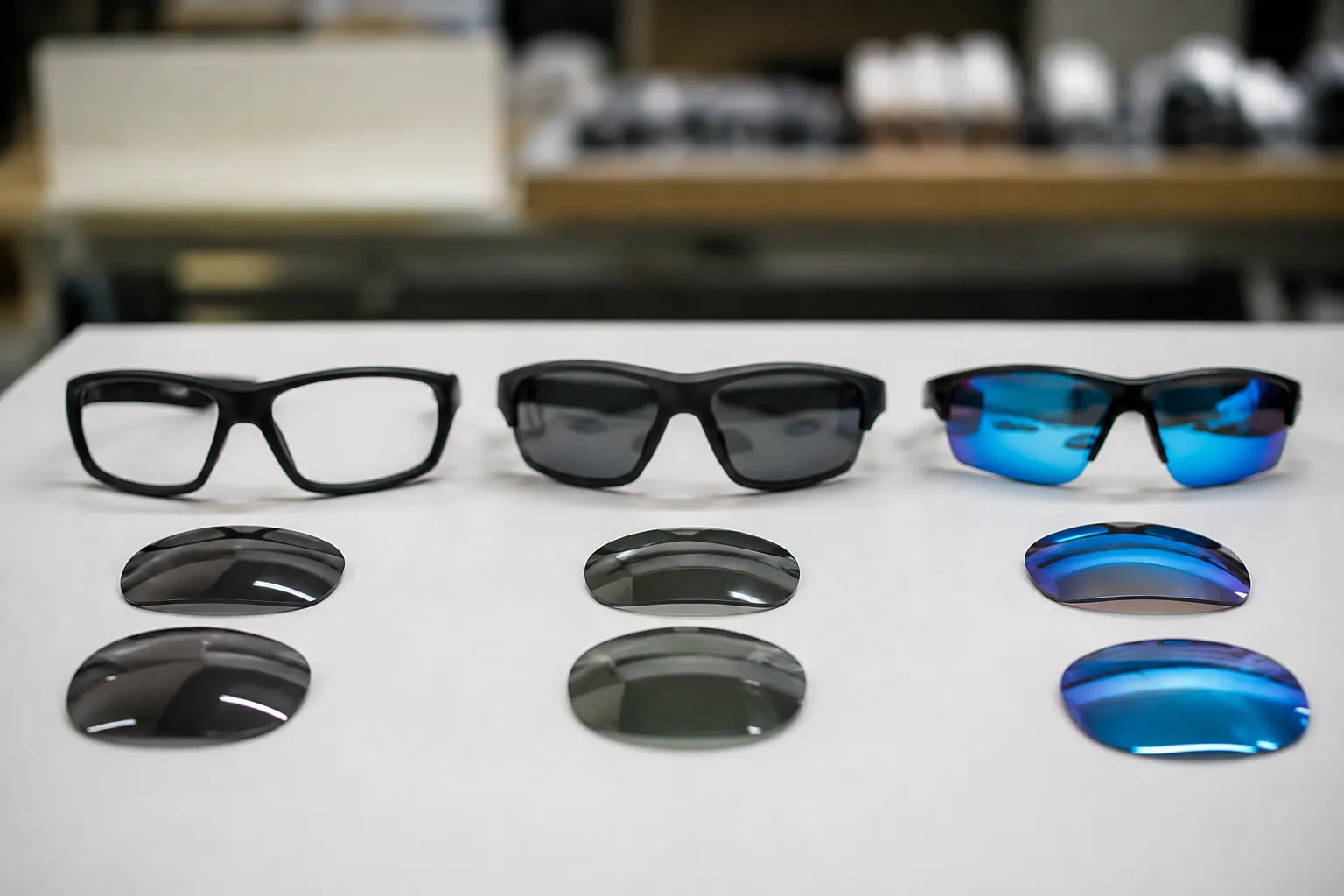
If you buy sunglasses for retail, wholesale, or private label, lens spec is not a cosmetic detail. It affects margin, sell-through, returns, and how easy the line is to merchandise. UV400, polarized, and mirrored lenses solve different problems. The right choice depends on channel, customer intent, and production economics. This guide breaks down what each spec does, where it sells best, and how to source it without paying for features your channel cannot use.
Start with the selling job
Buyers often ask for UV400, polarized, and mirrored lenses as if they were interchangeable. They are not. UV400 describes ultraviolet protection. Polarization reduces glare from reflected light. Mirroring adds a reflective surface finish that changes appearance and brightness. If you are buying for a pharmacy chain, a resort shop, an online storefront, or a fashion label, the right mix is different in each case.
The commercial question is simple: what helps the customer choose this pair, and what creates avoidable returns? A commuter wants less glare on wet roads. A parent wants a clear UV protection message. A fashion shopper wants color and shelf impact. A channel buyer wants a SKU that is easy to explain, stock, and reorder. Spec the lens to the channel first. Then choose plain, polarized, mirrored, or a combination.
In practice, a strong sunglasses program usually starts with one stable frame platform and several lens variants. That keeps tooling fixed and gives the sales team different price points. It also reduces QC variables. If the frame, fit, and temple geometry stay constant, the supplier only needs to manage lens color, coating, and transmission targets across variants.
Rule of thumb: protect first, control glare second, style last. Reverse that order and you usually pay for features the channel cannot sell.
A supplier should be able to explain the lens build, the coating sequence, and the inspection steps for each variant. If that answer is vague, the spec is not ready for bulk approval.
What each spec does
These three specs solve different problems. UV400 is the baseline. Polarization is functional. Mirroring is visual. Treat them as separate decisions, not one bundled upgrade.
| Spec | Primary function | Typical target range | Buyer value | Main trade-off |
|---|---|---|---|---|
| UV400 | Blocks UVA and UVB up to 400 nm | UV transmission near 0% in the UVA/UVB range | Clear protection message, broad market acceptance | Does not reduce glare by itself |
| Polarized | Filters horizontal reflected glare | Visible light transmission depends on tint and use case | Useful for driving, fishing, boating, snow, and golf | Can affect screen readability and some dashboard visibility |
| Mirrored | Reflective outer coating that reduces visible brightness and increases visual impact | Usually applied over a tinted base lens | Strong fashion and sport appeal, strong shelf presence | Surface defects and scratches are more visible if coating quality is weak |
UV400 is the minimum serious buyers should expect. It is not premium. It is the basic protection claim consumers understand. Polarized lenses add a light-filtering function through a polarizing layer or film aligned to reduce reflected glare from flat surfaces such as roads, water, snow, glass, and wet pavement. Mirrored lenses are mainly a merchandising and styling tool. They help the product stand out on a peg hook, read well in lifestyle photography, and look more premium at first glance. They do not replace UV protection.
One common mistake is buying mirrored lenses without checking the base tint, transmission, and coating build. A mirror layer can sit on a lens that is too dark for some use cases, too light for the retail channel, or too reflective for camera-heavy e-commerce. Specify the stack from the inside out: substrate, tint, transmission, then mirror finish.
The base lens material matters too. CR-39 and polycarbonate behave differently under coating and impact. Polycarbonate is lighter and generally more impact resistant. CR-39 is known for clear optics and tint consistency. Confirm the substrate before approving a lens spec. The same UV400 claim can feel different once the lens is in hand.
Which spec sells by channel
Channel matters more than style charts. A supermarket program, a golf shop, and an online fashion drop all reward different lens behavior. The best sellers are usually the easiest SKUs to explain, restock, and photograph.
| Channel | Best-selling spec | Why it moves | Buyer caution |
|---|---|---|---|
| General retail / convenience | UV400 + light mirror or plain tint | Easy to explain, low hesitation, broad appeal | Do not overprice with full polarization unless the channel can clearly sell the value |
| Outdoor and sport shops | Polarized + UV400 | The benefit is immediately legible to the shopper | Check lens color and transmission for the intended activity |
| Fashion / boutique | Mirrored + UV400 | Strong shelf impact and social media visibility | Keep colorways tight; too many options slow replenishment |
| Driving / travel | Polarized gray or brown + UV400 | Clear use case, easy selling story | Avoid extremely dark lenses that can reduce comfort at dusk |
For many buyers, the fastest-moving SKU is not the most technical one. It is the easiest one to explain at the point of sale and the easiest one to reorder. UV400 with a good tint often wins in price-sensitive channels because it keeps the assortment clean and the landed cost predictable. Polarized earns its keep where customers actively want glare reduction. Mirrored usually wins on first impression, especially for seasonal programs and fashion refreshes.
Channel also determines how many options you should carry. A chain store may only need two or three lens variants per frame: plain UV400, one polarized color, and one mirrored color. A DTC brand can support more styles, but too many lens options create operational drag. Every extra combination adds sampling time, inventory risk, and photo assets. The best assortment is the one sales can explain without a product cheat sheet.
If you sell into multiple channels, keep the same frame and run lens variants by market. That reduces mold count, simplifies fit testing, and lets you compare sell-through without changing several variables at once.
Where polarization is worth it
Polarized lenses cost more because the process includes a film or layered treatment that must be aligned and laminated correctly. That extra step makes sense only if the buyer can feel the difference. The strongest use cases are driving accessories, fishing, boating, snow sports, golf, and premium outdoor retail. In those categories, glare reduction is not a nice-to-have. It is the reason the customer is buying.
From a factory perspective, polarization adds process control requirements. The polarizing axis must be oriented correctly, lamination pressure needs to be stable, and optical inspection has to catch edge issues or non-uniformity before packing. Buyers should ask whether the supplier checks polarizing performance on a sample basis, not just by visual inspection. A lens can look fine on the line and still underperform if the axis is off.
Polarized lenses also affect screen readability. Shoppers may notice dimmer phone screens, distorted LCD dashboards, or reduced visibility on some navigation units. That is not a defect. It is the trade-off. The issue is channel fit. Urban fashion lines, low-price impulse programs, and screen-heavy commuter assortments often sell better with UV400-only or lightly mirrored lenses because the use case is broader.
- Best use cases: driving, fishing, boating, snow, golf, and outdoor performance retail
- Less suitable: pure fashion lines, low-price impulse buys, and screen-heavy urban use
- Buyer check: confirm the target lens color, transmission, and use case before bulk approval
- Production check: require axis verification and edge inspection before shipment
If you are building a mixed assortment, use polarization on a minority of SKUs and keep the rest UV400-only. That holds down landed cost while giving your sales team a clear premium step-up.
Why mirrored lenses move in fashion
Mirrored lenses win because they sell the look fast. Customers notice the flash before they evaluate technical features. In fashion retail, that is enough. In private label programs, mirror color can also separate one collection from another without changing the frame or the core fit.
The problem is quality control. Mirror coatings are visible, so defects are visible. Poor adhesion, uneven reflectivity, pinholes, and edge lift all stand out immediately. Scratches also show more quickly on a mirrored surface than on a plain tinted lens. Buyers should ask how the mirror layer is applied, what inspection criteria are used, and whether transit packaging protects the lens face from rub damage.
Decoration sits in the same visual system. If the frame uses pad printing, laser engraving, metal badges, or hot stamping, the lens finish and frame branding need to read as one product. A cloudy mirror or a misregistered logo can drag down the whole SKU. That is why some suppliers keep mirror programs tightly controlled. A mirrored line has less tolerance for cosmetic inconsistency than a simple tint.
In process terms, mirrored lenses are often built as a tint base plus reflective coating, followed by inspection under angled light to catch defects. If a supplier cannot describe the stack clearly, be cautious. The coating affects more than color. It changes how the lens reflects light, especially on darker tints.
Choose mirror colors from sales data, not personal taste. Blue, silver, gold, and rainbow finishes all have a place, but too many colors complicate inventory and slow replenishment. For most buyers, three good mirror options beat eight speculative ones. The goal is a focused assortment that turns quickly, not a long color list that looks good on a mood board and stalls in the warehouse.
Cost, MOQ, and lead time
Lens choice affects cost, but assortment fragmentation usually has the bigger effect. A plain UV400 lens is simpler to produce than a polarized or mirrored version. Still, the real cost driver is often how many colors, coatings, and SKUs you split the order into. Every split adds setup time, QC touchpoints, and leftover inventory risk.
| Lens option | Typical cost direction | Practical MOQ impact | Lead time impact |
|---|---|---|---|
| UV400 plain tint | Lowest | Easiest to hold at 50 pairs/design | Usually closest to standard sample and bulk timing |
| UV400 + mirrored | Moderate | Works well at 50 pairs, more efficient at 300+ pairs per color | May add inspection time for coating quality and edge checks |
| UV400 + polarized | Higher | Better economics at 300/1000/5000+ pairs | Can extend bulk if film sourcing, lamination, or axis control needs synchronization |
For custom eyewear programs, MOQ logic usually follows setup effort and process stability. Small runs are possible, but they become more expensive per pair when you ask for multiple lens colors, special mirror shades, or split shipments. A 50-pair order can work for a sample-worthy fashion launch or a small test program. Once you move to 300 pairs and above, the economics improve because the line spends less time resetting for each color or coating.
Discuss MOQ and timing before sampling. If the supplier says a lens variant is possible, ask whether it is a standard build or a new process. Standard builds are easier to schedule. New colors, new coatings, or new artwork should be treated as development work, which usually takes longer than a reorder of an approved spec.
Lead time depends on whether the lens spec is already proven and whether the order adds decoration. For a straightforward project, samples often take 7 to 10 days and bulk 25 to 35 days. If the buyer requests new mirror colors, special logo decoration, or a fresh transmission target, expect the timeline to move toward the longer end. The supplier needs to confirm finish stability before full production.
Material and process choices change timing too. A simple tinted UV400 lens with standard pad printing is faster than a polarized lens with multi-step inspection or a mirror finish that needs extra visual review. Lock the exact lens spec at sampling, then keep the bulk order unchanged. Reopening the spec after sample approval is one of the easiest ways to add days to the schedule.
How to spec without creating returns
Most returns come from expectation gaps, not from the lens itself. The customer thought the glasses would be darker, clearer, or less reflective than they are. The buyer has to control that gap through the spec sheet, product page copy, and sample approval process.
Start with the use case, then write the spec. Fashion, driving, sport, and general retail are not interchangeable contexts. Next, choose one primary promise. If the message is UV protection, do not overemphasize glare reduction. If the message is glare reduction, do not bury the customer in style language. Clear positioning makes the product easier to sell and easier to review.
- Define the channel use case first: fashion, driving, sport, or general retail.
- Choose one primary promise: UV protection, glare reduction, or visual style.
- Lock lens color, mirror effect, and target transmission before sampling.
- Approve the sample under real light, not only under showroom LEDs.
- Check logo placement, coating edge quality, and scratch resistance before bulk.
For production approval, ask for concrete lens data. Know the visible light transmission target, the substrate type, and the mirror finish level. A gray polarized lens for driving behaves differently from a brown polarized lens for outdoor sport. If the supplier cannot state the intended use and finish clearly, the bulk order is already at risk.
Compliance language also needs discipline. Use only the standards and registrations you can support with real documentation. Depending on the market, that may include CE EN ISO 12312-1, ANSI Z80.3, AS/NZS 1067, REACH, FDA registration where applicable, ISO 9001, and BSCI. Do not mix marketing claims with legal claims, and do not print certification language unless the exact documentation is in hand.
A useful buyer habit is to request the lens transmission target in writing and ask how the supplier measures it. Good suppliers can explain the test method, the acceptable tolerance band, and how they handle variation between batches. That conversation often separates a real OEM partner from a trading layer.
Buyer shortlist by segment
If you want the shortest answer, use this. Different buyer profiles need different default specs, and the best programs keep the frame stable while changing the lens layer and finish.
| Buyer segment | Best default spec | Why |
|---|---|---|
| Price-sensitive general retail | UV400 plain or light mirror | Lowest friction, easy margin control |
| Outdoor specialty | Polarized + UV400 | Clear functional benefit, easier upsell |
| Fashion brand | Mirrored + UV400 | Visual impact and collection differentiation |
| Distributor with mixed channels | Core UV400 line plus one polarized tier | Balances stocking risk and premium upsell |
For most overseas buyers, the right portfolio is not one lens spec. It is a ladder. Base UV400 for volume. Polarized for niche demand and premium use cases. Mirrored for fashion, seasonal refreshes, and social-friendly merchandising. Keep the frame platform stable so you can switch lens variants without reworking the whole line.
That is also the cleanest way to manage inventory. One frame, multiple lenses, controlled color count, fixed inspection process. It simplifies reorder planning, keeps photography consistent, and reduces the risk of overbuilding the wrong variant. A tight assortment usually beats a broad one, especially when the buyer is responsible for sell-through, not just placement.
A supplier should be able to support a repeat order with the same lens spec, the same inspection gates, and the same documentation set. If a reorder needs a new explanation every time, the program is too loose to scale well.
Have a custom sunglasses project in mind?
Send us your styles, target market and quantities and we will return a detailed quote with MOQ, lead time and a sample plan.
Get a QuoteWhy source this from Wenzhou with LumiShades
Wenzhou in Zhejiang Province is widely regarded as China’s eyewear manufacturing capital, producing a large share of the world’s sunglasses. That concentration matters to buyers: a deep local supply chain for acetate sheet, hinges, lens blanks, plating and packaging means shorter component lead times, easier color and material matching, and a workforce with decades of eyewear-specific skill. LumiShades has manufactured in this ecosystem since 2009, and our vertical integration — in-house injection molding, acetate cutting, CNC milling, lens tinting, decoration and quality control — means no part of your order is quietly subcontracted to a workshop you cannot audit.
For international buyers, that vertical control translates into accountability. When a single factory owns every step, defects are traced and fixed at source rather than bounced between vendors, and your specifications survive intact from first sample to bulk. We back this with 15+ years of experience, shipments to 60+ countries, more than 5 million pairs produced per year and a 98.5% on-time delivery rate. Our certifications — CE EN ISO 12312-1, FDA registration, ANSI Z80.3, AS/NZS 1067, REACH, ISO 9001 and BSCI audit — mean the compliance documentation your market requires already exists. Explore our manufacturing capabilities and quality control process to see how this works in practice.
Frequently asked questions
Is UV400 enough for most private label sunglasses orders? Yes, for many general retail and fashion programs, UV400 is the safest base spec. It gives a simple protection message and keeps cost under control. Add polarization only if the channel can clearly sell the glare-control benefit, and keep the product page copy focused on the actual lens feature rather than vague performance language.
When should I pay for polarized lenses? Use polarized lenses when the end user clearly benefits from glare reduction: driving, fishing, boating, snow, golf, or outdoor sport retail. If the buyer cannot explain the use case in one sentence, the feature often adds cost without improving sell-through. Ask the supplier for the target transmission, the intended activity, and the test documentation before you approve bulk.
Do mirrored lenses improve protection? Not by themselves. Mirror is mainly a surface finish and style feature. Protection still depends on the underlying UV400 lens and the actual transmission target. If you need a protection claim on the spec sheet, confirm the lens's UV400 documentation and do not rely on the mirror finish to imply higher protection.
What is the minimum order for custom lens variants? MOQ depends on the factory and the process, but a 50-pair-per-design starting point is common for simple programs. Polarized lenses and multi-color mirror programs usually become more efficient at higher volumes because they spread setup and inspection work across more units. If you want several lens colors, ask for pricing by color so you can see where the cost step-ups begin.
How do I avoid compliance mistakes on the spec sheet? Separate marketing terms from legal claims. Use only the standards and registrations you can document for the exact product and market: CE EN ISO 12312-1, ANSI Z80.3, AS/NZS 1067, REACH, FDA registration where applicable, ISO 9001, and BSCI. If the supplier cannot provide the supporting files, leave the claim off the spec sheet until it is verified.
How long should I allow for samples and bulk? For a straightforward project, plan roughly 7 to 10 days for samples and 25 to 35 days for bulk. Add time if you are changing mirror colors, adding decoration, or approving a new lens transmission target. The safest way to protect the schedule is to lock the lens spec before sample approval and keep bulk unchanged after sign-off.
Ready to start?
Explore our shield & oversized sunglasses or request a quote — our sales team replies within 12 hours.
Request a Quote