
Photochromic Sunglass Lenses for Private Label
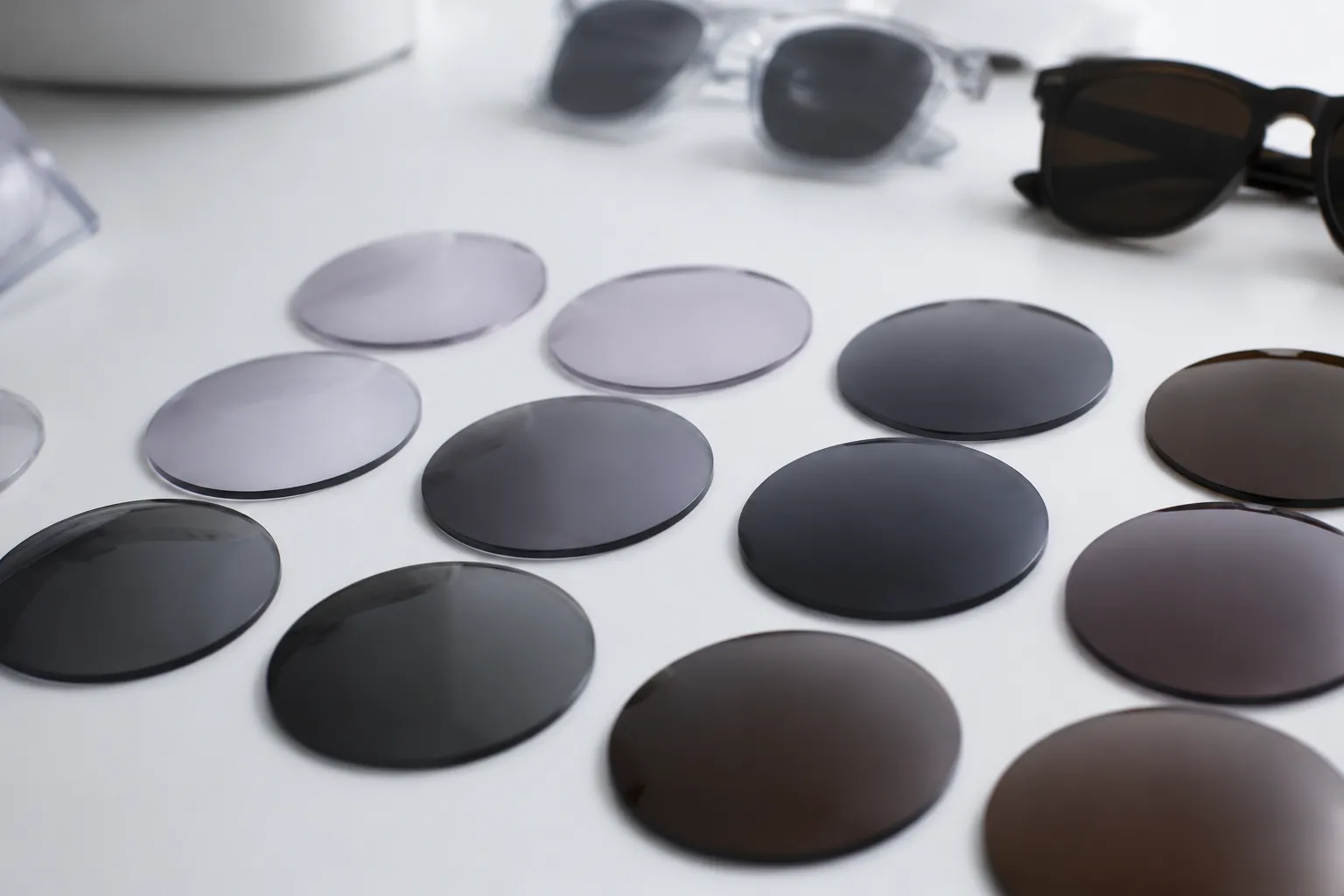
Photochromic lenses are useful in some private label programs and a poor fit in others. They add cost, testing, and claim risk. If you buy for retail, distribution, or a brand line, the real question is simple: does the feature improve sell-through in your channel, climate, and price band? This guide gives you a commercial filter, not hype.
Start with the buyer problem
Photochromic lenses darken in ultraviolet light and return toward clear when UV drops. That is the feature. The buying decision is broader. It depends on use case, channel, and how much premium your program can absorb. If the customer only wants a fashion sunglass, the feature may add little. If the customer moves between indoor and outdoor light all day, it can be useful.
For private label, the first question is channel fit. A convenience shopper may buy photochromic because it feels practical. A fashion-first shopper may not care until after purchase. Travel, outdoor, and specialty buyers usually understand the value faster. They also expect the lens to perform consistently. Match the spec to the channel. Do not treat photochromic as a universal upsell.
Climate matters too. In higher-UV markets, the darkening effect is easier to demonstrate in sampling and at retail. In colder or lower-UV markets, activation can feel slower. In cars, many lenses do not fully darken because standard windshields block much of the UV that triggers the reaction. Say that up front. Do not hide it.
The commercial test is plain: if the lens premium raises landed cost, the feature needs to improve conversion, support a higher retail price, or reduce the need to stock both clear and sunglass versions. If none of those apply, the feature is probably not earning its place.
Where photochromic lenses sell best
Different channels value function differently. Photochromic works best where the shopper already expects an explanation or where the feature solves a visible problem. The table below shows the commercial logic by channel.
| Channel | Commercial fit | What the buyer values | Main risk |
|---|---|---|---|
| Travel / outdoor retail | Strong | One pair for changing light, less swapping, compact packing | Customer expects clear activation and may compare the product with premium brands |
| Optical / specialty eyewear | Strong to medium | Function, durability, compliance, and technical explanation | Higher scrutiny on optical quality and documentation |
| Mass retail / distributor programs | Medium | Simple story and acceptable margin structure | Price pressure if the lens premium pushes shelf price too high |
| Fashion-first DTC | Weak to medium | Looks, frame shape, and color consistency | The effect may be invisible until the customer tests it outside |
If the channel is impulse-heavy, keep the shelf story short: "Darkens outdoors, clears indoors." That is enough. If the channel is technical, support the claim with lens data, samples, and compliance files. This is where an OEM partner with in-house lens tinting, surface inspection, and fit QC helps. You can hold the tint target, check activation consistency, and keep the build stable across reorders.
For a first test, many buyers start with one hero shape and one lens family. That is enough to see whether the feature resonates. If sell-through is strong, the second order can justify a broader rollout. If it does not land, you avoid tying up cash in a slow-moving SKU family.
Cost, MOQ, and lead time
Photochromic lenses are a premium component, but the lens itself is only part of the cost. You also pay for extra sample cycles, activation checks, packaging review, and a stricter approval process. A low-cost frame can turn into a mid-cost program quickly if the lens spec keeps changing.
For a factory such as LumiShades, MOQ starts at 50 pairs per design. That is workable for concept tests, retailer validation, or a regional pilot. Price improves at 300, 1000, and 5000+ pairs. Spec discipline matters more as volume rises. The frame, lens color, and decoration need to stay stable if you want efficient production.
| Order level | Typical buying logic | Commercial note |
|---|---|---|
| 50 pairs/design | Test the concept | Best for samples, limited channel trials, and buyer validation |
| 300 pairs | First serious reorder level | Usually where the premium starts to make sense if sell-through is real |
| 1000 pairs | Multi-door or distributor launch | Better unit economics and enough scale for a cleaner margin model |
| 5000+ pairs | Scaled private label | Best pricing leverage if the style and lens spec are locked |
Lead time depends on how much custom work you add. Sampling is usually 7-10 days if the frame is already tooled or the factory can move quickly. Bulk production is usually 25-35 days. Add custom tint targets, special coatings, logo engraving, soft-touch paint, or custom packaging, and expect the upper end of that range. What slows jobs most is spec churn. Not the photochromic process itself.
Lock the lens spec first. Then lock decoration. Then approve packaging copy. Buyers who keep changing base tint, logo placement, or carton language create avoidable delays. If you are still debating color chips, the order is not ready to scale.
Material behavior and optical trade-offs
Photochromic performance depends on lens material, dye system, coating stack, and UV exposure. Two lenses can look similar on paper and behave differently in the field. Ask how the lens performs in direct sun, shade, cloud cover, and indoor recovery. Do not stop at the question of whether it changes color.
Polycarbonate is common because it is light, impact-resistant, and suitable for many mass-market sunglass programs. TAC can work well in laminated or polarized builds, but the construction needs control. Some materials recover faster. Others offer better clarity or impact performance. The point is not to guess the best material. The point is to match it to the channel and test it under the same conditions your customers will see.
Color choice also changes the experience. Gray usually gives the most neutral look and the cleanest transition story. Brown often feels warmer and sells well in outdoor and lifestyle programs because it increases perceived contrast. Green can work, but some buyers dislike the visible shift during activation and recovery. Base tint matters too. A lighter pre-tint may look cleaner in showroom lighting. A darker base tint can make the photochromic effect feel less dramatic but more useful on bright days.
Ask for practical targets. You want the dark state, the return-to-clear behavior, and the shade tolerance window. If a sample is supposed to land in a medium-gray range, ask for repeatability across multiple pairs, not just one good sample. In production, define the acceptable range before approval. Otherwise, color becomes subjective after the goods are finished.
Do not over-spec everything at once. Faster transition, darker final state, better scratch resistance, and lower cost do not all improve together. A predictable mid-tier lens often sells better than a premium lens with a long claims list and a high wholesale price.
What to ask the factory for
Ask for the exact specification you need, not a generic "photochromic option." Confirm how the lens behaves, how it is tested, and what tolerances are acceptable before you approve the order.
- Lens material and base tint: confirm whether the lens is polycarbonate, TAC, or another material, and request the pre-activation color as a physical sample.
- Activation target: define the expected darkening level under UV and the approximate recovery window indoors.
- Shade tolerance: ask what variation is acceptable across a production lot and how the factory checks it during QC.
- Coating stack: confirm scratch resistance, anti-reflective needs, and whether the coating changes activation speed or clarity.
- Fit and alignment: ask for lens-to-frame fit checks, optical centering, and edge finish tolerances before shipping.
- Packaging copy: make sure claims match actual performance, especially for car use and low-UV environments.
Decoration details matter too. Laser engraving is clean and durable for a first run. Hot-stamping can work if the art is simple and the substrate is compatible. Small metal logos, pad printing, and subtle temple graphics are also common, but each adds a failure point if the run is rushed. If you want a premium private label look, keep the frame decoration simple and let the lens carry the commercial message.
Good factories also run a basic QC sequence: incoming lens inspection, activation spot-checking under UV, surface defect checks, frame/lens assembly fit, and final carton review. That matters because photochromic buyers often blame the lens when the problem is actually assembly or packaging damage. Fewer handoffs mean fewer excuses and a cleaner order history.
Compliance is part of the decision
For overseas B2B buyers, compliance is not an afterthought. If the destination market is wrong, the feature can become dead stock even when the product looks good. Keep the certification set limited to real, relevant documents: CE EN ISO 12312-1, ANSI Z80.3, AS/NZS 1067, REACH, FDA registration, ISO 9001, and BSCI.
CE EN ISO 12312-1 is relevant for sunglasses sold into the EU market. ANSI Z80.3 matters for U.S. sunglass performance expectations. AS/NZS 1067 applies to Australia and New Zealand. REACH is important for chemical compliance, especially for coatings, plastics, inks, and decoration chemicals. FDA registration is not a product approval stamp, so do not present it that way, but many importers still ask for it. ISO 9001 and BSCI speak to management systems and social compliance rather than product performance.
Ask for reports tied to the exact build. If you change frame material, lens material, lens coating, or decoration process, confirm whether the prior reports still apply. Buyers get into trouble when they treat compliance as a one-time checkbox instead of a model-specific file. Keep one compliance folder per style and one revision history per change.
Claims language matters too. If the lens is not designed to darken behind a windshield, do not imply that it will. If the lens is intended for general outdoor wear only, say that. Clean claim discipline is risk control, not just marketing polish.
Private label playbook: test, then scale
The safest way to launch photochromic private label is to treat it as a controlled test, not a full-line commitment. Start with one or two frame shapes and one lens color. Keep the decoration simple. One logo method, one carton style, one channel story. That is enough for a first round.
Use a small order to validate sell-through and customer feedback. If the product lands, reorder the same specification and increase quantity. That is where unit cost improves and where the factory can reduce setup friction. If the product stalls, you have limited exposure and actual market data instead of a warehouse problem.
Practical launch sequence:
- Pick one channel and one climate assumption.
- Choose one lens color and one frame material.
- Approve samples in 7-10 days.
- Request activation and shade checks before bulk approval.
- Launch 50 to 300 pairs first.
- Review returns, customer comments, and sell-through before expanding.
A pilot also needs a clear success threshold. For example, a buyer might decide that a reorder only happens if sell-through reaches the target level within the planned replenishment window, or if complaints stay below a set limit. That keeps emotion out of the next order.
Many buyers make the same mistake: they ask for three frame colors, two lens colors, and four logo placements on the first order. That creates confusion, slows approval, and makes the numbers hard to read. Keep the first run tight. The cleaner the test, the easier it is to know whether photochromic is worth scaling.
Bottom line by buyer type
Photochromic lenses make commercial sense when the feature solves a real use case and the channel can support a small premium. They are strongest for travel, outdoor lifestyle, and technical eyewear programs. They are weaker for pure fashion lines and for buyers focused on the lowest possible landed cost.
If you are a brand owner, ask whether the feature strengthens your story or just adds noise. If you are an importer or distributor, ask whether your retailers can explain it in one sentence. If you are a retailer, ask whether customers will understand the value without a long demo.
At the right price point, photochromic can help a private label line stand out and reduce SKU duplication. At the wrong price point, it is just margin drag. The decision is not whether the feature is interesting. The decision is whether it earns its place in your channel and your cost stack.
Have a custom sunglasses project in mind?
Send us your styles, target market and quantities and we will return a detailed quote with MOQ, lead time and a sample plan.
Get a QuoteWhy source this from Wenzhou with LumiShades
Wenzhou in Zhejiang Province is widely regarded as China’s eyewear manufacturing capital, producing a large share of the world’s sunglasses. That concentration matters to buyers: a deep local supply chain for acetate sheet, hinges, lens blanks, plating and packaging means shorter component lead times, easier color and material matching, and a workforce with decades of eyewear-specific skill. LumiShades has manufactured in this ecosystem since 2009, and our vertical integration — in-house injection molding, acetate cutting, CNC milling, lens tinting, decoration and quality control — means no part of your order is quietly subcontracted to a workshop you cannot audit.
For international buyers, that vertical control translates into accountability. When a single factory owns every step, defects are traced and fixed at source rather than bounced between vendors, and your specifications survive intact from first sample to bulk. We back this with 15+ years of experience, shipments to 60+ countries, more than 5 million pairs produced per year and a 98.5% on-time delivery rate. Our certifications — CE EN ISO 12312-1, FDA registration, ANSI Z80.3, AS/NZS 1067, REACH, ISO 9001 and BSCI audit — mean the compliance documentation your market requires already exists. Explore our manufacturing capabilities and quality control process to see how this works in practice.
Frequently asked questions
Do photochromic sunglasses work while driving? Usually not well through a standard windshield, because many windshields block much of the UV that triggers the darkening reaction. If you plan to market in-car performance, ask the factory for test evidence for the exact lens and do not rely on a generic photochromic claim.
What MOQ should I expect for a private label photochromic style? A practical starting point is 50 pairs per design for testing. Once sell-through is proven and the specification is stable, many buyers move to 300 pairs or more to improve pricing and reduce setup friction.
How long does sampling and bulk production take? Sampling is commonly 7-10 days when the frame is available and the specification is clear. Bulk production is usually 25-35 days, but it can stretch if you change lens tint, decoration, coatings, or packaging during approval.
Which compliance documents should I ask for? Match the market and the exact build. Common documents include CE EN ISO 12312-1 for the EU, ANSI Z80.3 for the U.S., AS/NZS 1067 for Australia and New Zealand, and REACH for chemical compliance. You can also request FDA registration, ISO 9001, and BSCI where relevant, but do not treat them as universal substitutes for market-specific testing.
What lens color sells best for photochromic programs? Gray is the safest neutral choice because it keeps the transition story simple. Brown often works well in outdoor, travel, and lifestyle programs. Green can work, but sample it carefully because some buyers dislike the visible shift during activation and recovery.
When does the premium price make sense? It makes sense when the feature solves a real use case and supports a clearer commercial story. That is most common in travel, outdoor, specialty, and technical channels, or in markets where customers regularly move between indoor and outdoor light.
Ready to start?
Explore our cat-eye sunglasses or request a quote — our sales team replies within 12 hours.
Request a Quote