
Polarized vs Non-Polarized Sunglasses by Channel
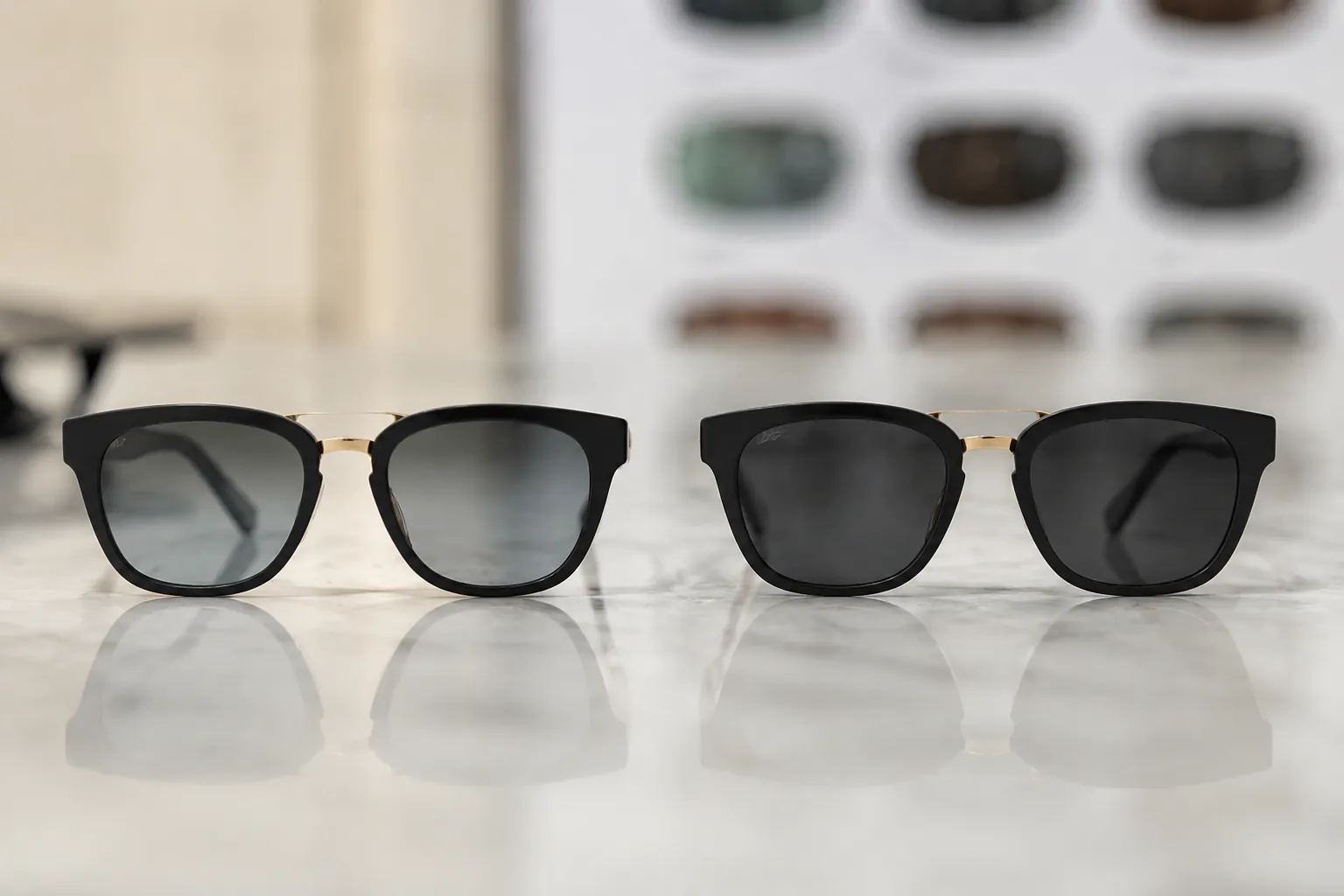
Buyers do not need a theory lesson. They need a channel decision. Which lens type sells, which one protects margin, and which one creates problems at checkout? This guide is for brands, importers, distributors, and retailers buying sunglasses in volume. The right answer changes by channel, ticket price, and compliance target.
The difference that matters
Polarized lenses reduce reflected glare from flat surfaces like water, roads, and snow. Non-polarized lenses reduce brightness, but they do not cut that reflected glare in the same way. That is the core difference.
Optics matter, but they are not the whole buying decision. Lens choice affects price, assortment depth, customer education, and how easy the product is to explain at the point of sale. Polarized sunglasses usually support a higher price tier because they solve a clear visual problem. Non-polarized sunglasses usually fit better in fashion-led, promo-led, or entry-price programs where cost and appearance matter more than glare control.
One frame can often be sold with either lens type. That helps brands and distributors build a channel-specific assortment without changing the frame itself. Keep the frame stable. Change the lens only when the market asks for it.
Where polarized lenses win
Polarized lenses work best when glare reduction is part of the value proposition. Common channels include travel, fishing, boating, driving, golf, and premium outdoor retail. In these channels, buyers can usually understand why the lens costs more and what it does.
They also solve a common complaint: sunglasses that are dark but still leave the wearer bothered by reflected glare. Polarized lenses reduce that problem because they target the source of the discomfort. That can support stronger customer satisfaction and fewer returns when the channel values function.
There is a trade-off. Polarized lenses can make some LCD and smartphone screens look darker or distorted at certain angles. That is normal. It is not a defect. If your channel depends on screen demos or customers who rely on dashboard displays, train staff to explain that clearly.
Use polarized lenses when the buyer needs a functional story and the customer is willing to pay for it.
Where non-polarized sells better
Non-polarized sunglasses are usually the safer choice for fashion retail, promotions, broad gift programs, and lower entry price points. They are easier to explain, easier to merchandise, and often better aligned with purchases driven by frame shape, color, and brand.
Promo and corporate buyers often work under tight budgets and short approval cycles. In those cases, non-polarized lenses help keep unit cost lower and avoid over-specifying a product that will be bundled, handed out, or sold as a seasonal add-on. For private label fashion, the frame, finish, and decoration often do most of the selling.
Non-polarized lenses also reduce buyer education friction. Some shoppers understand polarization. Many do not. If the channel is impulse-driven, a technical feature can add explanation without improving conversion. Simple wins.
Use non-polarized lenses when the product is sold mainly on look, price, and speed of purchase.
Channel-by-channel buying guide
| Channel | Best lens choice | Why it works | Watch-outs |
|---|---|---|---|
| Retail fashion | Non-polarized | Lower cost, easier merchandising, fewer screen-related objections | Do not pay for a feature the shopper is unlikely to value at checkout |
| Travel and airport | Polarized on core SKUs | Glare control is easy to understand and easy to sell | Keep one or two non-polarized entry SKUs for price-sensitive buyers |
| Outdoor and sport | Polarized | Higher functional value and stronger support for premium pricing | Check fit, wrap angle, and lens tint before mass production |
| Promo and corporate gifts | Non-polarized | Cost control and simpler branding | Decoration quality matters more than lens technology in this channel |
A practical assortment often starts with more non-polarized SKUs for fashion and promo volume, then adds a smaller polarized tier for outdoor and travel. That is not a rule. It depends on your channel. If you sell heavily into boating, fishing, or driving, a larger polarized share may make sense. If sales are driven by color and price, keep polarized styles narrower and more selective.
Cost and margin impact
Polarized lenses usually add cost because of the material and processing involved. The size of that difference depends on lens specification, tint, coatings, mirror effects, and frame assembly requirements. Buyers should compare more than unit price. Look at sell-through and gross margin by channel too.
For custom eyewear programs, MOQ, pricing, and lead time vary by factory and product complexity. Ask the supplier for the minimum order per design, the price breaks at higher quantities, and whether polarized and non-polarized versions can be produced under the same frame specification. That makes total landed cost easier to compare.
Sampling and bulk timelines also depend on the order. Ask for sample lead time, production lead time, and whether both lens options can be sampled in parallel. If you are comparing both versions, request both at once. Do not compare one finished sample against one guess.
Think in terms of channel margin, not lens preference. If polarized moves slowly in a price-led channel, the extra cost may hurt profit. If it sells as a clear upgrade, the premium can be justified.
Compliance and claim control
Do not make claims you cannot support. For B2B eyewear buyers, the relevant documents depend on the target market and the product. Common references include CE EN ISO 12312-1 for the EU, ANSI Z80.3 for the U.S. market, AS/NZS 1067 for Australia and New Zealand, REACH for restricted substances, FDA registration where applicable, and management-system certifications such as ISO 9001 or BSCI where relevant to supplier qualification.
Polarized and non-polarized lenses can both be used in compliant sunglasses. The lens type does not replace product testing or documentation. If you sell into the EU, you still need the correct documentation for CE EN ISO 12312-1. If you sell into the U.S., ask for the documents and test results that support ANSI Z80.3 compliance and any FDA-related requirements that apply to your product category. For Australia and New Zealand, confirm alignment with AS/NZS 1067. REACH covers material compliance, not performance claims.
Ask the supplier to keep compliance records tied to the SKU or product version, especially if one frame is sold with both polarized and non-polarized lenses. That reduces confusion when customs, retailers, or distributors request exact records.
What to ask before the PO
- Ask whether the lens version changes unit price, MOQ, or lead time for each design.
- Ask for samples of both polarized and non-polarized versions in the same frame.
- Ask which claims can appear on the hangtag, carton, or product page, and which claims require supporting documents only.
- Ask how the factory checks lens effect, color consistency, fit, and final assembly during quality control.
- Ask whether both lens types can be produced under the same frame specification or whether they require separate production runs.
Keep the comparison clean. One frame, two lens options, separate documentation, and a clear price ladder make it easier to measure what the market actually wants.
That also helps with reorders. You can track which version sells faster, which one returns less often, and which one supports better margin by channel.
A simple buyer rule
If the channel sells function, choose polarized. If the channel sells look and price, choose non-polarized. If the channel is mixed, build a two-tier assortment instead of asking one lens type to do every job.
Use polarized in travel, outdoor, sport, and higher-ticket retail where glare control is part of the story. Use non-polarized in fashion, promo, and price-led retail where speed and margin matter more than optical performance. If you are unsure, start small: one polarized hero SKU and one non-polarized volume SKU, both sampled side by side and quoted against the same frame spec.
That is the lowest-risk way to test sell-through before you commit to a larger order. The channel will tell you which lens belongs on the next PO.
Have a custom sunglasses project in mind?
Send us your styles, target market and quantities and we will return a detailed quote with MOQ, lead time and a sample plan.
Get a QuoteWhy source this from Wenzhou with LumiShades
Wenzhou in Zhejiang Province is widely regarded as China’s eyewear manufacturing capital, producing a large share of the world’s sunglasses. That concentration matters to buyers: a deep local supply chain for acetate sheet, hinges, lens blanks, plating and packaging means shorter component lead times, easier color and material matching, and a workforce with decades of eyewear-specific skill. LumiShades has manufactured in this ecosystem since 2009, and our vertical integration — in-house injection molding, acetate cutting, CNC milling, lens tinting, decoration and quality control — means no part of your order is quietly subcontracted to a workshop you cannot audit.
For international buyers, that vertical control translates into accountability. When a single factory owns every step, defects are traced and fixed at source rather than bounced between vendors, and your specifications survive intact from first sample to bulk. We back this with 15+ years of experience, shipments to 60+ countries, more than 5 million pairs produced per year and a 98.5% on-time delivery rate. Our certifications — CE EN ISO 12312-1, FDA registration, ANSI Z80.3, AS/NZS 1067, REACH, ISO 9001 and BSCI audit — mean the compliance documentation your market requires already exists. Explore our manufacturing capabilities and quality control process to see how this works in practice.
Frequently asked questions
Is polarized always better for sunglasses sales? No. Polarized lenses are better when the end user needs glare reduction, such as for driving, fishing, boating, or outdoor sport. Non-polarized lenses often perform better in fashion, promo, and entry-price channels because they are simpler to position and usually easier to price competitively.
Does polarization change compliance requirements? Polarization does not remove the need for product compliance, and it does not create a separate compliance category by itself. You still need the correct documentation for the target market, such as CE EN ISO 12312-1, ANSI Z80.3, AS/NZS 1067, REACH, and any applicable FDA-related requirements for your product and market.
Can one frame be sold with both lens types? Yes. That is often the most practical structure for B2B buyers. Keep the frame specification stable, change only the lens version, and ask the supplier to provide separate samples, pricing, and compliance records for each SKU so you can compare performance accurately.
What MOQ should I expect for custom sunglasses? MOQ is factory-specific and depends on the frame, lens, decoration, and packaging. Ask for the minimum order per design, whether the MOQ changes for polarized versus non-polarized lenses, and what price breaks apply at higher quantities. Do not assume one universal MOQ across suppliers.
How long should I plan for sampling and bulk production? Lead times vary by factory workload, material availability, and product complexity. Ask for a sample timeline and a production timeline for the exact SKU you want, and confirm whether polarized and non-polarized versions can be sampled in parallel. That gives you a realistic schedule for launch planning.
When should I skip polarized lenses to protect sell-through? Skip polarized lenses when the channel is price-led, the product is promotional, or the shopper is buying mainly on style rather than function. In those cases, non-polarized lenses usually protect margin better and reduce the risk of over-specifying the product.
Ready to start?
Explore our sport wrap sunglasses or request a quote — our sales team replies within 12 hours.
Request a Quote