
TR90 vs PC vs Acetate by Sales Channel
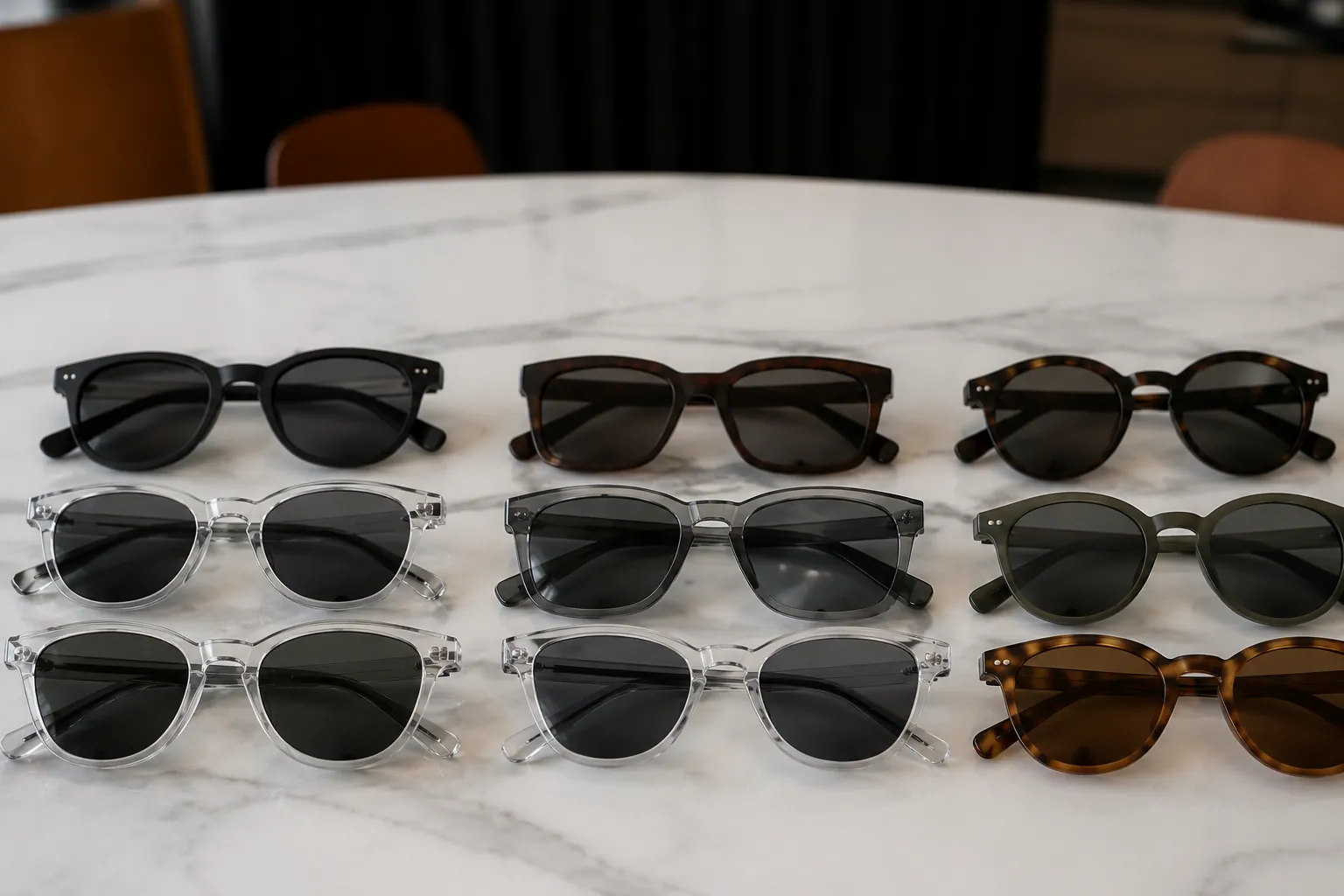
This guide is for brand owners, importers, distributors, and retailers building sunglasses across multiple price tiers. The key question is not which material is "best." It is which material fits the sales channel, margin target, product story, replenishment model, and compliance scope. Use the framework below to compare PC, TR90, and acetate against buying criteria that can be checked during development: MOQ, tooling route, unit economics, wear performance, decoration options, documentation, and production timing. If one collection needs to serve promotional accounts, chain retail, and premium fashion or optical-adjacent channels, this approach keeps the discussion commercial and specific.
Start with the channel, not the material
Buyers often start with the wrong question: Which frame material is best? That comes later. Start here instead: Where will this SKU sell, at what retail price, and with what margin requirement?
A value retailer, promotional distributor, and boutique fashion account do not reward the same product choices. A distributor supplying giveaways or opening-price seasonal programs usually needs low landed cost, fast sample turnaround, standard color options, and low replenishment risk. A mid-market chain usually wants better comfort, more consistent fit, and a stronger product story without losing cost control. A premium boutique or optical-adjacent account may accept a higher ex-factory cost if the frame supports a higher ticket, lower markdown pressure, and better perceived quality in hand.
That is where material choice matters:
- PC fits opening price points, promotions, kids' programs, travel retail, and high-volume private label where cost control is the priority.
- TR90 fits active, outdoor, and mid-market collections where low weight, flexibility, and comfort matter more than a dense premium feel.
- Acetate fits premium fashion, boutique, and optical-adjacent assortments where color depth, polish, and hand-feel support a higher retail ticket.
Channel-first planning cuts sourcing mistakes. Mixed-material collections often break down when color standards, lens specifications, branding placement, and packaging are developed separately across too many suppliers. Keep those decisions coordinated. The collection will be easier to sample, approve, and scale.
What each material actually offers
The differences between PC, TR90, and acetate show up in comfort, finish, durability expectations, manufacturing method, and retail position. Not just in cost.
| Material | Best channel fit | Main strengths | Main limits |
|---|---|---|---|
| PC | Promotional, mass retail, entry private label | Cost-efficient for volume programs, commonly used in injection-molded frames, supports straightforward scaling | Lower perceived value in many channels, finish quality must be controlled carefully, less suitable for premium storytelling |
| TR90 | Sports, outdoor, travel, mid-market chains | Lightweight, flexible, comfortable for extended wear, suitable for active and wrap-oriented shapes | Color richness and luxury perception are usually weaker than acetate, premium fashion positioning can be harder to support |
| Acetate | Boutique, premium fashion, optical retail | Rich color appearance, polished finish, stronger hand-feel, widely associated with premium eyewear | Higher processing cost, more labor-intensive finishing, longer production process, often heavier than injection materials |
Material behavior affects manufacturing as much as merchandising. PC is usually the efficient route to entry pricing. TR90 is often the right pick where flexibility and comfort matter most. Acetate earns its place through visual depth, polished edges, bevel detail, and tactile quality. It also brings more process sensitivity in cutting, milling, tumbling, and hand finishing.
Do not force a material outside its lane. If retail has a hard ceiling, acetate can crush margin. If the brand promise depends on rich finish and layered color, a low-cost injection material may not hold up at shelf level.
Build the collection in commercial tiers
The clearest way to mix materials is to build the line in entry, mid, and premium tiers. Set cost guardrails before sampling. Not after prototypes are approved.
- Entry tier: Use PC for volume-driven core styles. Keep construction simple, limit color count, use standard lens options, and apply practical branding such as pad print or laser marking where appropriate.
- Mid tier: Use TR90 for comfort-led frames, wraps, and active silhouettes. Add polarized lenses only when the retail position supports the step-up in cost and claim management.
- Premium tier: Use acetate for statement fronts, layered colors, thicker temples, bevel details, and upgraded packaging where the channel will pay for the finish difference.
For most first orders, the mix should not be equal across materials. A practical launch usually places more units in PC or TR90 to support volume, while using a smaller acetate group to test higher-ticket demand and raise average selling price without overexposing the buy.
MOQ logic matters. A factory may accept a low minimum for sampling or trial orders, but the lowest minimum rarely delivers the best economics. Buyers usually improve cost efficiency by consolidating quantities by material, color, lens, and trim. When comparing quotations, ask for price breaks by quantity and by construction complexity instead of relying on one reference number across all materials.
Margin planning: where cost increases really come from
Many buyers focus too much on raw material and miss the bigger problem: specification creep. In sunglasses, margin erosion often comes from added complexity rather than from frame material alone.
Common cost drivers include:
- Frame construction complexity, part count, and hinge specification
- Lens choice, including tint, gradient, mirror, polarized construction, or added coatings
- Decoration method, such as pad print, laser engraving, hot foil, or applied metal logo parts
- Color count and color matching difficulty, especially on patterned acetate
- Packaging standard, inserts, barcoding, and pack-out labor
- Inspection level, test scope, and agreed defect tolerance
PC usually protects margin best in straightforward volume programs because the build is easier to standardize. TR90 often costs more than basic PC, but the increase can make sense if the retail position is active or comfort-led and the sales team can explain the benefit clearly. Acetate can produce strong retail margin when the channel accepts the higher ticket. In a price-sensitive environment, though, it can turn into risky inventory fast.
Set an ex-factory target by tier before development starts. If entry retail must stay below a fixed ceiling, keep decoration simple and limit upgrades. If premium retail can support a higher price, spend on the details customers notice first: acetate color quality, polish consistency, hinge feel, and packaging presentation.
A premium material in the wrong channel is not a better product. It is often just a more expensive SKU to clear later.
Process, tolerances, and lead time buyers should plan for
Sampling and production timing should match the material and the level of approval control. Lead time varies by factory capacity, tooling status, finish complexity, and packaging scope, so ask for a stage-by-stage timeline. One sample estimate or bulk estimate is not enough.
For PC and TR90, the main variables are mold readiness, color matching, lens assembly, and branding position. For acetate, risk often shifts later in the process: sheet selection, lamination direction, CNC accuracy, polishing standard, and final assembly consistency.
If one launch combines all three materials, lock the acetate styles first. They are usually less forgiving when front thickness, temple profile, or color direction changes after initial sampling.
A practical process flow looks like this:
- Confirm CAD, frame dimensions, bridge fit, temple length, and lens base curve.
- Approve resin reference or acetate sheet reference with a defined color standard.
- Review first samples for hinge setting, temple spread, lens seating, branding placement, and overall finish.
- Confirm compliance requirements for the target market before pre-production approval.
- Approve the pre-production sample with final labeling, packaging, and pack-out instructions.
- Run in-line inspection and final random inspection before shipment.
Ask for measurable control points, not general promises. Common checkpoints include:
- Front symmetry: left-right balance and stable table contact
- Temple consistency: matching length, bend, and opening feel
- Hinge alignment: smooth opening and closing without abnormal play
- Lens fit: no visible stress marks, looseness, or edge gaps
Dimensional tolerance depends on process, material, and design. Do not rely on a generic tolerance claim. Request written tolerances for critical features during development and use those values in sample approval and inspection criteria.
Compliance is not optional, and it changes the specification
If you sell internationally, material selection must match the destination market and the lens specification, not just the cost target. A compliant sunglass program is always a frame-and-lens decision together.
Common references and documentation requests include CE EN ISO 12312-1, ANSI Z80.3, AS/NZS 1067, REACH, and, where applicable, FDA registration. Supplier-qualification references such as ISO 9001 and BSCI may also matter during factory review, but they do not replace product compliance testing.
The buyer's practical task is simple: confirm the destination market, lens category, labeling requirement, and any feature claims before final sample approval. Polarization claims, mirror coatings, tint category, and packaging language can all affect what must be verified.
| Requirement | Why it matters | When to confirm it |
|---|---|---|
| CE EN ISO 12312-1 | Core performance and safety reference for many sunglass markets | Before sample sign-off |
| ANSI Z80.3 | Common US market reference for non-prescription sunglasses | Before bulk approval |
| AS/NZS 1067 | Relevant for Australia and New Zealand programs | At quotation stage if those markets are planned |
| REACH | Important for chemical compliance in applicable markets | Before final material confirmation |
Request compliance documents and test planning before mass production, not after packing. A premium acetate frame without the right documentation is still a risk. An entry-price PC frame with the wrong lens specification is still non-compliant.
Decoration, finish, and perceived value by material
Perceived value often comes less from the base material itself than from how well the frame carries branding, finish, and assembly quality. Two frames with similar material cost can present very differently depending on polish, logo execution, and shipment consistency.
For entry programs, pad printing is often the most practical choice because it is repeatable and cost-efficient for simple logos or markings. Laser engraving can suit understated branding where durability matters more than color impact. Metal logo plates or inset decorative hardware usually make more sense on acetate or higher-ticket programs, where the added component cost supports the retail story.
Material affects what looks commercially credible:
- PC: best with clean, simple branding and controlled trim cost
- TR90: well suited to sport-led temple branding and understated performance cues
- Acetate: supports premium details such as exposed layered color, polished bevels, and upgraded logo application
Do not overload entry styles with expensive trim. Buyers often add decorative parts, upgraded packaging, mirror lenses, and too many colorways to a price-sensitive style, then lose the margin they were trying to protect. Spend where the customer will notice the difference and where the retailer can defend the price.
A practical buying matrix for mixed-material programs
If one collection must serve multiple channels, discipline matters more than variety. Too many materials, trims, lens colors, and packaging options create complexity fast. Sell-through does not always improve.
| Channel | Recommended material | Typical design focus | Buying advice |
|---|---|---|---|
| Promotional and value retail | PC | Core shapes, simple branding, standard tinted lenses | Buy deeper on fewer SKUs, keep colors commercial, and request clear quantity breaks before finalizing the order |
| Sports and mid-market chains | TR90 | Lightweight comfort, wrap shapes, active styling | Control fit carefully, keep trim practical, and add lens upgrades only where the margin still holds |
| Boutique and premium fashion | Acetate | Statement fronts, layered colors, polished finish | Approve color standards early, allow more development time, and focus MOQ on the strongest shapes |
| Mixed retailer programs | PC plus TR90, or TR90 plus acetate | Tiered line architecture | Standardize lens colors, packaging, and labeling where possible to simplify replenishment and reduce inventory risk |
A good first order usually combines dependable volume styles with a smaller group of margin-lifting statement pieces. That gives the buyer room to test price elasticity without risking the whole season on higher-cost frames. It also keeps approvals, documentation, and replenishment decisions more manageable.
The short version is simple. Use PC to compete at opening price. Use TR90 where comfort, flexibility, and active wear support the sale. Use acetate where finish, color depth, and hand-feel justify a higher retail. Put each material in the right lane and the collection is easier to price, source, and replenish.
Have a custom sunglasses project in mind?
Send us your styles, target market and quantities and we will return a detailed quote with MOQ, lead time and a sample plan.
Get a QuoteWhy source this from Wenzhou with LumiShades
Wenzhou in Zhejiang Province is widely regarded as China’s eyewear manufacturing capital, producing a large share of the world’s sunglasses. That concentration matters to buyers: a deep local supply chain for acetate sheet, hinges, lens blanks, plating and packaging means shorter component lead times, easier color and material matching, and a workforce with decades of eyewear-specific skill. LumiShades has manufactured in this ecosystem since 2009, and our vertical integration — in-house injection molding, acetate cutting, CNC milling, lens tinting, decoration and quality control — means no part of your order is quietly subcontracted to a workshop you cannot audit.
For international buyers, that vertical control translates into accountability. When a single factory owns every step, defects are traced and fixed at source rather than bounced between vendors, and your specifications survive intact from first sample to bulk. For procurement review, buyers can request process records, approved samples, quality checkpoints and project-specific compliance files before placing a bulk order. Required testing and documentation are confirmed against the destination market and product specification rather than assumed from a generic certificate list. Explore our manufacturing capabilities and quality control process to see how this works in practice.
Frequently asked questions
How should I split a first mixed-material order if I am testing a new market? Start with a channel-based plan, not an equal split by material. Put most units into the material that best matches the core retail price band, then use a smaller group of higher-spec styles to test how far the market will stretch. Keep the SKU count tight, consolidate colors and lenses, and ask the factory for quantity breaks by style so you can compare whether it is better to deepen fewer SKUs or spread units too thinly. Before confirming the order, review expected retail price, gross margin, and replenishment risk for each material tier.
Is TR90 always better than PC for mid-market sunglasses? No. TR90 is often the better choice when lightweight comfort, flexibility, and active wear are central to the product story, especially for wrap or sport-influenced shapes. PC may still be the better buying decision when the retail ceiling is strict, the construction is simple, and the program needs tighter cost control. To decide, compare the retail price target, wear use case, finish expectations, and whether the sales team can clearly explain the upgrade from PC to TR90.
What is the minimum order quantity if I want several materials in one collection? There is no single MOQ that applies to every factory, material, and construction. Ask for MOQ by style, by color, and by logo method, because a mixed-material collection can meet a style minimum while still failing a color or packaging minimum. For buying efficiency, consolidate shared lens colors, branding methods, and packaging across the line where possible. When evaluating quotations, request price breaks at several quantity levels and compare the cost impact of adding one more colorway versus increasing units on proven styles.
How early should compliance documents be discussed with the factory? At quotation stage if the destination market is known, and no later than sample development. Confirm the target market, lens category, labeling, and any claims such as polarized or mirror before approving the pre-production sample. Ask the supplier which documents they can provide for CE EN ISO 12312-1, ANSI Z80.3, AS/NZS 1067, REACH, or FDA registration where applicable, and make sure the test scope matches the exact frame-and-lens configuration you intend to ship.
What usually delays bulk production on acetate styles? The most common causes are late color changes, repeated dimensional revisions after sample approval, unclear finish expectations, and slow confirmation of sheet references. Acetate depends on controlled cutting, milling, polishing, and assembly, so upstream indecision creates downstream delay. To reduce risk, lock the approved color reference, confirm critical dimensions in writing, approve hinge and branding details before pre-production, and require the final pre-production sample to match the packaging and labeling that will ship.
Ready to start?
Explore our shield & oversized sunglasses or request a quote — our sales team replies within 12 hours.
Request a Quote