
Stainless Steel vs Titanium for Premium Sunglasses
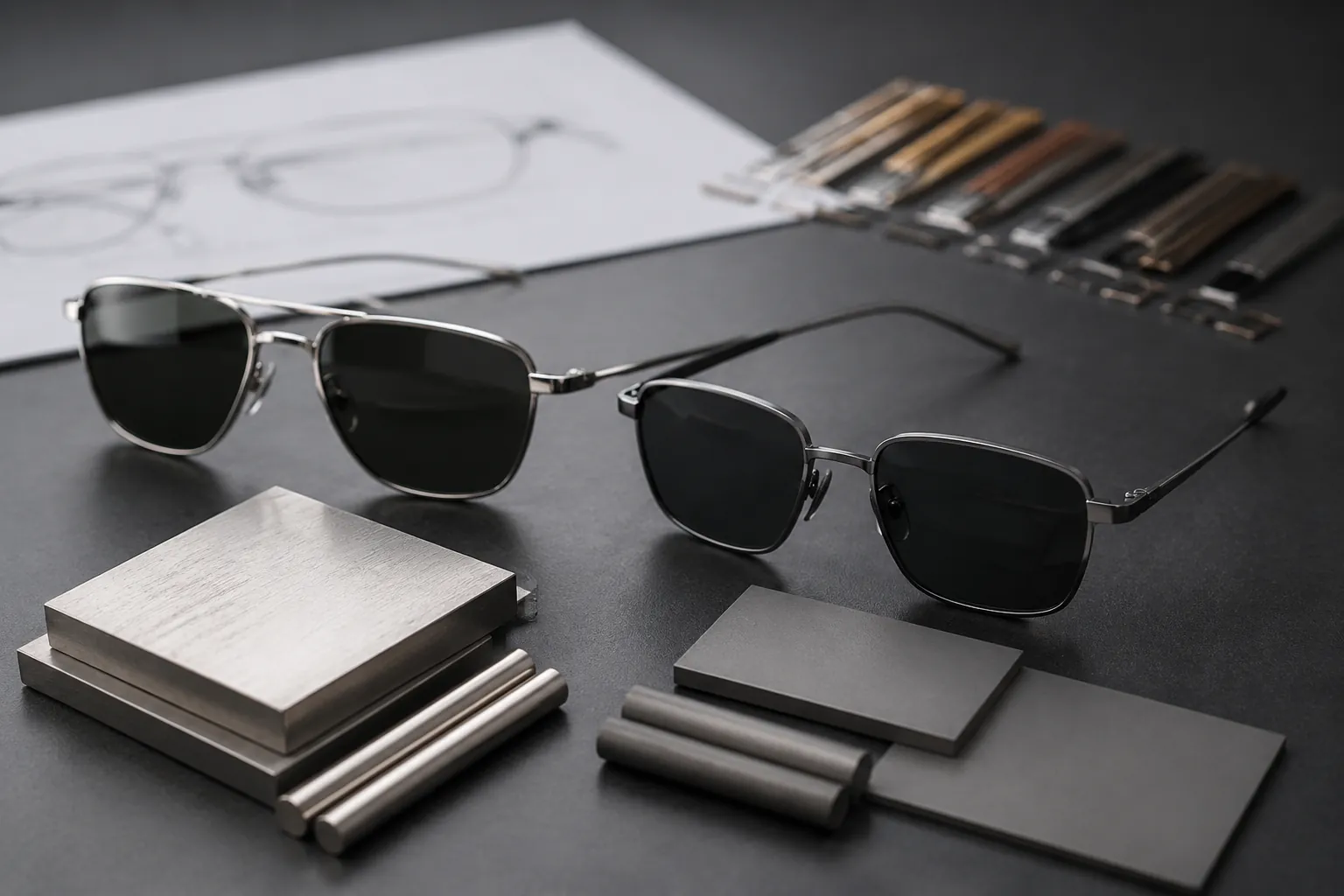
This guide is for buyers building premium sunglasses lines and deciding whether stainless steel or titanium is the better commercial fit. The choice affects FOB cost, frame weight, forming complexity, assembly yield, finishing options, after-sales handling, compliance, and the retail band the product can support. In custom metal eyewear, a wrong material choice can trigger expensive revisions after tooling, sample approval, or finish sign-off. The right choice matches the brief, the design, and the reality of the market.
Start with the brief, not the metal
Buyers often ask which metal is better. That is the wrong first question. Start with the target retail price, required gross margin, expected reorder volume, channel, and the product story the customer will actually buy. Then choose the metal that supports that position.
Stainless steel usually fits accessible premium price points. It gives a refined metal look without pushing FOB too high. Titanium is more common when the line needs lower weight, a stronger hypoallergenic angle, or a clearer reason for a higher shelf price. Both can work. They solve different problems.
Before you brief a supplier, check the basics.
- What retail band are you targeting? The material should support the price architecture, not strain it.
- How important is weight reduction? If low weight is part of the promise, titanium deserves review.
- What reorder volume is realistic? A test launch and a repeat order do not carry the same cost risk.
- What finish route do you need? Brushed, polished, plated, engraved, or mixed-material details may be easier in one metal than the other.
- Who sells the product? Optical and specialty channels can explain technical material claims better than fast-turn fashion channels.
Sampling is where many issues show up. Frame symmetry, hinge alignment, lens seating, finish consistency, and logo placement all matter. Material choice should be tied to that full path, not just the first visual sample.
Weight and wear comfort
Titanium is generally lighter than stainless steel. That is its clearest physical advantage. In similar constructions, it usually lowers finished frame weight and can support comfort-led positioning. The gain is most obvious in larger eye sizes, all-day wear styles, and slim wire frames.
Light weight is not the same as a better product. Some buyers and consumers read a little extra heft as substance. Stainless steel often feels denser. Titanium feels lighter and more technical. Neither reaction is wrong.
Geometry changes the result. In slim metal frames, titanium's weight advantage is easy to feel. In heavier builds with thick lenses, double bridges, side shields, large logo parts, or mixed-material temples, the gap narrows. Non-frame parts add weight fast. Ask for actual sample weights. Compare complete frames, not material names.
| Factor | Stainless Steel | Titanium | Buyer Impact |
|---|---|---|---|
| Relative finished frame weight | Usually heavier in comparable constructions | Usually lighter in comparable constructions | Titanium supports comfort-led positioning, especially in larger sizes |
| Hand feel | More solid and dense | Lighter and more technical-feeling | Choose based on brand language and customer expectation |
| Best commercial fit | Mid-premium fashion and scalable volume | Premium comfort and flagship technical styles | Match the retail story, not only the engineering preference |
| Cost effect | Usually lower material and processing cost | Usually higher material and fabrication cost | Titanium needs tighter retail discipline to protect margin |
For optical, travel, and specialty channels, the comfort story can justify the premium. For fashion-led programs with sharper opening prices, stainless steel often gives a better comfort-to-cost balance.
Cost, MOQ, and quote logic
Material choice affects more than raw metal price. It changes forming difficulty, scrap risk, finishing options, assembly tolerance, and how confidently a supplier can quote repeat orders. Do not compare stainless steel and titanium on material name alone.
Stainless steel usually gives more flexibility on opening orders because the cost base is lower and the process is familiar across many eyewear factories. Titanium typically carries a higher FOB because raw material costs more and the process window is narrower. The gap often widens with custom nose pad arms, laser engraving, plated decorations, or mixed acetate-metal assemblies.
- Sampling cost matters first. Premium buyers often need more than one prototype round when fit, finish, and branding are tightly controlled.
- Bulk cost matters next. Polishing yield, assembly consistency, and finish rejection can change the unit cost.
- Reorder cost matters most. Once a style is stable, repeat orders are easier to quote because engineering and approval risk are lower.
A practical approach is to avoid putting titanium across the full range unless the market will support the higher retail. Many buyers use titanium for hero SKUs and stainless steel for the volume assortment. That lowers cash risk and still gives the collection a clear flagship story.
Durability and repair reality
Both materials can perform well, but they fail differently. Stainless steel offers good structural strength and can hold up well when grade selection, forming, and finishing are controlled. Titanium is valued for corrosion resistance and is often preferred for wearers exposed to sweat, humidity, sunscreen, or coastal conditions.
Durability is not determined by metal alone. Hinge construction, weld quality or joint design, temple stability, groove precision, lens fitting, and finish quality all matter. A poor titanium frame can create more field problems than a well-made stainless steel one. Simple as that.
For warranty planning, focus on likely failures instead of brochure claims.
- Stainless steel risks: finish wear at contact points, corrosion if finishing quality is poor, and shape drift in thin parts after repeated adjustment.
- Titanium risks: higher replacement cost, more sensitive retail adjustment handling, and greater dependence on disciplined fabrication and finishing.
- Shared risks: hinge play, loose screws, crooked temples, poor lens retention, unstable nose pad hardware, and detached decorative parts.
Repairability matters too. Many optical stores and service networks are more familiar with stainless steel for routine adjustment and repair. Titanium can sell well at retail, but buyers should confirm whether their after-sales network can handle it before they scale the range.
Finishing and branding
Premium eyewear buyers are not sourcing a metal substrate. They are sourcing a surface result: polished silver, brushed gold, matte black, dark gun, champagne, antique tones, or a mixed-material technical look. Stainless steel often gives broader commercial flexibility for these directions at a manageable cost.
Titanium can deliver a strong result too, but the finishing route usually needs tighter planning from the start. If the target look depends on decorative plating, multiple color variants, or strong visual depth, stainless steel is usually easier to scale. If the direction is understated technical luxury with low weight and a cleaner metallic expression, titanium may be the better fit.
Process sequence matters because branding usually happens after surface treatment but before final assembly inspection. That affects cosmetic yield and rework risk.
- Metal components are formed, cut, or machined.
- Weld points or assembly joints are checked and corrected.
- Surface finishing, polishing, brushing, or color treatment is completed.
- Branding is added through engraving, pad printing, or applied logo hardware.
- Lenses are fitted after dimensional and alignment checks.
- Final QC confirms hinge action, cosmetic appearance, logo position, frame symmetry, and packing accuracy.
Approve the finish against a retained physical sample, not only a digital file. Small gloss or color shifts that look minor on screen can look very different under retail lighting.
Compliance and export testing
Choosing a premium metal does not reduce compliance work. The frame material, finish, and final assembly all have to support the product passing the required market standard and chemical checks. Evaluate finished sunglasses, not isolated parts.
For export programs, common target frameworks include CE EN ISO 12312-1, ANSI Z80.3, and AS/NZS 1067 depending on the destination. Chemical compliance such as REACH matters because coatings, pads, adhesives, and decorative parts can create risk. In some US supply chains, FDA registration may also be requested as part of importer documentation. ISO 9001 and BSCI are commonly used as process and social references, but they do not replace product testing.
| Requirement Area | What Buyer Should Confirm | Why It Matters |
|---|---|---|
| Lens standard | Correct market route such as CE EN ISO 12312-1, ANSI Z80.3, or AS/NZS 1067 | Finished sunglasses must meet the destination market requirement |
| Chemical compliance | REACH status for coatings, pads, adhesives, and finishes | Surface treatments and components can create hidden risk |
| Marking and traceability | Correct model marking, lens category, and production records | Helps link bulk goods to approved specifications |
| Production control | Documented QC process, supported where relevant by systems such as ISO 9001 | Reduces variation between approved sample and shipment |
Ask one direct question in supplier review: which tests are run on the finished sunglass, not only on the lens or raw components? A reliable supplier should answer clearly and provide the documentation route.
Lead times and process risk
Premium metal eyewear programs are often delayed more by approval drift than by factory capacity. Stainless steel programs are usually easier to correct when finish or fit needs adjustment. Titanium usually needs firmer front-end decisions because material cost, fabrication sensitivity, and cosmetic consistency make rework more expensive.
The common delay points are predictable.
- Metal color approved from a photo instead of a retained physical sample
- Logo artwork changed after engraving setup or hardware confirmation
- Target frame weight not defined before first prototype review
- Lens color approved without checking how it reads against the frame finish
- Packaging revised after bulk material planning starts
- Temple logo position or bridge shape adjusted after fit approval
If a launch date is fixed, freeze three items early: finish standard, lens specification, and branding position. Most repeated sample loops, rush charges, and shipment delays start with late movement in one of those areas.
How to choose by range strategy
For most B2B buyers, the answer is not stainless steel or titanium across the whole line. It is a tiered material strategy tied to the job each SKU has to do.
Use stainless steel when the collection needs a premium look with better cost control, broader finish flexibility, and safer margin on opening orders. It fits distributors, retailers, and private label programs that need consistent price architecture across several styles and colorways.
Use titanium when the line needs a flagship model with lower weight, stronger premium justification, and room for a higher retail ticket. It is often best for hero styles, technical lifestyle capsules, and channels where staff can explain the material difference.
Practical rule: put stainless steel in the volume drivers and titanium in the margin drivers, unless your brand already has proven demand for lightweight premium metal frames.
That split is safer operationally too. It lets buyers test shape acceptance, color uptake, and reorder behavior in a lower-risk metal, then move titanium only into silhouettes that already show traction.
Have a custom sunglasses project in mind?
Send us your styles, target market and quantities and we will return a detailed quote with MOQ, lead time and a sample plan.
Get a QuoteWhy source this from Wenzhou with LumiShades
Wenzhou in Zhejiang Province is widely regarded as China’s eyewear manufacturing capital, producing a large share of the world’s sunglasses. That concentration matters to buyers: a deep local supply chain for acetate sheet, hinges, lens blanks, plating and packaging means shorter component lead times, easier color and material matching, and a workforce with decades of eyewear-specific skill. LumiShades has manufactured in this ecosystem since 2009, and our vertical integration — in-house injection molding, acetate cutting, CNC milling, lens tinting, decoration and quality control — means no part of your order is quietly subcontracted to a workshop you cannot audit.
For international buyers, that vertical control translates into accountability. When a single factory owns every step, defects are traced and fixed at source rather than bounced between vendors, and your specifications survive intact from first sample to bulk. For procurement review, buyers can request process records, approved samples, quality checkpoints and project-specific compliance files before placing a bulk order. Required testing and documentation are confirmed against the destination market and product specification rather than assumed from a generic certificate list. Explore our manufacturing capabilities and quality control process to see how this works in practice.
Frequently asked questions
Which material usually gives better margin for a new premium collection? For a new launch, stainless steel usually gives the safer margin structure because FOB is lower and the finish route is easier to scale. Titanium can still produce strong margin if the market accepts the higher retail price. Cost both materials against the same target retail, then compare landed cost, markdown risk, and reorder probability before you lock the range.
Is titanium always better for durability? No. Titanium is known for corrosion resistance and low weight, but field durability still depends on hinge design, assembly quality, lens retention, finish control, and how the frame is adjusted after sale. Ask for the exact construction details, review the sample after lens fitting, and assess likely service issues such as screw loosening, hinge play, or finish wear instead of relying on the material claim alone.
At what order size does titanium make more sense? Titanium usually makes more sense once there is proof that the style can reorder at a premium retail price. There is no universal quantity threshold. Check three things: whether the first sample hits the intended fit and finish, whether the sales channel can explain the premium, and whether the style can absorb the higher FOB without heavy discounting. For many buyers, that means introducing titanium on proven hero styles first.
What should I approve before bulk production starts? Approve a retained physical sample for frame finish, lens color, logo placement, hardware specification, overall fit, and perceived weight. Confirm the bill of materials, packaging details, and any decorative parts that affect cosmetics or compliance. For export programs, also confirm the intended standard route such as CE EN ISO 12312-1, ANSI Z80.3, or AS/NZS 1067, plus REACH status for relevant materials and any FDA registration or importer documentation required by the supply chain.
Do stainless steel and titanium affect lead time? Yes, mostly through development risk rather than factory speed. Stainless steel is often easier to revise if finish or fit needs adjustment. Titanium usually needs firmer front-end decisions because finish changes, geometry changes, or repeated sample corrections can add cost and time faster. To reduce delay, lock the finish standard, branding position, lens specification, and approval criteria before the first full prototype review.
Ready to start?
Explore our rimless sunglasses or request a quote — our sales team replies within 12 hours.
Request a Quote