
PC, TR90 and Acetate: Build Better SKU Tiers
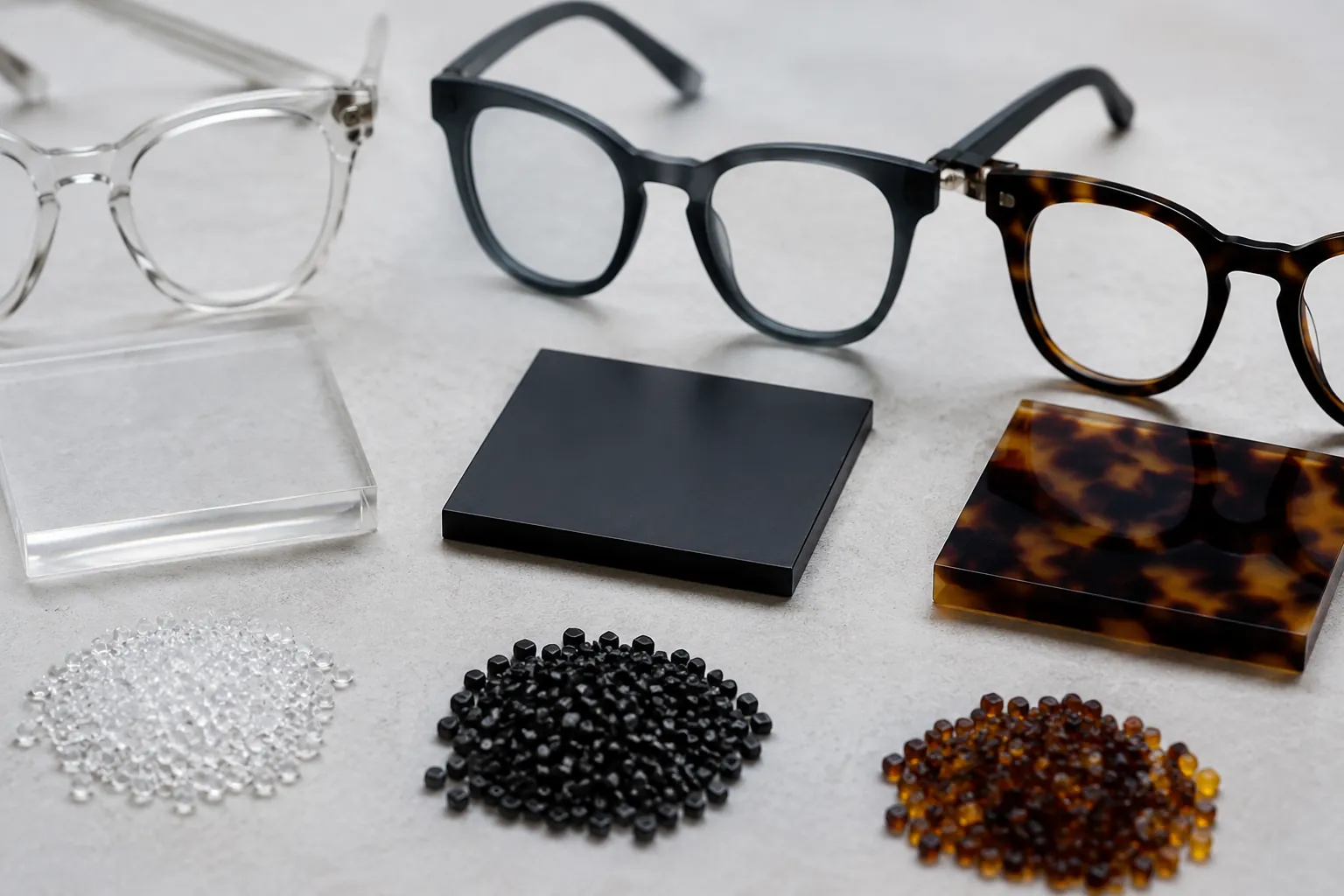
This guide is for buyers building a commercial sunglasses range, not picking a frame material on taste alone. Force one material across every SKU and problems show up fast. Entry prices get harder to hit. Premium styles lose credibility. Mid-tier development gets messy. A better approach is to assign PC, TR90 and acetate by SKU role, user need, decoration method and order scale. Done properly, that gives you clearer target costs, stronger retailer segmentation, more convincing good-better-best tiers and less factory-side friction during sampling, assembly and final inspection.
Why one-material collections often underperform
Many buyers start with a simple brief: one shape family, one frame material, one brand language. It sounds efficient. Commercially, it often is not. A single-material range can be too expensive for entry SKUs, too plain for premium SKUs, or too exposed if cost, labor or yield shifts hit the whole assortment at once.
PC, TR90 and acetate do different jobs. PC is widely used where buyers need efficient injection molding, straightforward color control and repeatable output at volume. TR90 is often chosen where low weight and flexibility support a comfort-led sales story. Acetate usually sits at the top end, where shoppers notice visual depth, polished edges and a more substantial hand feel the moment they pick up the frame.
The common mistake is treating material choice as a design decision only. It is not. It changes the manufacturing route, finishing steps, decoration options, assembly complexity, rework risk and tolerance control. Injection-molded PC and TR90 programs follow a very different path from acetate programs, which usually involve sheet selection, cutting, machining, polishing and hinge fitting.
Good assortment planning matches each material to the price band where its cost-to-perceived-value ratio is strongest. That matters even more when a supplier can start at a low MOQ but only delivers better economics at repeat volume. Material strategy is not theory. It is margin control, sourcing control and risk control.
Use material by SKU tier, not preference
A practical collection structure uses three bands: entry, mid and premium. Each band needs its own target ex-works cost, retail ladder, gross-margin requirement and merchandising role. Buyers who set those limits early usually get cleaner quotations and fewer redesign rounds after sampling.
| Tier | Best-fit material | Typical ex-works logic | Best use case | Main trade-off |
|---|---|---|---|---|
| Entry | PC | Often the lowest frame-cost route for injection-molded styles; usually improves further as volume consolidates | Promo lines, fashion drops, mass retail and repeat programs | Lower premium feel and less visual depth than acetate |
| Mid | TR90 | Usually costs more than basic PC because the value proposition is comfort and performance, not the lowest possible frame cost | Sport-casual, travel, comfort-led retail and active lifestyle channels | Less visual richness than acetate and usually simpler branding execution |
| Premium | Acetate | Higher material and labor input; margin depends on a retail price that can support the finish standard | Capsules, fashion accounts, giftable lines and optical-sun hybrids | More processing steps, tighter finish expectations and more QC sensitivity |
For many importers, the right mix is not fixed. It follows the channel and the price architecture. Volume often leans toward PC because it fits opening-price and repeat business. TR90 earns its place when comfort, flexibility or light weight is central to the sales pitch. Acetate works best when the retailer and end customer will see the upgrade and pay for it.
Keep the order of decisions simple: define the retail role first, set the cost ceiling second, then assign the material. Not the other way around.
Where PC usually makes the most sense
PC is the commercial workhorse for entry-level sunglasses. It combines relatively efficient production with broad styling flexibility. Once tooling and process settings are stable, factories can usually maintain consistent shape output across volume orders. That matters if you need repeat programs, broad color offers or replenishment business.
Use PC when you need:
- Opening prices that still leave room for importer, distributor or retailer margin
- Fast sampling on trend-led shapes using a common molded construction route
- Broad color coverage, including standard blacks, tortoise effects and fashion shades produced through established color-matching methods
- Simple, scalable logo execution such as pad printing or laser marking
- Programs that may repeat and need practical consistency from order to order
In production terms, PC is commonly paired with injection molding, routine edge cleanup, basic finishing, lens fitting and standard branding methods. Typical QC checks include flash removal at mold lines, front symmetry, lens groove consistency, hinge function, temple balance and print adhesion where relevant. Be specific. "Good quality" is not a standard. Approved samples and measurable pass-fail points are.
PC also works well when you want a wider shape and color architecture without forcing too much cost into the frame. Its limit is perceived value. Even a well-made PC frame rarely delivers the layered look, edge polish or material story of acetate. That is why PC should carry opening-price and high-volume roles, not every role in the line.
Where TR90 helps with comfort and fit
TR90 fills the space between basic molded value styles and premium acetate. Its main advantage is not luxury signaling. It is wear performance. Buyers usually choose TR90 when they want a lightweight feel and a degree of flexibility that supports comfort-led positioning.
That is why TR90 appears so often in travel retail, outdoor channels, sport-adjacent assortments and easy-fit unisex programs. It can be especially useful for wrap shapes or styles meant for repeated on-and-off wear. If retailer feedback keeps mentioning tight fit, rigidity or all-day discomfort, TR90 deserves a close look in the next development round.
- Use TR90 when temple flexibility and lightweight comfort are central to the sales story.
- Pair it with lens options that support the same practical proposition, such as polarized or performance-led lens configurations where relevant.
- Keep branding durable and restrained so the product still reads as functional, comfortable and easy to wear.
TR90 still needs disciplined process control. Check temple recovery, screw retention, stress marks near hardware points, hinge feel and left-right balance after lens insertion. Do not approve from one sample alone. Compare several early-production units side by side for spread, front curve and opening feel. TR90 is not a stand-in for acetate. It is the mid-tier answer for comfort, resilience and everyday wearability.
Where acetate earns premium pricing
Acetate supports premium pricing when the customer can see and feel the upgrade right away. It gives you richer translucency, laminated color effects, thicker silhouettes and a more substantial hand feel. In premium retail, those signals matter. They help justify the higher ticket.
The production route is also different from direct injection molding. Acetate frames usually start with sheet selection and color matching. Fronts and temples are cut, machined, shaped, polished, assembled and adjusted through multiple stages. More steps mean more points where variation can creep in. So sample review and approval standards need to be tighter.
Buyers should watch sheet consistency, visible color difference between front and temples, hinge alignment, bevel finish, polish quality and warpage after lens fitting. Small issues show more clearly on acetate because finish expectations are higher. A defect that might pass on a promotional style can become a rejection issue on a premium acetate SKU.
Use acetate where the retail plan can absorb higher labor input and where the retailer will actually tell the material story: brand capsules, fashion-led statements, premium gift periods and optical-sun crossover styles. Do not spend acetate money on SKUs sold mainly on opening price or on styles where the shopper will not notice the upgrade.
Build cost around MOQ and process reality
The wrong way to cost a collection is to compare materials by resin or sheet price alone. The right way is to look at frame material, manufacturing route, lens specification, decoration count, packaging level and order scale together. The same frame concept can move sharply in cost once you add polarized lenses, metal trims, branded components or upgraded packaging.
| Factor | PC | TR90 | Acetate |
|---|---|---|---|
| MOQ starting point | Often workable for lower-volume entry programs, especially on simple molded designs | Often workable for lower-volume comfort-led programs, but color splits should be controlled carefully | Possible at low volume, but unit economics are usually less forgiving because of material and labor input |
| Best price movement | Usually improves most clearly when repeat volume is consolidated | Usually improves with higher volume and simpler SKU architecture | Can improve with scale, but labor content often limits dramatic cost compression |
| Sampling speed | Often faster on straightforward molded programs | Often fast to moderate, depending on construction and lens combination | Usually slower than molded programs because machining and polishing add steps |
| Bulk lead time | Often shorter on standard molded constructions, subject to tooling, lens and packaging requirements | Commonly similar to other molded or semi-technical programs, depending on specification | Usually longer because cutting, machining, polishing and assembly involve more touchpoints |
| Decoration fit | Pad print, laser marking and other straightforward branding methods | Best with durable, restrained branding and practical trims | Works well with engraved details, premium finish work and other higher-perceived-value branding elements |
If you already know your range architecture, negotiate by family rather than by isolated SKU. Group PC carryovers together, TR90 comfort styles together and acetate premium styles together. That gives the factory a cleaner planning base and often leads to more rational quotations. Also control color counts. Too many low-volume color splits can wipe out the efficiency you expected from an otherwise simple frame program.
Match compliance and QC to the material plan
Frame material affects more than appearance. It changes inspection logic and document control too. Buyers should confirm the compliance path for the complete sunglass, including frame, lens, coating, ink, metal trims and packaging components where relevant. Documents that support one final configuration should not be assumed to cover another if the frame material, lens type or decoration changes.
For export programs, common reference points include CE EN ISO 12312-1, ANSI Z80.3, AS/NZS 1067 and REACH, depending on destination market and product specification. FDA registration may also be relevant as supplier or facility background, but it is not proof that the finished product meets every market requirement. If you change from PC to acetate, or from non-polarized to polarized lenses, ask the supplier and test partner whether the existing file still applies or whether extra testing or document updates are needed.
A sensible QC checklist changes by material:
- PC: mold line cleanliness, flash removal, logo adhesion, lens fit stability and basic symmetry
- TR90: flex recovery, temple symmetry, stress marks at hardware points and screw retention after repeated opening
- Acetate: sheet color consistency, polish quality, hinge alignment, edge finish and post-fitting warpage
Good factories usually manage this through pre-production approval, inline inspection and final random inspection. ISO 9001 or social-audit frameworks such as BSCI can support process discipline and buyer due diligence, but they do not replace model-level checks. Ask for approval gates at three stages: sample confirmation, pre-production sample signoff and final shipment inspection against the approved standard.
A practical assortment plan buyers can use now
If you are building a new line, keep the architecture narrow and commercial. A mixed-material assortment should feel deliberate, not random. One of the easiest ways to lose control is to add too many colors, finishes and price points before the first sell-through and return data comes back.
- Set three landed-cost bands before sketch approval and place every SKU into one of them.
- Assign PC to opening-price fashion, promotional and replenishment-driven styles.
- Assign TR90 to comfort-led, sport-casual, travel or easy-fit unisex models.
- Assign acetate to visible premium SKUs with enough gross-margin headroom to justify the added labor and finish standard.
- Limit launch colorways to core proven shades first, then expand only after early sales and return data support it.
- Sample in stages: shape approval first, then material and color confirmation, then branding, packaging and final QC standard.
This staged method helps buyers make cleaner decisions and gives factories a clearer route from development to bulk production. It also works well when the business starts with cautious order volumes and scales only after repeat demand is proven.
The objective is simple: every SKU should have a clear role, a defendable margin, an appropriate quality standard and a production path the factory can repeat without drama.
Have a custom sunglasses project in mind?
Send us your styles, target market and quantities and we will return a detailed quote with MOQ, lead time and a sample plan.
Get a QuoteWhy source this from Wenzhou with LumiShades
Wenzhou in Zhejiang Province is widely regarded as China’s eyewear manufacturing capital, producing a large share of the world’s sunglasses. That concentration matters to buyers: a deep local supply chain for acetate sheet, hinges, lens blanks, plating and packaging means shorter component lead times, easier color and material matching, and a workforce with decades of eyewear-specific skill. LumiShades has manufactured in this ecosystem since 2009, and our vertical integration — in-house injection molding, acetate cutting, CNC milling, lens tinting, decoration and quality control — means no part of your order is quietly subcontracted to a workshop you cannot audit.
For international buyers, that vertical control translates into accountability. When a single factory owns every step, defects are traced and fixed at source rather than bounced between vendors, and your specifications survive intact from first sample to bulk. For procurement review, buyers can request process records, approved samples, quality checkpoints and project-specific compliance files before placing a bulk order. Required testing and documentation are confirmed against the destination market and product specification rather than assumed from a generic certificate list. Explore our manufacturing capabilities and quality control process to see how this works in practice.
Frequently asked questions
Can I mix PC, TR90 and acetate under one collection name without confusing retailers? Yes, if the structure is easy to explain. Keep the design language, packaging hierarchy and price ladder consistent, then define each material by retail role: PC for opening price and repeat volume, TR90 for comfort and active use, and acetate for premium finish and perceived value. In the sell-in deck, show one line sheet that groups styles by tier and states why each material was chosen. That frames the assortment as a strategy, not a random mix.
What material is safest for a first order at 50 pairs per design? PC is usually the lowest-risk starting point for entry styles because the construction and branding methods are often simpler to control at small scale. TR90 can also make sense if the SKU is sold on comfort, fit or lightweight wear. Acetate is possible at low volume, but buyers should budget more carefully for sampling, finishing review and unit cost. Before placing the first order, ask the supplier to confirm the exact construction, approved colorway, branding method, packaging spec and which QC points will be checked at pre-production and final inspection.
How should I allocate decoration across these materials? Match decoration cost to the role of the SKU. On PC, use scalable methods such as pad printing or laser marking if they fit the design. On TR90, keep branding durable and understated so it supports the functional positioning. On acetate, reserve higher-perceived-value details such as engraved elements or premium finish accents for styles with enough margin to absorb them. In all cases, ask for an adhesion or durability check on the final decorated sample before approving bulk production.
Do I need separate compliance checks if I change only the frame material? Often yes. A frame-material change can alter the final product specification and the supporting technical file, so buyers should not assume an earlier report still applies. Confirm with the supplier which documents support the final configuration and whether the product still aligns with the target market requirements, such as CE EN ISO 12312-1, ANSI Z80.3, AS/NZS 1067 and REACH where relevant. If the supplier mentions FDA registration, treat that as supplier background only, not proof that the finished sunglasses meet every market requirement.
How do lead times usually change by material? PC and TR90 programs are often faster than acetate when the construction is straightforward, because molded production routes usually involve fewer manual finishing steps. Acetate often takes longer because cutting, machining, polishing and assembly add more stages and more finish-sensitive checkpoints. The practical move is to ask for a stage-by-stage timeline at quotation stage: sampling, sample revision, pre-production approval, bulk production and final inspection. That gives you a real critical path instead of a headline lead-time promise.
Ready to start?
Explore our aviator sunglasses or request a quote — our sales team replies within 12 hours.
Request a Quote