
Injection Molded vs CNC Sunglass Parts
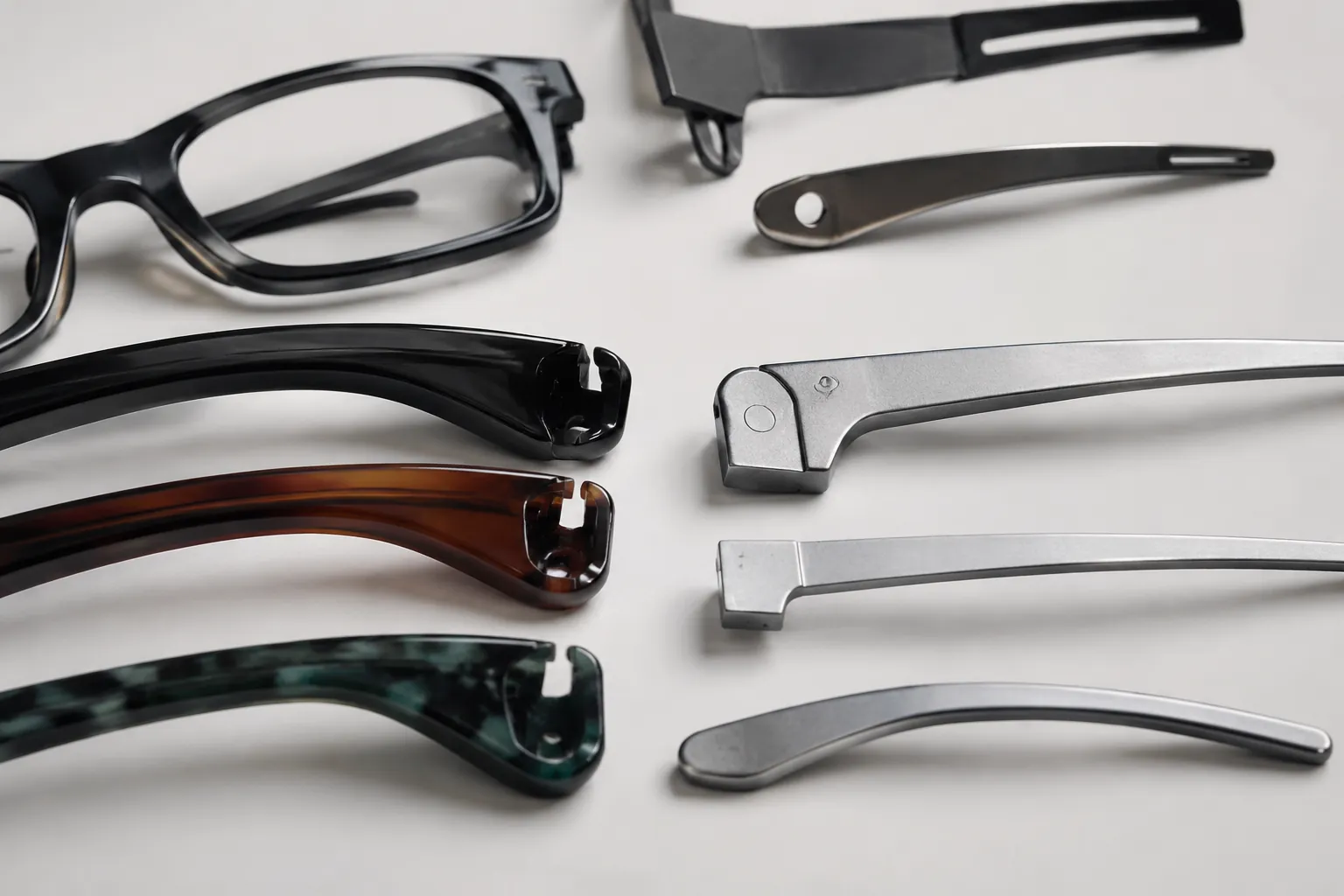
This guide is for eyewear brands, importers, distributors, and retailers comparing molded parts with CNC-processed parts in custom sunglasses programs. The key sourcing question is not which process is better in the abstract. It is which parts need machining for fit, finish, branding, or assembly control, and which parts should stay molded for cost and scale. Below is a practical review of process differences, visible quality trade-offs, decoration limits, tooling logic, MOQ effects, lead-time implications, and compliance checkpoints that matter before you place a bulk order. The goal is simple: spend more only where the customer can see or feel the difference, or where tighter process control can cut rework, scrap, or returns.
Start with the buying decision, not the machine
Buyers often frame this as injection molding versus CNC machining. That is too simple for most sunglass programs. The real decision is which components should be molded for efficiency and which features should be machined for precision. Many successful frames use both.
Injection molding is the standard process for high-volume thermoplastic parts. You pay for tooling up front, then produce repeat parts from the mold. CNC machining works differently. It removes material from sheet, block, or semi-finished parts, so machine time is added to every unit. Different process, different cost logic.
Use molding when you need repeatable output, stable geometry, and competitive unit economics on larger runs. Use CNC when a part needs sharper detailing, tighter pockets or grooves, cleaner edge definition, or a better base for premium branding details than molding alone can provide.
For example, a TR or polycarbonate frame may be injection molded, then trimmed, polished, decorated, and assembled. A premium acetate frame is more often cut from acetate sheet, milled on CNC equipment, then bevelled, tumbled, hand polished, fitted with hinges, and aligned. Those extra steps raise cost. They can also improve edge clarity, surface definition, and perceived quality.
This matters early. If the product is meant to compete mainly on price, molding usually sets the baseline. If the product is meant to signal material quality, refined detailing, or more durable branding execution, selective CNC work may be worth it. Decide that before quoting gets too far. Process choice affects cost structure, lead time, and the quality controls that matter later.
Where injection molding wins on cost, speed, and scale
Injection molding remains the default route for many sunglass components because it is efficient once the design is stable. Thermoplastic material such as TR90 or polycarbonate is heated, injected into a mold cavity, cooled, ejected, trimmed, and sent to finishing. For repeat programs, that supports steady throughput and easier replenishment than a machining-heavy route.
For buyers, the advantages are straightforward.
- Lower unit cost at scale once tooling is spread over repeat production.
- Strong repeatability when the same mold, resin, and approved finish are used.
- Efficient output for mainstream frames with stable geometry and standard features.
- Good fit for resin-based colors and common finishing methods.
- Faster production flow for many high-volume plastic frame programs.
Its limits matter too. Molded edges are usually less crisp than machined edges on premium acetate. Fine recesses or sharp cosmetic transitions may show rounding. Uneven wall thickness can increase the risk of sink, warp, or local instability, especially around hinges, bridge transitions, or thick branding zones. The overall shape may still look fine. The trouble often appears in local assembly areas.
That is why molded frames perform best when the design stays disciplined: standard hinge layout, practical wall thickness, controlled draft, and decoration methods that suit a molded substrate, such as pad printing or hot stamping. Do not assume a strong molded sample means every cosmetic detail will stay as sharp as a machined acetate frame at bulk scale. Compare by feature, not just by silhouette.
Where CNC adds value buyers can actually sell
CNC machining earns its cost when it improves features the customer can see, touch, or rely on during use. In eyewear, that usually means tighter control on assembly-critical interfaces, sharper surface definition, and better preparation for premium branding details. It is especially relevant for acetate, mixed-material frames, and private label collections where the frame itself signals the brand position.
In acetate production, the process often starts with sheet cutting, followed by CNC roughing and finishing. The machine cuts the front shape, lens opening, bevel, bridge transitions, temple profile, and hinge pocket from sheet stock rather than forming those features inside a mold cavity. That gives the factory more freedom to create faceted planes, laminated color reveals, stepped thickness changes, and cleaner recesses for inserts or logos.
The value is not that CNC sounds premium. It is that machining can improve control where control matters. Hinge pockets, lens grooves, logo recesses, and mating surfaces are common examples because small deviations there can affect alignment, lens fit, or visual quality. CNC also helps when a design depends on sharp bevel lines, symmetrical facets, or a flush fit between different parts.
CNC can also improve decoration quality because it creates a more controlled base for secondary operations. Common examples include:
- Flush-fit metal logo plates seated into machined recesses.
- Laser engraving on flat or deliberately prepared areas.
- More consistent registration for printed or filled branding details.
- Debossed channels for enamel fill or contrasting paint.
- Cleaner transitions between matte and polished surface treatments.
That is why many premium frames are not fully CNC for marketing reasons alone. They use machining where precision changes the finished product in a visible or functional way: bevel definition, temple branding, hinge feel, lens seating, and polished edge quality. That is where buyers are most likely to recover the extra cost through better presentation, easier assembly, or stronger perceived value at retail.
Compare the trade-offs by component, not by theory
| Component or Feature | Injection Molded Approach | CNC-Machined Approach | Best Commercial Use |
|---|---|---|---|
| Frame front | Low unit cost at volume, good shape repeatability, softer edge definition on fine details | Sharper facets, cleaner bevel lines, better control on laminated acetate transitions | Molding for mass retail; CNC for premium acetate or design-led fronts |
| Temple arms | Efficient for standard profiles and broad SKU rollout | More precise hinge pocket geometry, slimmer profile control, cleaner logo recesses | CNC when temple feel and branding are key selling points |
| Lens groove and seating | Adequate for basic shapes, more fitting adjustment on demanding designs | More consistent groove depth and lens retention on fashion or high-wrap shapes | CNC where assembly yield and lens fit are critical |
| Logo application area | Suitable for pad print, hot stamp, and simpler inserts | Better for flush metal plates, engraved channels, and precise alignment | CNC where branding must look durable and premium |
| Prototype revisions | Tool changes can be slower and more expensive after mold approval | Faster iteration on angles, pocket depth, bevel profile, and decorative details | CNC for early development, approvals, and pilot collections |
| Unit economics | Best after tooling is spread across repeat volume | Higher per-piece cost but lower upfront tooling commitment | Molding for repeat volume; CNC for lower-volume premium tests |
The buying lesson is simple. You do not need one process for the whole frame. A molded front with CNC-refined temples may be right. A fully machined acetate frame may also be right if the retail position and margin support it. The useful comparison is not abstract process superiority. It is whether each component is made in the way that best fits its commercial job.
Tolerance, fit, and defect risk: where hidden cost shows up
Many sourcing decisions go wrong for one reason: buyers compare quoted FOB price but ignore assembly loss, cosmetic sorting, hand adjustment, or returns caused by inconsistent fit. Precision costs money. Inconsistency does too.
In sunglasses, the hidden-cost points are usually predictable. Hinge pocket geometry affects temple alignment and opening feel. Front symmetry affects how balanced the frame looks on face. Lens groove consistency affects glazing difficulty and the risk of cosmetic gaps or excess fitting stress. Recess depth affects whether metal logos sit flush. Temple-to-front fit affects whether the product feels controlled or loose.
This is why tolerance questions should be tied to function. A supplier does not need to quote one number for the entire frame. Buyers should ask which dimensions are critical, what tolerance applies to each one, and how those points are measured during production. Critical checkpoints often include hinge pocket dimensions, bridge width, lens groove width and depth, temple angle, total frame width, and recess depth for logos or inserts.
Ask factories for process checkpoints, not vague claims about precision. Useful questions include whether those dimensions are checked in process or only at final inspection, whether go or no-go gauges are used where appropriate, and how nonconforming parts are separated before assembly. If the supplier cannot explain which features are controlled and how they are verified, the quoted price may not reflect the real risk of rework or uneven bulk quality.
Process integration matters too. If molding, CNC, decoration, and assembly are split across different vendors, each handoff adds risk of dimensional drift, handling damage, or conflicting interpretation of the approved sample. Strong in-house control or well-managed handoff will not remove all risk. It does improve the odds that bulk production will match the approved sample in both fit and appearance.
How MOQ, tooling, price breaks, and lead time change the choice
The lowest process cost on paper is not always the best sourcing decision. The right route depends on expected volume, reorder potential, design maturity, and how much development risk is still on the table.
For injection-molded frames, the economic advantage appears when expected volume can justify tooling over time. That usually means the design is proven or likely to reorder. For CNC-led development, the advantage is different. The buyer can test shape, branding, and detailing without committing to mold tooling too early. That is useful for pilot collections, concept validation, premium capsule drops, or programs that will probably go through several design revisions.
Lead time follows the same logic. Mold development adds an upfront stage that machining-led prototyping may avoid. CNC-heavy bulk production, however, can add time at the unit level because multiple machining and finishing steps are involved. Actual timing depends on the factory setup, material availability, decoration complexity, and approval discipline. Ask for a process-based timeline that separates sampling, tooling if any, pre-production approval, bulk production, and final inspection.
Several factors commonly push timing and cost upward:
- Custom metal logo plates or other fitted trim parts.
- Multilayer or laminated acetate that requires controlled orientation and finishing.
- Extra CNC passes for facets, chamfers, or complex bevel changes.
- Special lens treatments such as mirror, polarized, or photochromic options.
- Higher cosmetic standards for polish, symmetry, and alignment.
The practical rule is blunt. Do not expect a low-volume order with premium machining details to behave like a standard molded replenishment program. If the frame depends on costly materials, multiple finishing stages, or close visual matching, the quote and timeline should show that from the start. A good supplier can separate the cost drivers: tooling, labor, machine time, decoration, and lens upgrades.
Compliance supports access, but process control protects consistency
For export buyers, compliance and process discipline should be judged separately. A frame can pass testing on an approved sample and still create bulk problems if production drifts away from the tested construction.
Depending on the destination market and product category, sunglasses programs may need alignment with CE EN ISO 12312-1, ANSI Z80.3, AS/NZS 1067, REACH, or FDA-related requirements such as FDA registration where applicable. Factory credentials such as ISO 9001 and BSCI can point to established management systems or social compliance controls, but they do not replace product-specific testing or document review.
CNC machining does not make a frame compliant by itself. What it can do is improve consistency in physical features that affect how closely bulk goods match the approved design. Lens groove geometry, lens seating condition, front curve consistency, and hinge alignment all influence whether the shipped product reflects the tested sample and intended performance.
Buyers should confirm three points before purchase order release:
- The tested lens and frame specification matches the bulk bill of materials, including material, tint category, coating, and geometry.
- The supplier can provide the correct market-specific documents, not just general statements.
- The QC plan covers both cosmetic and dimensional checks, especially at assembly-critical features.
On premium frames, this discipline matters more because exact fit and clean detailing make variation easier to spot. Compliance supports market access. Process control helps keep the shipment aligned with the approved standard.
A practical sourcing rule for premium custom sunglasses
If your end customer mainly buys on color, silhouette, and price, molded construction will often do the job. If that customer notices edge sharpness, hinge feel, flush branding, acetate depth, and the way the frame opens and closes, selective CNC work is more likely to justify its cost.
A useful rule is to buy precision where the customer sees it, touches it, or where the factory can clearly reduce assembly risk. That often includes temple branding zones, hinge pockets, lens grooves on premium acetate styles, front bevels, and decorative insert seats. Outside those zones, added machining may not improve the product enough to support the extra cost.
Do not over-specify. A frame does not need every component CNC-machined to feel premium. In many cases, the strongest commercial result is a hybrid route: molded efficiency where geometry is straightforward, machining where detail and tolerance affect perceived quality or production control. That usually gives a better balance of margin, appearance, and manufacturing stability than an all-or-nothing approach.
Before approval, ask the supplier for a clear process map covering material choice, molding or sheet-cutting route, CNC operations if any, decoration method, lens specification, dimensional checkpoints, sample approval flow, and bulk production sequence. A capable factory should be able to explain that route in plain language and show how it links to the quote. Insist on that level of clarity before you commit.
The right question is not whether CNC is better. It is whether extra precision improves sellable quality, assembly reliability, or brand presentation enough to pay for itself.
Have a custom sunglasses project in mind?
Send us your styles, target market and quantities and we will return a detailed quote with MOQ, lead time and a sample plan.
Get a QuoteWhy source this from Wenzhou with LumiShades
Wenzhou in Zhejiang Province is widely regarded as China’s eyewear manufacturing capital, producing a large share of the world’s sunglasses. That concentration matters to buyers: a deep local supply chain for acetate sheet, hinges, lens blanks, plating and packaging means shorter component lead times, easier color and material matching, and a workforce with decades of eyewear-specific skill. LumiShades has manufactured in this ecosystem since 2009, and our vertical integration — in-house injection molding, acetate cutting, CNC milling, lens tinting, decoration and quality control — means no part of your order is quietly subcontracted to a workshop you cannot audit.
For international buyers, that vertical control translates into accountability. When a single factory owns every step, defects are traced and fixed at source rather than bounced between vendors, and your specifications survive intact from first sample to bulk. For procurement review, buyers can request process records, approved samples, quality checkpoints and project-specific compliance files before placing a bulk order. Required testing and documentation are confirmed against the destination market and product specification rather than assumed from a generic certificate list. Explore our manufacturing capabilities and quality control process to see how this works in practice.
Frequently asked questions
At what order volume does injection molding usually make more sense than CNC-heavy production? There is no universal break-even point because tooling cost, frame complexity, material choice, and expected repeat orders all change the economics. In practice, injection molding usually makes more sense when the design is stable and you expect repeat production from the same mold. Ask the supplier to quote both routes separately: one with tooling cost, unit cost, and expected reorder pricing for molding, and one with unit pricing for CNC-heavy production at your planned quantities. Then compare total landed cost across the first order and at least one realistic reorder scenario.
Should I use CNC for the whole frame if I want a premium result? Not necessarily. A premium result depends on where precision matters, not on using CNC everywhere. Ask which features are most visible or most sensitive during assembly, such as hinge pockets, lens grooves, bevels, logo recesses, or decorative insert seats. If those areas benefit from machining but the rest of the frame does not, a hybrid process can protect margin without weakening the product. Request a component-by-component process split on the quote so you can see exactly what you are paying for.
What tolerance level should I ask about on premium sunglass parts? Do not ask for one blanket tolerance for the whole frame. Ask the supplier to define tolerances by feature and by function. The most useful checkpoints are hinge pocket dimensions, lens groove width and depth, bridge width, total frame width, temple angle, and logo recess depth. Then ask how each point is measured, when it is checked during production, and what happens if it falls outside spec. That gives you a usable quality standard instead of a vague claim about precision.
What details should I request on a quote for a CNC-enhanced frame program? Ask for the material by component, the exact process split between molding and machining, the finishing and decoration methods, the critical dimensions that will be controlled, the tooling requirement if any, MOQ by design and color, sample timing, bulk timing, and any separate charges for metal logos, special hinges, laminated acetate, or upgraded lenses. Also ask whether the quoted price includes assembly, logo application, and final inspection. A strong quote should show where CNC is used and why, not just label the frame premium.
How fast can samples and bulk orders move on custom sunglasses? Timing varies by process route and factory capacity, so treat any fixed number as a project-specific estimate rather than a rule. Sampling can move relatively quickly when revisions are minor and materials are standard, but custom trims, acetate development, or repeated approval changes will extend the schedule. Bulk timing depends on whether tooling is required, how many CNC and finishing steps are involved, material availability, and the inspection plan. Ask the supplier for a staged timeline covering sample development, tooling if applicable, pre-production approval, bulk production, and final QC so you can see where delays are most likely.
Ready to start?
Explore our round sunglasses or request a quote — our sales team replies within 12 hours.
Request a Quote