
OEM vs Private Mold Sunglasses: When Tooling Pays Off for B2B Buyers
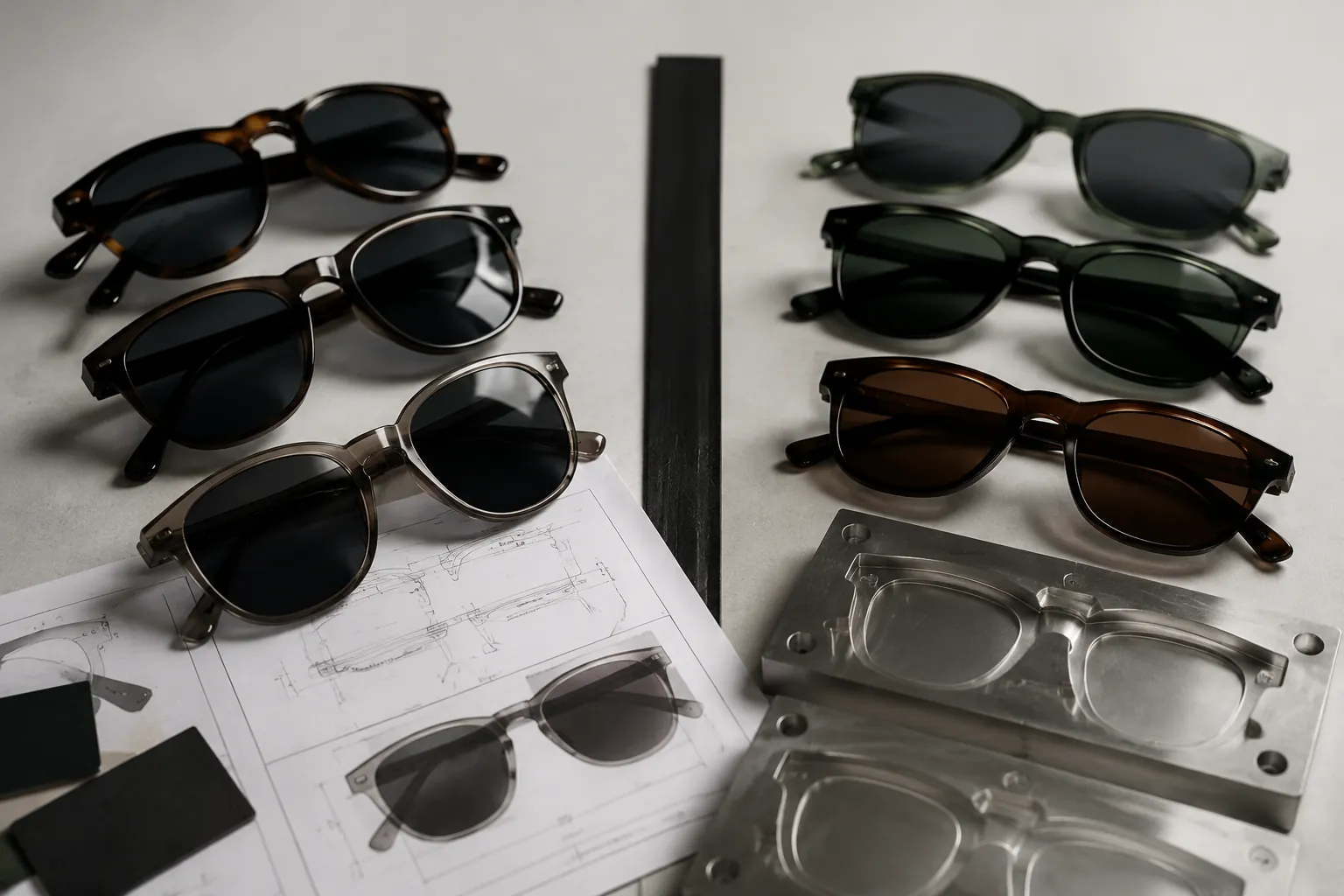
For sunglasses importers, retailers, and brand teams, the tooling decision affects cash flow, speed, fit, and margin long before packaging or logo placement does. An existing mold keeps upfront risk low and gets you to market fast. A private mold costs more at the start, but it can support a proprietary shape, tighter fit control, and better long-run economics. The hard part is timing. Tool too early and you tie money up in a style that may not reorder. Tool too late and you keep paying for compromises in shape, fit, and differentiation. This guide explains where the break-even usually sits, what actually changes in engineering and production, and how experienced buyers judge whether a mold will earn back its cost.
What OEM and private mold mean in eyewear sourcing
In sunglasses sourcing, OEM usually means you start with an existing factory platform and customize the commercial details around it. That can include frame color, lens tint, logo print, a metal emblem, laser engraving, packaging, barcode labels, and sometimes small trim changes. The main geometry of the front, lens opening, bridge, and temples already exists in the factory tool.
Private mold means the factory creates dedicated tooling for a new front shape, new temples, or both. In practice, that can involve CAD development, 3D confirmation, tool cutting, test shots, fit review, adjustment, and production release. For acetate frames, the route may involve custom cutting templates, CNC programs, bevel settings, polishing allowances, and hardware positioning jigs rather than only an injection tool. Either way, it becomes a product-development project with engineering checkpoints, not just a sourcing order.
The commercial difference is large. With an existing mold, the buyer mainly pays for materials, labor, decoration, and packaging. With private tooling, the buyer also pays for development time, tooling cost, and at least one extra approval cycle. The trade-off is control. A dedicated mold gives more control over lens size, bridge curve, temple spread, wrap angle, end-piece thickness, and the visual signature of the frame. That matters when the product is part of a core retail line rather than a short seasonal buy.
For example, a stock injection frame may let you choose a black or translucent frame color, polarized or non-polarized lenses, pad print on both temples, and custom box packaging with low minimums on the factory's standard platform. A private mold program may require a higher commitment, but it allows you to specify a different temple length, bridge width, eye size, or acetate thickness so the frame better matches your brand's fit and design intent.
The real break-even is unit economics, not just mold cost
Buyers often start by asking what the mold fee will be. That number matters, but it is not the real decision point. The better question is how many pairs you expect to sell, how many repeat orders are realistic, and what margin lift a proprietary frame can create.
Private tooling for sunglasses varies widely by construction and complexity. A simple injected front with standard temples is a different engineering job from a custom acetate frame with a new bevel profile, embedded metal core, and matching lens shape. What matters to the buyer is amortization. If tooling adds upfront cost but lowers the per-pair cost over multiple runs, or supports a higher sell-through rate because the frame is more distinctive, the investment can pay back. If the style lasts one season and disappears, the tool cost becomes dead inventory in another form.
The decision should be modeled at the contribution-margin level, not in isolation. A buyer should compare the first order, the most likely reorder quantity, and any retail-price premium supported by an exclusive design. If a style is expected to stay in line across multiple seasons or channels, tooling becomes easier to justify. If the line is still being tested, an existing mold is usually the safer route.
| Option | Typical upfront spend | Unit cost behavior | Lead time logic | Best fit |
|---|---|---|---|---|
| Existing mold with light customization | Lowest; mainly sampling, trims, and packaging setup | Usually best at 50-1,000 pairs | Samples about 7-10 days, bulk about 25-35 days after approval | Market tests, seasonal capsules, promo and price-led programs |
| Private mold for one style | Higher; includes CAD review, tooling, test shots, revisions | Often improves from 1,000 pairs upward if the style repeats | Longer first cycle due to engineering and approval rounds | Core lines, better fit control, semi-exclusive retail programs |
| Private mold family program | Highest; several linked tools or parts sharing a design language | Best at 5,000+ pairs and multi-SKU reorders | Slowest launch, but efficient repeat production once approved | Chain programs, distributor exclusives, anchor brand shapes |
| Existing mold first, tooling later | Moderate over time; spend is phased instead of front-loaded | Best when demand is unproven but has upside | Fast launch first, slower second phase for the winning shape | Most practical path for overseas buyers managing risk |
Where private tooling creates measurable value
Private molds usually pay off when they solve a specific commercial or technical problem. The first case is a stable seller. If a shape has already reordered once or twice, investing in exclusivity can protect margin and reduce direct comparison with generic catalog frames. The second case is fit control. Small geometry changes can materially reduce returns, especially in e-commerce or chain retail where staff do limited fitting.
In production terms, private tooling allows the factory to lock key dimensions instead of adapting a near-match. That can include bridge width, pantoscopic angle, face wrap, lens groove depth, temple opening force, and end-piece alignment. Buyers should ask for the actual tolerance targets the factory will hold on critical dimensions. A serious supplier should be able to discuss hinge positioning, left-right temple symmetry, lens-cut consistency, and warpage control in concrete terms.
Material behavior also matters. Injection frames can deliver lighter weight and repeatable wall thickness, but they rely heavily on mold design, cooling balance, and shrinkage control. If wall sections are uneven, the frame can warp after ejection or show sink marks near thicker areas. Acetate behaves differently. It supports richer polish, stronger color expression, and a more premium hand feel, but it also involves cutting, tumbling, barrel polishing, bending, and manual adjustment. A custom acetate temple cross-section or thicker front profile can justify tooling because those details are part of the perceived value.
Private tooling also improves repeatability. Once geometry is locked, lens-edge seating, hinge alignment, and temple closure tend to become more consistent across reorders. That reduces QC variation. On busy production lines, inconsistency usually appears as lens gaps, uneven temple spread, left-right height mismatch, or excessive hinge torque drift. Those defects are expensive because they are discovered late and can affect the whole lot.
When existing molds are the smarter commercial choice
There are many cases where tooling is the wrong move. If the product is a first-market test, a short fashion capsule, a giveaway program, or a price-sensitive retail bundle, existing molds are usually the better decision. They reduce commitment, shorten the development window, and let the buyer spend budget on sellable features instead of fixed tooling cost.
Existing molds also make sense when order patterns are irregular. A buyer who places 300 pairs now and may or may not buy 800 more in six months usually does not yet have the reorder visibility needed for a new tool. The same is true when the design team keeps changing frame shape, temple width, or lens profile every season. Tooling only works when the shape remains stable long enough to amortize the investment.
A stock mold does not mean generic-looking if the trim package is specified well. A buyer can still change lens category, add mirror or gradient tint, choose matte or high-gloss finish, use pad print or laser logo, add a metal emblem, specify a microfiber pouch and rigid case, and request retail barcode labeling. The frame may not be exclusive at the geometry level, but it can still present as a clean branded product.
- Use existing molds for first launches, promo programs, and trend-driven seasonal buys.
- Keep existing molds when reorder probability is unclear or SKU churn is high.
- Spend the saved cash on better lenses, packaging, or faster replenishment.
- Move to private tooling only after one shape shows stable demand across colors or channels.
For many buyers, the best commercial sequence is simple: start with a stock platform, learn which colorways and lens options sell, tighten the specification, and only then create a private tool for the proven winner.
What changes in sampling, engineering, lead time, and QC
The operational difference between stock mold and private mold programs is most visible in sampling and approval flow. For existing molds, the sample route is usually straightforward: confirm the frame reference, lens spec, logo artwork, decoration position, and packaging; then review a pre-production sample. Because the geometry already exists, samples can often be completed in about 7-10 days, followed by bulk production in roughly 25-35 days once approval, deposit, and materials are in place.
Private mold development adds several steps. The factory may begin with technical drawings or a 3D rendering, then create a prototype or first-shot sample, review fit and appearance, adjust the tool, and issue a second round before production sign-off. Depending on complexity, that can add several weeks. Buyers should ask whether the approval sample is made from production material, from a CNC mock-up, or from a handmade prototype. Those are not equivalent. A hand-polished sample can look excellent but still fail to reflect injection shrinkage, hinge placement tolerance, or acetate bending behavior in mass production.
Decoration methods should also be specified early because they affect both appearance and process flow. Common options include pad printing for logos, silk screening for simple graphics, laser engraving for a permanent mark, hot stamping on some components, and metal logo plates for a more premium look. Each has different durability, setup, and placement limitations. Lens options likewise change the process. TAC polarized lenses, PC lenses, nylon lenses, mirror coating, anti-scratch treatment, and gradient tint each add cost and inspection points.
QC for sunglasses should be tied to the exact construction. Standard checks often include lens tint consistency, visible surface finish, logo placement, hinge screw security, opening and closing feel, temple alignment, and package count. A higher-control program may also define acceptable limits for left-right symmetry, lens seating, and cosmetic defects by viewing distance. For export, compliance cannot be separated from QC. Buyers should verify which standard applies to the destination market and request evidence for the exact model, lens category, and material combination being purchased. Common references include CE EN ISO 12312-1, ANSI Z80.3, AS/NZS 1067, REACH, FDA registration, ISO 9001, and BSCI, where applicable.
How volume tiers, SKU count, and price bands should guide the decision
The cleanest decision model is to map volume against reorder probability and SKU discipline. A one-time order at 50-300 pairs is almost never enough reason to fund a private mold unless the product carries unusually high margin or the frame is strategically important to the brand. At 300-1,000 pairs, the program can justify a tool only if the buyer already has strong confidence in repeat demand. At 1,000-5,000 pairs, tooling becomes a real option, especially if the design is stable and the unit-cost improvement is measurable. Above 5,000 pairs, private tooling often becomes commercially sensible for an established style.
SKU count matters just as much as volume. Ten weak styles rarely outperform two proven ones. Tooling spread across too many shapes destroys amortization and complicates forecasting. Buyers get the best return when one frame platform can support multiple colorways, lens tints, or channel-specific packaging without changing geometry.
| Order pattern | Recommended path | Commercial logic |
|---|---|---|
| 50-300 pairs | Existing mold | Lowest cash risk, fast sample-to-sale cycle, ideal for testing |
| 300-1,000 pairs | Existing mold first; tool only with visible reorder confidence | Enough volume to learn sell-through, often still too early for dedicated tooling |
| 1,000-5,000 pairs | Case by case | Tooling can pay if the style is stable, margin lift is clear, and reorders are probable |
| 5,000+ pairs | Private mold often justified | Amortization improves, exclusivity matters more, and repeat QC gets easier to control |
In practice, buyers should compare at least three scenarios: existing mold for one run, existing mold with one reorder, and private mold across two to three runs. That comparison usually reveals whether the tool is solving a real business need or just satisfying a design preference.
Questions to ask before approving a private mold
Before releasing tooling payment, buyers should push for specific technical and commercial answers. Vague language at this stage usually leads to expensive ambiguity later. The goal is not to challenge the supplier for the sake of it. The goal is to understand exactly what is being locked, what can still change, and what happens if the first trial does not meet spec.
- Which parts are new: front, temples, lens shape, metal trim, or the full frame set?
- What dimensions are critical, and what tolerances will be held on those points?
- How many sample or test-shot rounds are included before production release?
- Can one tool support multiple colorways and lens variants without recutting?
- What is the expected unit price at 300, 1,000, and 5,000 pairs with the agreed lens and packaging spec?
- How will the factory handle warpage, flash, sink marks, hinge drift, or lens-fit issues found in first shots?
- Who owns the tool, where is it stored, and what happens if the program pauses for a season?
A disciplined buyer should also ask for a decision rule internally. If the style is likely to stay in line for at least 12 months, has clear reorder potential, supports the brand identity, and can absorb tooling across several runs, then private development is worth quoting seriously. If only one or two of those conditions are true, stock molds are usually the safer choice.
For most overseas programs, the lowest-regret path is phased. Launch on an existing mold, validate the sell-through, refine the specification after real market feedback, and then move the winning shape into private tooling. It is less glamorous than starting from scratch, but it protects cash, sharpens product decisions, and usually produces a better long-term line.
Have a custom sunglasses project in mind?
Send us your styles, target market and quantities and we will return a detailed quote with MOQ, lead time and a sample plan.
Get a QuoteWhy source this from Wenzhou with LumiShades
Wenzhou in Zhejiang Province is widely regarded as China’s eyewear manufacturing capital, producing a large share of the world’s sunglasses. That concentration matters to buyers: a deep local supply chain for acetate sheet, hinges, lens blanks, plating and packaging means shorter component lead times, easier color and material matching, and a workforce with decades of eyewear-specific skill. LumiShades has manufactured in this ecosystem since 2009, and our vertical integration — in-house injection molding, acetate cutting, CNC milling, lens tinting, decoration and quality control — means no part of your order is quietly subcontracted to a workshop you cannot audit.
For international buyers, that vertical control translates into accountability. When a single factory owns every step, defects are traced and fixed at source rather than bounced between vendors, and your specifications survive intact from first sample to bulk. For procurement review, buyers can request process records, approved samples, quality checkpoints and project-specific compliance files before placing a bulk order. Required testing and documentation are confirmed against the destination market and product specification rather than assumed from a generic certificate list. Explore our manufacturing capabilities and quality control process to see how this works in practice.
Frequently asked questions
At what MOQ does private mold tooling start to make sense? There is no fixed MOQ threshold. A practical rule is to consider private tooling when the design is stable, you expect at least one reorder, and the tooling can be spread across multiple runs. Many buyers start reviewing the case seriously around 1,000 pairs, and it becomes much easier to justify at 5,000+ pairs. The real test is whether the expected margin gain or exclusivity benefit outweighs the upfront development cost.
Can I start with an existing mold and move to private tooling later? Yes. In many cases, that is the lowest-risk approach. Start with an existing platform, launch the style, track sell-through by colorway and lens option, then invest in private tooling only after the winning shape is proven. That sequence helps you avoid paying for a custom tool before the market confirms demand.
How fast can samples and bulk production move? For stock-mold custom programs, samples are commonly completed in about 7-10 days and bulk production in about 25-35 days after approval and material readiness. Private molds take longer because the process adds drawing review, tooling, test shots, and revision rounds. Ask the supplier for a written schedule that separates sample lead time, tool lead time, and bulk lead time so you can see where the delay comes from.
What should I verify for export compliance? Match the product to the destination market and request evidence for the exact model, lens type, and material combination. Common references include CE EN ISO 12312-1, ANSI Z80.3, AS/NZS 1067, REACH, FDA registration, ISO 9001, and BSCI, where applicable. Ask for current reports or documents, not just a logo on a slide, and confirm the scope covers the exact style you are buying.
What parts can I customize without new tooling? On existing molds, buyers can usually customize lens tint, lens type, frame color, finish, logo print, laser engraving, metal logo plates, packaging, labels, and some decorative details. The base frame geometry, including the main front and temple shape, normally stays unchanged. If you need to change fit-critical dimensions such as bridge width, lens size, or temple length, that usually moves the project into private tooling.
Ready to start?
Explore our sport wrap sunglasses or request a quote — our sales team replies within 12 hours.
Request a Quote