
How to Compare Sunglasses Supplier Samples
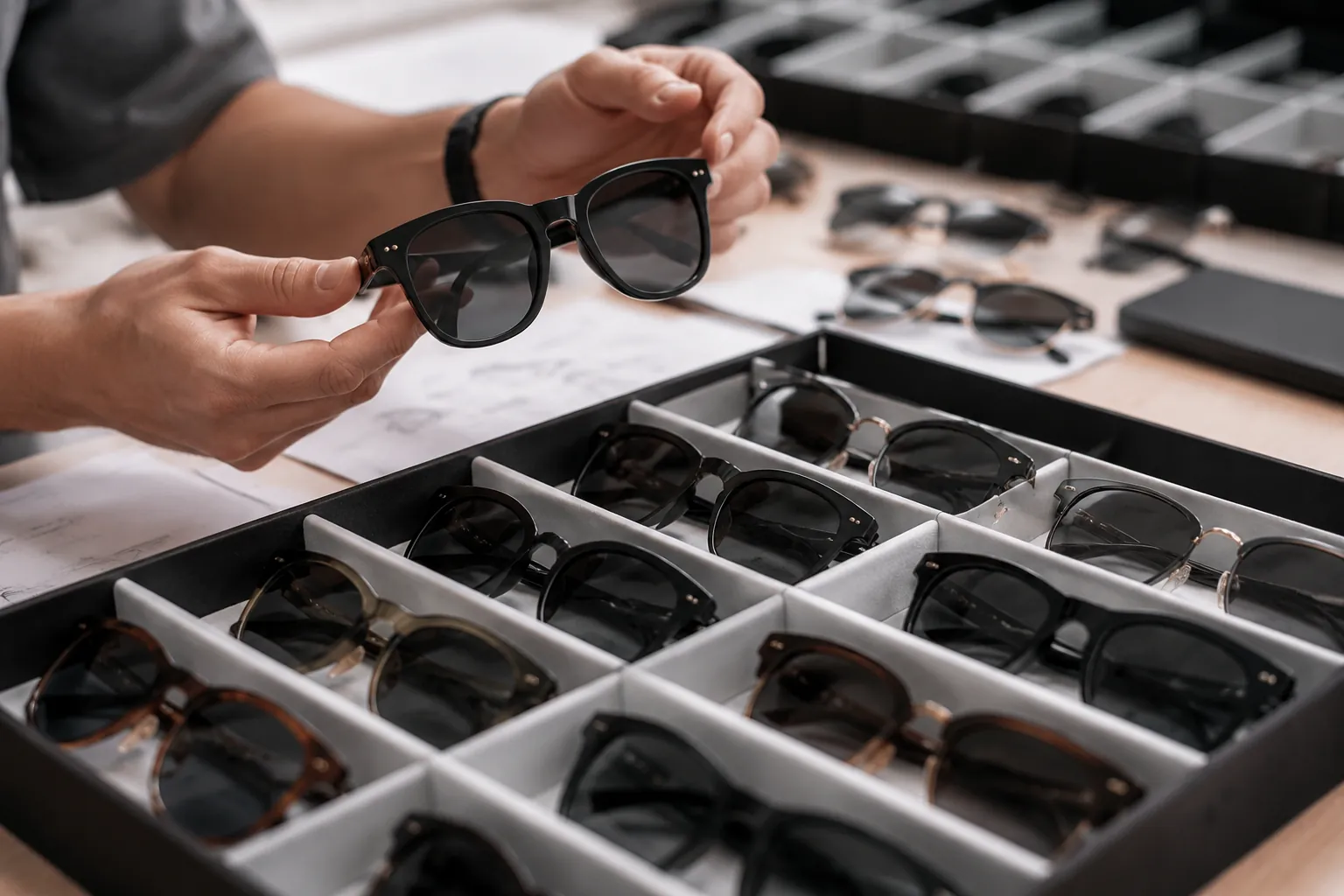
If you buy sunglasses for a brand, importer, retail chain, or distribution business, sample review is where expensive mistakes surface early. This guide shows how to request samples from multiple suppliers, compare them against the same criteria, and spot weak factories before you place a bulk order. It also covers packaging, communication, compliance, and repeatability. Use it as a working checklist, not a pitch.
Start With One Clear Sample Brief
Do not ask five suppliers for "a sample" and expect a useful comparison. Give each supplier the same brief and the same commercial assumptions. Keep it controlled.
A solid brief should include frame type, frame material, lens material, lens color, coating, target retail price, branding method, packaging, destination market, and any compliance requirement. If you want an acetate wayfarer with polarized TAC lenses, say that. If you need an injected sport frame with UV400 lenses and rubber nose pads, say that too.
Keep the first round simple: one SKU, one lens tint, one logo method, one packaging format. If you change the shape, lens color, and decoration at the same time, you will not know what caused the result. Too many variables ruin the comparison.
Add dimensions to the brief: lens width, bridge width, temple length, front width, frame height, and base curve if relevant. State acceptable tolerance up front. A capable factory should be able to discuss dimensional control against the approved spec and explain where variation may occur by material or process. If a supplier cannot talk clearly about tolerance, it is not ready for bulk.
Also define finish targets. If you want matte black acetate, specify the finish level or send a physical reference. If color matters, provide Pantone references or a lab-dip standard. If decoration matters, name the method: laser engraving, pad print, hot stamp, metal logo plate, in-mold logo, or decal. Each one has different durability, cost, and production limits. The goal is simple: every supplier quotes against the same target, so sample differences actually mean something.
Ask For The Right Sample Set
One sample is not enough. In eyewear, the first piece is often hand-finished by the best technician. It may look better than bulk. Ask for a sample set that shows both design fit and process repeatability.
A practical request looks like this:
- 1 first-round development sample for fit, shape, and proportions
- 1 confirmation sample with final color, lens, logo, and finish
- 1 packaging sample or photo pack showing carton, inner box, pouch, cloth, insert, and label
- 1 pre-production or pilot sample if tooling or decoration changes are involved
Ask what is actually done in-house. Not in general. On your style. You need to know whether the frame is molded, cut, CNC-machined, tinted, assembled, polished, and inspected internally or passed between subcontractors. More in-house control often means fewer errors in lens fit, temple alignment, hinge consistency, and logo placement.
Use timing as a filter. Ask for standard sample lead time and bulk lead time for the exact style, and note whether tooling already exists. If a supplier cannot give a clear range or explain what drives the schedule, treat that as a risk signal. MOQ also depends on material, lens type, decoration, and packaging, so compare quotes only after the exact configuration is confirmed.
Ask for sample shipping that reflects real production pack-out. A special hard case can hide weak pouch construction or poor carton sizing. You need the standard production presentation, not a showroom version that will never be used in the order.
Check The Frame Like A Buyer
A good-looking sample can still be a weak product. Review the frame with a ruler, a flat surface, and basic QC discipline. Start with symmetry. The left and right temples should match in length and angle, the front should sit flat without rocking, and hinge action should feel even on both sides. Small defects get obvious fast on a display wall or on a customer's face.
Check material behavior, not just appearance. On acetate, look for uniform polish, sink marks, stress lines near the hinge, sharp edges, and glue residue around inserts or laminations. It should feel dense and finished, not chalky or brittle. On injection frames, inspect gate marks, flash, weld lines, and mold parting lines. On metal or mixed-material styles, check weld points, temple straightness, plating consistency, and nose bridge alignment. Light is fine. Flimsy is not.
Measure key points on every sample, not just the best one. Lens width, bridge width, temple length, front width, and total weight should stay close to the approved specification. Repeated drift matters more than one outlier. If one sample is off on the bridge and the next sample shifts again, process control is weak. Even a small change in bridge width or temple angle can affect fit enough to create returns.
Pay close attention to hinge behavior. Open and close the temples several times. You want smooth movement, even resistance, and no side-to-side wobble. Spring hinges should return cleanly, not snap loosely. If the supplier uses a 3-barrel, 5-barrel, or spring hinge, ask what test method it uses for opening and closing consistency. A frame that feels acceptable in a quick review can still loosen too fast in real use.
Check Lens Performance And Compliance
Lenses are a common shortcut area, and lens failures are expensive to fix later. Review tint uniformity, optical clarity, edge finish, coating consistency, and support for the UV claim. Look through the lens at text, straight lines, and bright light. Distortion, haze, ripples, or color banding are warning signs. Stop there and ask questions.
Material matters. TAC lenses are popular because they are lightweight and work well in polarized constructions, but they can be more vulnerable to surface damage if handling is poor. Polycarbonate is impact-resistant and common in sport or youth styles, but weak cutting or coating can leave visible processing marks. CR-39 often offers good optics for fashion programs, but weight and impact expectations differ. Glass can be optically clear, but it adds weight and packing risk. Match the material to the channel, not just the quote.
For overseas B2B buyers, ask for model-specific compliance, not a generic PDF bundle. CE EN ISO 12312-1 is relevant for many sunglasses sold in Europe. ANSI Z80.3 matters in the U.S. market. AS/NZS 1067 applies in Australia and New Zealand. REACH covers restricted substances in materials and coatings. FDA registration may be relevant depending on the product and channel. Ask which requirement applies to the exact model, lens type, and destination market, and request reports or registration evidence tied to that SKU.
Do not confuse a factory certificate with product compliance. An ISO 9001 certificate shows a management system exists. It does not prove a specific sunglass model passed the right test. Ask for the report date, lab name, model code, and confirmation that the lens tint, frame material, and finishing method match the tested sample. Traceability reduces customs delays and retail rejection risk.
| Sample Area | What To Check | Typical Failure | Buyer Impact |
|---|---|---|---|
| Frame symmetry | Temple alignment, front flatness, hinge action | One side sits higher, hinge opens unevenly | Poor fit, higher returns, weak shelf appeal |
| Lens quality | Tint uniformity, clarity, UV claim support, coating finish | Haze, banding, scratches, inconsistent darkness | Brand risk, QC rejection, customer complaints |
| Decoration | Logo position, print sharpness, laser depth, adhesion | Misalignment, fading, weak abrasion resistance | Damaged branding and poor perceived value |
| Compliance | Model-specific reports, marks, and documentation | Generic certificates only | Market-entry delays and possible customs holds |
Compare Packaging Like A Shipment
Packaging is part of the product. Judge it that way. A clean sample inside a premium hard case can hide weak production pack-out. What matters is whether the retail-ready configuration survives transport, handling, and shelf unpacking.
Check carton size, inner protection, pouch material, lens cloth quality, insert accuracy, barcode placement, and whether the set is packed to prevent lens-to-frame abrasion. For low-cost fashion programs, a soft pouch may be enough. For many buyers, it is not. If the carton is oversized, products move and rub. If it is too tight, temple tips can deform in transit. Ask the supplier how many pairs go into each inner box, how separators are arranged, and how the outer carton is built.
Inspect packaging decoration with the same discipline you use on the frame. A logo that looks sharp on a flat mockup may blur on curved plastic or textured paper. Pad printing is often cost-effective for simple artwork, but it can wear faster than engraving. Hot stamping can look premium, but adhesion depends on the substrate. Metal logo plates can work well on presentation boxes, while laser marking suits subtle branding on hard surfaces. If packaging matters to the brand, test it by rubbing, folding, and repeated handling.
Also check labels and identifiers. Item code, color code, country-of-origin marking, and carton labels should match the brief exactly. If a supplier cannot label a sample correctly, expect the same problem at scale.
Use A Scoring Sheet Across Suppliers
Do not rely on memory after reviewing too many samples. Use one scorecard and compare every supplier on the same scale. Weight the criteria that affect sell-through, returns, and compliance risk. Not everything deserves equal weight.
A simple scoring structure can cover fit and symmetry, frame finish, lens quality, decoration, packaging accuracy, communication speed, and document quality. For most B2B sunglasses programs, repeatability matters more than visual appeal. A supplier that sends an acceptable sample quickly and explains its limits honestly is often safer than one that promises perfection but stays vague on materials, tooling, or tolerance.
Use hard numbers where you can. Record quoted sample lead time, bulk lead time, MOQ, unit price, and any extra fees for tooling, custom lens tints, logos, or packaging dies. Compare only like for like: same frame material, same lens material, same coating, same branding, same packaging, same destination market. A lower unit price means little if the factory cannot repeat the same specification.
When comparing cost, separate tooling, sample fees, and production price. Some suppliers credit sample fees against the first bulk order. Others do not. Some charge separately for custom lens tint plates, logo molds, or packaging dies. Those costs change the real landed picture, so list them clearly before choosing a supplier.
Read The Supplier's Communication For Risk
Communication quality often predicts production quality. Slow replies, vague answers, and shifting specs are early warnings. If the quotation does not stay aligned with the sample, or if the story changes each time you ask a technical question, bulk production will likely be messy too.
Strong suppliers answer in process terms. They can tell you what is molded, cut, polished, plated, tinted, assembled, and inspected in-house. They explain where handwork is unavoidable, what tolerances they can hold, and which steps are most likely to create variation. They should also be able to explain lead-time drivers such as tooling availability, lens sourcing, coating queues, decoration capacity, and seasonal congestion. That is useful information. Anything less is thin.
Weak suppliers stay broad. They say "high quality" but cannot name the lens material, hinge type, or logo method. They avoid confirming whether the frame is acetate, TR90, polycarbonate, metal, or mixed material. They cannot explain inspection points or acceptance standards. If a supplier will not discuss how quality is controlled, assume control is weak.
Ask how they handle problems. What happens if lens tint drifts, a temple loosens, or the logo shifts during production? A professional supplier should be able to describe the corrective action, whether that means rework, sorting, pilot approval, or hold-and-release. Clear answers here are often worth more than a small price gap.
Turn Sample Review Into A Bulk Decision
Do not move to bulk until the sample is approved in writing against the exact specification. Attach approved photos, frame material, lens type, color code, logo method, packaging spec, and compliance documents to the approval record. If possible, keep one physical golden sample sealed and marked as the production reference. Use it later if a dispute appears.
Before placing the order, confirm pilot quantity, acceptable variance, inspection points, and what happens if color, fit, or decoration drifts. A practical buyer also confirms whether the factory will run incoming material inspection, in-process checks, and final inspection. Small shifts in polish, hinge tension, or lens tint can change how sunglasses look on display and feel in hand. Minor drift is not always minor in the market.
Use sample review to set production discipline before the order is placed. Ask for a pre-production sample if the order is large or the style uses multiple materials. Ask for packing photos from the line, not just a finished sample shot. Ask for a clear response plan if final bulk differs from the approved sample. Make the rules early.
A good sample process saves money twice: first by helping you reject a weak supplier, then by reducing rework with the supplier you choose. If a factory can produce clean samples, explain the process clearly, and support the model with the right compliance documents such as CE EN ISO 12312-1, ANSI Z80.3, AS/NZS 1067, REACH, ISO 9001, BSCI, or FDA registration where relevant, it is worth moving into bulk review.
Have a custom sunglasses project in mind?
Send us your styles, target market and quantities and we will return a detailed quote with MOQ, lead time and a sample plan.
Get a QuoteWhy source this from Wenzhou with LumiShades
Wenzhou in Zhejiang Province is widely regarded as China’s eyewear manufacturing capital, producing a large share of the world’s sunglasses. That concentration matters to buyers: a deep local supply chain for acetate sheet, hinges, lens blanks, plating and packaging means shorter component lead times, easier color and material matching, and a workforce with decades of eyewear-specific skill. LumiShades has manufactured in this ecosystem since 2009, and our vertical integration — in-house injection molding, acetate cutting, CNC milling, lens tinting, decoration and quality control — means no part of your order is quietly subcontracted to a workshop you cannot audit.
For international buyers, that vertical control translates into accountability. When a single factory owns every step, defects are traced and fixed at source rather than bounced between vendors, and your specifications survive intact from first sample to bulk. For procurement review, buyers can request process records, approved samples, quality checkpoints and project-specific compliance files before placing a bulk order. Required testing and documentation are confirmed against the destination market and product specification rather than assumed from a generic certificate list. Explore our manufacturing capabilities and quality control process to see how this works in practice.
Frequently asked questions
How many suppliers should I sample from at once? Three to five suppliers is usually enough to compare quality, price, and responsiveness without making the review hard to manage. Keep the spec identical across all suppliers and compare only like for like: same frame material, lens material, coating, packaging, and destination market.
Should I compare samples before asking for compliance documents? No. Request the sample and the matching compliance basis at the same time. A sample without model-specific documentation is incomplete, especially if you need CE EN ISO 12312-1, ANSI Z80.3, AS/NZS 1067, REACH, ISO 9001, BSCI, or FDA registration evidence for a specific market or channel.
What if one supplier's sample looks better but costs more? Check whether the sample is repeatable, whether the supplier can explain the process clearly, and whether the documentation matches the product. A higher unit price can still be the better decision if it reduces rejects, rework, and delays. Compare tooling, sample fees, and packaging costs before you decide.
Is one perfect sample enough to approve a factory? No. Ask for a confirmation sample or pre-production sample before bulk approval. One piece can hide variation in color, hinge tension, lens tint, and decoration placement. You need a second check against the same approved specification.
What lead times should I expect for custom sunglasses samples and bulk? Ask the supplier for its standard lead time for your exact style and confirm whether tooling already exists. The useful benchmark is not a universal number. It is a clear written timeline for sampling, approval, and bulk production tied to the final specification and any tooling changes.
Ready to start?
Explore our aviator sunglasses or request a quote — our sales team replies within 12 hours.
Request a Quote